On This Page
Description
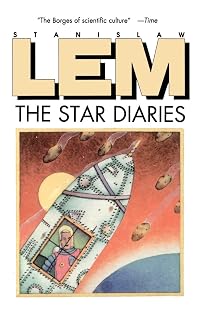
Ijon Tichy, Lem's Candide of the Cosmos, encounters bizarre civilizations and creatures in space that serve to satirize science, the rational mind, theology, and other icons of human pride. Line drawings by the Author. Translated by Michael Kandel. A Helen and Kurt Wolff Book.Tags
Recommendations























Member Reviews
Summary: Ijon Tichy’s voyages across the galaxy, satirical short pieces of science fiction by Polish writer Stanislaw Lem.
This is science fiction satire that makes that strains every idea of what is plausible in space travel. Ijon Tichy hops into his rocket and takes off on voyages across the galaxy like we might hop into a car for a spontaneous road trip. And predictably, he sometimes runs out of fuel, bringing further mishaps. The Star Diaries is a collection of short pieces Polish science fiction writer began writing in the 1950’s and added to for this 1971 publication. These are accounts of twelve of at least twenty-eight voyages by our intrepid space traveler.
In each voyage, Tichy gets in and out of difficulties, often in the show more most improbable ways. For example, in the first story, his rocket develops rudder problems that he needs a spare hand to fix. No problem! Just head into a space vortex and create a double of oneself. Of course, there are unforeseen problems and soon he has a ship full of doubles. Eventually he gets the rudder fixed and the doubles sent back to their own proper time. But not without a certain amount of hilarity.
In other voyages he represents earth’s petition to join a galactic United Nations, a study in bureaucratic tomfoolery. On another planet, he disguises himself as a robot to end a robot tyranny. Squamp-hunting is the focus of another voyage. Lem explores time travel and its problems by a 2166 version of himself visiting the future to persuade him to take his own place and sort out the space-time continuum. Tichy and his time alter ego end up stuck in a time loop. His trip to Dichotica represents a version of an encounter with transhumanists, with much philosophical folderol. His next voyage explores the pitfalls of extra-terrestrial proselytizing. And on a space constrained planet, people are often reduced to their atoms, and then recomposed from stored patterns (I wonder if this is where Star Trek got the idea for transporters!).
What’s really going on here? Is Lem just pulling our leg and having fun? Or is he playing a more clever game of getting his writing past Communist Party censors in Cold War Poland? Many think the latter, which I’m inclined to think credible. He portrays robotic tyrannies and states devoted to evolving their own super-species, and pokes fun at scientific and bureaucratic tensions. Meanwhile, part of the fun is the wordplay in which he creates whole paragraphs of made up words of semi-serious import. He also seems to delight in keeping the reader off balance, alternating between ridiculous satire and philosophical explorations, often in the same story! I also like to think that Lem saw himself in the venturous, resourceful, and intrepid Ijon Tichy.
Reading him, it is fun to imagine a meeting between him and Douglas Adams. Perhaps in another timeline…. show less
This is science fiction satire that makes that strains every idea of what is plausible in space travel. Ijon Tichy hops into his rocket and takes off on voyages across the galaxy like we might hop into a car for a spontaneous road trip. And predictably, he sometimes runs out of fuel, bringing further mishaps. The Star Diaries is a collection of short pieces Polish science fiction writer began writing in the 1950’s and added to for this 1971 publication. These are accounts of twelve of at least twenty-eight voyages by our intrepid space traveler.
In each voyage, Tichy gets in and out of difficulties, often in the show more most improbable ways. For example, in the first story, his rocket develops rudder problems that he needs a spare hand to fix. No problem! Just head into a space vortex and create a double of oneself. Of course, there are unforeseen problems and soon he has a ship full of doubles. Eventually he gets the rudder fixed and the doubles sent back to their own proper time. But not without a certain amount of hilarity.
In other voyages he represents earth’s petition to join a galactic United Nations, a study in bureaucratic tomfoolery. On another planet, he disguises himself as a robot to end a robot tyranny. Squamp-hunting is the focus of another voyage. Lem explores time travel and its problems by a 2166 version of himself visiting the future to persuade him to take his own place and sort out the space-time continuum. Tichy and his time alter ego end up stuck in a time loop. His trip to Dichotica represents a version of an encounter with transhumanists, with much philosophical folderol. His next voyage explores the pitfalls of extra-terrestrial proselytizing. And on a space constrained planet, people are often reduced to their atoms, and then recomposed from stored patterns (I wonder if this is where Star Trek got the idea for transporters!).
What’s really going on here? Is Lem just pulling our leg and having fun? Or is he playing a more clever game of getting his writing past Communist Party censors in Cold War Poland? Many think the latter, which I’m inclined to think credible. He portrays robotic tyrannies and states devoted to evolving their own super-species, and pokes fun at scientific and bureaucratic tensions. Meanwhile, part of the fun is the wordplay in which he creates whole paragraphs of made up words of semi-serious import. He also seems to delight in keeping the reader off balance, alternating between ridiculous satire and philosophical explorations, often in the same story! I also like to think that Lem saw himself in the venturous, resourceful, and intrepid Ijon Tichy.
Reading him, it is fun to imagine a meeting between him and Douglas Adams. Perhaps in another timeline…. show less
Stanislaw Lem es conocido mundialmente sobre todo por la magnífica ‘Solaris’. Sin embargo, la obra corta de Lem quizás no sea tan conocida. Diarios de las estrellas reúne en un solo volumen los Viajes y las Memorias de un curioso personaje, Ijon Tichy.
A través de sus extraordinarios viajes (que me recordaron poderosamente a Gulliver y Munchausen), siempre en su inseparable cohete, Tichy descubrirá las más absurdas e inverosímiles formas de vida, así como las sociedades más disparatadas. El humor de Lem es de lo más irónico y satírico. Pero lo absurdo no está reñido con lo trágico, y un humor ciertamente absurdo puede dar un giro hacia lo sombrío. Mediante las múltiples situaciones en las que Tichy se ve envuelto, show more Lem nos está hablando en realidad, a través de la extrapolación, de nuestro planeta y de los absurdos y estupidez de nuestra sociedad. Discusiones sobre sexo, religión, política, cibernética, inteligencia artificial, ciencia, teorías cosmogónicas, etcétera, ponen de relieve la variedad de temas y la fértil imaginación de Lem. Para el recuerdo queda el viaje séptimo, en el que Tichy se encuentra con múltiples versiones de sí mismo; el viaje decimoctavo, donde Tichy nos relata cómo creó el universo; o el viaje vigésimo primero, que habla de teología y clonación, entre otros temas.
En resumen, un libro divertido, aunque espeso en algunos pasajes, hard incluso, que se deja leer muy bien, y además mueve a la reflexión. show less
A través de sus extraordinarios viajes (que me recordaron poderosamente a Gulliver y Munchausen), siempre en su inseparable cohete, Tichy descubrirá las más absurdas e inverosímiles formas de vida, así como las sociedades más disparatadas. El humor de Lem es de lo más irónico y satírico. Pero lo absurdo no está reñido con lo trágico, y un humor ciertamente absurdo puede dar un giro hacia lo sombrío. Mediante las múltiples situaciones en las que Tichy se ve envuelto, show more Lem nos está hablando en realidad, a través de la extrapolación, de nuestro planeta y de los absurdos y estupidez de nuestra sociedad. Discusiones sobre sexo, religión, política, cibernética, inteligencia artificial, ciencia, teorías cosmogónicas, etcétera, ponen de relieve la variedad de temas y la fértil imaginación de Lem. Para el recuerdo queda el viaje séptimo, en el que Tichy se encuentra con múltiples versiones de sí mismo; el viaje decimoctavo, donde Tichy nos relata cómo creó el universo; o el viaje vigésimo primero, que habla de teología y clonación, entre otros temas.
En resumen, un libro divertido, aunque espeso en algunos pasajes, hard incluso, que se deja leer muy bien, y además mueve a la reflexión. show less
The Star Diaries by Stanislaw Lem (another Swedish author!) came into my life due to an observant patron recognizing my Star Trek tattoo as the nerd alert that it is and recommending it to me. [Hallelujah!] The book is organized into short stories touted as the numbered voyages of Ijon Tichy. [A/N: Don't be thrown by the fact they aren't in order. Read my note at the end of this review for a better understanding.] The beginning offers an introduction which has the reader questioning the 'validity' of Tichy as a narrator and the last voyage really solidifies that doubt. [We are given to believe that these chronicles are studied by dedicated scholars and that Tichy is a great explorer.] We follow Tichy as he makes his way across the show more universe on a solo trip which ultimately turns into a philosophical journey about the nature of being and how he fits into the grand picture of the universe. One particular story was a standout for me (and absolutely terrifying) featuring robot monks, wild furniture, and a type of humanity that was horrifying for Tichy (and the reader) to behold. (Really dig into the underlying message here.) Lem, like most good sci-fi writers, is looking at what it means to be human by tapping into our curiosity for all things that are decidedly alien or other. Tichy is our lens into a world that is as ever changing as the various voyages that he makes. I absolutely loved it. 10/10
A/N: A note at the back of the book explained that the voyages were written out of order because Lem wrote the book over the course of 20 years and his writing style changed somewhat across the span of the stories. show less
A/N: A note at the back of the book explained that the voyages were written out of order because Lem wrote the book over the course of 20 years and his writing style changed somewhat across the span of the stories. show less
Bold adventurer Ijon Tichy zooms across the universe in his midget rocket ship as if zipping around Poland (Stanislaw Lem’s home country) in a midget racing car. Are we talking here about another Flash Gordon or Hans Solo? Hardly. Ijon is more like your prototypical college math instructor with his skinny tie, wrinkled shirt, corduroy pants, scuffed up loafers and nerd eyeglasses held together by tape. But, it must be admitted, Ijon Tichy keeps a level head as he deals with a string of challenges bizarre and Borges-like. The Star Diaries recounts a dozen separate kooky, bugged out, way-out voyages of our undaunted explorer. A batch of snapshots of Ijon in action:
IN THE TIME LOOP
The exterior of Ijon's mini rocket ship is damaged and show more must be repaired but unfortunately this is a two-man job and Ijon is flying solo.
That night, while asleep, a slightly familiar looking man shakes Ijon and demands he get out of bed and join him in repairing the rocket. Ijon knows he's flying solo and tells the intruder he's nothing more than a dream.
The next morning Ijon consults textbooks and maps to calculate his present location since his damaged rocket has veered off course. Looks like he could be ensnared in a heap of trouble - he's in a mysterious gravitational vortex with incalculable relativistic effects.
A misty human shape cooking an omelet appears at the stove in his kitchen and just as quickly vanishes. Mystified, Ijon consults another book on the General Theory of Relativity that explains how in certain gravitational vortices there can be a complete reversal of time causing a duplication of the present.
Following a trip to the engine room to produce a slight change in the rocket's direction, Ijon returns only to see himself asleep in bed. "I realized at once that this was I of the previous day, that is, from Monday night." Ijon tries to rouse his Monday self so they can both go out together to repair the ship. His Monday self gruffly informs him that he is only a dream.
The time loop expands over the next fourteen pages in ways of duplication and multiplication only Stanislaw Lem could imagine (apologies to Jorges Luis Borges but with this fictional doozy Lem outpaces the Argentine man of letters). One of the most zany, convoluted and imaginative tales a reader will ever encounter.
Stanislaw Lem's drawing of Ijon caught in the time loop
WATERY SOLUTION
Ijon has many confabs and dealings with a Professor Tarantoga, astrozoologist, a quirky genius credited with a string of phenomenal discoveries, including a fluid for the removal of unpleasant memories. A true psychic quantum leap! The ingenious professor will quickly put a number of psychiatrists and counselors out of business. Men and women will be able to live in the present without having to rehash all those times when they were slapped around by an abusive parent or picked on by the schoolyard bully or traumatized in a war zone or a thousand other painful experiences.
TARANTOGA TIME MACHINE
Holy H.G. Wells! Our stupendous astrozoologist invents a time machine Ijon can take on his next voyage to planet Amauropia. Along the way beyond the Milky Way, explorer Tichy encounters the Gypsonians who roam around the cosmos ever since they destroyed their own planet by continuous strip mining, turning the entire surface into one vast pit. I Tichy to the rescue! Ijon obtains a secondhand moon, fixes it up and, thanks to his stellar connections (no pun intended), upgrades it to the status of a planet. The Gypsonians are elated but it remains to be seen if they learned their lesson about greed and natural resources.
Once on Amauropia Ijon encounters a race of Microcephalids crawling around on all fours. Using his time machine, Ijon propels their evolution to tool using hunter gatherers and then to agrarian civilization. Of course, accelerated evolution contains both pros and cons - the Microcephalds alternately worship Ijon and send him off to be tortured. Ah, civilized society! At one point Ijon escapes and begins preaching love and universal brotherhood. Not long thereafter, a cult forms around his teachings. Predictably, the king and his royal court despise Ijon's revolutionary ideas and demand his Earthly blood. By the skin of his astronomical teeth, Ijon blasts off, leaving the planet far behind but his time on Amauropia provides Stanislaw Lem oodles of opportunities to make piquant philosophical observations about the universal tendencies of politics and religion, war and peace, customs and ideologies.
SAME O' SAME O'
Ijon travels to the remarkable world of Panta wherein all the inhabitants have identical smiling faces. As an elderly Pantan pontificates,"we have completely eliminated individuality on behalf of the society. On our planet there are no entities - only the collective." Turns out, the roles of engineer, gardener, mechanic, ruler, physician are rotated among the Pantans every day; in other words, there are no differences within their society, these Pantans have achieved the highest degree of social interchangeability. Ijon asks more questions and the elderly one is more than happy to provide answers, even how on his planet the reality of death has been transcended via the absence of individual identity. I'm sure you sense Stanislaw Lem poking a long, sharp satirical needle at the prevailing 1960s Communist states. Ouch!
HOMO SAPIENS OR SUB-NEANDERTHALS?
Ijon is present as a room filled with wise, peace-loving alien life forms from all over the cosmos debate if humans from planet Earth should be admitted to the solar assembly. After once speaker portrays homo sapiens as a species of monsters wallowing in an ocean of blood - massacres, wars, pogroms, crusades, genocide, torture - looks like the vote might be a mighty "NO." But an objection is raise - certainly the current human population is above not below the level of Neanderthal. All look toward Ijon Tichy. Can our outer orbit Odysseus come through for us?
QUICK ZAPS FROM MY REVIEWER RAY GUN
Many more voyages; many more encounters. Blast off with Ijon Tichy to read all about the metaphysics and magic of potatoes, robot theologians, how compassionate aliens make sure a missionary is granted his wish to become a saint and martyr and thus go to heaven, an electric brain with an infinite number of stand-up comic jokes that can be inserted into the wall of an astronaut's rocket in order to alleviate boredom (a sort of George Carlin/HAL) and a planet where travel is done by Star Trek-like beaming (the brainy Polish author's beaming predates the famous TV series). All written with a light, comical touch. Thanks, Stanislaw. show less
One must be in the right mood...and I am pretty sure that most readers do not have this mood. Ready yourself for a conglomeration of satire, faux-narrative, farce, pulp, insanity, philosophy and humor. In most cases, it works for me!
As far as the four stars go, I love Lem and I hope that I manage to read every translated work/word of his I can get my hands on. But in trying to situate this work among his others, I would actually give this about a 3.5 in his own oeuvre.
The Translator's Note in my version lists the actual historical composition order as opposed to the listed "voyage" ordering. Interestingly, "The Twenty-First Voyage" was written last. It is the only Voyage that I scribbled some side notes to return to and to reread the show more sections on Tichy, the narrator's, recording of how the planet's inhabitants talk about faith, the point of monastic work in their culture, and their thoughts on 'good and evil." Lem's depiction of the earlier forms of religious thought on this planet which, of course, he implies mirror our current forms is biting. Religion is a kind of bargaining with God--tit for tat--that has not the slightest vestige of unadulterated faith. For me, the rest of this chapter's voyage serves as a kind of frame tale for setting up these forays into religion. It probably goes too far--though not by much--to say that The Brothers Karamozov is a frame tale for the discussion between Ivan and Alyosha in the Pro and Contra chapters, but structurally, Lem's work on a small scale reminds me of Dostoevsky's against a much grander backdrop.
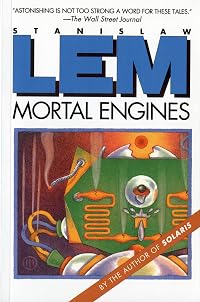
Glad to have read; glad to move on to Mortal Engines. show less
As far as the four stars go, I love Lem and I hope that I manage to read every translated work/word of his I can get my hands on. But in trying to situate this work among his others, I would actually give this about a 3.5 in his own oeuvre.
The Translator's Note in my version lists the actual historical composition order as opposed to the listed "voyage" ordering. Interestingly, "The Twenty-First Voyage" was written last. It is the only Voyage that I scribbled some side notes to return to and to reread the show more sections on Tichy, the narrator's, recording of how the planet's inhabitants talk about faith, the point of monastic work in their culture, and their thoughts on 'good and evil." Lem's depiction of the earlier forms of religious thought on this planet which, of course, he implies mirror our current forms is biting. Religion is a kind of bargaining with God--tit for tat--that has not the slightest vestige of unadulterated faith. For me, the rest of this chapter's voyage serves as a kind of frame tale for setting up these forays into religion. It probably goes too far--though not by much--to say that The Brothers Karamozov is a frame tale for the discussion between Ivan and Alyosha in the Pro and Contra chapters, but structurally, Lem's work on a small scale reminds me of Dostoevsky's against a much grander backdrop.
Glad to have read; glad to move on to Mortal Engines. show less
An amazing mix of science fiction and fantasy, philosophy and satire operating at several different levels. Lem uses the science fiction genre to satirise the human propensity to see itself as the pinnacle of development, taking different elements of human society and examining them through the lens of human and non-human cultures. But a well as this broad sweep, there is the more narrow examination of the absurdities of the Soviet culture in which he lived and wrote. The end result is a complex mixture which, for the most part, works well although at times the philosophical aspects crowd out the satire. Amusing, engaging and fascinating. 28 January 2017.
First Lem book I ever read and was completely overwhelmed by its clever philosophical satire and science fantasy. I have re-read this many times and its one of my Lem favourites. The character Tichy, a cosmonaut comes across as a down to earth average guy character, not perfect but a good egg mostly and we follow him through a series of Voyages which cover a chapter each and describe his adventures in space, on planets and various scrapes. He encounters strange space phenomena, alien civilisations, and even time warped versions of himself during his crazy adventures. The style is high farce but with some very interesting ideas threaded through the humour. Very readable and a book that I will always come back for. Lems writing is always show more full of new surprises upon each reading as the reader matures. I first read this book when I was 13 and enjoyed it for its humourous space adventure aspects, but upon later subsequent readings I really came to appreciate the the deeper side of Lems thinking on mans place in the universe, alien cultures and space exploration and colonisation. Star Diaries is a good introduction to Lems work and once you get his taste you will not be able to forget him. His passing was a great loss to the world of truly sophisticated Science Fiction writing. He had little of positive note to say regarding Western sci-fi writers with a couple of notable exceptions. Sadly the tradition of dumbed down fadddish writing continues apace. Lem is one of the worlds leaders in speculative science fiction/satire and just makes a lot of todays so-called genii of the art look verbose and cliched. He could write a better story in 80 pages than most can in 800 page tomes today with or without gold embossed writing, pretentious name or over-fawning praise. Lem rules and rocks for ever. show less
Members
- Recently Added By
Lists

Read the book and saw the movie
1,170 works; 195 members

Books Read in 2021
5,361 works; 113 members
Author Information

Polish science fiction writer Stanislaw Lem was born on September 12, 1921. A medical graduate of Cracow University, he is at home both in the sciences and in philosophy, and this broad erudition gives his writings genuine depth. He has published extensively, not only fiction, but also theoretical studies. His books have been translated into 41 show more languages and sold over 27 million copies. He gained international acclaim for The Cyberiad, a series of short stories, which was first published in 1974. A trend toward increasingly serious philosophical speculation is found in his later works, such as Solaris (1961), which was made into a Soviet film by Russian director Andrei Tarkovsky in 1972 and remade by Steven Soderbergh in 2002. He died on March 27, 2006 in Krakow at the age of 84. (Bowker Author Biography) show less
Some Editions
Awards and Honors
Notable Lists
Series

Belongs to Publisher Series
st (549)
Dzieła Stanisława Lema (Wydawnictwo Gazety Wyborczej)
Work Relationships
Is contained in
Contains
Common Knowledge
- Canonical title
- The Star Diaries
- Original title
- Dzienniki gwiazdowe
- Original publication date
- 1957
- Original language*
- Polnisch
*Some information comes from Common Knowledge in other languages. Click "Edit" for more information.
Classifications
- Genres
- Science Fiction, Fiction and Literature
- DDC/MDS
- 891.8 — Literature & rhetoric Literatures of other languages East Indo-European and Celtic literatures West and South Slavic languages (Bulgarian, Slovene, Polish, Czech, Slovak, Serbo-Croatian, and Macedonian)
- LCC
- PG7158 .L39 .D9213 — Language and Literature Slavic languages and literatures. Baltic languages. Albanian language Slavic. Baltic. Albanian Slavic Polish
- BISAC
Statistics
- Members
- 1,576
- Popularity
- 14,502
- Reviews
- 32
- Rating
- (4.06)
- Languages
- 13 — English, Estonian, Finnish, French, German, Hebrew, Hungarian, Japanese, Polish, Russian, Spanish, Swedish, Turkish
- Media
- Paper, Audiobook, Ebook
- ISBNs
- 58
- ASINs
- 20