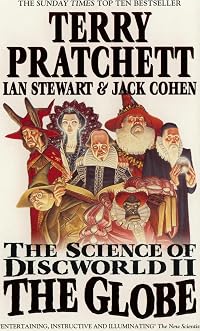
The Science of Discworld II: The Globe
by Terry Pratchett, Jack Cohen, Ian Stewart
The Science of Discworld (book 2), Discworld (Science of Discworld — Science II)
On This Page
Description
Roundworld, aka Earth, is under siege. Are three wizards and an orangutan Librarian enough to thwart the Elvish threat?When the wizards of Unseen University first created Roundworld, they were so concerned with discovering the rules of this new universe that they overlooked its inhabitants entirely. Now, they have noticed humanity. And humanity has company. Arriving in Roundworld, the wizards find the situation is even worse than they'd expected. Under the elves' influence, humans are show more superstitious, fearful, and fruitlessly trying to work magic in a world ruled by logic. Ridcully, Rincewind, Ponder Stibbons, and the orangutan Librarian must travel through time to get humanity back on track and out of the dark ages.
The Globe goes beyond science to explore the development of the human mind. Terry Pratchett and his acclaimed co-authors Ian Stewart and Jack Cohen combine the tale of the wizards rewriting human history with discussions of the origins and evolution of culture, language, art, and science, offering a fascinating and brilliantly original view of the world we live in. show less
Tags
Recommendations





Member Reviews
The wizards are at it again. Will Roundworld ever be free of Discworldian influence? Probably not. This book has the same pop science alternating with story as the first Science of Discworld book. And it was still enjoyable. Sometimes I thought the real science parts kinda dragged on because some of the facts were, not outdated, but no longer mind blowing since they have been a part of the science-minded crowd's knowledge base for so long. Also, I may have found Rincewind annoying in The Colour of Magic, but he's growing on me. He was a pretty good character in this story, and seemed actually competent compared to some of his fellow wizards.
This book alternates between a storyline on Roundworld, with Discworld characters, and chapters discussing quantum physics, evolution, psychology, religion, time, multiverses, culture, and philosophy. Since I haven't read any of the other books about Discworld, this was probably not the smartest place start. Nor did I think the storyline was developed enough. I would just get into it when we would switch back to the science behind the world. Of course, I love science so that was the best part of the book for me. Okay, and the footnotes--they were hilarious! Cohen and Stewart wrote the science sections, while Sir Terry Pratchett carried out the storyline. I will have to give Discworld one more chance and find one of the first books...
My reaction to the second Science of Discworld book is similar to my reaction to the first. As before, the book alternates between short, fictional chapters that tell a Discworld story and longer chapters that discuss real-world (mostly) science.
I enjoyed the fictional chapters. The story was pretty entertaining, but it made up the smaller portion of the book. The science parts, as with the first book, focus heavily on theory and origin topics whereas I would have preferred a heavier emphasis on more practical topics. No doubt other people prefer it exactly the way it is. There were definitely parts that interested me, and parts that made me chuckle, but there were also a lot of parts that induced yawns.
I also found it rather show more repetitive. At least a couple things were repeated from the first book, and there were some themes that the authors went on about over and over. Religion seems to be a particularly favorite topic. Even though I agree with most of their points about religion, they really overdid it, especially when considering it was also discussed quite a bit in the first book. To totally misuse a metaphor, I wanted them to stop preaching to the choir and spend more time on actual science. And, for people who don’t belong to this particular choir, I can imagine they would be even more annoyed. Trust me, repeating something over and over isn’t influential; it’s just irritating.
Skimming through some reviews over on Goodreads, I don’t see many people who had a similar reaction, so maybe it just boils down to me being the wrong audience for this set of books. In any case, I plan to skip the last two science books. show less
I enjoyed the fictional chapters. The story was pretty entertaining, but it made up the smaller portion of the book. The science parts, as with the first book, focus heavily on theory and origin topics whereas I would have preferred a heavier emphasis on more practical topics. No doubt other people prefer it exactly the way it is. There were definitely parts that interested me, and parts that made me chuckle, but there were also a lot of parts that induced yawns.
I also found it rather show more repetitive. At least a couple things were repeated from the first book, and there were some themes that the authors went on about over and over. Religion seems to be a particularly favorite topic. Even though I agree with most of their points about religion, they really overdid it, especially when considering it was also discussed quite a bit in the first book. To totally misuse a metaphor, I wanted them to stop preaching to the choir and spend more time on actual science. And, for people who don’t belong to this particular choir, I can imagine they would be even more annoyed. Trust me, repeating something over and over isn’t influential; it’s just irritating.
Skimming through some reviews over on Goodreads, I don’t see many people who had a similar reaction, so maybe it just boils down to me being the wrong audience for this set of books. In any case, I plan to skip the last two science books. show less
What a sad thing to review this book right after Sir Terry has passed away; sadder still that I have to say that I didn’t really like the book. It was okay; I read the whole thing without finding it a chore, but it wasn’t what I expected. I thought it might be a humorous book on how *Discworld* works, rather than our own.
There are four books in the Science of Discworld series; this is the only one I’ve read. The books are written in an alternating chapter format: Sir Terry writes the short, fiction, chapters and Stewart and Cohen write the longer, nonfiction, ones. The fiction portion tells a tale of the wizards of Discworld and a misadventure while doing a team building exercise in the forest. They find themselves interacting show more with Roundworld, a globular world where magic doesn’t exist, but elves do. Thinking this situation is unfair to the humans, they first eliminate the elves from Roundworld. Then they discover that this was a horrible mistake, as humans need to believe in magic in order to thrive and progress- even though the magic is imaginary. They have to go through great effort to correct their meddling.
The science part of the book covers a lot of different subjects; quantum physics, evolution, psychology, religion, time, multiverses, culture, and philosophy. It’s all in terms that most will find accessible, but there is some repetition.
It’s an attempt to get lovers of fantasy to read science-y stuff and sneak some education down our throats, sort of like a grown up version of Mickey Mouse teaching kids about math or something. It works, but not terribly well. The wizard story is just barely held together; the wizards do something, and then they stop and what just happened is explained to us. By the end of the book, I remembered a lot of the science but little of the story. While Cohen and Stewart wrote the science sections, I swear I see Sir Terry’s hand in that; the footnotes are some of the funniest stuff in the book.
Final verdict? Certainly not my favorite Pratchett, but if I see the other three in the series I’ll probably read them. Just not that eagerly. show less
There are four books in the Science of Discworld series; this is the only one I’ve read. The books are written in an alternating chapter format: Sir Terry writes the short, fiction, chapters and Stewart and Cohen write the longer, nonfiction, ones. The fiction portion tells a tale of the wizards of Discworld and a misadventure while doing a team building exercise in the forest. They find themselves interacting show more with Roundworld, a globular world where magic doesn’t exist, but elves do. Thinking this situation is unfair to the humans, they first eliminate the elves from Roundworld. Then they discover that this was a horrible mistake, as humans need to believe in magic in order to thrive and progress- even though the magic is imaginary. They have to go through great effort to correct their meddling.
The science part of the book covers a lot of different subjects; quantum physics, evolution, psychology, religion, time, multiverses, culture, and philosophy. It’s all in terms that most will find accessible, but there is some repetition.
It’s an attempt to get lovers of fantasy to read science-y stuff and sneak some education down our throats, sort of like a grown up version of Mickey Mouse teaching kids about math or something. It works, but not terribly well. The wizard story is just barely held together; the wizards do something, and then they stop and what just happened is explained to us. By the end of the book, I remembered a lot of the science but little of the story. While Cohen and Stewart wrote the science sections, I swear I see Sir Terry’s hand in that; the footnotes are some of the funniest stuff in the book.
Final verdict? Certainly not my favorite Pratchett, but if I see the other three in the series I’ll probably read them. Just not that eagerly. show less
I just reread this (because the fourth science of Discworld book should be released in the U.S. next month). While I found this second book a bit more of a slog than the first, it is an insightful commentary on how fiction can help create an environment where science can take hold.
I do enjoy the Discworld books... especially stories pertaining to the wizards so that was a thumbs-up for this book. The other half of the book... the sciency stuff was hard going at times. I can deal with topics involving biology, evolution & human ideology, however, quantum physics & other similar topics leave my head reeling a bit. Because of this I did tend to skim over the more physics-based chapters.
Apart from the occasional lapses into dreaded physics this 2nd book gets to grips with human "narrativium" & the development of stories within our species pretty well & is, overall, an enjoyable read.
Apart from the occasional lapses into dreaded physics this 2nd book gets to grips with human "narrativium" & the development of stories within our species pretty well & is, overall, an enjoyable read.
The "science of" chapters are filled with anti-semitism and other concerning opinions about oppressed peoples. Which was very disappointing, because the story chapters were entertaining.
Won't be reading another Pratchett book.
Won't be reading another Pratchett book.
Members
- Recently Added By
Lists

Genre Benders: Comic Fantasy
97 works; 16 members

Books Read in 2023
5,638 works; 147 members

Books Read in 2016
4,666 works; 199 members
Author Information

423+ Works 581,555 Members
Terry Pratchett was on born April 28, 1948 in Beaconsfield, United Kingdom. He left school at the age of 17 to work on his local paper, the Bucks Free Press. While with the Press, he took the National Council for the Training of Journalists proficiency class. He also worked for the Western Daily Press and the Bath Chronicle. He produced a series show more of cartoons for the monthly journal, Psychic Researcher, describing the goings-on at the government's fictional paranormal research establishment, Warlock Hall. In 1980, he was appointed publicity officer for the Central Electricity Generating Board with responsibility for three nuclear power stations. His first novel, The Carpet People, was published in 1971. His first Discworld novel, The Colour of Magic, was published in 1983. He became a full-time author in 1987. He wrote more than 70 books during his lifetime including The Dark Side of the Sun, Strata, The Light Fantastic, Equal Rites, Mort, Sourcery, Truckers, Diggers, Wings, Dodger, Raising Steam, Dragons at Crumbling Castle: And Other Tales, and The Shephard's Crown. He was diagnosis with early onset Alzheimer's disease in 2007. He was knighted for services to literature in 2009 and received the World Fantasy award for life achievement in 2010. He died on March 12, 2015 at the age of 66. (Bowker Author Biography) show less

13+ Works 8,751 Members

89+ Works 20,241 Members
Ian Stewart is a professor emeritus of mathematics at the University of Warwick. The author of numerous books on math, he has written for New Scientist, Discover, and Scientific American, among other publications in the United Kingdom and the United States. He lives in Coventry, England.
Some Editions
Series


Belongs to Publisher Series
Work Relationships
Is contained in
Has the adaptation
Common Knowledge
- Canonical title
- The Science of Discworld II: The Globe
- Original title
- The Science of Discworld II: The Globe
- Original publication date
- 2002
- People/Characters
- The Chair of Indefinite Studies; The Dean; John Dee; Hex (Unseen University's thinking engine); Mustrum Ridcully (Archchancellor); Rincewind (show all 9); William Shakespeare; Ponder Stibbons; Sir Francis Walsingham
- Important places
- Ankh-Morpork, Discworld; Unseen University, Ankh-Morpork, Discworld; London, England, UK
- First words
- In the airy, crowded silence of the forest, magic was hunting magic on silent feet.
- Last words
- (Click to show. Warning: May contain spoilers.)And what about homo sapiens? Yes, we think that would be a very good idea...
Classifications
Statistics
- Members
- 2,066
- Popularity
- 10,082
- Reviews
- 15
- Rating
- (3.76)
- Languages
- 5 — Czech, English, French, German, Polish
- Media
- Paper, Audiobook, Ebook
- ISBNs
- 22
- ASINs
- 13