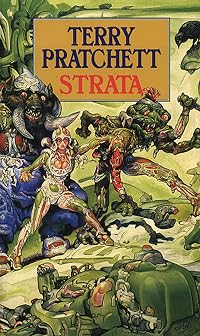
Strata
by Terry Pratchett
On This Page
Description
THE COMPANY BUILDS PLANETS. Kin Arad is a high-ranking official of the Company. After twenty-one decades of living, and with the help of memory surgery, she is at the top of her profession. Discovering two of her employees have placed a fossilized plesiosaur in the wrong stratum, not to mention the fact it is holding a placard which reads, 'End Nuclear Testing Now', doesn't dismay the woman who built a mountain range in the shape of her initials during her own high-spirited youth. But then show more came discovery of something which did intrigue Kin Arad. A flat earth was something new... show lessTags
Recommendations





Member Reviews
I feel as if I've been given a peek down the other leg of the Trousers of Time into a world where Sir Terry decided Discworld should be science fiction rather than fantasy. Strata is a hodgepodge of various science fiction tropes mixed together with a generous helping of irreverence. Set mainly on a disc world*, the story is basically about a planet builder traveling around this impossible planet trying to figure out how the hell it works. Truth be told, it's not a terribly good book**, but it has so much in it that obviously was recycled into the Discworld series that I can't help but feel a deep affection for it.
*But not the Discworld
**Although I've read far worse
*But not the Discworld
**Although I've read far worse
That's more like it! Reading Pratchett chronologically, I was disappointed by the first two books. They were funny, but chaotic and disjointed. Strata wraps all the chaos and absurdity into a story which successfully holds it together, and stays strong throughout.
Through a set of circumstances, a human planet-builder meets up with two aliens. Without being given that much of a choice they find themselves at a place which really shouldn't exist. Strange stuff ensues.
Strata does the wonderful British thing of being funny without seeming like it tries to be funny, and consists of a sci-fi, fantasy story with nuggets of wonderful absurdity and understated jokes throughout. I don't want to spoil anything, so I won't say much more. But unlike show more The Dark Side of The Sun, which had a pseudo-philosophical point which was really just silly, Strata concludes on a note which is actually quite profound. At least to me. There are also interesting points scattered throughout which made me stop for a second to think about them.
By Strata it seems like Pratchett had found his groove, and this is only on his third book. I look forward to continuing reading through the groove. show less
Through a set of circumstances, a human planet-builder meets up with two aliens. Without being given that much of a choice they find themselves at a place which really shouldn't exist. Strange stuff ensues.
Strata does the wonderful British thing of being funny without seeming like it tries to be funny, and consists of a sci-fi, fantasy story with nuggets of wonderful absurdity and understated jokes throughout. I don't want to spoil anything, so I won't say much more. But unlike show more The Dark Side of The Sun, which had a pseudo-philosophical point which was really just silly, Strata concludes on a note which is actually quite profound. At least to me. There are also interesting points scattered throughout which made me stop for a second to think about them.
By Strata it seems like Pratchett had found his groove, and this is only on his third book. I look forward to continuing reading through the groove. show less
Early Pratchett sci-fi novel. I first read this along with Dark Side Of The Sun back in the early 90s, and while they have some good ideas and a few good jokes, they are not great novels and are nowhere near the quality of the Discworld series, even the fumbling early Color of Magic.
The central joke here is world-building: a professional terraformer whose crew plants fake dinosaur skeletons and so forth (to keep colonists busy for a few thousand years) joins in the investigation of a clearly manufactured planet, only the labels have been ripped off and nobody can figure out who made it. The planet is flat, surprisingly earthlike, and home to improbabilities like dragons, djinn, demons, and so forth.
There is some sly stuff here, with show more Pratchett working in an alternate history for Earth (America is called Valhalla, for one thing, so the Vikings clearly settled it), making this a sort of historical-future-fiction. A lot of the prep-work for the nuts-and-bolts ideas of the Discworld are here (e.g. seas run off the edge, which looks nice and lets you use the word rimfall, but what happens to all the water?), and precursors to some of the jokes as well. The Broken Drum tavern makes its first appearance here, and the name drily explained ("you can't beat it").
There's a fair bit of garbage as well, including a sort of machina-ex-deus-ex-machina ending that solves everyone's problems, and a cosmic punchline that falls a bit flat, having been telegraphed throughout the novel, and not having been that great a joke to begin with.
Let's just say that if you read this as a Terry Pratchett novel, you're bound to be disappointed, but if you read it as a second-rate Ringworld (or Titan or any of the other we-found-a-manufactured-world novels) ripoff, it's fairly entertaining. show less
The central joke here is world-building: a professional terraformer whose crew plants fake dinosaur skeletons and so forth (to keep colonists busy for a few thousand years) joins in the investigation of a clearly manufactured planet, only the labels have been ripped off and nobody can figure out who made it. The planet is flat, surprisingly earthlike, and home to improbabilities like dragons, djinn, demons, and so forth.
There is some sly stuff here, with show more Pratchett working in an alternate history for Earth (America is called Valhalla, for one thing, so the Vikings clearly settled it), making this a sort of historical-future-fiction. A lot of the prep-work for the nuts-and-bolts ideas of the Discworld are here (e.g. seas run off the edge, which looks nice and lets you use the word rimfall, but what happens to all the water?), and precursors to some of the jokes as well. The Broken Drum tavern makes its first appearance here, and the name drily explained ("you can't beat it").
There's a fair bit of garbage as well, including a sort of machina-ex-deus-ex-machina ending that solves everyone's problems, and a cosmic punchline that falls a bit flat, having been telegraphed throughout the novel, and not having been that great a joke to begin with.
Let's just say that if you read this as a Terry Pratchett novel, you're bound to be disappointed, but if you read it as a second-rate Ringworld (or Titan or any of the other we-found-a-manufactured-world novels) ripoff, it's fairly entertaining. show less
Met de humor van [a:Terry Pratchett|1654|Terry Pratchett|https://d.gr-assets.com/authors/1235562205p2/1654.jpg] ben ik ondertussen bekend, ook al heb ik tot nu toe slechts enkele boeken van hem gelezen: [b:The Light Fantastic|601239|The Light Fantastic (Discworld, #2)|Terry Pratchett|https://d.gr-assets.com/books/1416857230s/601239.jpg|592532], [b:Hogfather|797189|Hogfather (Discworld, #20)|Terry Pratchett|https://d.gr-assets.com/books/1306814220s/797189.jpg|583655] en [b:Good Omens|20493713|Good Omens|Terry Pratchett|https://d.gr-assets.com/books/1389215151s/20493713.jpg|4110990]. Ik ben echter van plan meer van zijn 'Discworld'-novels te lezen... te gepasten tijde.
Op een recente zoektocht naar nieuw leesmateriaal, niet enkel inzake show more Discworld-verhalen, zag ik toevallig 'Strata' op het schap staan. Dit blijkt een voorloper, een soort testcase geweest te zijn voor de hele 'Discworld'-reeks. Het betreft een alleenstaand verhaal, Fantasy met een vleugje Sci-Fi. De (hoofd)personages zijn menselijk (Kin) of Shand (Silver) of Kung (Marco).
Ook in 'Strata' is er sprake van een schijfwereld, hier gebaseerd op de Aarde, maar dan wel beheerd en bediend door computers, machines, met alle gevolgen van dien. Het is wel leuk om te lezen hoe Pratchett verschillende culturen erin verwerkt heeft, hier vooral dan de Vikingen en Arabieren.
Gezien dit een van zijn eerste verhalen is, is de kwaliteit en het humorgehalte nog niet op het peil van de latere 'Discworld'-novels. Dat spreekt voor zich. Af en toe mis je wat samenhang of springt de focus op iets anders zoals bij een soapserie. Dat kan hinderlijk overkomen, maar als je weet dat dit een oud werk van Pratchett is en je reeds recenter spul van hem hebt gelezen, dan zie je dit euvel door de vingers.
Hoewel de humor, zoals gezegd, niet op het niveau van de latere werken is, is er toch humor aanwezig, hoe weinig of subtiel ook. Vooral in de tweede helft dan, vond ik. Een voorbeeldje dat er voor mij uitsprong - behalve bepaalde verwoordingen - is dit, wanneer Kin (hoofdfiguur) op een robotpaard zit en het paard tot leven komt:
The neck in front of her came up. The head swivelled 180 degrees and the horse looked at Kin with bright insectile eyes.
'YOUR WISH IS MY COMMAND,' it said inside Kin's head.
'Hell!'
'THOSE ARE NOT MEANINGFUL CO-ORDINATES.'
Ook zit er wat levenswijsheid in, zoals dit:
'We all think we understand each other,' Kin heard Silver say. 'We eat together, we trade, many of us pride ourselves on having alien friends - but all this is only possible, only possible, Kin, because we do not fully comprehend the other. You've studied Earth history. Do you think you could understand the workings of of the mind of a Japanese warrior a thousand years ago? But he is as a twin to you compared with Marco, or with myself. When we use the word "cosmopolitan" we use it too lightly - it's flippant, it means we're galactic tourists who communicate in superficialities. We don't comprehend. Different worlds, Kin. Different anvils of gravity and radiation and evolution.'
Om het kort te houden: 'Strata' is een vermakelijk verhaaltje, een leuke intro/prequel/wat dan ook tot de 'Discworld'-reeks. Of als tussendoortje tout court. Vlot te lezen Fantasy, een snuifje Sci-Fi, dit alles licht gekruid met Pratchetts humor. show less
Op een recente zoektocht naar nieuw leesmateriaal, niet enkel inzake show more Discworld-verhalen, zag ik toevallig 'Strata' op het schap staan. Dit blijkt een voorloper, een soort testcase geweest te zijn voor de hele 'Discworld'-reeks. Het betreft een alleenstaand verhaal, Fantasy met een vleugje Sci-Fi. De (hoofd)personages zijn menselijk (Kin) of Shand (Silver) of Kung (Marco).
Ook in 'Strata' is er sprake van een schijfwereld, hier gebaseerd op de Aarde, maar dan wel beheerd en bediend door computers, machines, met alle gevolgen van dien. Het is wel leuk om te lezen hoe Pratchett verschillende culturen erin verwerkt heeft, hier vooral dan de Vikingen en Arabieren.
Gezien dit een van zijn eerste verhalen is, is de kwaliteit en het humorgehalte nog niet op het peil van de latere 'Discworld'-novels. Dat spreekt voor zich. Af en toe mis je wat samenhang of springt de focus op iets anders zoals bij een soapserie. Dat kan hinderlijk overkomen, maar als je weet dat dit een oud werk van Pratchett is en je reeds recenter spul van hem hebt gelezen, dan zie je dit euvel door de vingers.
Hoewel de humor, zoals gezegd, niet op het niveau van de latere werken is, is er toch humor aanwezig, hoe weinig of subtiel ook. Vooral in de tweede helft dan, vond ik. Een voorbeeldje dat er voor mij uitsprong - behalve bepaalde verwoordingen - is dit, wanneer Kin (hoofdfiguur) op een robotpaard zit en het paard tot leven komt:
The neck in front of her came up. The head swivelled 180 degrees and the horse looked at Kin with bright insectile eyes.
'YOUR WISH IS MY COMMAND,' it said inside Kin's head.
'Hell!'
'THOSE ARE NOT MEANINGFUL CO-ORDINATES.'
Ook zit er wat levenswijsheid in, zoals dit:
'We all think we understand each other,' Kin heard Silver say. 'We eat together, we trade, many of us pride ourselves on having alien friends - but all this is only possible, only possible, Kin, because we do not fully comprehend the other. You've studied Earth history. Do you think you could understand the workings of of the mind of a Japanese warrior a thousand years ago? But he is as a twin to you compared with Marco, or with myself. When we use the word "cosmopolitan" we use it too lightly - it's flippant, it means we're galactic tourists who communicate in superficialities. We don't comprehend. Different worlds, Kin. Different anvils of gravity and radiation and evolution.'
Om het kort te houden: 'Strata' is een vermakelijk verhaaltje, een leuke intro/prequel/wat dan ook tot de 'Discworld'-reeks. Of als tussendoortje tout court. Vlot te lezen Fantasy, een snuifje Sci-Fi, dit alles licht gekruid met Pratchetts humor. show less
I quite like Terry Pratchett's writing, and have managed to read all of his Discworld novels, as well as most of his non-Discworld novels. Discworld is a satirical fantasy series set on a flat planet, atop four elephants riding a giant tortoise, by the way, and is quite enjoyable reading. However, Pratchett's two earliest works are science fiction, which leads to my review of his second novel, "Strata" on the "42 Science Fiction Challenge" blog.
Firstly, apologies in advance to everyone whom has not read Discworld or does not enjoy it the way I do, but as Discworld is Pratchett's main body of work, and concerns itself with the same idea that "Strata" does (a flat earth, and what it is like to live there), so it inevitably leads to a show more comparison between the two.
"Strata" is the story of Kin Arad, a planetary engineer, a job that has her constructing planets for a living, false fossils included. She is then informed of the existence of a flat earth, which, as a planetary engineer, she wishes to investigate. Instigate an adventure to the Discworld, and then an exploration of it.
For those whom have read Discworld, enjoyed it, and expect something in a similar vein here, reading this is something of a dissapointment. It doesn't have the incisive satire of Discworld, much of it's humour, or the writing skill Pratchett displayed in his earlier Discworld books, for that matter. Occasionally, I saw glimmerings of Pratchett's future writing skills here, but I can't enjoy this in the same way that I enjoy Discworld.
For everyone else besides myself who is not addicted to Discworld, I should do something of a proper review of the book. The first part of the story comes off as little more than a poorly-written adventure in space. The characters are not well-fleshed out, the journey in reaching the Discworld is not mentally challenging, or even that exciting. However, upon reaching the Discworld, the story is somewhat more interesting. Although the inhabitants believe that the Discworld is magical, everything is actually explainable by the technologies that the crew are surrounded by in their life. The workings of the actual Discworld itself, from the stars to volcanoes is quite interesting, and the final revelation almost makes "Strata" a worthwhile read. But not quite.
I can only recommend this to fans of Pratchett's writing, and say that you will enjoy this the most if you don't expect to read a science-fiction-flavoured Discworld. show less
Firstly, apologies in advance to everyone whom has not read Discworld or does not enjoy it the way I do, but as Discworld is Pratchett's main body of work, and concerns itself with the same idea that "Strata" does (a flat earth, and what it is like to live there), so it inevitably leads to a show more comparison between the two.
"Strata" is the story of Kin Arad, a planetary engineer, a job that has her constructing planets for a living, false fossils included. She is then informed of the existence of a flat earth, which, as a planetary engineer, she wishes to investigate. Instigate an adventure to the Discworld, and then an exploration of it.
For those whom have read Discworld, enjoyed it, and expect something in a similar vein here, reading this is something of a dissapointment. It doesn't have the incisive satire of Discworld, much of it's humour, or the writing skill Pratchett displayed in his earlier Discworld books, for that matter. Occasionally, I saw glimmerings of Pratchett's future writing skills here, but I can't enjoy this in the same way that I enjoy Discworld.
For everyone else besides myself who is not addicted to Discworld, I should do something of a proper review of the book. The first part of the story comes off as little more than a poorly-written adventure in space. The characters are not well-fleshed out, the journey in reaching the Discworld is not mentally challenging, or even that exciting. However, upon reaching the Discworld, the story is somewhat more interesting. Although the inhabitants believe that the Discworld is magical, everything is actually explainable by the technologies that the crew are surrounded by in their life. The workings of the actual Discworld itself, from the stars to volcanoes is quite interesting, and the final revelation almost makes "Strata" a worthwhile read. But not quite.
I can only recommend this to fans of Pratchett's writing, and say that you will enjoy this the most if you don't expect to read a science-fiction-flavoured Discworld. show less
While I thought it was fun to see some of Pratchett's later ideas bleeding through in this early novel I was ultimately disappointed by his attempts at science fiction here. There seemed to be too much focus on the science which seemed to come at the expense of the whimsy and loveable characters which I've come to expect from Pratchett. I would suggest that readers stick with his disc world novels, or if you're after something else sci-fi with a heavy scoop of fantasy he has a wonderful short story about a time traveler stuck in a king Arthur like world buried in his [b:Once More* *with footnotes|78903|Once More* *with footnotes|Terry Pratchett|https://d.gr-assets.com/books/1229323807s/78903.jpg|76184] anthology.
Another early Pratchett, brimming with promise, full of creativity and ideas, haphazardly and incompletely realized. For the Pratchett aficionado, however, witnessing the birth of Discworld is priceless. As the story moves from sci-fi to fantasy, Pratchett obviously had more fun with the fantasy parts. And the rest is history...
Members
- Recently Added By
Lists

Genre Benders: Comic Science Fiction
37 works; 5 members
Author Information

425+ Works 580,011 Members
Terry Pratchett was on born April 28, 1948 in Beaconsfield, United Kingdom. He left school at the age of 17 to work on his local paper, the Bucks Free Press. While with the Press, he took the National Council for the Training of Journalists proficiency class. He also worked for the Western Daily Press and the Bath Chronicle. He produced a series show more of cartoons for the monthly journal, Psychic Researcher, describing the goings-on at the government's fictional paranormal research establishment, Warlock Hall. In 1980, he was appointed publicity officer for the Central Electricity Generating Board with responsibility for three nuclear power stations. His first novel, The Carpet People, was published in 1971. His first Discworld novel, The Colour of Magic, was published in 1983. He became a full-time author in 1987. He wrote more than 70 books during his lifetime including The Dark Side of the Sun, Strata, The Light Fantastic, Equal Rites, Mort, Sourcery, Truckers, Diggers, Wings, Dodger, Raising Steam, Dragons at Crumbling Castle: And Other Tales, and The Shephard's Crown. He was diagnosis with early onset Alzheimer's disease in 2007. He was knighted for services to literature in 2009 and received the World Fantasy award for life achievement in 2010. He died on March 12, 2015 at the age of 66. (Bowker Author Biography) show less
Some Editions
Series
Belongs to Publisher Series
Science Fiction Book Club (6493)
Work Relationships
Common Knowledge
- Original title
- Strata
- Original publication date
- 1981-06
- People/Characters
- Kin Arad; Marco Farfarer; Silver [from Strata]; Jago Jalo
- Epigraph
- I met a mine foreman who has a piece of coal with a 1909 gold sovereign embedded in it. I saw an ammonite, apparently squashed in the fossil footprint of a sandal.
There is a room in the basement of the Natural Histor... (show all)y Museum which they keep locked. Among other oddities in there are the tyrannosaurus with a wristwatch and the Neanderthal skull with gold fillings in three teeth. What are you going to do about it? -Dr. Carl Untermond, The Overcrowded Eden - First words
- It was, of course, a beautiful day - a Company brochure day.
- Quotations
- The races of the galaxy look towards mankind as the essential lunatic element.
CREATION IS NOT A THING THAT GODS DO, IT IS SOMETHING THAT THEY ARE. - Last words
- (Click to show. Warning: May contain spoilers.)The ship fell onwards, into the scenery.
- Original language
- English
Classifications
Statistics
- Members
- 3,052
- Popularity
- 5,786
- Reviews
- 40
- Rating
- (3.34)
- Languages
- 7 — Bulgarian, Czech, Dutch, English, French, German, Polish
- Media
- Paper, Audiobook, Ebook
- ISBNs
- 28
- ASINs
- 18