
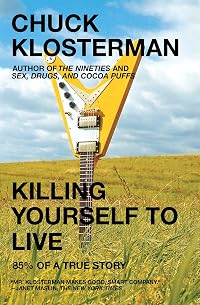
Killing Yourself to Live: 85% of a True Story
by Chuck Klosterman
On This Page
Description
For 6,557 miles, Chuck Klosterman thought about dying. He drove a rental car from New York to Rhode Island to Georgia to Mississippi to Iowa to Minneapolis to Fargo to Seattle, and he chased death and rock 'n' roll all the way. Within the spanof twenty-one days, Chuck had three relationships end-one by choice, one bychance, and one by exhaustion. He snorted cocaine in a graveyard. He walked a halfmile through a bean field. A man in Dickinson, North Dakota, explained to him why we have fewer show more windmills than we used to. He listened to the KISS solo albums and the Rod Stewart box set. At one point, poisonous snakes became involved. The road is hard. From the Chelsea Hotel to the swampland where Lynyrd Skynyrd's plane went down to the site where Kurt Cobain blew his head off, Chuck explored every brand of rock star demise. He wanted to know why the greatest career move any musician can make is to stop breathing. . . and what this means for the rest of us. show lessTags
Recommendations







Member Recommendations
Member Reviews
As a longtime admirer of Chuck Klosterman’s writing on pop music and culture, it pains me to report that his latest book, Killing Yourself to Live: 85% of a True Story, is a dismal, shoddy piece of work. The premise is promising: Klosterman sets out on a cross-country road trip to visit all of the sites of rock ’n’ roll’s long, rich history of death. It seems a brilliant idea — Klosterman’s combination of irreverence and curiosity make him the perfect candidate to unseat the holy-pilgrimage seriousness (and pathos) of most writing on rock ’n’ roll tragedy.
It doesn’t take long for the project to turn sour. Here’s the problem: Klosterman is used to skating by on the wit and originality of his own personal world-view; show more in his last collection, Sex, Drugs, and Cocoa Puffs, his observations on MTV, pornography, video games, and so on, emerged from a perspective that led him to some surprising conclusions. There was a sense of play, of intellectual gamesmanship, that was fresh and engaging. In Killing Yourself, however, he’s become self-reflexive to the point where he can no longer discriminate between what is valuable and what is piffle; it’s all self-narrative. If he’s looking at something, he thinks his reaction to it — how it affects him — automatically matters simply because it’s him, Chuck Klosterman, looking at it. He has become too lazy and uninterested to make any serious effort at thinking or observing and analyzing what a specific site or incident might mean, and falls back on relaying what it means to him, at that moment.
The most devastating element here is the incomprehensible decision to let Klosterman devote much of the book to pseudo-Hornby writhing about the three (!) women with whom he’s currently involved (that is, either sleeping with or wanting to sleep with). Aside from being, at times, downright creepy, it’s both lazy and irrelevant: as smart and funny and interesting as Chuck Klosterman is, I couldn’t really give two shits about his love life. His self-absorption on this count goes so far as to include a chapter-long conversation between the three women and himself that takes place entirely in his head. What’s sad is that he seems to realize this; the book closes with an actual, real-world conversation between the author and one of his female colleagues at Spin, who urges him not to become “the female Elizabeth Wurtzel.” At this point, one tends to agree wholeheartedly with the criticism, and Klosterman’s only retort is to tell her that “her disdain can only be voiced if I do the opposite of what you suggest.” It’s pre-emptive critical damage control. It’s embarrassing.
It is unsettling to see how turning Klosterman loose on such a promising theme brings out his worst instincts as a writer, because his feature pieces for Spin are often brilliant. A perfect example was his reporting on the Rock Cruise, one of those only-in-America phenomena wherein 40-year-old couples pay to hear REO Speedwagon and Styx perform on a boat. It is hard to imagine a riper opportunity for superiority and ridicule, yet Klosterman never condescends to these people — working-class Midwesterners who are paying money to see over-the-hill versions of the two of the most reviled bands in rock history — and in the end lends both the bands and fans an odd kind of dignity. It is frustrating to know that the author is capable of such insights and then to slog through 235 pages of crap that wouldn’t make it onto a Weezer B-side. One can only hope Killing Yourself was just something he needed to get out of his system.
From THE L MAGAZINE, July 20 2005 show less
It doesn’t take long for the project to turn sour. Here’s the problem: Klosterman is used to skating by on the wit and originality of his own personal world-view; show more in his last collection, Sex, Drugs, and Cocoa Puffs, his observations on MTV, pornography, video games, and so on, emerged from a perspective that led him to some surprising conclusions. There was a sense of play, of intellectual gamesmanship, that was fresh and engaging. In Killing Yourself, however, he’s become self-reflexive to the point where he can no longer discriminate between what is valuable and what is piffle; it’s all self-narrative. If he’s looking at something, he thinks his reaction to it — how it affects him — automatically matters simply because it’s him, Chuck Klosterman, looking at it. He has become too lazy and uninterested to make any serious effort at thinking or observing and analyzing what a specific site or incident might mean, and falls back on relaying what it means to him, at that moment.
The most devastating element here is the incomprehensible decision to let Klosterman devote much of the book to pseudo-Hornby writhing about the three (!) women with whom he’s currently involved (that is, either sleeping with or wanting to sleep with). Aside from being, at times, downright creepy, it’s both lazy and irrelevant: as smart and funny and interesting as Chuck Klosterman is, I couldn’t really give two shits about his love life. His self-absorption on this count goes so far as to include a chapter-long conversation between the three women and himself that takes place entirely in his head. What’s sad is that he seems to realize this; the book closes with an actual, real-world conversation between the author and one of his female colleagues at Spin, who urges him not to become “the female Elizabeth Wurtzel.” At this point, one tends to agree wholeheartedly with the criticism, and Klosterman’s only retort is to tell her that “her disdain can only be voiced if I do the opposite of what you suggest.” It’s pre-emptive critical damage control. It’s embarrassing.
It is unsettling to see how turning Klosterman loose on such a promising theme brings out his worst instincts as a writer, because his feature pieces for Spin are often brilliant. A perfect example was his reporting on the Rock Cruise, one of those only-in-America phenomena wherein 40-year-old couples pay to hear REO Speedwagon and Styx perform on a boat. It is hard to imagine a riper opportunity for superiority and ridicule, yet Klosterman never condescends to these people — working-class Midwesterners who are paying money to see over-the-hill versions of the two of the most reviled bands in rock history — and in the end lends both the bands and fans an odd kind of dignity. It is frustrating to know that the author is capable of such insights and then to slog through 235 pages of crap that wouldn’t make it onto a Weezer B-side. One can only hope Killing Yourself was just something he needed to get out of his system.
From THE L MAGAZINE, July 20 2005 show less
What is it about premature death that makes musicians so famous?
That's the question that Spin editor Sia Michel used to convince Chuck Klosterman to embark on an epic road trip across America to visit the places where musicians met their demise.
Killing Yourself to Live started out as a feature article for Spin, but ended up book-length when Klosterman decided to pack the story full of his musing on past lovers, turning this travelogue into a memoir. This article/book was supposed to follow a standard script. At the end of his journey, his coworker, Lucy asks him some questions.
"Are you going to be able to write a compelling story that will dissect the perverse yet undeniable relationship between celebrity and mortality? Will the show more narrative illustrate how society glamorizes dying in order to perpetuate the hope that death validates life? Will you be able to prove that living is dying, and that we're all slowly dying through every moment of life" (233)?
That's not the story Klosterman came up with, however. In the end he realized that "love and death and rock 'n' roll are the same experience" (234).
This memoir is painfully narcissistic (not to mention exploitative of his relationships), but his brutal honesty makes for compelling reading. Klosterman doesn't seem to care what the reader will think of him or his moral choices. Add to this his encyclopedic knowledge of rock and roll culture and you get Killing Yourself to Live: a window into the mind of one of our generation's best cultural critics. show less
That's the question that Spin editor Sia Michel used to convince Chuck Klosterman to embark on an epic road trip across America to visit the places where musicians met their demise.
Killing Yourself to Live started out as a feature article for Spin, but ended up book-length when Klosterman decided to pack the story full of his musing on past lovers, turning this travelogue into a memoir. This article/book was supposed to follow a standard script. At the end of his journey, his coworker, Lucy asks him some questions.
"Are you going to be able to write a compelling story that will dissect the perverse yet undeniable relationship between celebrity and mortality? Will the show more narrative illustrate how society glamorizes dying in order to perpetuate the hope that death validates life? Will you be able to prove that living is dying, and that we're all slowly dying through every moment of life" (233)?
That's not the story Klosterman came up with, however. In the end he realized that "love and death and rock 'n' roll are the same experience" (234).
This memoir is painfully narcissistic (not to mention exploitative of his relationships), but his brutal honesty makes for compelling reading. Klosterman doesn't seem to care what the reader will think of him or his moral choices. Add to this his encyclopedic knowledge of rock and roll culture and you get Killing Yourself to Live: a window into the mind of one of our generation's best cultural critics. show less
I really like Klosterman's writing, but this made me hate the man. The ending is fascile and lazy. Read "Sex, Drugs and Cocoa Puffs" instead. For a better description of what is to hate about this book that serves also as a cautionary tale for would-be writers about what an audience most definitely ain't interested in reading about, read "Mike's" review here (he gives the book a star):
Mike rated it: 12/05/07
bookshelves: nonfiction
Read in April, 2005
As a longtime admirer of Chuck Klosterman’s writing on pop music and culture, it pains me to report that his latest book, Killing Yourself to Live: 85% of a True Story, is a dismal, shoddy piece of work. The premise is promising: Klosterman sets out on a cross-country road trip to visit show more all of the sites of rock ’n’ roll’s long, rich history of death. It seems a brilliant idea — Klosterman’s combination of irreverence and curiosity make him the perfect candidate to unseat the holy-pilgrimage seriousness (and pathos) of most writing on rock ’n’ roll tragedy.
It doesn’t take long for the project to turn sour. Here’s the problem: Klosterman is used to skating by on the wit and originality of his own personal world-view; in his last collection, Sex, Drugs, and Cocoa Puffs, his observations on MTV, pornography, video games, and so on, emerged from a perspective that led him to some surprising conclusions. There was a sense of play, of intellectual gamesmanship, that was fresh and engaging. In Killing Yourself, however, he’s become self-reflexive to the point where he can no longer discriminate between what is valuable and what is piffle; it’s all self-narrative. If he’s looking at something, he thinks his reaction to it — how it affects him — automatically matters simply because it’s him, Chuck Klosterman, looking at it. He has become too lazy and uninterested to make any serious effort at thinking or observing and analyzing what a specific site or incident might mean, and falls back on relaying what it means to him, at that moment.
The most devastating element here is the incomprehensible decision to let Klosterman devote much of the book to pseudo-Hornby writhing about the three (!) women with whom he’s currently involved (that is, either sleeping with or wanting to sleep with). Aside from being, at times, downright creepy, it’s both lazy and irrelevant: as smart and funny and interesting as Chuck Klosterman is, I couldn’t really give two shits about his love life. His self-absorption on this count goes so far as to include a chapter-long conversation between the three women and himself that takes place entirely in his head. What’s sad is that he seems to realize this; the book closes with an actual, real-world conversation between the author and one of his female colleagues at Spin, who urges him not to become “the female Elizabeth Wurtzel.” At this point, one tends to agree wholeheartedly with the criticism, and Klosterman’s only retort is to tell her that “her disdain can only be voiced if I do the opposite of what you suggest.” It’s pre-emptive critical damage control. It’s embarrassing.
It is unsettling to see how turning Klosterman loose on such a promising theme brings out his worst instincts as a writer, because his feature pieces for Spin are often brilliant. A perfect example was his reporting on the Rock Cruise, one of those only-in-America phenomena wherein 40-year-old couples pay to hear REO Speedwagon and Styx perform on a boat. It is hard to imagine a riper opportunity for superiority and ridicule, yet Klosterman never condescends to these people — working-class Midwesterners who are paying money to see over-the-hill versions of the two of the most reviled bands in rock history — and in the end lends both the bands and fans an odd kind of dignity. It is frustrating to know that the author is capable of such insights and then to slog through 235 pages of crap that wouldn’t make it onto a Weezer B-side. One can only hope Killing Yourself was just something he needed to get out of his system.
From THE L MAGAZINE, July 20 2005...less show less
Mike rated it: 12/05/07
bookshelves: nonfiction
Read in April, 2005
As a longtime admirer of Chuck Klosterman’s writing on pop music and culture, it pains me to report that his latest book, Killing Yourself to Live: 85% of a True Story, is a dismal, shoddy piece of work. The premise is promising: Klosterman sets out on a cross-country road trip to visit show more all of the sites of rock ’n’ roll’s long, rich history of death. It seems a brilliant idea — Klosterman’s combination of irreverence and curiosity make him the perfect candidate to unseat the holy-pilgrimage seriousness (and pathos) of most writing on rock ’n’ roll tragedy.
It doesn’t take long for the project to turn sour. Here’s the problem: Klosterman is used to skating by on the wit and originality of his own personal world-view; in his last collection, Sex, Drugs, and Cocoa Puffs, his observations on MTV, pornography, video games, and so on, emerged from a perspective that led him to some surprising conclusions. There was a sense of play, of intellectual gamesmanship, that was fresh and engaging. In Killing Yourself, however, he’s become self-reflexive to the point where he can no longer discriminate between what is valuable and what is piffle; it’s all self-narrative. If he’s looking at something, he thinks his reaction to it — how it affects him — automatically matters simply because it’s him, Chuck Klosterman, looking at it. He has become too lazy and uninterested to make any serious effort at thinking or observing and analyzing what a specific site or incident might mean, and falls back on relaying what it means to him, at that moment.
The most devastating element here is the incomprehensible decision to let Klosterman devote much of the book to pseudo-Hornby writhing about the three (!) women with whom he’s currently involved (that is, either sleeping with or wanting to sleep with). Aside from being, at times, downright creepy, it’s both lazy and irrelevant: as smart and funny and interesting as Chuck Klosterman is, I couldn’t really give two shits about his love life. His self-absorption on this count goes so far as to include a chapter-long conversation between the three women and himself that takes place entirely in his head. What’s sad is that he seems to realize this; the book closes with an actual, real-world conversation between the author and one of his female colleagues at Spin, who urges him not to become “the female Elizabeth Wurtzel.” At this point, one tends to agree wholeheartedly with the criticism, and Klosterman’s only retort is to tell her that “her disdain can only be voiced if I do the opposite of what you suggest.” It’s pre-emptive critical damage control. It’s embarrassing.
It is unsettling to see how turning Klosterman loose on such a promising theme brings out his worst instincts as a writer, because his feature pieces for Spin are often brilliant. A perfect example was his reporting on the Rock Cruise, one of those only-in-America phenomena wherein 40-year-old couples pay to hear REO Speedwagon and Styx perform on a boat. It is hard to imagine a riper opportunity for superiority and ridicule, yet Klosterman never condescends to these people — working-class Midwesterners who are paying money to see over-the-hill versions of the two of the most reviled bands in rock history — and in the end lends both the bands and fans an odd kind of dignity. It is frustrating to know that the author is capable of such insights and then to slog through 235 pages of crap that wouldn’t make it onto a Weezer B-side. One can only hope Killing Yourself was just something he needed to get out of his system.
From THE L MAGAZINE, July 20 2005...less show less
This book purports to be the record of Chuck Klosterman's pilgrimmage to the U.S. sites hallowed by the deaths of assorted rock 'n' roll personages. That's not really what it's about. Or, that's what it's about in only the very loosest sense. Probably only around 5% of the 235 pages of text are actually devoted to the thesis Chuck set out to write about when he left New York. That's alright. The rest is written affably, and I enjoyed it a lot. I read it in fewer than ten waking hours, which is EXTREMELY fast for me.
Klosterman put me in touch with my inner teenager, obsessed as I was with "love, death, and rock 'n' roll" (p. 234). I remember feeling that way, and the book mostly made me realize how much work it was to walk around show more smoldering like that all the time. It is absolutely bizarre how much more time you spend thinking about your mortality when you're sixteen than when you're twenty-six. Klosterman never quit feeling that way, apparently, but luckily, he's more articulate than my friends were when I was in high school. I'd highly recommend this to recovering teenagers looking for something to read on a lazy afternoon. show less
Klosterman put me in touch with my inner teenager, obsessed as I was with "love, death, and rock 'n' roll" (p. 234). I remember feeling that way, and the book mostly made me realize how much work it was to walk around show more smoldering like that all the time. It is absolutely bizarre how much more time you spend thinking about your mortality when you're sixteen than when you're twenty-six. Klosterman never quit feeling that way, apparently, but luckily, he's more articulate than my friends were when I was in high school. I'd highly recommend this to recovering teenagers looking for something to read on a lazy afternoon. show less
Normally I'm not drawn to nonfiction books because I love the notion of other worlds no matter how realistic a book is, but Chuck Klosterman is by far my favorite writer when it comes to Esquire. I figured reading a book by him wouldn't kill me. And it didn't, but did make me realize just how fucked up things can be when you're alone with your thoughts chasing the dead.
But what 85% of this odyssey is fact and what 15% is fiction? I'd like to believe that the whole thing is indeed fact, while some of the dialogue might just be on the spot because, as he mentions early on, he doesn't carry a recorder wherever he goes (I do. Seriously you can ask most of the people who are unfortunate enough to know me).
I know it's pretentious of me to show more compare my life at the moment with Chuck Klosterman's life during the time he complied the book, but the similarities are too obvious to ignore. Perhaps this is the life of every non-serious guy in the USA. Or perhaps what Klosterman does with music and KISS, I do with literature and books. Who knows. Pick up a copy, if you have the time.
And now a quote: "Are and love are the same thing: It's the process of seeing yourself in things that are not you. It's understanding the unreasonable." show less
But what 85% of this odyssey is fact and what 15% is fiction? I'd like to believe that the whole thing is indeed fact, while some of the dialogue might just be on the spot because, as he mentions early on, he doesn't carry a recorder wherever he goes (I do. Seriously you can ask most of the people who are unfortunate enough to know me).
I know it's pretentious of me to show more compare my life at the moment with Chuck Klosterman's life during the time he complied the book, but the similarities are too obvious to ignore. Perhaps this is the life of every non-serious guy in the USA. Or perhaps what Klosterman does with music and KISS, I do with literature and books. Who knows. Pick up a copy, if you have the time.
And now a quote: "Are and love are the same thing: It's the process of seeing yourself in things that are not you. It's understanding the unreasonable." show less
I have Seth Cohen (The O.C.) to thank for introducing me to Chuck Klosterman. I spotted him reading Sex, Drugs and Cocoa Puffs during an episode of The O.C., and the title of the book intrigued me so much that I had to hunt it down. It was entirely fitting that a geek of Seth's stature should be reading the work of a self-proclaimed music and pop culture geek. Of course, I use the word geek in an affectionate way, given that I myself am not entirely without geekiness (I actually took some notes while reading this book).
Chuck Klosterman began his career as a journalist, writing mainly about music and popular culture. Killing Yourself To Live is his attempt to "understand why some rock stars don't start living until they die, why death show more equals credibility". Klosterman begins his journey at the Chelsea Hotel in New York, somewhat unsuccessfully. The hotel manager doesn't want him to talk about the hotel in his book, and insists that the room where Nancy Spungen died no longer exists. Undeterred, Klosterman picks up a rental car, stocks it with over 600 CDs for the trip, and sets off cross-country, taking in the site in Rhode Island where a fire killed over 100 Great White fans at a concert, the spot where Buddy Holly's plane came down, and a few others, culminating in a trip to Washington, where he visits Seattle and Aberdeen.
Klosterman is an entertaining narrator, and the book is peppered with soundbites, musings and tenuous analogies drawn between films and music. Not since High Fidelity (the film mind, not the book), have I enjoyed hearing someone describe music in such detail before. Klosterman describes, compares and critically evaluates the music he loves (rock music mainly), though it's a meandering journey and digressions abound, mainly on the subject of his old girlfriends. He discloses a lot of personal detail about his relationships, and what went wrong with them, and there's quite an analogy near the end of the book where each ex-girlfriend is compared to a member of KISS.
Near the beginning of the book, Klosterman states that "sexuality is 15% real and 85% illusion". Killing Yourself To Live is subtitled 85% Of A True Story. My powers of deduction are telling me that some of this book has been embellished somewhat, and at first I thought that this 15% illusion was to be found in the discussion of his relationships, and the almost unlikely fabulousness of the women who loved him. Then I thought it may have been in the characters he meets on his travels. I'm still undecided. The actual site visits are often fleeting and unremarkable, but that could be the point - even with the knowledge that someone died there to give a location meaning, years after the event it's just a location after all. Popular culture is assigning significance to the sites, and I think that Klosterman gets this completely.
It could be argued that there is too much of the author in this book, but then maybe that's also the point. Klosterman is an avid consumer of music and films, and more importantly he is infectiously enthusiastic about his passions. I have Chuck Klosterman to thank for introducing me to the Dixie Chicks, following his discussion of their song There's Your Trouble in Sex, Drugs and Cocoa Puffs. His writing has that effect on me. I'm off now to buy more Led Zeppelin albums. show less
Chuck Klosterman began his career as a journalist, writing mainly about music and popular culture. Killing Yourself To Live is his attempt to "understand why some rock stars don't start living until they die, why death show more equals credibility". Klosterman begins his journey at the Chelsea Hotel in New York, somewhat unsuccessfully. The hotel manager doesn't want him to talk about the hotel in his book, and insists that the room where Nancy Spungen died no longer exists. Undeterred, Klosterman picks up a rental car, stocks it with over 600 CDs for the trip, and sets off cross-country, taking in the site in Rhode Island where a fire killed over 100 Great White fans at a concert, the spot where Buddy Holly's plane came down, and a few others, culminating in a trip to Washington, where he visits Seattle and Aberdeen.
Klosterman is an entertaining narrator, and the book is peppered with soundbites, musings and tenuous analogies drawn between films and music. Not since High Fidelity (the film mind, not the book), have I enjoyed hearing someone describe music in such detail before. Klosterman describes, compares and critically evaluates the music he loves (rock music mainly), though it's a meandering journey and digressions abound, mainly on the subject of his old girlfriends. He discloses a lot of personal detail about his relationships, and what went wrong with them, and there's quite an analogy near the end of the book where each ex-girlfriend is compared to a member of KISS.
Near the beginning of the book, Klosterman states that "sexuality is 15% real and 85% illusion". Killing Yourself To Live is subtitled 85% Of A True Story. My powers of deduction are telling me that some of this book has been embellished somewhat, and at first I thought that this 15% illusion was to be found in the discussion of his relationships, and the almost unlikely fabulousness of the women who loved him. Then I thought it may have been in the characters he meets on his travels. I'm still undecided. The actual site visits are often fleeting and unremarkable, but that could be the point - even with the knowledge that someone died there to give a location meaning, years after the event it's just a location after all. Popular culture is assigning significance to the sites, and I think that Klosterman gets this completely.
It could be argued that there is too much of the author in this book, but then maybe that's also the point. Klosterman is an avid consumer of music and films, and more importantly he is infectiously enthusiastic about his passions. I have Chuck Klosterman to thank for introducing me to the Dixie Chicks, following his discussion of their song There's Your Trouble in Sex, Drugs and Cocoa Puffs. His writing has that effect on me. I'm off now to buy more Led Zeppelin albums. show less
A quick read (took me a few days of off and on reading) in which the intrepid reporter wanders around the country in a rented Ford Taurus under the pretense of writing stories for Spin magazine about visiting various locations where rock stars died. However, it really is just a long book about these three women he is currently or was previously in love with and how exactly he relates all of his trip to that. It sounds boring, but it's actually fun to read and Klosterman makes fun observations about the places he visit and the people he meets.
Members
- Recently Added By
Author Information

41+ Works 17,549 Members
Chuck Klosterman, currently a music, film, & culture critic for Ohio's "Akron Beacon Journal", began his career with "The Forum" in Fargo, North Dakota. He lives in Akron, Ohio, where he once consumed nothing but McDonald's Chicken McNuggets for seven straight days. (Publisher Provided) Chuck Klosterman is the New York Times bestselling author of show more six books of nonfiction (including Sex, Drugs, and Cocoa Puffs, I Wear the Black Hat and But What If We're Wrong?) and two novels (Downtown Owl and The Visible Man). His debut book, Fargo Rock City, was a winner of the ASCAP-Deems Taylor Award. He currently covers sports and popular culture for ESPN and serves as "The Ethicist" for the New York Times Magazine. (Bowker Author Biography) show less
Awards and Honors
Distinctions
Common Knowledge
- Canonical title
- Killing Yourself to Live: 85% of a True Story
- Original title
- Killing Yourself to Live: 85% of a True Story
- Original publication date
- 2005
- People/Characters
- Sid Vicious; Kurt Cobain; Allman Brothers; Robert Johnson; Ace Frehley; Nancy Spungen
- Important places
- Chelsea Hotel, New York, New York, USA; New York, New York, USA; The Station, West Warwick, Rhode Island, USA; Clear Lake, Iowa, USA
- Epigraph
- I tell you what's really ridiculous - going into a bookstore and there's all these books about yourself. In a way, it feels like you're already dead. ~Thom Yorke
- First words
- I am not qualified to live here.
- Quotations
- The fact that [Sid Vicious] could not do something correctly, yet still do it significantly is all anyone needs to know about punk rock. That notion is punk rock, completely defined in one sentence.
- Last words
- (Click to show. Warning: May contain spoilers.)I am ready to be alone.
- Blurbers
- Coupland, Douglas; Ellis, Bret Easton
Classifications
- Genres
- Nonfiction, Music, General Nonfiction, Biography & Memoir
- DDC/MDS
- 781.660973 — Arts & recreation Music General principles and musical forms Traditions of music Rock (Rock 'n' roll) History, geographic treatment, biography North America
- LCC
- ML394 .K59 — Music Literature on music Literature on music History and criticism Biography
- BISAC
Statistics
- Members
- 2,284
- Popularity
- 8,719
- Reviews
- 29
- Rating
- (3.68)
- Languages
- 6 — English, French, German, Italian, Spanish, Swedish
- Media
- Paper, Audiobook, Ebook
- ISBNs
- 20
- UPCs
- 1
- ASINs
- 9