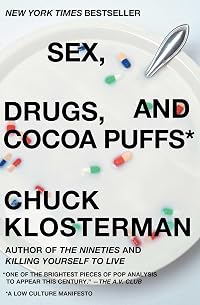
Sex, Drugs, and Cocoa Puffs
by Chuck Klosterman
On This Page
Description
Countless writers and artists have spoken for a generation, but no one has done it quite like Chuck Klosterman. With an exhaustive knowledge of popular culture and an almost effortless ability to spin brilliant prose out of unlikely subject matter, Klosterman attacks the entire spectrum of postmodern America: reality TV, Pamela Anderson and literary Jesus freaks. And don't even get him started on his love life and the whole Harry-Met-Sally situation. Whether deconstructing Saved by the Bell show more episodes or the artistic legacy of Billy Joel, the symbolic importance of The Empire Strikes Back or the Celtics/ Lakers rivalry, Chuck will make you think, he'll make you laugh, and he'll drive you insane -- usually all at once. Sex, Drugs, and Cocoa Puffs is ostensibly about art, entertainment, infotainment, sports, and politics but -- really -- it's about us. All of us. As Klosterman realizes late at night, in the moment before he falls asleep, "In and of itself, nothing really matters. What matters is that nothing is ever 'in and of itself.'". show lessTags
Recommendations










Member Recommendations

MShock Recommended for any Klosterman fan. I would describe Sullivan's writing as more literary and less humorous than Klosterman's, though just as insightful and entertaining. Like Klosterman, his essays run the gamut of popular culture: from Axl Rose to Hurrcane Katrina, to One Tree Hill.
Member Reviews
I'll be the first to admit it. This is one of the more unlikely titles you'll see reviewed by this pastor. Klosterman is Coupland without a conscience—Žižek without political science. He wears the black hat proudly and although you might cringe at some of the things he confesses to, he comes off as strangely honest in his admitted depravity.
I read Klosterman for two reasons:
1. He is wickedly funny.
2. His analysis of popular culture reveals the heart of our society.
This was even true in the last essay in this collection, "How to Disappear Completely and Never Be Found," which is an analysis of the Left Behind phenomenon. Here's how he unpacks (acerbically yet truthfully) the effect believing that you're right has on people's show more humility:
"There is no sophisticated reason for believing in anything supernatural, so it really comes down to believing you're right. This is another example of how born agains are cool—you'd think they'd be humble, but they've got to be amazingly cocksure. And once you've crossed over, you don't even have to try to be nice; according to the born-again exemplar, your goodness will be a natural extension of your salvation. Caring about orphans and helping the homeless will come as naturally as having sex with coworkers and stealing office supplies. If you consciously do good works out of obligation, you'll never get into heaven; however, if you make God your proverbial copilot, doing good works will just become an unconscious part of your life" (238).
Now, I know I could challenge the misconceptions in this paragraph (just as I could pull apart the theological naivety behind the Left Behind books). It's clear from his comments on sophistication that he's simply never read any sophisticated Christian. Put those thoughts aside, though and hear what he says. This is what the Left Behind phenomenon conveys of Christians to one of the smartest cultural critics around.
It's not just religion Klosterman focuses on. In fact, religion is one of the smaller themes in his writing. He is at home discussing movies, music, sports, and all the other forms of entertainment we consume.
Now do you see why this pastor reads Klosterman? show less
I read Klosterman for two reasons:
1. He is wickedly funny.
2. His analysis of popular culture reveals the heart of our society.
This was even true in the last essay in this collection, "How to Disappear Completely and Never Be Found," which is an analysis of the Left Behind phenomenon. Here's how he unpacks (acerbically yet truthfully) the effect believing that you're right has on people's show more humility:
"There is no sophisticated reason for believing in anything supernatural, so it really comes down to believing you're right. This is another example of how born agains are cool—you'd think they'd be humble, but they've got to be amazingly cocksure. And once you've crossed over, you don't even have to try to be nice; according to the born-again exemplar, your goodness will be a natural extension of your salvation. Caring about orphans and helping the homeless will come as naturally as having sex with coworkers and stealing office supplies. If you consciously do good works out of obligation, you'll never get into heaven; however, if you make God your proverbial copilot, doing good works will just become an unconscious part of your life" (238).
Now, I know I could challenge the misconceptions in this paragraph (just as I could pull apart the theological naivety behind the Left Behind books). It's clear from his comments on sophistication that he's simply never read any sophisticated Christian. Put those thoughts aside, though and hear what he says. This is what the Left Behind phenomenon conveys of Christians to one of the smartest cultural critics around.
It's not just religion Klosterman focuses on. In fact, religion is one of the smaller themes in his writing. He is at home discussing movies, music, sports, and all the other forms of entertainment we consume.
Now do you see why this pastor reads Klosterman? show less
This collection of essays from the early 2000s is described on the cover as "a low culture manifesto," and it does, indeed, feature a lot of discussion of supposedly lowbrow pop cultural topics, from tribute bands to Saved by the Bell to internet porn.
Klosterman is an interesting writer. He has lots of opinions, and the sillier and less defensible they are, the more deliberately loud and hyperbolic he gets about them. He also gives the impression, reasonably often, that he might be just a liiiiiiiitle bit talking out of his ass, and that he knows it and expects you to know it, too. Now, more often than not, I find people like that obnoxious and offputting, but Klosterman actually really pulls it off. He's funny, he can be genuinely show more thought-provoking, and he very much conjures up the feeling of someone trying to pick an entertaining, good-natured argument with a friend over a beer, rather than a serious and nasty one on the internet with a stranger. The result, more often than not, is fun to read, whether you agree with anything he says or not.
The fact that this collection is something like twenty years old does make it dated, but in a way that makes it feel, to me, like a fascinating little time capsule. Mind you, it probably helps that I'm the same age as Klosterman and remember all the stuff he's referencing, even if I didn't necessarily pay attention to all of it at the time.
It's also interesting to me how very, very Gen X Klosterman's voice and attitude and general everything are. It makes me a little nostalgic, if I'm honest, for the vanishingly brief period when my generation actually seemed to have some kind of cultural relevance.
I've seen, by the way, that he has a new book out now looking at the 90s with another twenty years of perspective. I'm definitely going to have to pick that one up. I'll be curious to see how much differently it reads from this one. show less
Klosterman is an interesting writer. He has lots of opinions, and the sillier and less defensible they are, the more deliberately loud and hyperbolic he gets about them. He also gives the impression, reasonably often, that he might be just a liiiiiiiitle bit talking out of his ass, and that he knows it and expects you to know it, too. Now, more often than not, I find people like that obnoxious and offputting, but Klosterman actually really pulls it off. He's funny, he can be genuinely show more thought-provoking, and he very much conjures up the feeling of someone trying to pick an entertaining, good-natured argument with a friend over a beer, rather than a serious and nasty one on the internet with a stranger. The result, more often than not, is fun to read, whether you agree with anything he says or not.
The fact that this collection is something like twenty years old does make it dated, but in a way that makes it feel, to me, like a fascinating little time capsule. Mind you, it probably helps that I'm the same age as Klosterman and remember all the stuff he's referencing, even if I didn't necessarily pay attention to all of it at the time.
It's also interesting to me how very, very Gen X Klosterman's voice and attitude and general everything are. It makes me a little nostalgic, if I'm honest, for the vanishingly brief period when my generation actually seemed to have some kind of cultural relevance.
I've seen, by the way, that he has a new book out now looking at the 90s with another twenty years of perspective. I'm definitely going to have to pick that one up. I'll be curious to see how much differently it reads from this one. show less
Klosterman's pop culture commentary promises an experience much like the cereal of the title -- a rush of pleasure without corresponding nourishment. He delivers something much better -- turns of phrase that linger and rhetorical questions you will find yourself asking your freinds. Could you ever marry a person, not matter how otherwise suitable, who was obsessed with Jim Henson's "The Dark Crystal?" That's a question you'll learn something from. When I asked my wife, she said she had already basically committed herself on that point...
Ay, la cultura pop. Cuando empiezas a leer a Klosterman desvariar como un poseso sobre cualquier tema habido y por haber (los asesinos en serie, Pamela Anderson, los Sims, Billy Joel, porqué el fútbol europeo es para fracasados, Lakers vs. Celtics, los cereales, Star Wars, las bandas tributo a Guns 'n' Roses)... ay, quieres que no acabe nunca.
Los ensayos son breves, divertidos, y aunque el punto de vista del autor es a veces cuestionable (más bien miserable, diría yo), tanto que me da cosita darle las cinco estrellas. Pero el contenido de este libro parece hecho para mí, y no puedo evitar puntuarlo así. Ojalá más libros petardos como este por ahí.
Los ensayos son breves, divertidos, y aunque el punto de vista del autor es a veces cuestionable (más bien miserable, diría yo), tanto que me da cosita darle las cinco estrellas. Pero el contenido de este libro parece hecho para mí, y no puedo evitar puntuarlo así. Ojalá más libros petardos como este por ahí.
Like most smart people, Chuck Klosterman thinks very deeply about a lot of things. However, unlike, say, a smart theoretical physicist or a smart behavioral psychologist, the stuff Klosterman ponders and writes about is both random and of remarkably little consequence. Of course, essays exploring relatively insignificant topics can still be interesting and occasionally very funny. For the most part, the author manages to do just that in this volume.
Take, for instance, the frequently cited chapter in which Klosterman explains why he thinks ‘Saved by the Bell’ became such an iconic television show for kids of a certain age, despite the fact that it was unrealistic, unimaginative, and not particularly good. Or, the author’s take on show more what may or may not be fascinating about having an acquaintance who turns out to be a serial killer. Or even his views of why Trisha Yearwood is more relevant than Bob Dylan and how the internet changed the dynamics of the porn industry.
My only real complaint about Sex, Drugs, and Cocoa Puffs is that much of the material feels a little dated by now, which is understandable given that most of the essays appear to have been written in the late 1990s and early 2000s. Still, an essay that contrasts the visions of reality presented in the movies Vanilla Sky and Memento is hardly cutting-edge material today. Also, the depth to which Klosterman dives into some of his more arcane arguments made reading them a little monotonous at times. Nevertheless, the author has a unique perspective on modern culture and that makes this book worth considering. show less
Take, for instance, the frequently cited chapter in which Klosterman explains why he thinks ‘Saved by the Bell’ became such an iconic television show for kids of a certain age, despite the fact that it was unrealistic, unimaginative, and not particularly good. Or, the author’s take on show more what may or may not be fascinating about having an acquaintance who turns out to be a serial killer. Or even his views of why Trisha Yearwood is more relevant than Bob Dylan and how the internet changed the dynamics of the porn industry.
My only real complaint about Sex, Drugs, and Cocoa Puffs is that much of the material feels a little dated by now, which is understandable given that most of the essays appear to have been written in the late 1990s and early 2000s. Still, an essay that contrasts the visions of reality presented in the movies Vanilla Sky and Memento is hardly cutting-edge material today. Also, the depth to which Klosterman dives into some of his more arcane arguments made reading them a little monotonous at times. Nevertheless, the author has a unique perspective on modern culture and that makes this book worth considering. show less
Sex, Drugs, and Cocoa Puffs is a book that raises a variety of interesting philosophical questions without becoming pedantic. The book is a series of essays primarily focused on the "chicken and egg" concept of whether cultural focal points (MTV's The Real World celebrity sex tapes, Left Behind and Coldplay) create the social consciousness or whether the social consciousness/concerns create these cultural focal points. While at times the author criticizes himself for his shallow viewpoints, I found that a lot of them were truly interesting to me and well worth the read.
One of the most interesting chapters to me, oddly enough, was the one concerning how soccer is an outcast sport. I found that point actually quite accurate and show more compelling, along with the Pam Anderson/Marilyn Monroe comparison. While the book is concerned with low culture, its ideas and philosophies are well suited to even higher cultural concerns.
And, yeah, Coldplay is still awful. show less
One of the most interesting chapters to me, oddly enough, was the one concerning how soccer is an outcast sport. I found that point actually quite accurate and show more compelling, along with the Pam Anderson/Marilyn Monroe comparison. While the book is concerned with low culture, its ideas and philosophies are well suited to even higher cultural concerns.
And, yeah, Coldplay is still awful. show less
Solipsist. Never has a single word ever summed up one person so well. When this came up on my book group's reading list, I was all excited: essays on pop culture? Yes, please! Too bad it turned out to be the ramblings of a self-satisfied, self-styled genius with all the piercing insight of the average brick.
Aside from Klosterman's incredible self-absorption, his casual misogyny infuriated me. Has this man ever actually talked to a woman? After reading the first essay, I had my doubts. By the end of the second or third, I was sure he hadn't. The relentless cliches about American female roles and the gratuitous swipes piled up to the point that I started wondering if Klosterman was talking to someone else.
Aside from Klosterman's incredible self-absorption, his casual misogyny infuriated me. Has this man ever actually talked to a woman? After reading the first essay, I had my doubts. By the end of the second or third, I was sure he hadn't. The relentless cliches about American female roles and the gratuitous swipes piled up to the point that I started wondering if Klosterman was talking to someone else.
Members
- Recently Added By
Lists

to get
244 works; 2 members

R29: These Books Make Us Literally Laugh Out Loud
6 works; 3 members

Books Read in 2020
4,379 works; 124 members

Florida
366 works; 3 members
Author Information

42+ Works 17,629 Members
Chuck Klosterman, currently a music, film, & culture critic for Ohio's "Akron Beacon Journal", began his career with "The Forum" in Fargo, North Dakota. He lives in Akron, Ohio, where he once consumed nothing but McDonald's Chicken McNuggets for seven straight days. (Publisher Provided) Chuck Klosterman is the New York Times bestselling author of show more six books of nonfiction (including Sex, Drugs, and Cocoa Puffs, I Wear the Black Hat and But What If We're Wrong?) and two novels (Downtown Owl and The Visible Man). His debut book, Fargo Rock City, was a winner of the ASCAP-Deems Taylor Award. He currently covers sports and popular culture for ESPN and serves as "The Ethicist" for the New York Times Magazine. (Bowker Author Biography) show less
Some Editions
Work Relationships
Common Knowledge
- Canonical title
- Sex, Drugs, and Cocoa Puffs
- Original publication date
- 2003-08-26
- People/Characters
- John Cusack; Woody Allen; Tom Cruise; Will Wright; Chuck Klosterman; Billy Joel (show all 34); Bruce Springsteen; Randy Trask; Paul Dischner; Pamela Anderson; Marilyn Monroe; Tommy Lee; Sylvester Graham; James Caleb Jackson; Ellen G. White; John Harvey Kellogg; Zach Morris; Samuel "Screech" Powers; A.C. Slater; Kelly Kapowski; Jessie Spano; Lisa Turtle; Mr. Belding; Luke Skywalker; Han Solo; Darth Vader; Dixie Chicks; Toby Keith; Trisha Yearwood; Michael Braae; John Wayne Gacy; Jeffrey Dahmer; Jerry B. Jenkins; Kirk Cameron
- Epigraph
- Sol-ip-sism (sol' ip size' em), n. Philos. The theory that only the self exists or can be proved to exist.
-- The Random House College Dictionary,
Revised Edition
"I remember saying things, but I have no idea what was said. It was generally a friendly conversation.
-- Associated Press Reporter Jack Sullivan,
attempting to recount 3 A.M. exchange
we had at a din... (show all)ner party and inadvertently
describing the past ten years of my life. - First words
- There are two ways to look at life. (Introduction)
No woman will ever satisfy me. - Last words
- (Click to show. Warning: May contain spoilers.)I'm hoping all those nuns were right: I'm angling for purgatory, and I'm angling hard.
- Blurbers
- Shteyngart, Gary; Odenkirk, Bob; Nawrocki, Tom; Mitchell, Ben; Garner, Dwight
Classifications
- Genres
- General Nonfiction, Nonfiction, Biography & Memoir
- DDC/MDS
- 306.0973 — Society, government, & culture Social sciences, sociology & anthropology Social Behavior - Dating, Marriage, Divorce Social history North America United States
- LCC
- E169.12 .K56 — History of the United States United States General
- BISAC
Statistics
- Members
- 5,321
- Popularity
- 2,561
- Reviews
- 94
- Rating
- (3.67)
- Languages
- English, Finnish, French, Swedish
- Media
- Paper, Audiobook, Ebook
- ISBNs
- 14
- ASINs
- 8