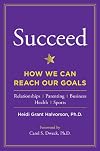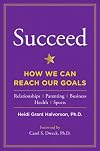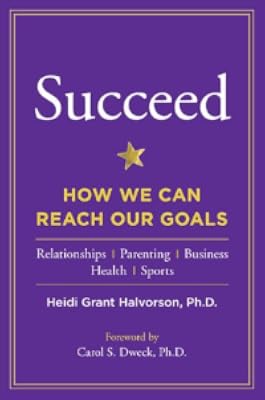
Succeed: How We Can Reach Our Goals
by Heidi Grant Halvorson
On This Page
Description
Whether it's wanting to impress our bosses, find a loving relationship, straighten out our finances, or take better care of ourselves, we all feel that there is at least one part of our lives that is in real need of improvement. We want to do better, but somehow we fall short and end up feeling like we don't have what it takes to reach our goals. And we could not be more wrong.Most of us have no idea why we fail to reach our goals. Now eminent social psychologist Heidi Grant Halvorson shows show more us how we can finally win by revealing how goals really work—and by showing us how to avoid what typically goes wrong.
Dr. Grant Halvorson offers insights—many surprising—that listeners can use immediately, including how to:
– Set a goal so that you will persist even in the face of adversity; – Build willpower, which can be strengthened like a muscle; – Avoid the kind of positive thinking that makes people fail.
The strategies outlined in this book will not only help everyone reach their own goals but will also prove invaluable to parents, teachers, coaches, and employers. Dr. Grant Halvorson shows listeners a new approach to problem solving that will change the way they approach their entire lives.
. show less
Tags
Recommendations










Member Reviews
I listened to this audiobook to start 2024 on a new note. I've read plenty of books about goals and related topics. Happily, there were new insights for me in this book thanks to the author's research driven approach.
There are several concepts form the book that were particularly helpful:
-Habit Change: making a plan for specifically when and where to perform the habit (e.g. exercise at 6am at the neighbourhood gym) is proven to significantly increase performance at the habit.
-Using different motivational statements: it is helpful to use both why statements (e.g., why do I care about achieving this goal?) and what statements (i.e., what are specific actions I need to do to achieve this goal)
-Visualization. I've heard about visualization show more before, and this book presented the idea in a new way. Research has found that visualizing the end result (e.g. winning a race) is less effective than visualizing the process involved to achieve the goal (e.g. picturing yourself putting in multiple training sessions over time).
While I found the book quite insightful overall, there were two aspects that I found disappointing. First, the book is best at personal scale habit change (e.g. weight loss, fitness, quit smoking). There was far less discussion of larger scope goals with longer duration (e.g. a 12 month or longer duration goal). I also found it disappointing that many (if not the majority) of the research studies involved college students and children. I gather that using college students in psychological research studies is very common since they are available and relatively easy to access. Still, the book could be improved by including examples of working adults (e.g. a study of 1000 accountants during 'busy season' for example). show less
There are several concepts form the book that were particularly helpful:
-Habit Change: making a plan for specifically when and where to perform the habit (e.g. exercise at 6am at the neighbourhood gym) is proven to significantly increase performance at the habit.
-Using different motivational statements: it is helpful to use both why statements (e.g., why do I care about achieving this goal?) and what statements (i.e., what are specific actions I need to do to achieve this goal)
-Visualization. I've heard about visualization show more before, and this book presented the idea in a new way. Research has found that visualizing the end result (e.g. winning a race) is less effective than visualizing the process involved to achieve the goal (e.g. picturing yourself putting in multiple training sessions over time).
While I found the book quite insightful overall, there were two aspects that I found disappointing. First, the book is best at personal scale habit change (e.g. weight loss, fitness, quit smoking). There was far less discussion of larger scope goals with longer duration (e.g. a 12 month or longer duration goal). I also found it disappointing that many (if not the majority) of the research studies involved college students and children. I gather that using college students in psychological research studies is very common since they are available and relatively easy to access. Still, the book could be improved by including examples of working adults (e.g. a study of 1000 accountants during 'busy season' for example). show less
Great book. Highly recommended.
Great book. Highly recommended.
Ratings
Members
- Recently Added By
Author Information
17+ Works 562 Members
Heidi Grant Halvorson, PhD, is a social psychologist and Associate Director of the Motivation Science Center at Columbia Business School. She is the author of four bestselling books, including Nine Things Successful People Do Differently, as well as a regular contributor to leading publications, including Harvard Business Review, Fast Company, show more WSJ.com, and Psychology Today. show less
Common Knowledge
- Original publication date
- 2010
Classifications
Statistics
- Members
- 195
- Popularity
- 168,636
- Reviews
- 3
- Rating
- (4.21)
- Languages
- English
- Media
- Paper, Audiobook, Ebook
- ISBNs
- 10
- ASINs
- 3