
Timothy A Pychyl
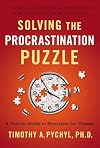
Author of Solving the Procrastination Puzzle : A Concise Guide to Strategies for Change
About the Author
Works by Timothy A Pychyl
Solving the Procrastination Puzzle : A Concise Guide to Strategies for Change (2013) 222 copies, 10 reviews
Tagged
Common Knowledge
Members
Reviews

"The value of this book is that it is a digest of my research, and most important, this book provides a concise summary of key strategies to reduce procrastination in your life."
Perhaps, like me, you've already heard about or been told Pychyl's most basic strategy (as it's the advice most often cited in nearly all how-to articles on procrastination): just get started.
For years this simple advice baffled me. What do you mean, just get started?! Because getting started IS the obstacle. Or so show more I thought.
Procrastination, or self-regulation failure, is defined by its intention-action gap. Pychyl states that we need to make predecisions to act in a different way than we have acted in the past. Predecisions, he says, are key to change.
The first step: When you feel that urge to put something off, stay put.
Next, pick the very first action in a task on your list. You don't even have to think about if it's the logical first action or if it's going to fit perfectly into the overall task / project. Select that action, whatever it is, and start -- the goal being to finish that action.
There, you've successfully completed basic strategy #1: just get started.
(What I've discovered is that once I'm over that initial hurdle, I keep going.)
Of course, you'll likely have to "just get started" several times throughout the day. And you'll probably take one step forward and two giant leaps backward in the journey to change your procrastination habit. But that's okay. Evaluate the thinking behind the voluntary delay. Forgive yourself for backsliding. And, you guessed it: just get started again.
I love strategies! And I love when decades of information can be distilled in a slim 107 pages!
This tiny book solidified the theory I'd learned in The Procrastination Equation and then took it up about a bazillion notches with its practical, actionable Strategies for Change at the end of every chapter.
I've been practicing the "stay put - get started strategy" for over a week now with fabulous results! I can't wait to test out the "implementation intentions" strategy next.
Highly recommended to anyone who genuinely wants to change their habit of putting off 'til tomorrow what they can (and often should) do today and who is willing to take the emotional inventory necessary to make those changes.
4 stars
My random reading notes
I often procrastinate on biz dev like finishing my new site (thinking: don't have everything planned out perfectly) or easy work tasks (feel boring or not meaningful)
emotional intelligence important in terms of more effective self-control
perceive, understand and regulate emotions
implementation intentions
powerful tool to move from goal intention to action
e.g., "If...then..."
Our motivational state does NOT need to match the intention
Chapter 5: Excuses and Self-Deception
The Planning Fallacy is a major one for me
Chapter 8: Willpower, Willpower
"It is exactly when we say to ourselves 'I'll feel more like it tomorrow' that we have to stop, take a breath, and think about why we intended to do the task today. Why is it important to us? What benefit is there in making the effort now? How will this help us achieve our goal?
Perhaps, like me, you've already heard about or been told Pychyl's most basic strategy (as it's the advice most often cited in nearly all how-to articles on procrastination): just get started.
For years this simple advice baffled me. What do you mean, just get started?! Because getting started IS the obstacle. Or so show more I thought.
Procrastination, or self-regulation failure, is defined by its intention-action gap. Pychyl states that we need to make predecisions to act in a different way than we have acted in the past. Predecisions, he says, are key to change.
The first step: When you feel that urge to put something off, stay put.
Next, pick the very first action in a task on your list. You don't even have to think about if it's the logical first action or if it's going to fit perfectly into the overall task / project. Select that action, whatever it is, and start -- the goal being to finish that action.
There, you've successfully completed basic strategy #1: just get started.
(What I've discovered is that once I'm over that initial hurdle, I keep going.)
Of course, you'll likely have to "just get started" several times throughout the day. And you'll probably take one step forward and two giant leaps backward in the journey to change your procrastination habit. But that's okay. Evaluate the thinking behind the voluntary delay. Forgive yourself for backsliding. And, you guessed it: just get started again.
I love strategies! And I love when decades of information can be distilled in a slim 107 pages!
This tiny book solidified the theory I'd learned in The Procrastination Equation and then took it up about a bazillion notches with its practical, actionable Strategies for Change at the end of every chapter.
I've been practicing the "stay put - get started strategy" for over a week now with fabulous results! I can't wait to test out the "implementation intentions" strategy next.
Highly recommended to anyone who genuinely wants to change their habit of putting off 'til tomorrow what they can (and often should) do today and who is willing to take the emotional inventory necessary to make those changes.
4 stars
My random reading notes
I often procrastinate on biz dev like finishing my new site (thinking: don't have everything planned out perfectly) or easy work tasks (feel boring or not meaningful)
emotional intelligence important in terms of more effective self-control
perceive, understand and regulate emotions
implementation intentions
powerful tool to move from goal intention to action
e.g., "If...then..."
Our motivational state does NOT need to match the intention
Chapter 5: Excuses and Self-Deception
The Planning Fallacy is a major one for me
Chapter 8: Willpower, Willpower
"It is exactly when we say to ourselves 'I'll feel more like it tomorrow' that we have to stop, take a breath, and think about why we intended to do the task today. Why is it important to us? What benefit is there in making the effort now? How will this help us achieve our goal?
I liked the quick and breezy approach, which helped to lighten the general message I am getting from all these procrastination books: "You are a moral failure." I think his solutions are much better and more realistic than the Power of Positive Thinking Aphorisms I got in the last book I read but putting it into practice is the real secret. Small but constant improvement....
I heard professor Pychyl speak recently, and I was captivated by his deep knowledge on the topic of procrastination. (The fact that he lives and works in my hometown also made me want to support him further.) I picked up this book hoping to get some practical tips on how to beat procrastination. I had intended to use what I learn in my own life and in my work with clients.
While this book is short and relatively dry (it really does read like an academic text), the solutions suggested are show more simple, practical, and applicable to any situation. None of what professor Pychyl offers here is groundbreaking. And it's nothing you haven't already heard or read from dozens of other sources. But everything serves as a solid reminder for what we already know: doing the work is the only way to meet our goals. And the more we can resist distractions and ignore the lure of feeling good in the moment, the quicker we'll get there. show less
While this book is short and relatively dry (it really does read like an academic text), the solutions suggested are show more simple, practical, and applicable to any situation. None of what professor Pychyl offers here is groundbreaking. And it's nothing you haven't already heard or read from dozens of other sources. But everything serves as a solid reminder for what we already know: doing the work is the only way to meet our goals. And the more we can resist distractions and ignore the lure of feeling good in the moment, the quicker we'll get there. show less
Full of good, actionable advice for fixing your procrastination issues. Having just finished it, I can't really comment on its efficacy, but I have a lot to go off if. You won't find any hidden gems in this little book, and you're not meant to. You're reading this book to face your procrastination, and to be told what to do about it. And you are told. Reading this in tandem with Atomic Habits is a wonderful combo.
You May Also Like


Statistics
- Works
- 4
- Members
- 248
- Popularity
- #92,013
- Rating
- 3.6
- Reviews
- 10
- ISBNs
- 10
- Languages
- 2