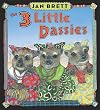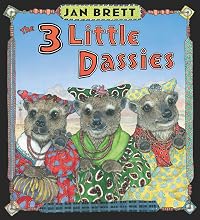
The 3 Little Dassies
by Jan Brett
On This Page
Description
In this adaptation of the traditional folktale, three little dassies (also called rock hyraxes) build their houses in the Namib Desert of Southern Africa, hoping for protection from the eagle that lives atop a nearby mountain.Tags
Recommendations



Member Reviews
The traditional English folktale of The Three Little Pigs has been transplanted to the Namib Desert, and the pigs transformed into dassies—otherwise known as the rock hyrax, these small mammals are (despite their size) closely related to the elephant—in this charming picture book from author/illustrator Jan Brett. As sisters Mimbi, Pimbi and Timbi move away from the rest of their family, seeking a cooler home at the foot of the mountains, they each build a home for themselves: one made of woven grass, one made of sticks, and one made of rocks. When the local eagle begins to hunt them, the former two homes are quickly demolished, and their residents taken to the eagle's eyrie. It is the third home that stands the test, protecting its show more owner from attack. Fortunately for the two captured dassies, Agama Man the lizard effects an escape and all ends well, except perhaps for the eagle...
According to the rear dust-jacket flap, The 3 Little Dassies was inspired by a trip Jan Brett made with her husband to Namibia, during which she encountered these cute little creatures. Although sometimes leery of these kinds of transplanted tales, especially when such changes divorce a story from its own cultural context for no good reason, this particular storytelling transformation didn't really bother me. I think this is owing to three factors. First, the characters are animals rather than humans—nothing annoys me more than this mistaken notion that fairy and folklore needs to be made diverse by these kind of interventions, when world folklore is already diverse—second, Jan Brett's artwork is lovely and her storytelling appealing; and third, it felt as if the changes made had actual significance. Which is to say: the transformation actually served a storytelling purpose. As it happens, dassies do live in stone "houses," using the rocks in their native habitat to protect themselves from the eagles which hunt them. Thus the The Three Little Pigs story fits in well with the native reality of Namibia. This, as well as the eventual fate of the eagle (the stand-in here for the big bad wolf), whose feathers are singed black by the fire into which he attempts to dive, also turns this folktale into a pourquoi story, one which explains why the eagles of the region are black, and why dassies live amongst the rocks. Leaving that all aside, this was also just a charming tale, accompanied by lovely artwork. Recommended to all young folklore enthusiasts. show less
According to the rear dust-jacket flap, The 3 Little Dassies was inspired by a trip Jan Brett made with her husband to Namibia, during which she encountered these cute little creatures. Although sometimes leery of these kinds of transplanted tales, especially when such changes divorce a story from its own cultural context for no good reason, this particular storytelling transformation didn't really bother me. I think this is owing to three factors. First, the characters are animals rather than humans—nothing annoys me more than this mistaken notion that fairy and folklore needs to be made diverse by these kind of interventions, when world folklore is already diverse—second, Jan Brett's artwork is lovely and her storytelling appealing; and third, it felt as if the changes made had actual significance. Which is to say: the transformation actually served a storytelling purpose. As it happens, dassies do live in stone "houses," using the rocks in their native habitat to protect themselves from the eagles which hunt them. Thus the The Three Little Pigs story fits in well with the native reality of Namibia. This, as well as the eventual fate of the eagle (the stand-in here for the big bad wolf), whose feathers are singed black by the fire into which he attempts to dive, also turns this folktale into a pourquoi story, one which explains why the eagles of the region are black, and why dassies live amongst the rocks. Leaving that all aside, this was also just a charming tale, accompanied by lovely artwork. Recommended to all young folklore enthusiasts. show less
An African version of the three little pigs except in a different setting and with different characters, but the main elements and themes are still there. It takes place in a desert and the main characters are rats. What I especially enjoyed about this story was its cultural aspect. The vibrant, colorful clothing worn by the daisies and other animals.
This is a fun story. I hadn't heard of a dassie before this. When I looked it up, it was quite like the illustration; a very cute animal. I think the 3 little pigs style story would work well with almost any predator/prey situation. It's a fun story to put a different twist on. Jan Brett does an amazing job with the illustrations in this book. The reader needs to take time to look at the illustrations on each page or they may miss the details that tell part of the story.
Characters: 3 dassies (rock rabbits), their family, a frog, and an eagle.
Setting: Africa – Namib desert
Theme: Variation of 3 little pigs
Genre: Traditional Literature - Folktale
Golden quote (optional): “I’ll flap and I’ll clap and I’ll blow your house in!”
Summary: In this rendition of The 3 Little Pigs, the pigs are dassies (rock rabbits) and they live in Africa. The dassies, named Mimbi, Pimbi, and Timbi, are leaving their family to move to the mountain area of the Namib Desert. A frog named Agama Man greets the sisters upon their arrival. The task of building their homes ensues. Mimbi builds a house out of long grasses, Pimbi builds her house out of driftwood, and Timbi builds her house out of stones and rocks. The next show more morning the eagle flies down and destroys the grass house, and the driftwood house, but fails to destroy the stone house. The eagle tries to descend into the stone house’s chimney but realizes the fire will destroy him and he leaves. The dassies, their family, and the Agama Man all celebrate the victory.
Audience: Kindergarten through sixth grade
Curriculum ties: World Cultures, variation on a theme
Awards (optional):
Personal response: This book is a delightful play on The 3 Little Pigs. The author has done a beautiful job adapting the story with an African backdrop. The illustrations are so lovely and colorful with all the details. The dassies are wearing traditional dresses and each animal has some type of clothing, except for the turtle, to give depth to the character. The sidebars are filled with illustrations to help enhance the story. My favorite pictures are when the Agama Man helps the first two dassies escape from the eagle’s nest; they use their dresses as parachutes. I actually like this telling of the folktale better than the original. show less
Setting: Africa – Namib desert
Theme: Variation of 3 little pigs
Genre: Traditional Literature - Folktale
Golden quote (optional): “I’ll flap and I’ll clap and I’ll blow your house in!”
Summary: In this rendition of The 3 Little Pigs, the pigs are dassies (rock rabbits) and they live in Africa. The dassies, named Mimbi, Pimbi, and Timbi, are leaving their family to move to the mountain area of the Namib Desert. A frog named Agama Man greets the sisters upon their arrival. The task of building their homes ensues. Mimbi builds a house out of long grasses, Pimbi builds her house out of driftwood, and Timbi builds her house out of stones and rocks. The next show more morning the eagle flies down and destroys the grass house, and the driftwood house, but fails to destroy the stone house. The eagle tries to descend into the stone house’s chimney but realizes the fire will destroy him and he leaves. The dassies, their family, and the Agama Man all celebrate the victory.
Audience: Kindergarten through sixth grade
Curriculum ties: World Cultures, variation on a theme
Awards (optional):
Personal response: This book is a delightful play on The 3 Little Pigs. The author has done a beautiful job adapting the story with an African backdrop. The illustrations are so lovely and colorful with all the details. The dassies are wearing traditional dresses and each animal has some type of clothing, except for the turtle, to give depth to the character. The sidebars are filled with illustrations to help enhance the story. My favorite pictures are when the Agama Man helps the first two dassies escape from the eagle’s nest; they use their dresses as parachutes. I actually like this telling of the folktale better than the original. show less
I adored the art in this book, particularly the clothes the animals wore, which look like they were inspired by tradititional Namibian clothes. I think children will really respond to the story and its art. In a class of older students, it might spark an interesting conversation about the similarities of folktales across the world.
This folklore brought me back to my childhood, this story was similar to my grandmother's favorite story to tell! This African folklore is a fun twist on the very popular tale of the, " The 3 little pigs." In lieu of 3 pigs and a wolf, this story is told with 3 dassies and an eagle. The story line and plot is pretty much exactly the same until the end. This story is a cute myth as to why dassies live in stone caves. To this day dassies are still adapted to living in stone caves to stay away from the number one predator on the food chain, the eagle. I love this interpretation of "The 3 Little Pigs." It is classic but at the same time true to it's countries heritage and culture. The mice seem to be dressed in traditional African clothing show more and the deserts are depicted perfectly. The illustrator did not miss a detail. Different species native to Namibia were included into the drawings like exotic lizards, cacti, tortoises, shrubs, trees and much more. My favorite part of the book was the ending, I like that the author took an original folktale and turned it into her own by adding a unique myth. The style of the book was fun and energetic, the animals' were animated and lively and the text portrayed each character's personality. show less
I loved this version of the long told tale. IT has the same theme and moral: nothing worth having comes easy or hard work pays off. I think that kids would enjoy this version of the story. I also love how the pictures on the side of the page foreshadow what comes next.
Members
- Recently Added By
Lists

al.vick-wishlist-Children's
462 works; 3 members

Written and Illustrated By
805 works; 1 member
Author Information

71+ Works 83,350 Members
Bestselling children's book author and illustrator Jan Brett was born on December 1, 1949. She decided to be an illustrator when she was a child and is known for her detailed and carefully-researched work. Brett grew up in New England and attended the Boston Museum School. Her books have received much acclaim by publications including Newsweek, show more The New Yorker, Parents magazine, Redbook, and Publishers Weekly. In 2005 Brett earned the Boston Public Library's Lifetime Achievement Award. Her book Three Little Dassies was published in 2010 and made the New York Times bestseller list. Other of her works that have made the New York Times best seller list are: Home for Christmas 2011, Mossy 2012, Cinders: A Chicken Cinderella., 2014 The Animal's Santa. (Bowker Author Biography) show less
Awards and Honors
Common Knowledge
- Dedication
- For Hayley Benadie
Classifications
Statistics
- Members
- 645
- Popularity
- 45,054
- Reviews
- 45
- Rating
- (3.85)
- Languages
- English
- Media
- Paper, Ebook
- ISBNs
- 5
- ASINs
- 2