On This Page
Description
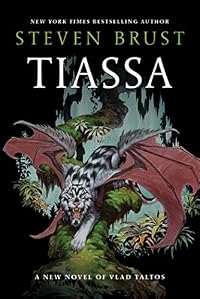
Long ago, one of the gods fashioned an artifact called the silver tiassa. To Devera the Wanderer, it's a pretty toy to play with. To Vlad Taltos, it's a handy prop for a con he's running. To the Empire, it's a tool to be used against their greatest enemies—the Jenoine. To the Jhereg, it's a trap to kill Vlad.The silver tiassa, however, had its own agenda.
Steven Brust's Tiassa tells a story that threads its way through more than ten years of the remarkable life of Vlad Taltos—and, to show more the delight of longtime fans, brings him together with Khaavren, from The Phoenix Guards and its sequels. Khaavren may be Vlad's best friend—or his most terrible enemy.
At the Publisher's request, this title is being sold without Digital Rights Management Software (DRM) applied.
. show less
Tags
Recommendations








Member Reviews
Tiassa is book 13 in Steven Brust's Vlad Taltos series, which is set in the fascinating world of Dragaera, and centers on a wisecracking assassin and crime boss (or, depending on where you are in the series, former assassin and crime boss). At least, it usually centers on him. This is an odd one, though. It's told in a series of different sections set at different times, each featuring different characters and a different style, with only the first section and a brief epilogue being in Vlad's usual first-person POV. Most of the rest of it he's barely in at all, even if he is important to the plot. All these story pieces are connected, but in a weird, disjointed sort of way that left me with a lot of unanswered questions at the end. And, show more I have to say, I had extremely mixed feelings about the overly detailed, overly literal narrative voice that a good third of the novel is written in. There's a lot of droll humor to it, but it's also genuinely annoying. I'm not positive, because I haven't read them yet, but I have the vague sense that this same voice is used in Brust's Khaavren novels, which are set in the same universe and with which this one is a crossover of sorts. And if that's true, it might well answer the question I've been musing on of whether I should give those a read when I'm finally done with Vlad, because while it's a gimmick that's funny enough to work for twenty pages or so, a hundred pages' worth of it is way too much. show less
This was rather interesting in that the main thread of the tale was in a little god-made figurine with incidental characters handling it throughout a space of ten years, including a young Vlad, an older Cawti, his estranged wife, and, oddly enough, the Captain of the Phoenix Guards, of which apparently has his own series, so I just got to enjoy *his* strong voice, which was a pleasure and quite different from either Vlad's or Cawti's.
Suffice to say, strange things are afoot. There could be a horrendous invasion on its way and only stoppable by this little artifact, or it could be just some rather desperate and complicated attempts on Vlad's life. Who knows? I mean, it's not like Vlad has ever given anyone reason to dislike him or show more anything.
No. Not him. He's as sunny as the Demon Goddess is explicable.
Fun tale, split up quite a bit differently than any others that I've read by Brust, but that's only natural if the main character in focus doesn't actually have a voice. :)
Still loving the series! show less
Suffice to say, strange things are afoot. There could be a horrendous invasion on its way and only stoppable by this little artifact, or it could be just some rather desperate and complicated attempts on Vlad's life. Who knows? I mean, it's not like Vlad has ever given anyone reason to dislike him or show more anything.
No. Not him. He's as sunny as the Demon Goddess is explicable.
Fun tale, split up quite a bit differently than any others that I've read by Brust, but that's only natural if the main character in focus doesn't actually have a voice. :)
Still loving the series! show less
I have this love/hate relationship with Brust—I loved the early Vlad Taltos books. Unfortunately, about midway through the series, the engine just went kerplooie. It misfired for a long time but, like a crack addict, I kept going back even though it wasn't that good. And then, it seemed to be inching back. More cylinders started firing. It still wasn't that smoothly purring V-12 Jaguar XK-E of yore but at least it wasn't a Yugo anymore.
Well, Tiassa threw a rod. It only has enough story content to make a novella...a short novella. At 335 pages, you find your eyes wanting to flick past all the filler material. What plot exists is simplistic, obvious and painfully thin. The characters are as flat as cardboard, their only substance coming show more from our memories of who they should be. And, gods help me, the awful voice of Paarfi is back for some of it (for those of you not in the know, think of someone satirizing an overwrought Alexandre Dumas, père narrator until your teeth hurt).
Since the overarching story line advances not a whit and the ending actually makes me think that some long-cherished hopes for where things will go are futile, I'm honestly sorry I wasted my money on this one.
Brust says the series is 19 books...will I have the fortitude to say "Enough!" right here? I don't know. I would give a lot to see Vlad, Morrolan, Aliera, Sethra and, yes, Cawti back together swashbuckling their way through life as they did when we first met them. But, I begin to doubt it will ever happen. show less
Well, Tiassa threw a rod. It only has enough story content to make a novella...a short novella. At 335 pages, you find your eyes wanting to flick past all the filler material. What plot exists is simplistic, obvious and painfully thin. The characters are as flat as cardboard, their only substance coming show more from our memories of who they should be. And, gods help me, the awful voice of Paarfi is back for some of it (for those of you not in the know, think of someone satirizing an overwrought Alexandre Dumas, père narrator until your teeth hurt).
Since the overarching story line advances not a whit and the ending actually makes me think that some long-cherished hopes for where things will go are futile, I'm honestly sorry I wasted my money on this one.
Brust says the series is 19 books...will I have the fortitude to say "Enough!" right here? I don't know. I would give a lot to see Vlad, Morrolan, Aliera, Sethra and, yes, Cawti back together swashbuckling their way through life as they did when we first met them. But, I begin to doubt it will ever happen. show less
This one was a great read - using a McGuffin device, Vlad Taltos recounts the story of how he recieved the Silver Tiassa, It also involves a con of breaking the legitamacy of a tracing spell that merchants are using to track stolen money. It involves Kaavren, Captain of the Phoenix Guards, Devera doing Devera things, and Vlad, who tells the story to a mysterious Easterner.
Well written, very intricate, lots of parts, lots of dead ends, and generally a lot of fun to read. This one is probably in my favorite list of the Vlad Taltos Novels.
Well written, very intricate, lots of parts, lots of dead ends, and generally a lot of fun to read. This one is probably in my favorite list of the Vlad Taltos Novels.
Tiassa is the thirteenth Vlad Taltos book, going by publication order, and goodness knows what chronologically, because it contains three main sections which are set at different points of time. (The third section does seem to be set after the twelfth book, Iorich.) Each of those section is set in the city of Adrilanhka and involves, in various ways, a silver tiassa, members of the House of Tiassa and, of course, Vlad.
“The Silver Tiassa” is told by Vlad about a job he undertook in the days between his engagement and his marriage. This section is the most lighthearted.
“Whitecrest” is set years later. (Probably between Dzur and Iorich?) It’s told in the third person, each chapter from the perspective of a different character - show more none of whom are Vlad. The mystery at hand is connected to Vlad but he’s not directly involved.
I liked getting to see more of Cawti and Norathar and their partnership. Cawti is at a very different point in her life to where she was in “The Silver Tiassa”, and it’s interesting to see her without the Vlad filter - through her own perspective as well as Norathar’s and Khaavren’s wife’s.
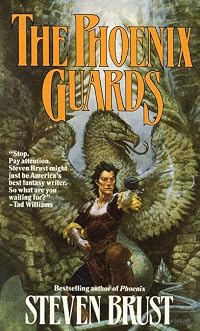
“Special Tasks” is told by Paarfi, the historian who narrates The Phoenix Guards. (I’m glad I read The Phoenix Guards before I read Tiassa. It might have been better if I had read the rest of the Khaavren books first, too, but then again, I’m not actually sure if I am going to read all of them.) An injured Eastern is fished out of the river, and Khaavren - with some knowledge of previous events - sets out to investigate.
These three stories connect to, and influence, each other, and the effect of the three of them sitting together is interesting and clever but not wholly satisfying. (Perhaps it would have been more so if I had read all the Khaavren books? Or if I had recently reread some of the Vlad books and so was able to better piece together how this one fits in?) It made me wish I was reading the series with a friend and had someone I could talk to about it.
As it is, Tiassa also has important information on some other things: how Vlad is telling these stories, about Aliera’s daughter, and a much-wanted update on a character who hasn’t appeared for a few books.
”That’s acceptable to me,” said Norathar. “You?”
[another character’s interruption omitted]
“We’re done with the part I care about,” said Cawti. “I’m indifferent towards the rest.”
“I knew that,” said Norathar. “But I had to ask.” show less
“The Silver Tiassa” is told by Vlad about a job he undertook in the days between his engagement and his marriage. This section is the most lighthearted.
“Whitecrest” is set years later. (Probably between Dzur and Iorich?) It’s told in the third person, each chapter from the perspective of a different character - show more none of whom are Vlad. The mystery at hand is connected to Vlad but he’s not directly involved.
I liked getting to see more of Cawti and Norathar and their partnership. Cawti is at a very different point in her life to where she was in “The Silver Tiassa”, and it’s interesting to see her without the Vlad filter - through her own perspective as well as Norathar’s and Khaavren’s wife’s.
“Special Tasks” is told by Paarfi, the historian who narrates The Phoenix Guards. (I’m glad I read The Phoenix Guards before I read Tiassa. It might have been better if I had read the rest of the Khaavren books first, too, but then again, I’m not actually sure if I am going to read all of them.) An injured Eastern is fished out of the river, and Khaavren - with some knowledge of previous events - sets out to investigate.
These three stories connect to, and influence, each other, and the effect of the three of them sitting together is interesting and clever but not wholly satisfying. (Perhaps it would have been more so if I had read all the Khaavren books? Or if I had recently reread some of the Vlad books and so was able to better piece together how this one fits in?) It made me wish I was reading the series with a friend and had someone I could talk to about it.
As it is, Tiassa also has important information on some other things: how Vlad is telling these stories, about Aliera’s daughter, and a much-wanted update on a character who hasn’t appeared for a few books.
”That’s acceptable to me,” said Norathar. “You?”
[another character’s interruption omitted]
“We’re done with the part I care about,” said Cawti. “I’m indifferent towards the rest.”
“I knew that,” said Norathar. “But I had to ask.” show less
Perhaps three and a half stars~
Initial thoughts: good, but not one of his best. The novel is more like four vignettes; a short story by Devera, a story about an elaborate distraction and con done during the days when Vlad was engaged with Cawti, an incident involving the Jenoine that involves Khaavren, Cawit, Daro and Norathar and another story that is more "current," when he meets Khaavren. The characters are well done as always, but the tiassa as object remains a mystery. Otherwise, Tiassa could very well refer to the Tiassa people, specifically Khaavren. I liked the stories, they were certainly true to the overall Taltos stories and fit well with other storylines. All four were told in different voices; the Devera section was more show more like a diary, the the Vlad story was told in typical early Taltos style, the third more like later Vlad or the Phoenix Guard style. The Paarfi voice made a reappearance for the last story, which was a little odd. I was expecting more of a cohesive novel similar to others in the Cycle series, but this was almost more of a "filler" book, or a short story book than a true installment in the Vlad chronicles. I look forward to the next. It seems like Brust has had some challenges of late that include a return to Minnesota; I wish him well with many more stories.
It was fun to see a picture of the cycle in it's entirety; I confess the pictures of some of the animals were nothing like the mental images I had. show less
Initial thoughts: good, but not one of his best. The novel is more like four vignettes; a short story by Devera, a story about an elaborate distraction and con done during the days when Vlad was engaged with Cawti, an incident involving the Jenoine that involves Khaavren, Cawit, Daro and Norathar and another story that is more "current," when he meets Khaavren. The characters are well done as always, but the tiassa as object remains a mystery. Otherwise, Tiassa could very well refer to the Tiassa people, specifically Khaavren. I liked the stories, they were certainly true to the overall Taltos stories and fit well with other storylines. All four were told in different voices; the Devera section was more show more like a diary, the the Vlad story was told in typical early Taltos style, the third more like later Vlad or the Phoenix Guard style. The Paarfi voice made a reappearance for the last story, which was a little odd. I was expecting more of a cohesive novel similar to others in the Cycle series, but this was almost more of a "filler" book, or a short story book than a true installment in the Vlad chronicles. I look forward to the next. It seems like Brust has had some challenges of late that include a return to Minnesota; I wish him well with many more stories.
It was fun to see a picture of the cycle in it's entirety; I confess the pictures of some of the animals were nothing like the mental images I had. show less
A new Vlad book! For fans of Steven Brust and the Vlad Taltos series, its always good to see a new book about our favorite human. This book stands out from the last few because for the first half of the book, this is an 'old' Vlad book, the story takes place very early in Vlad's career, back when he was running a neighborhood in Adrilanhka for the Jhereg. That also means a return of some other favorite characters, including Cawti and Kragar. However, the 2nd half of the books returns to the present, and also returns to the slow, aimless, Vlad the wanderer storyline, where something minor always happens but nothing significant seems to go on, while there is very slowly a build up to -something. This book really shows off Brust's style show more and skill in both halves of the novel and is very entertaining, as always. show less
Members
- Recently Added By
Lists

Books Read in 2023
5,547 works; 145 members

Books Read in 2013
1,629 works; 51 members
Author Information

72+ Works 35,523 Members
Steven Karl Zoltan Brust is a writer and musician. He was born on November 23, 1955. Brust has worked as a systems programmer for a computer company and played guitar, drums, and banjo in such bands as Cats Laughing, Morrigan, and Boiled in Lead. Brust writes science fiction, including the Vlad Taltos series, The Pheonix Guards, 500 Years After, show more and Brokedown Palace. He has written "choose-your-own-adventure" books for Tor and published several short stories in a series. Brust also released a solo album, A Rose for Iconoclastes, on the SteelDragon label. (Bowker Author Biography) show less
Some Editions
Series


Work Relationships
Common Knowledge
- Canonical title
- Tiassa
- Original publication date
- 2011-04
- People/Characters
- Cawti; Norathar; Vlad Norathar; Vlad Taltos; Aliera e'Kieron; Deverra (show all 12); Sethra Lavode; Loiosh; Khaavren of Castle Rock; Kragar; Melestav; Zerika the Fourth
- Dedication
- For Reesa, with love
- First words
- Sethra greeted me with the words, "There's someone I'd like you to meet, Vlad."
Classifications
Statistics
- Members
- 592
- Popularity
- 49,290
- Reviews
- 25
- Rating
- (3.80)
- Languages
- English
- Media
- Paper, Audiobook, Ebook
- ISBNs
- 6
- ASINs
- 6