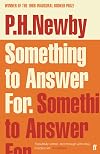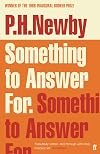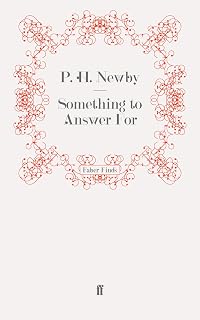
Something to Answer For
by P. H. Newby
On This Page
Description
It was 1956 and he was in Port Said. About these two facts Townrow was reasonably certain. He had been summoned there, to Egypt, by the widow of his deceased friend, Elie Khoury. Having been found dead in the street, she is convinced he was murdered, but nobody seems to agree with her. What of Leah Strauss, the mistress? And of the invading British paratroops? Only an Englishman, surely, would take for granted that the British would have behaved themselves. In this weirdly disorientating show more world, Townrow is forced towards a re-examination of the basic rules by which he has been living his life; and into a realization that he too may have something to answer for. show lessTags
Recommendations


















Member Reviews
A former British soldier named Townrow returns to Port Said, Egypt in 1956 after being summoned by his friend's widow. She's convinced her husband, Elie Khoury, was murdered. Once in Egypt Townrow's reality is tenuous. He's not sure at times of his identity, his nationality or even whether he's still alive. A blow to the head, his friend's death, the nationalization of the Suez Canal and subsequent invasion by the British don't help. He also meets a woman who "changed the chemistry of his blood."
Memory is integral to the story. Townrow's memory in particular. Events and timelines are muddled. "He must stop mis-remembering. He must clear his mind. What actually had happened?" An intelligent and skillfully written story with a great show more sense of time and place. show less
Memory is integral to the story. Townrow's memory in particular. Events and timelines are muddled. "He must stop mis-remembering. He must clear his mind. What actually had happened?" An intelligent and skillfully written story with a great show more sense of time and place. show less
I have decided to take a stab at reading all the Booker Prize winners that I haven't yet read, so started with this, the first one. This book was a slow burn. I had trouble getting into it, and the confusion of the man who was allegedly telling his story in this book. Townrow is a scoundrel, but even he's can't remember what he did. There had to be a reason for him to be in Egypt in 1956. I like how the actual historical events are woven into this story, and I like the confusion of never knowing where Townrow is coming from. The book is brilliantly written, and the total import of the story didn't hit me until the end. It was then I realized what a scoundrel Townrow was. I am sure that this book is the work of a master manipulator, and show more a fine example of an unreliable narrator. I am really glad I read this early work, and am looking forward to more surprises in the lengthy list of Booker Prize winners. show less
A Quantum of Suez - a darkly comic twisty tale of a rather unlikeable chap grappling with his and Britain's fading importance. Really grabbed me at the start but gradually lost its grip.
By the time I’d struggled to the last page of Something to Answer For there was little I felt sure about any longer. Nothing in the novel seems quite certain other than it’s set in Port Said, a city in the throes of the Suez Crisis and where the lead character Townrow, has travelled to see the widow of a recently deceased friend.
But who exactly is Townrow? Even he doesn’t seem to be exactly certain – at one point he remembers he was married; another time that he is Irish. But by then he has told so many different versions of his life that we can’t be sure where truth ends and the lies take over. Early on in the tale he is hit on the head and from then on, he operates in a dream like state in which he seems to recall events show more like his friend’s burial that have yet to happen. The borders between truth and reality become ever more distinct as the novel progresses. For the reader it’s a baffling experience.
Baffling, but not rewarding. P.H. Newby won the inaugural Booker Prize with this novel that one critic described as beautifully written and a tour de force of comic writing. There were certainly some passages that gave me a glimmer of hope that the book would improve. But they were simply transitory experiences before I was propelled into yet another labyrinth. By the end I suspected Newby had experienced more fun writing his book than I did in reading it. show less
But who exactly is Townrow? Even he doesn’t seem to be exactly certain – at one point he remembers he was married; another time that he is Irish. But by then he has told so many different versions of his life that we can’t be sure where truth ends and the lies take over. Early on in the tale he is hit on the head and from then on, he operates in a dream like state in which he seems to recall events show more like his friend’s burial that have yet to happen. The borders between truth and reality become ever more distinct as the novel progresses. For the reader it’s a baffling experience.
Baffling, but not rewarding. P.H. Newby won the inaugural Booker Prize with this novel that one critic described as beautifully written and a tour de force of comic writing. There were certainly some passages that gave me a glimmer of hope that the book would improve. But they were simply transitory experiences before I was propelled into yet another labyrinth. By the end I suspected Newby had experienced more fun writing his book than I did in reading it. show less
Rather like the narrator who gets a bump on the head early on in the action I found myself confused and unsure of what was going on. Its unclear who the narrator really is, and most of the people he meets along the way are slippery to pin down as well. But its a tick off the list of my quest to read all the Booker winners.
Something to Answer For takes place during the 1956 Suez Crisis. This was one of those typically complicated political tangles, and one I knew little about. The crisis involved military action by the British and French, in response to Egypt's nationalization of the Suez Canal (which in itself was a response to American actions taken when Egypt recognized the People's Republic of China ... and on and on ...).
Jack Townrow walks into the middle of all this when his friend Elie Khoury's widow writes to him requesting help to investigate her husband's death and settle his affairs. Against his better judgment he travels to Egypt. En route he meets a Jewish man who accuses Townrow -- or, rather, the British -- of allowing the Holocaust to show more happen. Townrow is aghast, certain the British government would have prevented genocide if they had known about it. He is equally certain the British can only do good in Egypt.
Soon after his arrival, Townrow is attacked and forgets his identity, his nationality, and many other details. He still tries hard to help Mrs. Khoury, although he questions whether Elie is really dead and sometimes goes off in search of him. He falls for a young woman named Leah, but evil and suspicion lurk around every corner, and it's difficult for Townrow -- and the reader -- to tell who the "good guys" really are.
Townrow's character appears to be a metaphor for the British Empire losing its colonial power, and I'm sure the events were still fresh in readers' minds when this book was published in 1968. But the metaphor didn't work for me, I found the plot a bit surreal, and the book very difficult to follow. It just wasn't my thing. show less
Jack Townrow walks into the middle of all this when his friend Elie Khoury's widow writes to him requesting help to investigate her husband's death and settle his affairs. Against his better judgment he travels to Egypt. En route he meets a Jewish man who accuses Townrow -- or, rather, the British -- of allowing the Holocaust to show more happen. Townrow is aghast, certain the British government would have prevented genocide if they had known about it. He is equally certain the British can only do good in Egypt.
Soon after his arrival, Townrow is attacked and forgets his identity, his nationality, and many other details. He still tries hard to help Mrs. Khoury, although he questions whether Elie is really dead and sometimes goes off in search of him. He falls for a young woman named Leah, but evil and suspicion lurk around every corner, and it's difficult for Townrow -- and the reader -- to tell who the "good guys" really are.
Townrow's character appears to be a metaphor for the British Empire losing its colonial power, and I'm sure the events were still fresh in readers' minds when this book was published in 1968. But the metaphor didn't work for me, I found the plot a bit surreal, and the book very difficult to follow. It just wasn't my thing. show less
I enjoyed this short novel, the main theme being the loss of identity of the main character Townrow. This of course is set with the back drop of the Suez Crisis so I feel this book is trying to capture the loss of identity the UK also felt at this time. Its adventure in Egpyt was seen as one of its last as a colonial power, as American super-seeded them as the new superpower. Both Townrow and the British Army come to Eygpt at the same time and discover a lot about themselves and change as a result. The writing style successfully captures the breakdown Townrow is experiencing with events happening, being forgotten and being dreamt and you like Townrow are never quite sure what is real and what is not.
Members
- Recently Added By
Lists

Top Five Books of 2019
387 works; 111 members

Booker Prize
491 works; 62 members

Man Booker Prize Longlist 1969
6 works; 1 member

Booker Prize Shortlist: Titles Not Yet Read
161 works; 4 members

Best Sellers / Popular 1968
237 works; 5 members
Author Information

30+ Works 557 Members
P.H. Newby, known as Howard Newby, was born in Crowborough, Sussex on June 25, 1918 and was educated at Hanley Castle Grammar School in Worcestershire, and St Paul's College of Education in Cheltenham, England. Newby served in the British Army during World War II and then took a teaching position at Fouad 1st University in Cairo. He also worked show more for the BBC, becoming Controller of the Third Programme. Newby published a novel, "A Journey to the Interior," in 1945. In 1969, he was the first winner of the Booker Prize, a British literary prize given to a Commonwealth writer for the best novel published in the U.K. during the previous year, for "Something to Answer For." He died on September 6, 1997. (Bowker Author Biography) show less
Awards and Honors
Awards
Common Knowledge
- Canonical title
- Something to Answer For
- Original publication date
- 1968
- People/Characters
- Jack Townrow; Lean Strauss
- Important places
- Port Said, Egypt
- Important events
- Suez Crisis
- First words
- The old girl kept writing and complaining about the police.
- Last words
- (Click to show. Warning: May contain spoilers.)He was intent, as though he had finally managed to strike a light with a damp match and was protecting it in the wind.
- Blurbers
- Bailey, Paul; Greene, Graham
Classifications
Statistics
- Members
- 210
- Popularity
- 155,564
- Reviews
- 10
- Rating
- (2.84)
- Languages
- English
- Media
- Paper, Ebook
- ISBNs
- 10
- ASINs
- 5