The Rise and Fall of Merry England: The Ritual Year 1400-1700
by Ronald Hutton
On This Page
Description
Highly readable and entertaining, Ronald Hutton's acclaimed work is the first comprehensive account of the religious and secular rituals of late medieval and early modern England.Tags
Recommendations


















Member Reviews
Actual history. Modern pagans should be required to read this.
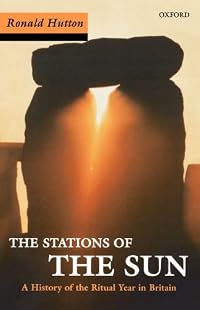
The forerunner to Stations of the Sun, covering a narrower period. Some extra information. Both are worth reading, but if you're getting just one, make it Stations of the Sun.
Ratings
Members
- Recently Added By
Published Reviews
ThingScore 100
Hutton, [is], taking a longer view from 1400 onwards. For him, culturally at least, the reformation was enforced, imposed, or made uniform by an increasingly centralising government and a small number of ideological fellow travellers: ‘What all these cases show is pressure to remove the old customs exerted from above, through or from members of an urban elite and against the wishes of at show more least some of the populace’.
This is a simplification of Hutton’s position of course, since there were many areas of the country where protestantism, even puritanism, were as strong, if not stronger, among the people as it was within the church. But in essence his story is one of the extirpation of a highly evolved community of culture and traditions; it is a narrative of defeat.
Having always seen myself as sympathetic to both the agents of change and to the people and popular culture, I found it a shock – and discomforting – to have those two positions in conflict with one another... However, having read Hutton I now find it very hard to view the Reformation – or more particularly its scorched earth policy to the existing anglo-catholic culture (as opposed to the institutions of the Catholic church), its destructiveness, its iconoclasm, and its approval of what was often little more than wholesale looting – with much enthusiasm. show less
This is a simplification of Hutton’s position of course, since there were many areas of the country where protestantism, even puritanism, were as strong, if not stronger, among the people as it was within the church. But in essence his story is one of the extirpation of a highly evolved community of culture and traditions; it is a narrative of defeat.
Having always seen myself as sympathetic to both the agents of change and to the people and popular culture, I found it a shock – and discomforting – to have those two positions in conflict with one another... However, having read Hutton I now find it very hard to view the Reformation – or more particularly its scorched earth policy to the existing anglo-catholic culture (as opposed to the institutions of the Catholic church), its destructiveness, its iconoclasm, and its approval of what was often little more than wholesale looting – with much enthusiasm. show less
added by feeling.is.first
Author Information

37+ Works 4,638 Members
Ronald Hutton is Professor of History at the University of Bristol.
Common Knowledge
- Original publication date
- 1994
- Dedication
- For three Cambridge ladies: Penelope Gwendolyn Ashbrook, Antonia Galloway, and Prudence Jones
- First words
- Nobody has hitherto attempted to provide a systematic portrait of English seasonal rituals and pastimes in the half-century before the Reformation.
- Last words
- (Click to show. Warning: May contain spoilers.)It will be fascinating to see if further research reveals this view to be an more objective than those before.
Classifications
Statistics
- Members
- 167
- Popularity
- 195,358
- Reviews
- 2
- Rating
- (3.75)
- Languages
- English
- Media
- Paper
- ISBNs
- 4