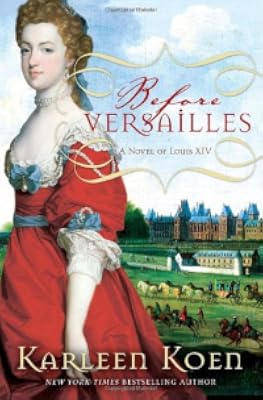
Before Versailles
by Karleen Koen
On This Page
Description
Assuming the responsibilities of governing France after the death of his prime minister, Louis XIV embarks on a love affair with his sister-in-law, Henriette, triggering a scandal that is complicated by a finance minister's growing power and a mysterious boy with an iron mask.Tags
Recommendations

















Member Reviews
I’ve always had a soft spot for the antics of the French court even more so than the English courts and I’m the type of person who can’t turn down a story about the Tudors. In books revolving around the monarchy, whether French or English, one can’t have a story without a mistress and let’s all agree that’s what makes the story. Isn’t that why these books are so much fun? Oh, it is and Koen doesn’t disappoint.
Cardinal Mazarin, the French prime minister, is dead and Louis XIV, only twenty-two years-old, is now king of France and a king with power. That power is not yet firmly grasped but he’s intent on learning to yield it fully. Unaware of many of the financial arrangements his mother and the Cardinal made while ruling show more in his stead, he’s in for a surprise when he finally takes it upon himself to investigate. Unsure of his financial minister’s monetary affairs and how mingled they are with the crown’s accounts, he has suspicions and employs a faithful counselor to help him sort through the courtly promises and financial advice being offered.
To add another distraction, Louis has fallen in love with his brother Philippe’s wife, Princess Henriette, a woman captivating not only the king but the entire French court. A man not used to being denied, Louis attempts to make Henriette his mistress against the wishes of not only his brother but also his mother who believes it will be his downfall. Married to a woman he greatly admires for her breeding and royal pedigree, unfortunately, he doesn’t truly love her and is looking for a distraction she can’t provide. He knows it’s the idea of passion and surprise that comes from his illicit affair with Henriette but Louis can’t help himself. To calm the court, Henriette suggests he flirt with one of her maids; a shy but very pretty young woman named Louise. Then something happens he didn’t expect --- Louis finds he might have fallen in love.
Before Versailles started slowly for but it was almost as if it was waiting for Louis to find his footing as king and once he found his confidence, so did the story. While the affair between Louis and Henriette is more intense, the affair with Louise is completely the opposite but in a way more satisfying. All the court intrigue requirements needed for a story like this are met and then some. Oddly, the financial scandal is also quite good, adding a harder edge to what is mostly a love story. It’s a nice contrast for Louis as he grows into his role as a king and what he’s dealing with on the political level makes you see why he craves love in the quieter parts of his life. I was happy to see the political elements here. In stories about kings and mistresses it sometimes gets pushed to the side and becomes background noise. Here that doesn’t happen and it’s refreshing. There is a small side story involving Louise that feels slightly out of place but it’s the only stumble in an otherwise entertaining book.
I read a lot of historical fiction and I love when authors find a way to make well-known figures interesting and intense characters that allow you to imagine another life for that person. Koen does that with Louis XIV. I finished wanting to know more about the king that would build the palace of Versailles. That can be difficult to accomplish sometimes. show less
Cardinal Mazarin, the French prime minister, is dead and Louis XIV, only twenty-two years-old, is now king of France and a king with power. That power is not yet firmly grasped but he’s intent on learning to yield it fully. Unaware of many of the financial arrangements his mother and the Cardinal made while ruling show more in his stead, he’s in for a surprise when he finally takes it upon himself to investigate. Unsure of his financial minister’s monetary affairs and how mingled they are with the crown’s accounts, he has suspicions and employs a faithful counselor to help him sort through the courtly promises and financial advice being offered.
To add another distraction, Louis has fallen in love with his brother Philippe’s wife, Princess Henriette, a woman captivating not only the king but the entire French court. A man not used to being denied, Louis attempts to make Henriette his mistress against the wishes of not only his brother but also his mother who believes it will be his downfall. Married to a woman he greatly admires for her breeding and royal pedigree, unfortunately, he doesn’t truly love her and is looking for a distraction she can’t provide. He knows it’s the idea of passion and surprise that comes from his illicit affair with Henriette but Louis can’t help himself. To calm the court, Henriette suggests he flirt with one of her maids; a shy but very pretty young woman named Louise. Then something happens he didn’t expect --- Louis finds he might have fallen in love.
Before Versailles started slowly for but it was almost as if it was waiting for Louis to find his footing as king and once he found his confidence, so did the story. While the affair between Louis and Henriette is more intense, the affair with Louise is completely the opposite but in a way more satisfying. All the court intrigue requirements needed for a story like this are met and then some. Oddly, the financial scandal is also quite good, adding a harder edge to what is mostly a love story. It’s a nice contrast for Louis as he grows into his role as a king and what he’s dealing with on the political level makes you see why he craves love in the quieter parts of his life. I was happy to see the political elements here. In stories about kings and mistresses it sometimes gets pushed to the side and becomes background noise. Here that doesn’t happen and it’s refreshing. There is a small side story involving Louise that feels slightly out of place but it’s the only stumble in an otherwise entertaining book.
I read a lot of historical fiction and I love when authors find a way to make well-known figures interesting and intense characters that allow you to imagine another life for that person. Koen does that with Louis XIV. I finished wanting to know more about the king that would build the palace of Versailles. That can be difficult to accomplish sometimes. show less
I read this book originally two years ago and just listened to it again, this time as a book on tape. It's wonderful historical fiction and probably paints the best picture of court intrigue during the time of Louis XIV of any book I've read.
The book covers four pivotal months in Louis's reign, when he is 22 and eager to assume complete power after growing up under the shadow of his mother and Cardinal Mazarin, who has recently died when the book begins. Louis's queen is expecting their first child, he becomes infatuated with his brother's new wife, Henriette, and the mystery of the man in the iron mask is about to unfold. The book also covers the early days of Louis's love affair with Louise de la Valliere, who is the clear heroine of show more the book in my mind.
But what's wonderfully described is the environment of deceit that surrounds the King, as people try to gain royal favor. Friends, relatives, even confessors -- very few can be trusted. The side stories of the building of Vaux-le-Vicomte and the fall of finance minister Nicolas Fouquet are both delicious. The reader gets the clear sense of how lonely it truly is to be a king. show less
The book covers four pivotal months in Louis's reign, when he is 22 and eager to assume complete power after growing up under the shadow of his mother and Cardinal Mazarin, who has recently died when the book begins. Louis's queen is expecting their first child, he becomes infatuated with his brother's new wife, Henriette, and the mystery of the man in the iron mask is about to unfold. The book also covers the early days of Louis's love affair with Louise de la Valliere, who is the clear heroine of show more the book in my mind.
But what's wonderfully described is the environment of deceit that surrounds the King, as people try to gain royal favor. Friends, relatives, even confessors -- very few can be trusted. The side stories of the building of Vaux-le-Vicomte and the fall of finance minister Nicolas Fouquet are both delicious. The reader gets the clear sense of how lonely it truly is to be a king. show less
I read this book originally two years ago and just listened to it again, this time as a book on tape. It's wonderful historical fiction and probably paints the best picture of court intrigue during the time of Louis XIV of any book I've read.
The book covers four pivotal months in Louis's reign, when he is 22 and eager to assume complete power after growing up under the shadow of his mother and Cardinal Mazarin, who has recently died when the book begins. Louis's queen is expecting their first child, he becomes infatuated with his brother's new wife, Henriette, and the mystery of the man in the iron mask is about to unfold. The book also covers the early days of Louis's love affair with Louise de la Valliere, who is the clear heroine of show more the book in my mind.
But what's wonderfully described is the environment of deceit that surrounds the King, as people try to gain royal favor. Friends, relatives, even confessors -- very few can be trusted. The side stories of the building of Vaux-le-Vicomte and the fall of finance minister Nicolas Fouquet are both delicious. The reader gets the clear sense of how lonely it truly is to be a king. show less
The book covers four pivotal months in Louis's reign, when he is 22 and eager to assume complete power after growing up under the shadow of his mother and Cardinal Mazarin, who has recently died when the book begins. Louis's queen is expecting their first child, he becomes infatuated with his brother's new wife, Henriette, and the mystery of the man in the iron mask is about to unfold. The book also covers the early days of Louis's love affair with Louise de la Valliere, who is the clear heroine of show more the book in my mind.
But what's wonderfully described is the environment of deceit that surrounds the King, as people try to gain royal favor. Friends, relatives, even confessors -- very few can be trusted. The side stories of the building of Vaux-le-Vicomte and the fall of finance minister Nicolas Fouquet are both delicious. The reader gets the clear sense of how lonely it truly is to be a king. show less
I understand now why Koen has such a devoted following. This deliciously huge novel has a fantastic cast, a fabulous setting, delicious intrigue, romance, and drama. Set during 1661, after Louis' prime minister Cardinal Mazarin died, the novel follows Louise, a lady-in-waiting for the stunning, energetic, and inspiring Madame Henriette -- the king's sister-in-law.
Those who've read Dumas' The Man in the Iron Mask (or seen one of the films) will immediately notice one of the stories plot lines, but it is one of a few threads woven through the novel. Koen blends historical fact and historical legend to create an engrossing and bittersweet story about privilege, love, loyalty, and excess.
I found I loved all the characters, heroes and show more villains alike, especially as the heroes and villains shifted and changed as the story went on. No one felt stock or cardboard flat which made the shimmering changes in loyalties feel realistic. I can't imagine what it would be like to live as a courtier at Fontainebleau but Koen's storytelling made it real for me -- and so, at moments, I wanted to be one of the ladies there and at other moments, I was so grateful I wasn't.
I really enjoyed Koen's writing style; I would almost describe it as literary hist fic. She has her solid frame of historical detail that make up the bulk of her narrative -- but she punctuates a scene or moment with a lovely line or two that mixes presentiment and fact, poetry and prose. For me, it enhanced the general bittersweet tone to the story; we know what the characters don't: how Louis will change as he grows, how his court will change, the courtiers, the country.
For anyone who wants a royal armchair escape, I recommend this one! show less
Those who've read Dumas' The Man in the Iron Mask (or seen one of the films) will immediately notice one of the stories plot lines, but it is one of a few threads woven through the novel. Koen blends historical fact and historical legend to create an engrossing and bittersweet story about privilege, love, loyalty, and excess.
I found I loved all the characters, heroes and show more villains alike, especially as the heroes and villains shifted and changed as the story went on. No one felt stock or cardboard flat which made the shimmering changes in loyalties feel realistic. I can't imagine what it would be like to live as a courtier at Fontainebleau but Koen's storytelling made it real for me -- and so, at moments, I wanted to be one of the ladies there and at other moments, I was so grateful I wasn't.
I really enjoyed Koen's writing style; I would almost describe it as literary hist fic. She has her solid frame of historical detail that make up the bulk of her narrative -- but she punctuates a scene or moment with a lovely line or two that mixes presentiment and fact, poetry and prose. For me, it enhanced the general bittersweet tone to the story; we know what the characters don't: how Louis will change as he grows, how his court will change, the courtiers, the country.
For anyone who wants a royal armchair escape, I recommend this one! show less
I have been a fan of Karleen Koen for many years so I was completely thrilled to find her latest novel. And I have to say, even I was taken aback by just how flat-out good this book is. I have told other historical fiction addicts that NO ONE writes about seventeenth- and eighteenth-century Europe the way Koen can. With atmosphere, triumph, tragedy, and romance in spades. I hold to my opinion on that. But this work ups the storytelling ante. Unlike a lot of lighter historical fare, Koen's works are always grounded in events--her characters react to and are effected by them all in very believable ways. Her characters live their times just the way we do. But in this work, the political and the personal are actually warring in the person show more at the center of the novel: Louis XIV. It is this tension that drives the drama, which is deeply touching and disturbing. I admit, I picked up Before Versailles half-expecting another breathless romp between royal master and lady mistress, although maybe with a triple-digit IQ. I should've known better. There are elements of love and magic here, but that is just one element of the plot. The action is most concerned with the making of a king. We see Louis XIV become the man who would become the greatest power of his age by betraying, weakening, and breaking the people closest to him. It is fascinating and wrenching to watch. You are not sure if you admire Louis, hate him, feel sorry for him--or some heightened mix of all three. So...read it and you won't be sorry. show less
An immensely detailed portrait of Louis XIV's early court, full of drama and intrigue. The young king should be happy, he is newly wed, his wife has conceived and he is the center of the youngest and most vibrant court in decades. But Louis is unhappy in his marriage and surrounded by the constant attentions of the most enchanting women in France.
He aspires to be a monarch like no other but his authority is under threat by a the unknown person who keeps delivering seditious poems to his most private chambers. Certainly the culprit must be one of his own court, but who?
He aspires to be a monarch like no other but his authority is under threat by a the unknown person who keeps delivering seditious poems to his most private chambers. Certainly the culprit must be one of his own court, but who?
Before one can truly understand the sentiments that brought about the Reign of Terror and the fall of the monarchy in France during the late 1700s, one must go back to the beginning and the behaviors and experiences that set France on its path. In Before Versailles, Karleen Koen takes the reader back to Louis XIV, back when the king of France, and as a result the country, was ruled by a variety of ministers, each with his own agenda. The pressure to dazzle everyone, from family to the lowliest of subjects, was great, and the need to show one’s power in the form of profligate spending was all but required. Against this backdrop comes the story of one of France’s most beloved kings, in power 200 years before the Reign of Terror would show more destroy his lineage.
Before Versailles opens at the onset of Louis XIV’s reign as King of France. Before he ever earned his moniker, The Sun King, he was just a young man taking tentative steps towards establishing what would later become the first absolute monarchy. As one would imagine, Louis is relatively naïve and spoiled. Yet, glimpses of his future self become evident as he struggles to wrest mastery of his kingdom away from previous ministers, especially Nicolas Fouquet. Louis earns the reader’s respect through his growth towards a self-aware king, one who is more than capable of running his country by himself.
In direct opposite to Louis’ strength of character is the multitude of women that surround him. Giddy, empty-minded, and even more naïve than Louis, the women are simply vacuous. While they are capable of manipulating men, they achieve their goals through the use of their feminine wiles, something most modern-day women can only read with disgust. While there are plenty of examples of women who use their brains to gain power and privilege for their offspring, these women are all but non-existent in Before Versailles. Their simpering, fawning, and tantrums are so excessive that it becomes difficult to stomach at times. While the reader is under no illusions that Mr. Koen is completely exaggerating the behavior of the female courtiers and royal women, their actions do take on a largely fictional quality because of their extreme natures. One looking to find a true, strong female role model in Louis’ court is going to be sorely disappointed.
The pacing of the novel is very similar, one imagines, to life within Fontainebleau. Constantly changing, the narrative changes characters as quickly and as often as Princess Henriette changes dresses. For those readers not paying close attention, it can become an exercise in confusion to discern who is involved in the current scene while remembering everything said in previous scenes. Based on Mr. Koen’s descriptions, one imagines that this is exactly what all courtiers faced – having to stay constantly vigilant and aware in an effort to stay one step ahead of other courtiers and in the king’s good graces. It can be as exhilarating an experience as it is tiresome. Having to pay such close attention for every single page in the novel can be daunting, but the experience of reading Before Versailles is much more fulfilling as a result.
Mr. Gardner’s performance was not quite what I was expecting. His is a forceful voice, leaving little room for nuance and performance. The differences in his characterization was slight, if non-existent, making it very difficult to discern who was speaking when. His French, while adding an air of authenticity, made it even more difficult to distinguish between the very large cast of characters because the names sound so similar and are spoken so rapidly. Listeners expecting variations or even emotion from Mr. Gardner will be disappointed, as there really is none. This makes the novel read a bit like a biography rather than a work of fiction. Mr. Gardner’s monotony is especially effective at minimizing the overly exaggerated emotional responses of the maids of honor and even of Princess Henriette that are so prevalent, but this muted performance does detract from the more honest sentiments expressed by Louis and other characters. Regardless of Mr. Gardner’s performance, I am not certain that Before Versailles is the right novel for audio. There are too many scene breaks and jumps in time that are unheralded by anything other than a pause to allow for smooth transitions audibly. Mr. Gardner did the best he could with the material at hand. Unfortunately, I do believe this is one novel better read in print than read aloud.
Before Versailles is interesting in the intimate look it gives at court life before there was such a thing as an absolute monarch. The plotting, the constant fawning, the politicizing of everything from accessories to the granting of favors is as shocking as it is titillating. Mr. Koen does a fantastic job capturing the exhausting excesses while utilizing some of the more well-known rumors and unsolved mysteries to advance the story. A reader finishes Before Versailles with a greater understanding of just what it meant to be among royalty, a greater appreciation for not being part of the royal family, and a growing appetite to learn more about Louis XIV.
Acknowledgements: Thank you to Blackstone Audio and Jen from Devourer of Books for this Audiobook Week giveaway! show less
Before Versailles opens at the onset of Louis XIV’s reign as King of France. Before he ever earned his moniker, The Sun King, he was just a young man taking tentative steps towards establishing what would later become the first absolute monarchy. As one would imagine, Louis is relatively naïve and spoiled. Yet, glimpses of his future self become evident as he struggles to wrest mastery of his kingdom away from previous ministers, especially Nicolas Fouquet. Louis earns the reader’s respect through his growth towards a self-aware king, one who is more than capable of running his country by himself.
In direct opposite to Louis’ strength of character is the multitude of women that surround him. Giddy, empty-minded, and even more naïve than Louis, the women are simply vacuous. While they are capable of manipulating men, they achieve their goals through the use of their feminine wiles, something most modern-day women can only read with disgust. While there are plenty of examples of women who use their brains to gain power and privilege for their offspring, these women are all but non-existent in Before Versailles. Their simpering, fawning, and tantrums are so excessive that it becomes difficult to stomach at times. While the reader is under no illusions that Mr. Koen is completely exaggerating the behavior of the female courtiers and royal women, their actions do take on a largely fictional quality because of their extreme natures. One looking to find a true, strong female role model in Louis’ court is going to be sorely disappointed.
The pacing of the novel is very similar, one imagines, to life within Fontainebleau. Constantly changing, the narrative changes characters as quickly and as often as Princess Henriette changes dresses. For those readers not paying close attention, it can become an exercise in confusion to discern who is involved in the current scene while remembering everything said in previous scenes. Based on Mr. Koen’s descriptions, one imagines that this is exactly what all courtiers faced – having to stay constantly vigilant and aware in an effort to stay one step ahead of other courtiers and in the king’s good graces. It can be as exhilarating an experience as it is tiresome. Having to pay such close attention for every single page in the novel can be daunting, but the experience of reading Before Versailles is much more fulfilling as a result.
Mr. Gardner’s performance was not quite what I was expecting. His is a forceful voice, leaving little room for nuance and performance. The differences in his characterization was slight, if non-existent, making it very difficult to discern who was speaking when. His French, while adding an air of authenticity, made it even more difficult to distinguish between the very large cast of characters because the names sound so similar and are spoken so rapidly. Listeners expecting variations or even emotion from Mr. Gardner will be disappointed, as there really is none. This makes the novel read a bit like a biography rather than a work of fiction. Mr. Gardner’s monotony is especially effective at minimizing the overly exaggerated emotional responses of the maids of honor and even of Princess Henriette that are so prevalent, but this muted performance does detract from the more honest sentiments expressed by Louis and other characters. Regardless of Mr. Gardner’s performance, I am not certain that Before Versailles is the right novel for audio. There are too many scene breaks and jumps in time that are unheralded by anything other than a pause to allow for smooth transitions audibly. Mr. Gardner did the best he could with the material at hand. Unfortunately, I do believe this is one novel better read in print than read aloud.
Before Versailles is interesting in the intimate look it gives at court life before there was such a thing as an absolute monarch. The plotting, the constant fawning, the politicizing of everything from accessories to the granting of favors is as shocking as it is titillating. Mr. Koen does a fantastic job capturing the exhausting excesses while utilizing some of the more well-known rumors and unsolved mysteries to advance the story. A reader finishes Before Versailles with a greater understanding of just what it meant to be among royalty, a greater appreciation for not being part of the royal family, and a growing appetite to learn more about Louis XIV.
Acknowledgements: Thank you to Blackstone Audio and Jen from Devourer of Books for this Audiobook Week giveaway! show less
Members
- Recently Added By
Lists

KayStJ's to-read list
1,616 works; 11 members
Author Information

7 Works 3,193 Members
Karleen Koen attended North Texas State University and was an editor at the Houston Home and Garden magazine. Koen has written Through a Glass Darkly, which took much preparation and research, and its sequel, Now Face to Face. (Bowker Author Biography)
Awards and Honors
Distinctions
Common Knowledge
- Canonical title
- Before Versailles
- People/Characters
- Louis XIV, 1638-1715; Louise de la Valliere (de la Baume le Blanc); Henriette-Anne Stuart, princess of England (Minette); Philippe d'Orléans (brother of Louis XIV); Anne of Austria (dowager queen of France, mother of Louis XIV); Nicolas Fouquet (Minister of Finance) (show all 7); Henriette of England
- Important places
- Paris, France; Château de Fontainebleau, Fontainebleau, Île-de-France, France (Royal chateau)
- Epigraph
- Purge me with hyssop, and I shall be clean: wash me, and I shall be whiter than snow. / Make me to hear joy and gladness; that the bones which thou has broken may rejoice. / Hide thy face from my sins, and blot out all mine i... (show all)niquities. / Create in me a clean heart, O God...
-- Psalms 51:7-10 - Dedication
- For X and for Louise de la Valliere
- First words
- A young woman galloped headlong and recklessly down half-wild trails in the immense forest of Fontainebleau. Her fair hair had come loos from its pins, and she leaned low against her horse's neck and whispered the filly onwar... (show all)d, as if she were being chased by murderers.
- Quotations
- ... the nobility surrounding him as he grew to manhood was as proud as Lucifer and as trustworthy. (Prologue, pg. 1)
Fresh, he thought. A young woman who didn't wish to talk to him or charm him or impress him or imply the offer of her body for a favor. (Chapter 4, pg. 63)
Ambition might be buried deep inside Nicolas - under the charm, the refinement, the creativity - but it was there, sharp as any gleaming blade. (Chapter 4, pg. 63) - Last words
- (Click to show. Warning: May contain spoilers.)"Long live the king," someone shouted when he was done, and others took up the cry, and he walked to the window and showed himself to his troop below, his heart pounding, because he could not yet know there would be no war; just as he could not yet know that his will, and his alone, would become the crux of a kingdom and the backbone of two hundred years of power and the last thing he would regret before he died.
Classifications
- Genres
- Fiction and Literature, General Fiction, Historical Fiction, Romance
- DDC/MDS
- 813.54 — Literature & rhetoric American literature in English American fiction in English 1900-1999 1945-1999
- LCC
- PS3561 .O334 .B44 — Language and Literature American literature American literature Individual authors 1961-
- BISAC
Statistics
- Members
- 280
- Popularity
- 115,615
- Reviews
- 24
- Rating
- (3.69)
- Languages
- English, Polish
- Media
- Paper, Audiobook, Ebook
- ISBNs
- 15
- UPCs
- 1
- ASINs
- 5