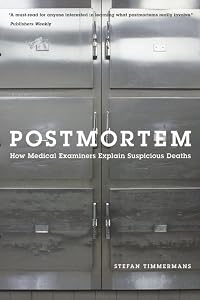
Postmortem: How Medical Examiners Explain Suspicious Deaths (Fieldwork Encounters and Discoveries)
by Stefan Timmermans
On This Page
Description
As elected coroners came to be replaced by medical examiners with scientific training, the American public became fascinated with their work. From the grisly investigations showcased on highly rated television shows like C.S.I. to the bestselling mysteries that revolve around forensic science, medical examiners have never been so visible-or compelling. They, and they alone, solve the riddle of suspicious death and the existential questions that come with it. Why did someone die? Could it show more have been prevented? Should someone be held accountable? What are the implications of ruling a death a suicide, a homicide, or an accident? Can medical examiners unmask the perfect crime? Postmortem goes deep inside the world of medical examiners to uncover the intricate web of pathological, social, legal, and moral issues in which they operate. Stefan Timmermans spent years in a medical examiner's office, following cases, interviewing examiners, and watching autopsies. While he relates fascinating cases here, he is also more broadly interested in the cultural authority and responsibilities that come with being a medical examiner. Although these professionals attempt to remain objective, medical examiners are nonetheless responsible for evaluating subtle human intentions. Consequently, they may end-or start-criminal investigations, issue public health alerts, and even cause financial gain or harm to survivors. How medical examiners speak to the living on behalf of the dead, is Timmermans's subject, revealed here in the day-to-day lives of the examiners themselves. show lessTags
Recommendations










Member Recommendations
Member Reviews
This is an academic ethnography of medical examiners, looking into how they interpret evidence, how they construct their authority, and the challenges they face as medicine and the legal system change. It's written about as compellingly as the usual ethnography, which means I only fell asleep reading it twice. But there are some interesting tidbits in here for people with practice slogging through academic prose.
I was disappointed because it only detailed ONE autopsy, and not one single picture. Though well-researched and well-written, it was not what I expected. My studies included watching autopsies at the County Coroner's of the Sheriff's dept. and I can definitely agree on a certain comment Mr. Timmermans made: page 54, " . . . forensic pathologists . . . anticpate the scientific puzzle to be solved . . . frustration comes from a lack of significant findings."
deadly dull
Ratings
Members
- Recently Added By
Author Information
9 Works 272 Members
Stefan Timmermans is professor of sociology at the University of California, Los Angeles
Common Knowledge
- Original publication date
- 2006
Classifications
- Genres
- Sociology, Nonfiction
- DDC/MDS
- 616.07 — Applied science & technology Medicine & health Diseases, Allergies, Skin Conditions Pathology; Diseases; Treatment Pathology
- LCC
- HV8073 .T56 — Social sciences Social pathology. Social and public welfare. Criminology Social pathology. Social and public welfare. Criminal justice administration Police. Detectves. Constabulary Police duty. Methods of protection Investigation of crimes. Examination
- BISAC
Statistics
- Members
- 86
- Popularity
- 372,915
- Reviews
- 3
- Rating
- (3.95)
- Languages
- English
- Media
- Paper, Ebook
- ISBNs
- 4
- ASINs
- 1