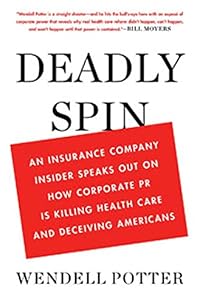
Deadly Spin: An Insurance Company Insider Speaks Out on How Corporate PR is Killing Health Care and Deceiving Americans
by Wendell Potter
On This Page
Description
"My name is Wendell Potter, and for twenty years I worked as a senior executive at health insurance companies. I saw how they confuse their customers and dump the sick-all so they can satisfy their Wall Street investors." -Senate testimony, June 24, 2009Wendell Potter is the insurance industry's worst nightmare.In June 2009, Wendell Potter made national headlines with his scorching testimony before the Senate panel on health care reform. This former senior vice president of CIGNA explained show more how health insurers make promises they have no intention of keeping, how they flout regulations designed to protect consumers, and how they skew political debate with multibillion-dollar public relations campaigns designed to spread disinformation.Potter had walked away from a six-figure salary and two decades as an insurance executive because he could no longer abide the routine practices of an industry where the needs of sick and suffering Americans take a backseat to the bottom line. The last straw: when he visited a rural health clinic and saw hundreds of people standing in line in the rain to receive treatment in stalls built for livestock.In Deadly Spin, Potter takes listeners behind the scenes to show how a huge chunk of our absurd health care spending actually bankrolls a propaganda campaign and lobbying effort focused on protecting one thing: profits. Whatever the fate of the current health care legislation, it makes no attempt to change that fundamental problem. Potter shows how relentless PR assaults play an insidious role in our political process anywhere that corporate profits are at stake-from climate change to defense policy. Deadly Spin tells us why-and how-we must fight back. show lessTags
Recommendations


























Member Reviews
This is an important book that draws vivid focus to the propaganda machine working to shape public opinion and public policy on health care financing in America. Wendell Potter was a top public relations executive at the CIGNA health insurance corporation. After a sort of "road to Damascus" experience, he realized he could no longer contribute to the unethcial and deceptive "spin" strategies and tactics that his company and the industry uses to delude the public and manipulate opinion about health insurance abuses.
The motives and tactics of the for-profit health insurance industry that Potter describes are not new revelations. We have known or suspected that the industry (and others like big tobacco and big oil) use PR spin methods to show more shape public opinion and draw attention away from their abuses. But the extent of such manipulation and its dishonesty is quite shocking and should enrage us. Such means as phony "grassroots" advocacy groups, soothing, feel-good media advertising (remember BP after the spill?), fear mongering and manipulating statistics are not new to the health care debate. That they are so widespread and so effective in distoring the truth and molding opinion for disguised corporate self-interest is a major point of Potter's book. The aggressiveness of corporations in engaging in these unethical practices and their willingness to spare no expense to promote distorted messages should be a concern to all Americans who value the open exchange of honest information in our democracy.
Potter cautions us to be wary of messages that shift focus away from problemmatic products (tobacco, fossil fuels) or controversial actions (oil spills, retroactive denial of insurance coverage, etc.) to fuzzy emotion-laden, sometimes scare tactic style messages -- "caps on CO2 emissions will cost you your job", "Obamacare is socialized medicine", "death panels", etc. This is great advice, but the spin machine is very powerful and unquestionably very effective. What could be of greater importance to the self-interests of Americans than access to affordable health care? Yet, the PR propaganda machine has turned this debate on its head by sublimating the real interest of the industry (increasing share value and profits) and refocusing public attention on red herring issues.
Potter also suggests that there are two other culprits here: the media for doing lousy, superficial reporting on these blatant PR campaigns, and, most sigificantly, us! Our gullibility and lack of critical consideration of these efforts to manipulate us is the main reason they succeed and, sadly, will likely continue. show less
The motives and tactics of the for-profit health insurance industry that Potter describes are not new revelations. We have known or suspected that the industry (and others like big tobacco and big oil) use PR spin methods to show more shape public opinion and draw attention away from their abuses. But the extent of such manipulation and its dishonesty is quite shocking and should enrage us. Such means as phony "grassroots" advocacy groups, soothing, feel-good media advertising (remember BP after the spill?), fear mongering and manipulating statistics are not new to the health care debate. That they are so widespread and so effective in distoring the truth and molding opinion for disguised corporate self-interest is a major point of Potter's book. The aggressiveness of corporations in engaging in these unethical practices and their willingness to spare no expense to promote distorted messages should be a concern to all Americans who value the open exchange of honest information in our democracy.
Potter cautions us to be wary of messages that shift focus away from problemmatic products (tobacco, fossil fuels) or controversial actions (oil spills, retroactive denial of insurance coverage, etc.) to fuzzy emotion-laden, sometimes scare tactic style messages -- "caps on CO2 emissions will cost you your job", "Obamacare is socialized medicine", "death panels", etc. This is great advice, but the spin machine is very powerful and unquestionably very effective. What could be of greater importance to the self-interests of Americans than access to affordable health care? Yet, the PR propaganda machine has turned this debate on its head by sublimating the real interest of the industry (increasing share value and profits) and refocusing public attention on red herring issues.
Potter also suggests that there are two other culprits here: the media for doing lousy, superficial reporting on these blatant PR campaigns, and, most sigificantly, us! Our gullibility and lack of critical consideration of these efforts to manipulate us is the main reason they succeed and, sadly, will likely continue. show less
 This review was written for LibraryThing Early Reviewers.
There is an old joke that defines Canadians as unarmed Americans with health insurance. It's not far off the mark since gun control and government-funded health care seem to be among the most hotly contested and divisive public policy issues south of the border. As a Canadian, I requested this book from Early Reviewers to get a better understanding of why the structure of the U.S. health care system is so different from that found in other Western democratic nations and why it is so passionately defended despite its obvious shortcomings.
Deadly Spin purports to be an insider's account of the rights and (mostly) wrongs of the current U.S. health care system written by Wendell Potter, a former public relations executive for two of the top show more insurance companies in the business. The background chapter on the development and rise of the American health industry was, for me, the best and most informative part of the book. As an exposé, however, it left me underwhelmed. Either Potter was incredibly naïve (for decades on end) about what his job as a spin doctor entailed or deeply and deliberately in denial about the damage---not to mention financial ruin---health insurance companies (and his own actions within them) routinely cause in denying legitimate coverage and/or compensation to their subscribers. Neither Potter’s insights nor analyses run very deep, regardless of whether he’s discussing his own or his industry’s culpability. His revelations are commonplace and "shocking" only in that he came to realize them (not to mention publicly confess to them) so late. His dramatic conversion from willing lackey to crusading whistle-blower rings false to my ears, and the cynic in me suspects this book is more about saving face than saving lives. show less
Deadly Spin purports to be an insider's account of the rights and (mostly) wrongs of the current U.S. health care system written by Wendell Potter, a former public relations executive for two of the top show more insurance companies in the business. The background chapter on the development and rise of the American health industry was, for me, the best and most informative part of the book. As an exposé, however, it left me underwhelmed. Either Potter was incredibly naïve (for decades on end) about what his job as a spin doctor entailed or deeply and deliberately in denial about the damage---not to mention financial ruin---health insurance companies (and his own actions within them) routinely cause in denying legitimate coverage and/or compensation to their subscribers. Neither Potter’s insights nor analyses run very deep, regardless of whether he’s discussing his own or his industry’s culpability. His revelations are commonplace and "shocking" only in that he came to realize them (not to mention publicly confess to them) so late. His dramatic conversion from willing lackey to crusading whistle-blower rings false to my ears, and the cynic in me suspects this book is more about saving face than saving lives. show less
This review was written for LibraryThing Early Reviewers.Wendell Potter's Deadly Spin bills itself as an "insurance company insider's" account of "how corporate PR is killing health care and deceiving Americans," and the book largely makes good on its title. Half expose and half memoir, Potter chronicles his journey from small town kid to newspaper reporter to head PR rep at one of the biggest health insurers in the United States and the two life-altering events that led him to question his role as spin master par excellence. Potter's explanation of why this change of heart occurred and his relative forthrightness about the deleterious role he himself played in making sure that Americans pay more for less health care are what set this book apart from other such "exposes" in which the author show more is happy to blame anyone but himself. (See, for instance, 2009's odious Confessions of a Subprime Lender.)
Potter is to be commended not only for acknowledging his own culpability but for refusing to resort to cheap theatrics. For instance, Potter's statements that pro-health industry PR work drove him to alcoholism are all the more powerful because he states them as fact and quickly moves on, instead descending into an extended woe-is-me exercise in self-pity. Potter deplores the health insurance industry's PR tactics but airs his disgust with reasoned arguments, resulting in a far more powerful message.
That said, while the section on the history of health industry PR efforts almost justifies the cover price on its own, one can't help but notice how Potter jumps straight from Nixon to Obama, completely eliding the massive battle over health care reform during the Clinton years. Indeed, one hears very little about Potter's work during this time. Perhaps he's bound by a non-disclosure agreement, or perhaps there are limits to how much blame he's willing to shoulder personally. Either way, the inclusion of this information would have only improved what is still a very powerful and convincing book. Deadly Spin comes well recommended. show less
Potter is to be commended not only for acknowledging his own culpability but for refusing to resort to cheap theatrics. For instance, Potter's statements that pro-health industry PR work drove him to alcoholism are all the more powerful because he states them as fact and quickly moves on, instead descending into an extended woe-is-me exercise in self-pity. Potter deplores the health insurance industry's PR tactics but airs his disgust with reasoned arguments, resulting in a far more powerful message.
That said, while the section on the history of health industry PR efforts almost justifies the cover price on its own, one can't help but notice how Potter jumps straight from Nixon to Obama, completely eliding the massive battle over health care reform during the Clinton years. Indeed, one hears very little about Potter's work during this time. Perhaps he's bound by a non-disclosure agreement, or perhaps there are limits to how much blame he's willing to shoulder personally. Either way, the inclusion of this information would have only improved what is still a very powerful and convincing book. Deadly Spin comes well recommended. show less
This review was written for LibraryThing Early Reviewers.This is an excellent, utterly enraging book about the health "insurance" industry, and why for-profit health "insurance" actually insures nothing but record profits for the company shareholders, and record salaries and bonuses for the company exectutives.
Briefly, the profit has to come from somewhere. Since these are for-profit companies, they not only have to be profitable each quarter, but are expected to be ever-more profitable in each quarter. This means that while non-profit health insurance companies have managed something like 90-95% of the money people pay them to go to the aqctual health CARE of the subscribers, in the for-profit companies all money that they have to pay out for actual health CARE is considered a LOSS, and show more they've minimized it to the point of something like 75-77%; the rest goes to imp[ortant things like making sure there's no legislation passed that will disrupt their profits, and paying off the execs.
It is also scary to know that any insurance company, pretty much, at any time, can deny any treatment at all, and aside from their in-house appeals process- overseen by the execs that would lose money if their stock option prices went down as a result of "overspending" on subscriber CARE- there is utterly no recourse. They cannot even be sued effectively. Plus- and here's a neat catch!- if the subscriber DIES as a result of their denial of care, they can't be sued AT ALL.
There's a lot of information in this book about how it all got this way, and some about what can be done about it... though it looks like a pretty impossible battle; the companies have it well sewn up at this point, and now that we're going to be required to buy their products, no matter how expensive and useless they are... well PROFIT!!!!
The author was a highly-placed executive in CIGNA, in charge of PR (which is a large amount of the problem) until he quit in disgust and started blowing the whistle. He talks about how that evolution happened, which was fascinating.
Highly recommended, if you have the stomach for it. show less
Briefly, the profit has to come from somewhere. Since these are for-profit companies, they not only have to be profitable each quarter, but are expected to be ever-more profitable in each quarter. This means that while non-profit health insurance companies have managed something like 90-95% of the money people pay them to go to the aqctual health CARE of the subscribers, in the for-profit companies all money that they have to pay out for actual health CARE is considered a LOSS, and show more they've minimized it to the point of something like 75-77%; the rest goes to imp[ortant things like making sure there's no legislation passed that will disrupt their profits, and paying off the execs.
It is also scary to know that any insurance company, pretty much, at any time, can deny any treatment at all, and aside from their in-house appeals process- overseen by the execs that would lose money if their stock option prices went down as a result of "overspending" on subscriber CARE- there is utterly no recourse. They cannot even be sued effectively. Plus- and here's a neat catch!- if the subscriber DIES as a result of their denial of care, they can't be sued AT ALL.
There's a lot of information in this book about how it all got this way, and some about what can be done about it... though it looks like a pretty impossible battle; the companies have it well sewn up at this point, and now that we're going to be required to buy their products, no matter how expensive and useless they are... well PROFIT!!!!
The author was a highly-placed executive in CIGNA, in charge of PR (which is a large amount of the problem) until he quit in disgust and started blowing the whistle. He talks about how that evolution happened, which was fascinating.
Highly recommended, if you have the stomach for it. show less
This review was written for LibraryThing Early Reviewers.A MUST READ for everyone, regardless of which side of the "health care reform" debate you support. I found "Chapter 5: Health Care History, Reform, and Failure" particularly fascinating. From the early days (1883) when Otto von Bismarck (well known "socialist" :) instituted "compulsory sickness insurance" through Teddy Roosevelt, FDR, Harry Truman, Clinton and Obama . . . the same patterns repeat over and over in only slightly different forms. Whatever your experience with health care and health insurance, you will learn much from reading this book—about what you are being sold and how you are being manipulated. One warning: this book is likely to make many people even more angry than they already are!
For 20 years Wendell Potter worked in public relations. He resigned as corporate communications director at CIGNA in 2008. A year later he was testifying before the a Senate sub-committee on the need for reform and for health insurance companies to be more transparent.
His book is both a history of why the US remains the only industrial country in the world without universal health care and how we are manipulated by public relations firms to believe that up is down and white is black. It is a story of fear, name-calling, euphemisms, and the use of glittering generalities to convince us that Obama-care was socialist medicine with “death panels” and that a proposed public option would wipe out existing health care plans for 119 show more million Americans. Never mind that the existing public plan – Medicare – has lower administrative costs and annual spending growth much lower than private insurers' over the past 10 years.
Public relations firms are the major villains in this story – and rightly so. It appears to be an industry that doesn't always follow its own ethical standards and often places their own profits over the interests of the public at-large. They spoon feed a media that frequently accepts the spinning press releases rather than doing the hard investigative work required to explain faulty research studies and expose the astro-turf citizen groups that spring up every time there is an effort to reign in some of the bigger abuses. Of course, it couldn't be accomplished without the help of the health insurance companies, the tobacco industry, big oil, financial institutions, and beverage companies that are willing to spend the hundreds of million of dollars a year to influence public opinion and lobby everyone from city councils to the U.S. Congress and regulators to increase stock prices and provide even bigger paydays for the executives who run these companies.
This book is a quick read and the behind-the-scenes efforts to kill health care make a good story. Wendell Potter remains an optimist about our ability to create a more equitable health care system and that someday we will be wise to the spin. After reading this book, I am not. show less
His book is both a history of why the US remains the only industrial country in the world without universal health care and how we are manipulated by public relations firms to believe that up is down and white is black. It is a story of fear, name-calling, euphemisms, and the use of glittering generalities to convince us that Obama-care was socialist medicine with “death panels” and that a proposed public option would wipe out existing health care plans for 119 show more million Americans. Never mind that the existing public plan – Medicare – has lower administrative costs and annual spending growth much lower than private insurers' over the past 10 years.
Public relations firms are the major villains in this story – and rightly so. It appears to be an industry that doesn't always follow its own ethical standards and often places their own profits over the interests of the public at-large. They spoon feed a media that frequently accepts the spinning press releases rather than doing the hard investigative work required to explain faulty research studies and expose the astro-turf citizen groups that spring up every time there is an effort to reign in some of the bigger abuses. Of course, it couldn't be accomplished without the help of the health insurance companies, the tobacco industry, big oil, financial institutions, and beverage companies that are willing to spend the hundreds of million of dollars a year to influence public opinion and lobby everyone from city councils to the U.S. Congress and regulators to increase stock prices and provide even bigger paydays for the executives who run these companies.
This book is a quick read and the behind-the-scenes efforts to kill health care make a good story. Wendell Potter remains an optimist about our ability to create a more equitable health care system and that someday we will be wise to the spin. After reading this book, I am not. show less
This review was written for LibraryThing Early Reviewers.This was a fascinating book by a former PR executive for CIGNA who decided that he needed to change careers. Potter ended up testifying in front of Congress during the debates over the health care reform law. In this easy to read book, he describes his personal involvement in many PR activities around discrediting the movie Sicko along with how the insurance industry killed the Clinton health care plan back in the 90s. Lots of tactics are described but not in such crazy detail that you cannot follow. I became interested in this book after Potter's interview with Bill Moyers. This book is a quick and easy read about how companies, not just the health insurance industry, uses PR and some shady tactics to be successful.
This review was written for LibraryThing Early Reviewers.Members
- Recently Added By
Lists

Bloomsbury Publishing
37 works; 2 members
Author Information

3 Works 291 Members
Wendell Potter is a senior analyst at the Center for Public Integrity, the senior fellow on health care at the Center for Media and Democracy, and a leading critic of the health insurance indus try. He has appeared on countless television and radio programs and has been quoted in newspapers and magazines across the country.
Awards and Honors
Awards
Common Knowledge
- Canonical title
- Deadly Spin: An Insurance Company Insider Speaks Out on How Corporate PR is Killing Health Care and Deceiving Americans
- Alternate titles
- Deadly Spin
- Original publication date
- 2011
- People/Characters
- Wendall Potter
- Epigraph
- The twentieth century has been characterized by three developments of great political importance: the growth of democracy, the growth of corporate power, and the growth of corporate propaganda as a means of protecting corpora... (show all)te power against democracy. -Alex Carey
- First words
- When my old friend and colleague Wendell Potter contacted me in 2008, it was the first time I'd heard from him in years. -Barney DuBois, Forward
About 45,000 people die in America each year because they have no health insurance. -Introduction - Blurbers
- Moyers, Bill; Pickert, Kate
- Canonical DDC/MDS
- 659.2936800973
- Canonical LCC
- HG9383.P68
Classifications
Statistics
- Members
- 237
- Popularity
- 136,562
- Reviews
- 44
- Rating
- (3.99)
- Languages
- English
- Media
- Paper, Audiobook, Ebook
- ISBNs
- 9
- ASINs
- 6