
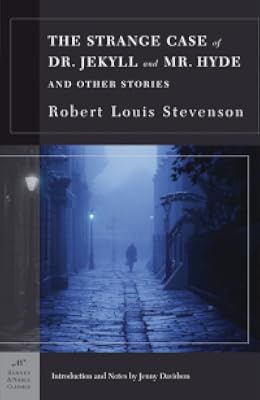
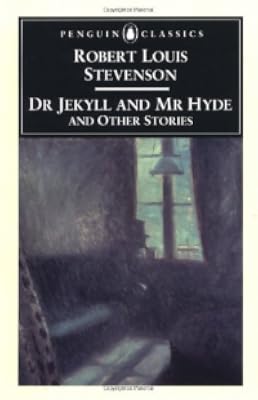
The Strange Case of Dr. Jekyll and Mr. Hyde and Other Stories
by Robert Louis Stevenson
On This Page
Description
A London physician leads a double life when he discovers a drug that alters his appearance and disposition.Tags
Recommendations












Member Recommendations

Member Reviews
This story got better and better as it continued. Stevenson is straight forward, maybe a little too tell-y vs. show-y, but the content is so good. If you've ever struggled with your vices, then this is the book. It contains so much good food for thought. My first real exposure to this story was actually the BBC miniseries Jekyll where the writers more explicitly made Hyde a manifestation of love, which was a lot of fun to think about as I read this novella as well. This honestly just feels like one of those foundational stories that I can enjoy in any iteration. It speaks to me in a big way.
These stories are classics. Mr Stevenson lived in a time when industrialization was just getting started - old world crafts were switching over to big machines, able to churn out more items in considerably less time. Its also the time of scientific curiosity. Scientists studied everything - with the hope of finding out what makes humans tick. With Dr. Jekyll and Mr. Hyde, a scientist has discovered how to switch off human conscience, giving in to the base emotion of lust, and immediate gratification.
A number of stories sit on gothic horror- for example Markheim, and Thrawn Janet, even The Body-Snatchers play into this. These stories play on the fears of the time, robbery, science gone wrong/against God, even body snatching. And with any show more good story, the backdrop of these stories are just as important as what is happening. show less
A number of stories sit on gothic horror- for example Markheim, and Thrawn Janet, even The Body-Snatchers play into this. These stories play on the fears of the time, robbery, science gone wrong/against God, even body snatching. And with any show more good story, the backdrop of these stories are just as important as what is happening. show less
In the title story, Mr. Utterson, a lawyer, is walking with his cousin when he hears a strange tale of a Mr. Hyde, who apparently has no conscience. Since he knows from his legal work that a respected man, Dr. Henry Jekyll, has written a strange clause into his will leaving all his property to this strange and unlikable man, Utterson determines to get to the bottom of what influence Mr. Hyde has over his friend. This story has become so much a part of our psyche that it's hard to approach it without already knowing the ending. I think I would've liked it even better if I could have somehow escaped spoilers, yet the ending lines weren't any less poignant for all that. The "science" of it all would be complete balderdash today, yet the show more story still explores the nature of good and evil and the heart of man.
The other short stories did not resonate with me as much, but they are still worth a read for anyone interested in Victorian Gothic and horror stories. Stevenson can definitely create a mood, and he writes some very unsettling stories. show less
The other short stories did not resonate with me as much, but they are still worth a read for anyone interested in Victorian Gothic and horror stories. Stevenson can definitely create a mood, and he writes some very unsettling stories. show less
The Strange Case of Dr. Jekyll and Mr. Hyde and Other Stories was decent, but nothing that will stand out to me in the long run. Each of the stories generally follows a man/group of men while various murders are taking place, and observes the ethics behind some of their actions and how society at the time treated death.
That being said, each of the stories captured (or didn't capture) my attention for different reasons. Sometimes it was the gothic vibes to the story, sometimes it was the actions of the characters, sometimes it was the way the characters spoke to others. But, there was no one story that stood out.
Ultimately, I'm glad I read it, but overall just an okay book in my opinion.
That being said, each of the stories captured (or didn't capture) my attention for different reasons. Sometimes it was the gothic vibes to the story, sometimes it was the actions of the characters, sometimes it was the way the characters spoke to others. But, there was no one story that stood out.
Ultimately, I'm glad I read it, but overall just an okay book in my opinion.
Another of the 501 must reads. I enjoyed the novel, read in one sitting. The novel hints, but rarely tells, of the atrocities committed by the alter ego. For me, the most interesting part were the steps taken by Dr. Jekyll in trying to restore his good nature and thus repress the evil Hyde,who begins to appear spontaneously without the necessity of medication.
I think by now most people are familiar with the lead story in this collection, the story of Dr. Jekyll and Mr. Hyde. Knowing the general plot of the story without having read it before spoiled it a bit for me, I found it neither suspenseful nor that well written enough to make it interesting.
This is a collection of stories, notes and commentary. The table of contents says there are 6 stories, but here are really 8. Of the 8, I found the 3 that make up "The Suicide Club" the most interesting. All together the longest story in the book, it seemed to be better written and just flowed better, despite some occasional odd jumping around. Two of the others, "Thrawn Janet" and "Markheim", I really didn't enjoy much at all. Perhaps Stevenson show more should be better known for his YA/adventure fiction, rather than his horror/gothic fiction. show less
This is a collection of stories, notes and commentary. The table of contents says there are 6 stories, but here are really 8. Of the 8, I found the 3 that make up "The Suicide Club" the most interesting. All together the longest story in the book, it seemed to be better written and just flowed better, despite some occasional odd jumping around. Two of the others, "Thrawn Janet" and "Markheim", I really didn't enjoy much at all. Perhaps Stevenson show more should be better known for his YA/adventure fiction, rather than his horror/gothic fiction. show less
Nineteenth century literature is filled with doppelganger stories, Dr. Jekyll and Mr. Hyde being the most famous of them. It explores the duality of human nature, good and evil, and the conflict within. The theme of split personality is also explored, although this story takes it to a literal sense and splits a person in two.
The novella revolves around a lawyer who investigates a series of strange events surrounding the repulsive Mr. Edward Hyde, who has mysteriously "befriended" Dr. Jekyll. The most notable of these events is the murder of a high-placed London politician.
Although the story is considered by many a classic, I frankly did not enjoy reading it. Everything just happens so fast, there's absolutely no suspense at all! Things show more fall into place much too quickly, there's no room for guesswork. It's all too obvious from the very beginning who committed the crimes described in the novella. It's supposed to be a mystery story, let there be place for mystery!
I find that while it would be 'normal' to feel guilt and remorse after conducting such experiments as trying to split your person in two, Dr. Jekyll comes off as stupid, whiny, and selfish. He explains why he conducted such experiments on himself and how Mr. Hyde came more and more often to the forefront, and how he feels he's losing his mind, but did he not think of the consequences of his actions? Did he not think that while being Mr. Hyde, he could potentially cause great suffering? He became so obsessed by his little experiment that he lost the big picture; man is a duality by nature. show less
The novella revolves around a lawyer who investigates a series of strange events surrounding the repulsive Mr. Edward Hyde, who has mysteriously "befriended" Dr. Jekyll. The most notable of these events is the murder of a high-placed London politician.
Although the story is considered by many a classic, I frankly did not enjoy reading it. Everything just happens so fast, there's absolutely no suspense at all! Things show more fall into place much too quickly, there's no room for guesswork. It's all too obvious from the very beginning who committed the crimes described in the novella. It's supposed to be a mystery story, let there be place for mystery!
I find that while it would be 'normal' to feel guilt and remorse after conducting such experiments as trying to split your person in two, Dr. Jekyll comes off as stupid, whiny, and selfish. He explains why he conducted such experiments on himself and how Mr. Hyde came more and more often to the forefront, and how he feels he's losing his mind, but did he not think of the consequences of his actions? Did he not think that while being Mr. Hyde, he could potentially cause great suffering? He became so obsessed by his little experiment that he lost the big picture; man is a duality by nature. show less
Members
- Recently Added By
Lists

Short Story Collections and Anthologies
261 works; 42 members

Best Psychological Fiction
81 works; 16 members

Fiction For Men
142 works; 11 members
Author Information

2,799+ Works 139,331 Members
Novelist, poet, and essayist Robert Louis Stevenson was born in Edinburgh, Scotland. A sickly child, Stevenson was an invalid for part of his childhood and remained in ill health throughout his life. He began studying engineering at Edinburgh University but soon switched to law. His true inclination, however, was for writing. For several years show more after completing his studies, Stevenson traveled on the Continent, gathering ideas for his writing. His Inland Voyage (1878) and Travels with a Donkey (1878) describe some of his experiences there. A variety of essays and short stories followed, most of which were published in magazines. It was with the publication of Treasure Island in 1883, however, that Stevenson achieved wide recognition and fame. This was followed by his most successful adventure story, Kidnapped, which appeared in 1886. With stories such as Treasure Island and Kidnapped, Stevenson revived Daniel Defoe's novel of romantic adventure, adding to it psychological analysis. While these stories and others, such as David Balfour and The Master of Ballantrae (1889), are stories of adventure, they are at the same time fine studies of character. The Master of Ballantrae, in particular, is a study of evil character, and this study is taken even further in The Strange Case of Dr. Jekyll and Mr. Hyde (1886). In 1887 Stevenson and his wife, Fanny, went to the United States, first to the health spas of Saranac Lake, New York, and then on to the West Coast. From there they set out for the South Seas in 1889. Except for one trip to Sidney, Australia, Stevenson spent the remainder of his life on the island of Samoa with his devoted wife and stepson. While there he wrote The Wrecker (1892), Island Nights Entertainments (1893), and Catriona (1893), a sequel to Kidnapped. He also worked on St. Ives and The Weir of Hermiston, which many consider to be his masterpiece. He died suddenly of apoplexy, leaving both of these works unfinished. Both were published posthumously; St. Ives was completed by Sir Arthur Quiller-Couch, and The Weir of Hermiston was published unfinished. Stevenson was buried on Samoa, an island he had come to love very much. Although Stevenson's novels are perhaps more accomplished, his short stories are also vivid and memorable. All show his power of invention, his command of the macabre and the eerie, and the psychological depth of his characterization. (Bowker Author Biography) show less
Some Editions
Series
Belongs to Publisher Series
Work Relationships
Common Knowledge
- Canonical title
- The Strange Case of Dr. Jekyll and Mr. Hyde and Other Stories
- Original publication date
- The Strange Case of Dr. Jekyll and Mr. Hyde 1886; A Lodging for the Night 1877; The Suicide Club 1878; Thrawn Janet 1881; The Body Snatcher 1884; Markheim 1886
- People/Characters
- Henry Jekyll; Edward Hyde; Francis Villon
- Important places
- London, England, UK; Paris, France
- Related movies
- Mary Reilly (1996 | IMDb)
- First words
- Mr. Utterson the lawyer was a man of a rugged countenance that was never lighted by a smile; cold, scanty and embarrassed in discourse; backward in sentiment; lean, long, dusty, dreary and yet somehow lovable.
- Quotations
- All things therfore seemed to point to this; that I was slowly losing hold of my original and better self, and becoming slowly incorporated with my second and worse.
- Last words
- (Click to show. Warning: May contain spoilers.)Here then, as I lay down the pen and proceed to seal up my confession, I bring the life of that unhappy Henry Jekyll to an end.
- Disambiguation notice
- This collection by Barnes and Noble (ISBNs 1593081316, 1566197104, 1593080549, 1593083505, 1411433211, possibly others) contains 6 of Robert Louis Stevenson's stories (see Description). It should not be combined with works th... (show all)at contain more stories, fewer stories, or different stories. Thank you.
This is a collection of six stories. Please do not combine with other collections unless they contain the same stories. Please note that Barnes & Noble published two collections of the same name with different contents.... (show all) Thanks.
Classifications
Statistics
- Members
- 2,790
- Popularity
- 6,528
- Reviews
- 25
- Rating
- (3.79)
- Languages
- English, Spanish
- Media
- Paper, Ebook
- ISBNs
- 12
- ASINs
- 4