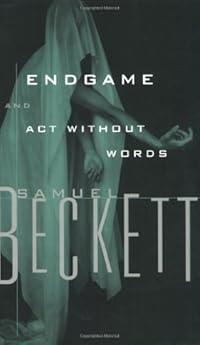
Endgame
by Samuel Beckett
On This Page
Description
Samuel Beckett was awarded the Nobel Prize for Literature in 1969; his literary output of plays, novels, stories and poetry has earned him an uncontested place as one of the greatest writers of our time. Endgame, originally written in French and translated into English by Beckett himself, is considered by many critics to be his greatest single work. A pinnacle of Beckett's characteristic raw minimalism, it is a pure and devastating distillation of the human essence in the face of approaching show more death. show lessTags
Recommendations














Member Reviews
Samuel Beckett remains a poet whatever he is writing with all the condensation of prose, metaphor and imagery that that implies.
Becket said, in relation to Endgame:
"My work is a matter of fundamental sounds (no joke intended) made as fully as possible, and I accept responsibility for nothing else. If people want to have headaches among the overtones, let them. And provide their own aspirin. Hamm as stated, and Clov as stated, together as stated . . . in such a place, and in such a world, that's all I can manage, more than I could".
This is a play about the end of the world. Not merely everybody but everything is dead or dying. The scene of the play is described more than once as a "shelter." Life means nothing but suffering to Hamm and show more Clov. At one point they think Nagg may be dead. "He's crying," says Clov. "Then he's living," answers Hamm. Clov finds a live flea and kills it, lest it start the evolutionary cycle over again. Nell, the only woman, is long past child-bearing, so she causes them no anxiety. A mysterious boy, seen from a window near the end of the play, does present a threat to complete extinction, but if he remains outside the shelter, he is sure to die. show less
Becket said, in relation to Endgame:
"My work is a matter of fundamental sounds (no joke intended) made as fully as possible, and I accept responsibility for nothing else. If people want to have headaches among the overtones, let them. And provide their own aspirin. Hamm as stated, and Clov as stated, together as stated . . . in such a place, and in such a world, that's all I can manage, more than I could".
This is a play about the end of the world. Not merely everybody but everything is dead or dying. The scene of the play is described more than once as a "shelter." Life means nothing but suffering to Hamm and show more Clov. At one point they think Nagg may be dead. "He's crying," says Clov. "Then he's living," answers Hamm. Clov finds a live flea and kills it, lest it start the evolutionary cycle over again. Nell, the only woman, is long past child-bearing, so she causes them no anxiety. A mysterious boy, seen from a window near the end of the play, does present a threat to complete extinction, but if he remains outside the shelter, he is sure to die. show less
In ‘Waiting For Godot’, Beckett’s characters wait for a man who symbolizes God or a higher meaning who will never arrive, making clear his view on life’s meaninglessness. In ‘Endgame’, with their bodies broken down, his characters live out their colorless, boring days, simply waiting for death. He holds an uncomfortable mirror up to the human condition and the end of our lives, and does so in an artistic way.
It’s symbolic that one of them can’t see or stand, and another can’t sit, and sees nothing but grayness or ‘zero’ out of their room’s high windows. The parents of the one live literally in ashbins. We will all die, Beckett reminds us grimly, many no longer enjoying life in the slightest when it happens, and show more some of us will cling to another simply because of that age-old adage, ‘misery loves company’.
One wonders if the events of the play, as simple as they are, with repetitious seemingly interior dialogue, are all in this one old and beaten down individual’s mind at the end of his life - his memories of his parents, his fear that his partner and caretaker will leave him, and his bitterness over the futility of life.
The play has a dark and pessimistic view of humanity as well. In one of several moments which seem post-apocalyptic, a flea should be caught because “humanity might start from there all over again,” which would be a bad thing, presumably because our lives are so shallow, meaningless, and filled with pain.
There are some moments of levity in Beckett’s wordplay, e.g. the story of the tailor who apologizes among other things for having “made a hash of the crotch”, as well as an elder “sucking his biscuit”, and the admonition to “Get out of here and love one another! Lick your neighbor as yourself!” However, I found these to be few and far between.
The story is one of recognizing our fate to suffer (“He’s crying” / “Then he’s living.”), and have no real hope (“Use your head, can’t you, use your head, you’re on earth, there’s no cure for that!”). It’s also one of cautionary warning (“One day you’ll be blind, like me. You’ll be sitting there, a speck in the void, in the dark, for ever, like me.”)
The trouble I have with the play is it's rather bleak. Life does end in degradation and suffering, but we can still lead full, beautiful lives, connect to others, and be happy in spite of the smallness of humanity, and life’s absurd daily repetition. Maybe his play is a cautionary warning about the end that awaits us all, and that we should go outside in the sunshine and enjoy our time while we can, but it just comes across as so grim and pessimistic, it's harder for me to fully enjoy. show less
It’s symbolic that one of them can’t see or stand, and another can’t sit, and sees nothing but grayness or ‘zero’ out of their room’s high windows. The parents of the one live literally in ashbins. We will all die, Beckett reminds us grimly, many no longer enjoying life in the slightest when it happens, and show more some of us will cling to another simply because of that age-old adage, ‘misery loves company’.
One wonders if the events of the play, as simple as they are, with repetitious seemingly interior dialogue, are all in this one old and beaten down individual’s mind at the end of his life - his memories of his parents, his fear that his partner and caretaker will leave him, and his bitterness over the futility of life.
The play has a dark and pessimistic view of humanity as well. In one of several moments which seem post-apocalyptic, a flea should be caught because “humanity might start from there all over again,” which would be a bad thing, presumably because our lives are so shallow, meaningless, and filled with pain.
There are some moments of levity in Beckett’s wordplay, e.g. the story of the tailor who apologizes among other things for having “made a hash of the crotch”, as well as an elder “sucking his biscuit”, and the admonition to “Get out of here and love one another! Lick your neighbor as yourself!” However, I found these to be few and far between.
The story is one of recognizing our fate to suffer (“He’s crying” / “Then he’s living.”), and have no real hope (“Use your head, can’t you, use your head, you’re on earth, there’s no cure for that!”). It’s also one of cautionary warning (“One day you’ll be blind, like me. You’ll be sitting there, a speck in the void, in the dark, for ever, like me.”)
The trouble I have with the play is it's rather bleak. Life does end in degradation and suffering, but we can still lead full, beautiful lives, connect to others, and be happy in spite of the smallness of humanity, and life’s absurd daily repetition. Maybe his play is a cautionary warning about the end that awaits us all, and that we should go outside in the sunshine and enjoy our time while we can, but it just comes across as so grim and pessimistic, it's harder for me to fully enjoy. show less
Absurdist, surreal, existentialist - all words thrown in together by literature students and aspiring actors trying to explain this play. Beckett hated all of them. Sure, use the terms as an attempt at genre classification if that's what you need to do. But to say the play is absurdist in the real Oxford dictionary definition of the word is, surely, missing the point. Beckett did not believe or try to prove in his plays that life is devoid of meaning and sense. The whole burden of Hamm and Clov's existence is that they have no idea whether this is just a game, or whether there's a purpose for all of this, for every single word they utter. And maybe - just maybe - the more absurdly they behave, the more preposterous their interactions, show more maybe someone will finally take notice and start paying attention! Hamm and Clov might act like they have given up hope in a meaningful world, but in reality they never do. They are still there waiting for another Godot to interrupt this silly play and shout "Stop that nonsense! There is a real world outside of here! Waiting for you to do something!". This Godot again, of course, never arrives during the play. But this doesn't prove that he won't do so later. The reason, you see, that Endgame is so painful is that the characters are NOT resigned to life's absurdity. They are merely unsure of it. They doubt. They fear. They sometimes dare to hope. They question. They wonder. But they don't know. Hamm is never sure whether Clov's threats to abandon his master are serious. And Clov never knows whether he will have the courage to leave. And not only that, but at the end of the play, we have no idea whether Clov left or not. This could be just another ritual, part of their monotonous lives. If Clov had left, he would have found out whether life outside this room is worth living, or - what he fears - just another absurd world only more dangerous than this one. But he never does find out. The neverending perpetuation of its doubt, its fear of the unknown, its unanswered questions, its "if"s and "maybe"s - these are the things that make the play powerful. And although Beckett was not fond of this interpretation either, it must be mentioned that post WWII ideology is rearing its ugly disconsolate head throughout Endgame again and again. Some even say that this was just another attempt by another playwright to find meaning in a world full of so much suffering. But that's not all there is to it, and that's probably why Beckett rejected this perspective.
I can't say that this is one of my favourite plays, on a level of sheer enjoyment. But I found it thought-provoking and strangely moving and I suppose that says something about its writer's intentions. Lastly, another matter worthy of mention is the death of a character in the play and the way this is portrayed. The interesting thing about this particular death is that it might be in fact the only happy event of the play, because it is the only event that provides some sort of resolution. You can see the remaining characters mourning, but you can also see that they are almost jealous of the dead one. The dead at least know now whether this whole Existence thing had some sort of higher meaning, or whether it was just an absurd game of chess, one silly move after another. show less
I can't say that this is one of my favourite plays, on a level of sheer enjoyment. But I found it thought-provoking and strangely moving and I suppose that says something about its writer's intentions. Lastly, another matter worthy of mention is the death of a character in the play and the way this is portrayed. The interesting thing about this particular death is that it might be in fact the only happy event of the play, because it is the only event that provides some sort of resolution. You can see the remaining characters mourning, but you can also see that they are almost jealous of the dead one. The dead at least know now whether this whole Existence thing had some sort of higher meaning, or whether it was just an absurd game of chess, one silly move after another. show less
Often considered a condensed dramatic version of Beckett's Three Novels, Endgame is a meditation on the futility of life and its intricacies. Stylistically, one could classify this play as part of the Theatre of the Absurd. Hamm's parents have no legs and live in dustbins filled with sand. Hamm himself cannot stand and lives in an armchair covered with a bloody handkerchief. His servant, Clov, sets about on trivial errands and is everyone's only source of information regarding the outside world. Clov threatens to leave the oppressive relationship between himself and Hamm, yet doesn't seem to be able to and it is possibly because he needs these wretched, geriatric creatures as much as they rely upon him for survival. Endgame is hilarious show more and explores both humanity in its weakest forms and the failure of language. Each character wishes to communicate their feelings and essential being to one another, yet every word they choose seems to make their thoughts progressively convoluted. Beckett uses a mixture of word play, puns, and story telling to make these characters not only identifiable, but engaging empathetic representations of elements within us all.
Act Without Words is a mime play consisting of, as the title suggests, no dialogue. Set in a brightly lit desert, this play revolves around one male figure who struggles with his environment and objects which may or may not be somewhat animate. I take this play to be about a man who is forced to contend with his external world to the point that he finally realises one must count on oneself to get through life for nothing else is reliable. The man not only begins to understand and listen to his own body as the play progresses, he also becomes defiant in the end. He refuses to play the game the objects falling from the tree have started. It can be viewed as a fatalist resignation, but that is only if one considers the end of the play its terminus. If one does not, the man's refusal to play along actually signifies his decision to rebel and start acting for himself rather than relying upon anything else. show less
Act Without Words is a mime play consisting of, as the title suggests, no dialogue. Set in a brightly lit desert, this play revolves around one male figure who struggles with his environment and objects which may or may not be somewhat animate. I take this play to be about a man who is forced to contend with his external world to the point that he finally realises one must count on oneself to get through life for nothing else is reliable. The man not only begins to understand and listen to his own body as the play progresses, he also becomes defiant in the end. He refuses to play the game the objects falling from the tree have started. It can be viewed as a fatalist resignation, but that is only if one considers the end of the play its terminus. If one does not, the man's refusal to play along actually signifies his decision to rebel and start acting for himself rather than relying upon anything else. show less
In this play a family; father, his son and parents, are facing the end of the world, apparently. The parents live in "bins" on the stage, reminiscent of Sesame Street. The father is blind and can't stand. The son can't sit. Their names are Nagg, Nell, Hamm and Clov.
The father, Hamm, tends toward long soliloquies. The son, Clov, tends to his needs. They're all resigned to their fates.
It's absurd, but I can't imagine anyone emerging from a production of this happier than went they went in. Perhaps more determined to live a meaningful life, yes.
Also included is Act Without Words. A Mime for One Player.
The father, Hamm, tends toward long soliloquies. The son, Clov, tends to his needs. They're all resigned to their fates.
It's absurd, but I can't imagine anyone emerging from a production of this happier than went they went in. Perhaps more determined to live a meaningful life, yes.
Also included is Act Without Words. A Mime for One Player.
All life long, the same questions, the same answers.
I read this in a hospital.
This morning.
The patient was someone I don't know very well.
It was thought that my presence would afford authority.
I am not sure about that.
The senseless ritual of life is unveiled in a drab flourish by Beckett. I love it. This isn't is powerful as Godot. There's no hope here -- for other than Death. There is memory and within that there's reverie, there's a lilting note which conveys. Our chores elongate without purification. I can sit and ponder the motives of the many gathered in this plush internment. I can also sit and not ponder.
I read this in a hospital.
This morning.
The patient was someone I don't know very well.
It was thought that my presence would afford authority.
I am not sure about that.
The senseless ritual of life is unveiled in a drab flourish by Beckett. I love it. This isn't is powerful as Godot. There's no hope here -- for other than Death. There is memory and within that there's reverie, there's a lilting note which conveys. Our chores elongate without purification. I can sit and ponder the motives of the many gathered in this plush internment. I can also sit and not ponder.
I remember reading this in anticipation of a lecture at the University of Chicago "First Friday' series. The lecturer certainly saw more references in the play to Dante, Descartes and others than I did. I have seen and read the play again since then and I am still trying to decipher a lot of what happens during the action. That is part of what makes Beckett interesting as a playwright for me. It is a play in one act with four characters, written in a style associated with the Theatre of the Absurd. It was originally written in French (entitled Fin de partie); as was his custom, Beckett himself translated it into English. The English title is taken from the last part of a chess game, when there are very few pieces left (the French title show more applies to games besides chess and Beckett lamented the fact that there was no precise English equivalent); Beckett himself was an avid chess player.
In the case of Endgame "Comedy" may be too cheerful a word to use for some of the lighter moments like the episodes in the ashcans. They are part of Mr. Beckett's grim joke on the futility of life. On the whole what Beckett has to say is contrary and nihilistic. But as a writer he can create a mood by using words as incantations. In the Paris Review article "Exorcising Beckett", Lawrence Shainberg claims that according to Beckett the characters' names signify the following: Hamm for Hammer, Clov for clou (the French for nail), Nagg for nagel (the German for nail), and Nell because of its resemblance to the English word nail. Although the dialogue is often baffling, there is no doubt about the total impression.
Ruby Cohn, in her book Back to Beckett, writes that "Beckett's favorite line in the play is Hamm's deduction from Clov's observation that Nagg is crying: Then he's living." But in Berlin he felt that the most important sentence is Nell's: "Nothing is funnier than unhappiness." and he directed his play to show the fun of unhappiness. This is a thinking persons drama and in spite of its bleakness we are still here in the twenty-first century reading and puzzling over this brilliant work. show less
In the case of Endgame "Comedy" may be too cheerful a word to use for some of the lighter moments like the episodes in the ashcans. They are part of Mr. Beckett's grim joke on the futility of life. On the whole what Beckett has to say is contrary and nihilistic. But as a writer he can create a mood by using words as incantations. In the Paris Review article "Exorcising Beckett", Lawrence Shainberg claims that according to Beckett the characters' names signify the following: Hamm for Hammer, Clov for clou (the French for nail), Nagg for nagel (the German for nail), and Nell because of its resemblance to the English word nail. Although the dialogue is often baffling, there is no doubt about the total impression.
Ruby Cohn, in her book Back to Beckett, writes that "Beckett's favorite line in the play is Hamm's deduction from Clov's observation that Nagg is crying: Then he's living." But in Berlin he felt that the most important sentence is Nell's: "Nothing is funnier than unhappiness." and he directed his play to show the fun of unhappiness. This is a thinking persons drama and in spite of its bleakness we are still here in the twenty-first century reading and puzzling over this brilliant work. show less
Members
- Recently Added By
Lists

Plays I Like
230 works; 31 members

Books You Read For University
184 works; 3 members

Fav. Stage Plays / First-Time Watched / Listened To / 2025
20 works; 1 member

Plays I Saw / 2025
37 works; 1 member

Next Plays to Watch
50 works; 1 member

Next Plays / 2025
352 works; 1 member

Read in 2009
44 works; 1 member

Best Dystopias
280 works; 271 members

Books Read in 2009
464 works; 11 members

Books Read in 2024
4,623 works; 126 members

New Lifetime Reading Plan by Fadiman and Major
225 works; 5 members

20th Century Literature
1,161 works; 55 members

Books Read in 2022
5,164 works; 113 members

Troublesome bodies
110 works; 7 members

Harold Bloom - The Western Canon: D. The Chaotic Age
833 works; 24 members

Modernism
140 works; 8 members

Favourite Theatre of the Absurd
30 works; 4 members
Best 20th Century French Plays
30 works; 4 members

Best of Irish Literature
37 works; 7 members

Existentialism
90 works; 11 members

.
396 works; 1 member
Author Information

Nobel Prize winner (1969) Samuel Beckett was born on April 13, 1906 near Dublin, Ireland into a middle-class Protestant family. As a boy, he studied French and enjoyed cricket, tennis, and boxing. At Trinity College he continued his studies in French and Italian and became interested in theater and film, including American film. After graduation, show more Beckett taught English in Paris and traveled through France and Germany. While in Paris Beckett met Suzanne Deschevaus-Dusmesnil. During World War II when Paris was invaded, they joined the Resistance. They were later forced to flee Paris after being betrayed to the Gestapo, but returned in 1945. Beckett and Deschevaus-Dusmesnil married in 1961. Samuel Beckett's first novel was Dream of Fair to Middling Women. Among his many works are Murphy; Malone Dies; and The Unnameable. His plays include Endgame, Happy Days, Not I, That Time, and Krapp's Last Tape. In 1953, the production of Waiting For Godot in Paris by director and actor Roger Blin earned Beckett international fame. Beckett was awarded the Nobel Prize in Literature in 1969. His style was postmodern minimalist and some of his major themes were imprisonment in one's self, the failure of language, and moral conduct in a godless world. Despite his fame, Samuel Beckett led a secluded life. In his later years he suffered from cataracts and emphysema. His wife Suzanne died on July 17, 1989 and Beckett died on December 22nd of the same year. (Bowker Author Biography) show less
Some Editions
Awards and Honors
Series
Belongs to Publisher Series
edition suhrkamp (96)
suhrkamp taschenbuch (171)
Work Relationships
Is contained in
Contains
Has as a study
Has as a commentary on the text
Has as a student's study guide
Common Knowledge
- Canonical title
- Endgame / Act Without Words; Endgame
- Original title
- Fin de partie suivi de acte sans paroles
- Original publication date
- 1957
- People/Characters
- Hamm; Nagg; Nell; Clov
- Dedication
- For Roger Blin
- First words
- Bare interior.
- Quotations
- NELL (without lowering her voice): Nothing is funnier than unhappiness, I grant you that. But—
HAMM (letting go his toque): What's he doing?
(Clov raises lid of Nagg's bin, stoops, looks into it. Pause.)
CLOV: He's crying.
(He closes the lid, straightens up.)
HAMM: Then he's living. - Last words
- (Click to show. Warning: May contain spoilers.)He looks at his hands. (Curtain)
- Original language
- French
- Disambiguation notice
- Endgame was never published without Act without Words. Even those editions which are titled simply Endgame actually contain Act without Words as well and are therefore correctly combined here.
Classifications
Statistics
- Members
- 3,432
- Popularity
- 4,840
- Reviews
- 27
- Rating
- (3.81)
- Languages
- 11 — Catalan, Czech, Dutch, English, Finnish, French, German, Italian, Portuguese, Spanish, Swedish
- Media
- Paper, Ebook
- ISBNs
- 35
- ASINs
- 49