On This Page
Description
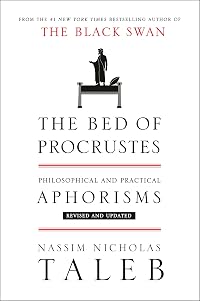
By the author of the modern classic The Black Swan, this collection of aphorisms and meditations expresses Taleb's view of modern civilization's hubristic side effects--modifying humans to satisfy technology, blaming reality for not fitting economic models, inventing diseases to sell drugs, defining intelligence as what can be tested in a classroom, and convincing people that employment is not slavery.Tags
Recommendations









Member Recommendations
Member Reviews
The Bed of Procrustes taught me a great deal about what inspires and angers Taleb, significantly less about what inspires and angers me, and almost nothing at all about the world. (I think "The person you are most afraid to contradict is yourself" is one of the only aphorisms that encouraged, in me, a new way to see things.)
It's not that there weren't interesting ideas in the book. It's just that most of the ideas I found interesting were ones I'd already considered...and I kept getting distracted by Taleb's increasing snark and cattiness as the book went on. (I have a difficult time seeing all journalists, economists, bankers, academics, consultants, nerds, newspaper readers, and men as exactly like the others of their category.)
Nor show more were the aphorisms all that memorable for their turn of phrase. (I'm not looking for wittiness or comedy, just a sense of pithy insight or piercing clarity of expression.) In truth, I doubt I'll wish to quote, or even remember, them in a month or two.
This sort of collection of aphorisms is, I think, best used for marking one's own personal journey. Buy a copy of this book. Write notes in response to the aphorisms that strike you. Put the book away for five, ten, twenty years, and then bring it out again. Do the aphorisms still strike you the same way? Are there some that didn't make sense then but do now? How has your understanding of the world---as mirrored in this handful of aphorisms---changed over the years? show less
It's not that there weren't interesting ideas in the book. It's just that most of the ideas I found interesting were ones I'd already considered...and I kept getting distracted by Taleb's increasing snark and cattiness as the book went on. (I have a difficult time seeing all journalists, economists, bankers, academics, consultants, nerds, newspaper readers, and men as exactly like the others of their category.)
Nor show more were the aphorisms all that memorable for their turn of phrase. (I'm not looking for wittiness or comedy, just a sense of pithy insight or piercing clarity of expression.) In truth, I doubt I'll wish to quote, or even remember, them in a month or two.
This sort of collection of aphorisms is, I think, best used for marking one's own personal journey. Buy a copy of this book. Write notes in response to the aphorisms that strike you. Put the book away for five, ten, twenty years, and then bring it out again. Do the aphorisms still strike you the same way? Are there some that didn't make sense then but do now? How has your understanding of the world---as mirrored in this handful of aphorisms---changed over the years? show less
This collection of adages dances with the general and the absolute delivery snarky wit masquerading as widow. This is more entertaining than enlightening. I am reminded of Mystery Men movie quotes like "Do not go there, my son! When you doubt your powers, you give power to your doubts." (Incidentally, while searching to get the quote right I learned this is based on a "famous quote" by Honoré de Balzac, “When you doubt your power, you give power to your doubt.”)
An interesting collection of aphorisms and general sayings and ideas. A bit cynical, snarky, definitely anti-journalist, anti-politician, and such. Super quick read, despite the prologue telling you to only read four or so at a time.
There are some gems in here, but a book of aphorisms is hard to digest all at once. I will probably pick this up again as I am sure that i didn’t absorb all the wisdom the first time through.
Quite pretentious. And quite useless. The best word for describing this editorial effort is: exploitation.The metaphor which gives the book its title is useful, though.
Disappointing. Despite some clever observations and pithy statements of those obervations the overarching impression is of the author's ego.
The more I read Taleb, the more I feel dwarfed by his thoughts. And it would be equivalent of puting my foot in my mouth if I were to pass my judgment or comment on his work. All I can say is that it is always enlightening and invigorating to have a peek at what's going on his brilliant mind.
Members
- Recently Added By
Lists

Ryan Holiday's Books To Base Your Life On
97 works; 2 members
Author Information

26+ Works 20,913 Members
Nassim Nicholas Taleb was born in 1960 in Amioun, Lebanon. He is a researcher, essayist, trader, epistemologist, and former practitioner of mathematical finance. Taleb received his bachelors and masters degree in science from the University of Paris. He holds an MBA from the Wharton School at the University of Pennsylvania, and a Ph.D. in show more Management Science from the University of Paris- Dauphine. Taleb began his financial mathematics career in several of New York City's Wall Street firms before becoming a scholar in the epistemology of chance events, randomness, and the unknown. Taleb's book, Fooled by Randomness, was translated into 23 languages. His book, The Black Swan, was translated into 27 languages and spent several months on the New York Times Bestseller list. Taleb is a Distinguished Professor of Risk Engineering at Polytechnic Institute of New York University and visiting professor of Marketing (Cognitive Science) at London Business School. Taleb has also taught at the University of Massachusetts in Amherst, Courant Institute of New York University, and the Wharton Business School Financial Institutions Center. His title Bed of Procrustes made the N.Y. Times Bestseller List for 2010 and his title Antifragile: Things That Gain from Disorder made The 2012 New York Times Bestseller List. show less
Some Editions
Series

Work Relationships
Common Knowledge
- Canonical title
- The Bed of Procrustes: Philosophical and Practical Aphorisms
- Original title
- The Bed of Procrustes
- Original publication date
- 2010
- Dedication
- To Alexander N. Taleb
- Quotations
- To understand the liberating effect of asceticism, consider that losing all your fortune is much less painful than losing only half of it.
I suspect that they put Socrates to death because there is something terribly unattractive, alienating, and nonhuman in thinking with too much clarity.
Education makes the wise slightly wiser, but it makes the fool vastly more dangerous.
Work destroys your soul by stealthily invading your brain during the hours not officially spent working; be selective about professions.
If you know, in the morning, what your day looks like with any precision, you are a little bit dead—the more precision, the more dead you are.
Procrastination is the soul rebelling against entrapment. (show all 7)
You remember e-mails you sent that were not answered better than e-mails that you did not answer. - Blurbers
- Appleyard, Bryan; Ferguson, Niall
- Original language
- English
Classifications
Statistics
- Members
- 940
- Popularity
- 28,187
- Reviews
- 15
- Rating
- (3.47)
- Languages
- 13 — Chinese, traditional, Dutch, English, Finnish, French, German, Greek, Italian, Polish, Portuguese (Portugal), Russian, Spanish, Turkish
- Media
- Paper, Audiobook, Ebook
- ISBNs
- 33
- ASINs
- 14