On This Page
Description
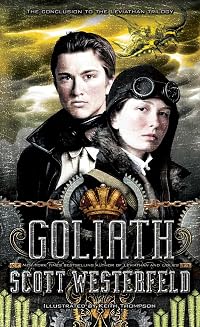
Alek and Deryn encounter obstacles on the last leg of their round-the-world quest to end World War I, reclaim Alek's throne as prince of Austria, and finally fall in love.Tags
Recommendations















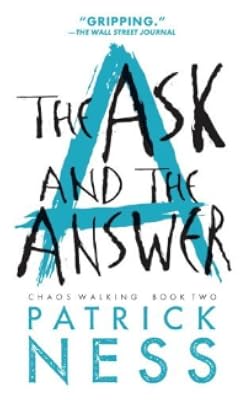
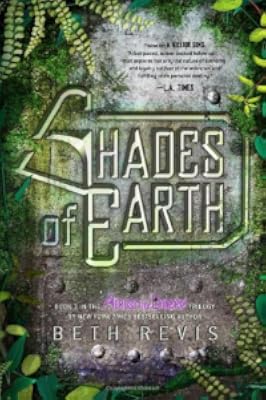

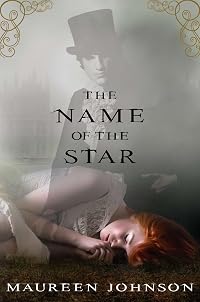
Member Recommendations
Member Reviews
Pros:
Goliath is the perfect conclusion to the Leviathan trilogy, and a real delight for those of us who have stuck with it this long. It’s tightly-plotted, with some outstanding action sequences that really keep the pages turning. Although there is no clear-cut antagonist this time around either, the addition of the inventor Nikola Tesla to the plot is intriguing and the concept of the weapon Goliath impeccably builds upon similar weapons throughout the series. The author’s ability to demonstrate its horrific effects early on both ups the ante in terms of the stakes and helps maintain a tangible sense of suspense all the way to the end. The bureaucracy, messiness, and sometimes, inhumanity inherent to war is plausibly captured which show more is a great change from previous books.
The relationship between Alek and Deryn is just great. The conflict between them early in the book is complex enough to be interesting but never resorts to melodrama. And because it’s based on real shared experience as opposed to the superficiality and flightiness that’s endemic in YA novels, it feels earned and realistic.
One thing I was especially pleased with the much more measured treatment of death in Goliath, especially when compared to Behemoth. It’s refreshing to see the characters finally reacting more realistically to the horror of war. This obviously helps smooth out a lot of the character inconsistencies that were present in the previous book, making the characters more likeable than previously.
In spite of less description, the many locations Leviathan visits in Goliath are more fully-realized that Istanbul was in the preceding volume. They seem alternately exotic and familiar, but are always interesting and colorful and make excellent backdrops for the action taking place. The terrific monochromatic pencil illustrations really help the setting come to life and are detailed enough to give the reader a mental image of hard-to-imagine beasties and weapons.
The ending is bittersweet and unexpected, but ultimately satisfying and really proves that a seemingly small action – at least in comparison to the war as a whole – can really tip the scales.
Cons:
The action sequences can lag somewhat because of over-description, and the plot still seems quite episodic. There are also parts of the book that suffer from a lack of a clear cut road forward.
Verdict: A very welcome return to form, Goliath brings more action, more heart, and more depth than previous books in the series, and is a brilliant close to adventures of Alek and Deryn abroad the Leviathan. show less
Goliath is the perfect conclusion to the Leviathan trilogy, and a real delight for those of us who have stuck with it this long. It’s tightly-plotted, with some outstanding action sequences that really keep the pages turning. Although there is no clear-cut antagonist this time around either, the addition of the inventor Nikola Tesla to the plot is intriguing and the concept of the weapon Goliath impeccably builds upon similar weapons throughout the series. The author’s ability to demonstrate its horrific effects early on both ups the ante in terms of the stakes and helps maintain a tangible sense of suspense all the way to the end. The bureaucracy, messiness, and sometimes, inhumanity inherent to war is plausibly captured which show more is a great change from previous books.
The relationship between Alek and Deryn is just great. The conflict between them early in the book is complex enough to be interesting but never resorts to melodrama. And because it’s based on real shared experience as opposed to the superficiality and flightiness that’s endemic in YA novels, it feels earned and realistic.
One thing I was especially pleased with the much more measured treatment of death in Goliath, especially when compared to Behemoth. It’s refreshing to see the characters finally reacting more realistically to the horror of war. This obviously helps smooth out a lot of the character inconsistencies that were present in the previous book, making the characters more likeable than previously.
In spite of less description, the many locations Leviathan visits in Goliath are more fully-realized that Istanbul was in the preceding volume. They seem alternately exotic and familiar, but are always interesting and colorful and make excellent backdrops for the action taking place. The terrific monochromatic pencil illustrations really help the setting come to life and are detailed enough to give the reader a mental image of hard-to-imagine beasties and weapons.
The ending is bittersweet and unexpected, but ultimately satisfying and really proves that a seemingly small action – at least in comparison to the war as a whole – can really tip the scales.
Cons:
The action sequences can lag somewhat because of over-description, and the plot still seems quite episodic. There are also parts of the book that suffer from a lack of a clear cut road forward.
Verdict: A very welcome return to form, Goliath brings more action, more heart, and more depth than previous books in the series, and is a brilliant close to adventures of Alek and Deryn abroad the Leviathan. show less
As expected, Scott Westerfeld managed to bring this fantastic steampunk series to a rollicking, satisfying close. I'm sad to see it end, but it was a thoroughly enjoyable ride.
The war is threatening to break out full force, even as the Leviathan changes course for yet another covert mission: meeting with an unusual scientist who may hold the key to stopping the war. Deryn's secret is threatening to unravel and expose her with each passing day, and the revolution in Istanbul has left Alek with the notion that he is destined to change the course of history. Will the motley crew aboard the most famous airship in the world turn the tide of a world war...or will they be forced to stand by as it spins out of control?
With a thrilling tour of show more the remaining countries we haven't yet glimpsed in the series, including Russia, Japan, America, and Mexico, and a host of new beasties and machines to round out the thrilling steampunk world Westerfeld has created, this book is the perfect endcap to an amazing story of two friends in the midst of an adventure soaring to its climax. Secrets are revealed, battles and started and averted, relationships change, and huge decisions are made. Keith Thompson, the illustrator, contributes some of the best sketches yet to bring the scenes to life. And Deryn and Alek, two fantastic characters that I've had the pleasure to follow, stay true to themselves to the end; strong, nuanced, loyal, and fun.
All in all, a series that will definitely stand among my favorites, and one that should be counted as one of the best of its steampunk genre. show less
The war is threatening to break out full force, even as the Leviathan changes course for yet another covert mission: meeting with an unusual scientist who may hold the key to stopping the war. Deryn's secret is threatening to unravel and expose her with each passing day, and the revolution in Istanbul has left Alek with the notion that he is destined to change the course of history. Will the motley crew aboard the most famous airship in the world turn the tide of a world war...or will they be forced to stand by as it spins out of control?
With a thrilling tour of show more the remaining countries we haven't yet glimpsed in the series, including Russia, Japan, America, and Mexico, and a host of new beasties and machines to round out the thrilling steampunk world Westerfeld has created, this book is the perfect endcap to an amazing story of two friends in the midst of an adventure soaring to its climax. Secrets are revealed, battles and started and averted, relationships change, and huge decisions are made. Keith Thompson, the illustrator, contributes some of the best sketches yet to bring the scenes to life. And Deryn and Alek, two fantastic characters that I've had the pleasure to follow, stay true to themselves to the end; strong, nuanced, loyal, and fun.
All in all, a series that will definitely stand among my favorites, and one that should be counted as one of the best of its steampunk genre. show less
Summary: After the events of the Ottoman Revolution, the great airship Leviathan heads east, although not to Tokyo, as midshipman Deryn Sharp and the rest of the crew initially assumed, but into the wilds of Siberia. They're there to pick up the scientist Nikola Tesla, a clanker scientist who has invented a weapon - Goliath - that is so powerful that it can level entire cities. Tesla plans to use Goliath - or the threat of it - to stop World War I, a motive that is dear to the heart of Alek, heir to the Austrian throne, who feels the war is his family's fault. But Deryn's got more on her mind than scientists and weapons, since she's been masquerading as a boy to serve on the airship, and she doesn't know how much longer her true show more identity - or her feelings for Alek - can remain a secret.
Review: I had somewhat of a mixed reaction to Goliath: as a continuation and end to the Leviathan series, it was wonderful; as a novel in and of itself, I don't think it's Westerfeld's best.
Let's deal with the second point first. All of the books in the series have been thoroughly action-packed, and Goliath is no exception. However, in the other two books, the action was central to the main plot of the story, while in Goliath's case, the plot was more character-centric. That's not a bad thing, at all, and the character development and emotional core of the story was excellently done. But it did have the effect of making the novel feel somewhat episodic and disjointed, more like a string of set pieces than a single flowing chain of events. Each piece was well-done, and things moved along at a good clip, but I did occasionally find myself thinking things like "Wait a minute, weren't we just in a battle with Japanese sea monsters? What are we suddenly doing in Mexico?" Westerfeld's inventive world-building is one of the best things about this series, but it did feel like Goliath was rushing a little to make sure that the entire rest of the globe got its due.
But the good news is that, on the whole, I was much too absorbed in Deryn and Alek's story to mind the occasional jumps in the action. With this series, Westerfeld's done one of my favorite things: he puts sympathetic characters in an impossible situation, one that I can't possibly see how it can be resolved satisfactorily, and then pulls out an ending that is unexpected, entirely satisfying, fits the story, and doesn't feel cheap. Deryn's been a great protagonist from the start, confident and capable, but I thought Alek really came into his own in this book. Watching their relationship grow and change has been one of the pleasures of this series, and Westerfeld handled it excellently as always - particularly important, since it formed the central plot of this novel, more so than the others. I'm sad to see the series end, of course, but if it had to end, this was a great way to do so.
Finally, while I did miss the illustrations, I'm so glad that I listened to this series as audiobooks. Alan Cumming does a great job with the narration, his skill with accents really bringing all of the characters to life... plus I love his interpretation of the Perspicacious Lorises. (Also, I just love the Lorises in general. Missster Sharp! They're totally going on my Christmas List.) 4 out of 5 stars.
Recommendation: Readers of Leviathan and Behemoth will likely not need my urging to read Goliath as well; newcomers should start at the beginning, but the series as a whole is wonderful imaginative fun that should appeal to historical fiction and steampunk fans alike. show less
Review: I had somewhat of a mixed reaction to Goliath: as a continuation and end to the Leviathan series, it was wonderful; as a novel in and of itself, I don't think it's Westerfeld's best.
Let's deal with the second point first. All of the books in the series have been thoroughly action-packed, and Goliath is no exception. However, in the other two books, the action was central to the main plot of the story, while in Goliath's case, the plot was more character-centric. That's not a bad thing, at all, and the character development and emotional core of the story was excellently done. But it did have the effect of making the novel feel somewhat episodic and disjointed, more like a string of set pieces than a single flowing chain of events. Each piece was well-done, and things moved along at a good clip, but I did occasionally find myself thinking things like "Wait a minute, weren't we just in a battle with Japanese sea monsters? What are we suddenly doing in Mexico?" Westerfeld's inventive world-building is one of the best things about this series, but it did feel like Goliath was rushing a little to make sure that the entire rest of the globe got its due.
But the good news is that, on the whole, I was much too absorbed in Deryn and Alek's story to mind the occasional jumps in the action. With this series, Westerfeld's done one of my favorite things: he puts sympathetic characters in an impossible situation, one that I can't possibly see how it can be resolved satisfactorily, and then pulls out an ending that is unexpected, entirely satisfying, fits the story, and doesn't feel cheap. Deryn's been a great protagonist from the start, confident and capable, but I thought Alek really came into his own in this book. Watching their relationship grow and change has been one of the pleasures of this series, and Westerfeld handled it excellently as always - particularly important, since it formed the central plot of this novel, more so than the others. I'm sad to see the series end, of course, but if it had to end, this was a great way to do so.
Finally, while I did miss the illustrations, I'm so glad that I listened to this series as audiobooks. Alan Cumming does a great job with the narration, his skill with accents really bringing all of the characters to life... plus I love his interpretation of the Perspicacious Lorises. (Also, I just love the Lorises in general. Missster Sharp! They're totally going on my Christmas List.) 4 out of 5 stars.
Recommendation: Readers of Leviathan and Behemoth will likely not need my urging to read Goliath as well; newcomers should start at the beginning, but the series as a whole is wonderful imaginative fun that should appeal to historical fiction and steampunk fans alike. show less
Everything that made the first two books excellent can be found here, plus new cultures to explore in this Clanker/Darwinist reimagining of history, plus several characters' personalities are explored more deeply, plus an extremely matter-of-fact treatment about how Deryn and Alek feel about each other. The romance is written true to the characters and not to any stinking stereotypes, and for that Westerfeld wins a fifth star. This is a trilogy that excites where lesser series would exhaust.
In the final book in the Leviathan trilogy, the gigantic airship sails around the globe from Russia to Japan to New York City, all in adherence with demands of the mad inventor who claims that his weapon, Goliath, can end the war. In the midst of all of this travel, Alek finally learns that Dylan is in fact a girl, whom we've known all along as Deryn. As he grapples with this new truth about his best friend, he must also make decisions that could affect the entire course of the Great War.
Goliath does everything I wanted for the conclusion of this fantastic series. The creatures and contraptions continue to be brilliant, the characters encounter exciting adventures and grow as individuals at the same time, and the plot is riveting. Also show more highly worthy of mention are Keith Thompson's brilliant illustrations which are absolutely beautiful and so richly detailed. While I did see some plot points coming, when you have a female character disguising herself as a boy, that is to be expected. I appreciated Westerfeld's approach to his alternate history and the choices he made. The ending, which can always be tricky in a trilogy, is also very well-done, being neither too saccharine nor too open-ended. Instead, I was very happy with how we left Alek and Deryn as they sailed away on the fascinating airship that is the Leviathan. show less
Goliath does everything I wanted for the conclusion of this fantastic series. The creatures and contraptions continue to be brilliant, the characters encounter exciting adventures and grow as individuals at the same time, and the plot is riveting. Also show more highly worthy of mention are Keith Thompson's brilliant illustrations which are absolutely beautiful and so richly detailed. While I did see some plot points coming, when you have a female character disguising herself as a boy, that is to be expected. I appreciated Westerfeld's approach to his alternate history and the choices he made. The ending, which can always be tricky in a trilogy, is also very well-done, being neither too saccharine nor too open-ended. Instead, I was very happy with how we left Alek and Deryn as they sailed away on the fascinating airship that is the Leviathan. show less
I don't use the word "heteronormative" lightly, but.....
(Ugh.)
Apart from the increasingly annoying Certified 100% Heterosexual Relationship that Westerfeld made central to the story, this was pretty good. It really didn't need the romance driving it; "romance" mostly just tosses a hat over gaping ridiculous plot developments likeAlek literally throwing away his royalty (very punny; I'm still wincing), and Alek having an actual consistent political position (if that's too much to expect from a teenager, then how does Dylan have such freedom of action in her relatively low-on-the-totem-pole military rank?) . Story itself was a little disjointed and strung-together, but it worked, and overall I really like Westerfeld's warping of history. show more I am still confused about Dylan's rank; the first two books make it seem like she was more of a cabin boy, but she always had a lot more latitude than I expected, even accounting for the "bell captain" effect (where the people who carry out the orders have a kind of power that the people giving the orders do not).
I liked the characterization of Tesla, although maybe it helps that I find his adoring present-day fan club annoying.
The social barriers Dylan ran up against, even with Dr. Barlow, were really painful to read. Maybe I took it too personally. I kept having flashes to [b:Monstrous Regiment|386371|Monstrous Regiment (Discworld, #31)|Terry Pratchett|https://d202m5krfqbpi5.cloudfront.net/books/1347894977s/386371.jpg|25787074]; I would have loved to see how Dylan was going to keep living her dream, or how other women were dealing with things-as-they-were. Which begs the question, is Dylan going to keep living as a man? Some hints are certainly dropped in that direction. Isn't that going to create some sticky social issues if she and Alek pursue their romantic relationship?
If so, Westerfeld isn't going to be the one to tell us about it. I've liked his work for a long time, his books are generally thoughtful and don't talk down to his young readers, but right now I am incredibly disappointed in him. Either he knew what he was doing with his queer subtext and was too cowardly to make it text/caved to the editors, or it was all just a joke to him. show less
(Ugh.)
Apart from the increasingly annoying Certified 100% Heterosexual Relationship that Westerfeld made central to the story, this was pretty good. It really didn't need the romance driving it; "romance" mostly just tosses a hat over gaping ridiculous plot developments like
I liked the characterization of Tesla, although maybe it helps that I find his adoring present-day fan club annoying.
The social barriers Dylan ran up against, even with Dr. Barlow, were really painful to read. Maybe I took it too personally. I kept having flashes to [b:Monstrous Regiment|386371|Monstrous Regiment (Discworld, #31)|Terry Pratchett|https://d202m5krfqbpi5.cloudfront.net/books/1347894977s/386371.jpg|25787074]; I would have loved to see how Dylan was going to keep living her dream, or how other women were dealing with things-as-they-were. Which begs the question, is Dylan going to keep living as a man? Some hints are certainly dropped in that direction. Isn't that going to create some sticky social issues if she and Alek pursue their romantic relationship?
If so, Westerfeld isn't going to be the one to tell us about it. I've liked his work for a long time, his books are generally thoughtful and don't talk down to his young readers, but right now I am incredibly disappointed in him. Either he knew what he was doing with his queer subtext and was too cowardly to make it text/caved to the editors, or it was all just a joke to him. show less
This final installment of the Leviathan trilogy had me on the edge of my seat pretty much the entire time. If Deryn's secret wasn't on the verge of being discovered then Alek was in danger or the engines were smoking or some other calamity. This part of our story takes us from Siberia to Japan to the USA, introducing a number of memorable new characters and visiting old friends along the way. And Bovril the perspicacious loris was endlessly adorable. There were far more historical figures this time around, making Westerfeld's "what actually happened" epilogue even more interesting. You know, I don't really care for steampunk or alternate histories or books about war - fictional or otherwise - but I really, really loved this trilogy. I show more loved the characters, how you're never quite sure who knows what or whom to trust. I loved the technology, the mix of science and fantasy involved in these genetically engineered critters. I loved the story, the adventures, the romance, the suspense. And the ending was quite satisfying, which is saying a lot considering how many loose ends were flapping about prior to it. Highly recommended. show less
Members
- Recently Added By
Lists

NPRs your favorites: 100 Best Ever Teen Novels
237 works; 49 members

Steampunk
13 works; 1 member

Books Read in 2012
816 works; 34 members

Books about World War I
80 works; 14 members
Author Information

67+ Works 76,584 Members
Scott Westerfeld was born in Dallas, Texas on May 5, 1963. He received a degree in philosophy from Vassar College in 1985. Before becoming a full time writer, he held several jobs including factory worker, software designer, editor, and substitute teacher. His works for young adults include the Uglies series, the Midnighters series, and The Last show more Days. He is the co-author of the Zeroes series written with Margo Lanagan and Deborah Biancotti. He also writes science fiction novels for adults. He has won numerous awards including a Special Citation for the 2000 Philip K. Dick Award for Evolution's Darling, a Victorian Premier's Award for So Yesterday, and an Aurealis Award for The Secret Hour. (Bowker Author Biography) show less
Some Editions
Awards and Honors
Series

Belongs to Publisher Series
新☆ハヤカワ・SF・シリーズ (5007)
Work Relationships
Is contained in
Common Knowledge
- Canonical title
- Goliath
- Original title
- Goliath
- Original publication date
- 2011-09-20
- People/Characters
- Aleksandar Ferdinand; Deryn Sharp; Bovril; Count Volger; Otto Klopp; Dr. Nora Darwin Barlow (show all 8); Tazza; Nikola Tesla
- Important places
- Siberia, Russia; Japan; Mexico; New York, USA
- Important events
- World War I; Tunguska event
- Dedication
- To everyone who loves a long-secret romance, revealed at last.
- First words
- "Siberia," Alek said. The word slipped cold and hard from his tongue, as forbidding as the landscape passing below.
- Last words
- (Click to show. Warning: May contain spoilers.)What it might mean in this context is unclear, though it suggests to this reporter that the young prince has found the comfort of new and powerful allies.
Classifications
- Genres
- Fiction and Literature, Teen, Tween, Young Adult, Science Fiction
- DDC/MDS
- 813.54 — Literature & rhetoric American literature in English American fiction in English 1900-1999 1945-1999
- LCC
- PZ7 .W5197 .G — Language and Literature Fiction and juvenile belles lettres Fiction and juvenile belles lettres Juvenile belles lettres
- BISAC
Statistics
- Members
- 1,995
- Popularity
- 10,563
- Reviews
- 101
- Rating
- (4.10)
- Languages
- 9 — Czech, English, French, German, Hungarian, Japanese, Polish, Portuguese, Spanish
- Media
- Paper, Audiobook, Ebook
- ISBNs
- 36
- ASINs
- 8