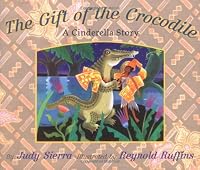
The Gift of the Crocodile: A Cinderella Story
by Judy Sierra
On This Page
Description
In this Indonesian version of the Cinderella story, a girl named Damura escapes her cruel stepmother and stepsister and marries a handsome prince with the help of Grandmother Crocodile.Tags
Recommendations















Member Reviews
A kindhearted young girl named Damura is manipulated into asking her widowed father to remarry in this Cinderella variant from Indonesia's Spice Islands (AKA the Maluku Islands). Mistreated by her new stepmother and stepsister, she is forced to take on the role of servant, and given only a ragged sarong to wear. When she loses this at the river one day, while doing the washing, she calls upon the wild animals for aid, and finds herself confronted by Grandmother Crocodile. This fearsome fairy godmother brings her a beautiful sarong of silver, while Damura cares for her offspring, but metes out a very different reward when Damura's stepsister attempts the same task. When the local prince holds a gathering in order to find the most show more graceful dancer, and Damura cannot attend because she does not have the required finery - her silver dress having been taken from her - Grandmother Crocodile steps in to help once again. But although Damura's dancing wins her the heart of the prince, who uses her golden slipper to locate her, the story does not end there, for the wicked stepmother and stepsister have another plan...
Adapted from a version of this story found in G.J. Ellen's 1916 Woordenlijst van het Pagoe op Noord-Halmahera ("Glossary of the Pagu of North Halmahera"), The Gift of the Crocodile: A Cinderella Story comes from the island of Halmahera, and contains many elements common to this tale type, the world over. The wicked stepmother and stepsister, the heroine being made to take the role of servant, the magical helper (or fairy godmother), the dainty slipper the heroine leaves behind for her prince - these are all present. I thought it was interesting that the magical helper here was a crocodile, as the fearsome reputation of this animal works to emphasize the heroine's kindness and good manners in the story, and to make her reward all the more extraordinary. By calling the crocodile 'Grandmother,' Damura emphasizes their connection, protecting herself from the animal's appetite, something Grandmother Crocodile herself confirms, when she says "it was wise of you to call me Grandmother...for if you had not, I might have eaten you." I also thought that the last episode of the story, in which Damura's wicked stepmother and stepsister feed her to a crocodile, only for Grandmother Crocodile to rescue and revive her, was fascinating, and added an unusual element to the tale. The accompanying artwork from Reynold Ruffins, done in acrylic, is beautiful, with bold colors and immensely appealing stylized figures. I have encountered Ruffins' work once before, in Verna Aardema's Misoso: Once Upon a Time Tales from Africa, and am glad to have run into another of his titles. This is one I would recommend to all young folklore enthusiasts, and to any reader interested in Cinderella type stories from around the world.
NOTE: like so many other authors who have retold Cinderella variants from around the world, Judy Sierra incorrectly states in her afterword that the Chinese version was the first version, worldwide, to be written down. This is an error I frequently see, and its ubiquity always confuses me. In point of fact, the first written version of a Cinderella-style story is that of Rhodopis, the Greek girl who was kidnapped by pirates and sold into slavery in Egypt. This 'Egyptian Cinderella' can be found in the first-century BC writings of the Greek author Strabo, predating the ninth-century AD Chinese version by many centuries. show less
Adapted from a version of this story found in G.J. Ellen's 1916 Woordenlijst van het Pagoe op Noord-Halmahera ("Glossary of the Pagu of North Halmahera"), The Gift of the Crocodile: A Cinderella Story comes from the island of Halmahera, and contains many elements common to this tale type, the world over. The wicked stepmother and stepsister, the heroine being made to take the role of servant, the magical helper (or fairy godmother), the dainty slipper the heroine leaves behind for her prince - these are all present. I thought it was interesting that the magical helper here was a crocodile, as the fearsome reputation of this animal works to emphasize the heroine's kindness and good manners in the story, and to make her reward all the more extraordinary. By calling the crocodile 'Grandmother,' Damura emphasizes their connection, protecting herself from the animal's appetite, something Grandmother Crocodile herself confirms, when she says "it was wise of you to call me Grandmother...for if you had not, I might have eaten you." I also thought that the last episode of the story, in which Damura's wicked stepmother and stepsister feed her to a crocodile, only for Grandmother Crocodile to rescue and revive her, was fascinating, and added an unusual element to the tale. The accompanying artwork from Reynold Ruffins, done in acrylic, is beautiful, with bold colors and immensely appealing stylized figures. I have encountered Ruffins' work once before, in Verna Aardema's Misoso: Once Upon a Time Tales from Africa, and am glad to have run into another of his titles. This is one I would recommend to all young folklore enthusiasts, and to any reader interested in Cinderella type stories from around the world.
NOTE: like so many other authors who have retold Cinderella variants from around the world, Judy Sierra incorrectly states in her afterword that the Chinese version was the first version, worldwide, to be written down. This is an error I frequently see, and its ubiquity always confuses me. In point of fact, the first written version of a Cinderella-style story is that of Rhodopis, the Greek girl who was kidnapped by pirates and sold into slavery in Egypt. This 'Egyptian Cinderella' can be found in the first-century BC writings of the Greek author Strabo, predating the ninth-century AD Chinese version by many centuries. show less
I found this book was great way to see differences in how other cultures tell stories. I loved the authors use of pictures and the simple twist of the story still made it easy to follow and enjoyable to read.
This spin-off of Cinderella gave me mixed feelings. I enjoyed the plot and the illustrations but I did not think the writing and language was complex at all. The plot gave a modified version of the classic tale, Cinderella. I loved the way the author changed this fairytale to adapt to a new culture and new set of characters. I particularly liked that they replaced the "Fairy God Mother" with "Grandmother Crocodile." I also really like the illustrations in the story. Reynolds Ruffins' illustrations were beautiful and tied right into the story. It was interesting to get a visual of the story and the style of illustration worked perfectly with the text. While a lot was good about this text, I did not like the actual writing. It seemed as show more if the writing was not academic at all, it was a little bit too casual. Other than the writing, I definitely liked this story. The big idea of this story was the same as the traditional Cinderella; that no matter how badly you are treated by some, others will see your worth. show less
I loved this version of Cinderella more than I loved the Disney version I grew up with. I loved that it still had a similar story line as the one I was familiar with (so I could compare and contrast) as well as adding a second conflict/twist to the story and involve animals/nature more into it.
The story is about a young girl, Damura, who's mother dies telling her to respect all wild creatures because they would help and comfort her. Damura ends up convincing her father to marry a neighbor because the woman made her a doll in exchange. After a while Damura's new stepmother and stepsister were mean to her, making her do all the chores, and not allowing the lorikeet to talk to Damura. One day Damura loses her old ragged sarong in a river show more and calls out to a crocodile, whom she refers to as Grandmother, to help her out in exchange for Damura to watch her baby crocodile. When the crocodile returns she has a beautiful silver sarong that isn't Damuras. The Crocodile tells Damura it's hers now because it's what she deserves. When her stepmother and stepsister see her new sarong the step sister travels down to the river to do what Damura did and get a new, beautiful sarong. Except when she watches the baby crocodile she has no respect for it, so the old crocodile (grandmother) comes back with one that turns into a bunch of leeches and is filthy and torn. Years later the prince announces he's going to hold an event for all the women in the village to dance for him so he can choose a princess. When Damura asks her stepmother if she can go and wear her silver sarong the stepmother laughs and says no, allowing her stepsister to wear the silver sarong. So Damura visits the river and gets a new sarong from the crocodile that is made out of gold with matching gold shoes and a carriage to ride in. The prince fell in love with Damura and upon Damura rushing at the roosters crow, found one of her golden shoes that got left behind. The prince sets on a search to find the owner of the shoe and finally finds Damura and they end up getting married. Sadly, Damura's stepsister and stepmother take her on a boat to the river after her wedding and push her into the river, a crocodile swallowing her up. When the prince finds out he goes to the river to tell the grandmother crocodile about it who demands the crocodile who swallowed her up spit her out and to eat her stepmother or stepsister immediately if they see them. The prince and Damura live happily ever after with their own children respecting all the wild animals. show less
The story is about a young girl, Damura, who's mother dies telling her to respect all wild creatures because they would help and comfort her. Damura ends up convincing her father to marry a neighbor because the woman made her a doll in exchange. After a while Damura's new stepmother and stepsister were mean to her, making her do all the chores, and not allowing the lorikeet to talk to Damura. One day Damura loses her old ragged sarong in a river show more and calls out to a crocodile, whom she refers to as Grandmother, to help her out in exchange for Damura to watch her baby crocodile. When the crocodile returns she has a beautiful silver sarong that isn't Damuras. The Crocodile tells Damura it's hers now because it's what she deserves. When her stepmother and stepsister see her new sarong the step sister travels down to the river to do what Damura did and get a new, beautiful sarong. Except when she watches the baby crocodile she has no respect for it, so the old crocodile (grandmother) comes back with one that turns into a bunch of leeches and is filthy and torn. Years later the prince announces he's going to hold an event for all the women in the village to dance for him so he can choose a princess. When Damura asks her stepmother if she can go and wear her silver sarong the stepmother laughs and says no, allowing her stepsister to wear the silver sarong. So Damura visits the river and gets a new sarong from the crocodile that is made out of gold with matching gold shoes and a carriage to ride in. The prince fell in love with Damura and upon Damura rushing at the roosters crow, found one of her golden shoes that got left behind. The prince sets on a search to find the owner of the shoe and finally finds Damura and they end up getting married. Sadly, Damura's stepsister and stepmother take her on a boat to the river after her wedding and push her into the river, a crocodile swallowing her up. When the prince finds out he goes to the river to tell the grandmother crocodile about it who demands the crocodile who swallowed her up spit her out and to eat her stepmother or stepsister immediately if they see them. The prince and Damura live happily ever after with their own children respecting all the wild animals. show less
This book puts a really interesting spin on the classic Cinderella story. It takes place in the spice islands and focuses on a girl named Damura. Her step-mother and step-sisters mistreat her and make her do chores around the house. Then one day as she rode down the river she met Grandmother Crocodile who creates her a sarong and gold silk slippers for the ball. The prince wants her to be his wife but her step-mother and step-sisters push her in the river where she is swallowed by a crocodile. Grandmother crocodile comes to her rescue and saves Damura. The illustrations in this book are beautiful in this twist on Cinderella. I think that this could be used as a great way to show how a different culture tells a familiar story. I would show more like to own this book and share it with my students. show less
“The Gift of the Crocodile” is a Cinderella story from the Spice Islands in Indonesia. Although the general premise of the story is similar to others, there are also many differences. Damura has a great relationship with her mother until her mother passes away. Before her mother’s death, she reminds Damura to always be kind to the animals that live on the island. Damura’s father remarries and the stepsisters and stepmother treat Damura like a slave. Damura’s fairy godmother comes in the form of “Grandmother Crocodile,” who helps Damura look like a princess to win over the prince.
I really enjoyed reading this book. I think it is very interesting how many different variations there are of the typical Cinderella story. In my show more future classroom, I would love to give each of my students a different Cinderella story and then have the class discuss similarities and differences.
I thought it was very interesting to see how the culture of Indonesia influenced the story in this particular variation. Damura wore a sarong to the ball because that is the attire that is worn in Indonesia for fancy events. Damura spoke to the different animals and was always kind to them, as her mother had told her to be. This ended up working in her favor because “Grandmother Crocodile” was her fairy godmother and always looked out for her. show less
I really enjoyed reading this book. I think it is very interesting how many different variations there are of the typical Cinderella story. In my show more future classroom, I would love to give each of my students a different Cinderella story and then have the class discuss similarities and differences.
I thought it was very interesting to see how the culture of Indonesia influenced the story in this particular variation. Damura wore a sarong to the ball because that is the attire that is worn in Indonesia for fancy events. Damura spoke to the different animals and was always kind to them, as her mother had told her to be. This ended up working in her favor because “Grandmother Crocodile” was her fairy godmother and always looked out for her. show less
This version of the Cinderella fairytale comes from the Spice Islands. Damura’s mother teaches her traditional dances and to respect the animals. When she dies, Damura is tricked into convincing her father to marry another woman in the village, who soon turns on Damura, treating her as a slave for herself and her daughter. When Damura is doing laundry at the river, she loses her old sarong, but Grandmother Crocodile gives her another made of silver. The stepsister tries to repeat Damura’s success, but after spanking a baby crocodile and being short with Grandmother Crocodile, she is given a ragged sarong covered in leeches. When the prince holds a ball to choose a bride, the stepmother and stepsister leave Damura at home, stealing show more her silver sarong. However, Grandmother Crocodile once again gifts the girl with a beautiful sarong, made out of gold, and matching slippers.
Like other Cinderella stories, she loses a slipper at the ball, but the prince uses it to track Damura down. Unlike most other versions, Damura’s story continues, as her stepmother and stepsister apologize, wishing to be friends. They take her on a boat ride, but then toss her overboard, where a crocodile eats her. When the prince tells Grandmother Crocodile of what happened, she gathers the other reptiles around her and forces the guilty croc to spit her out. Grandmother Crocodile brings Damura back to life and promises her and her children protection forever.
Fans of the Cinderella story will enjoy this Indonesian version. Sierra’s writing is clever and humorous, but also echoes the traditional narration style. The varying details in this story will keep readers fascinated. The author’s note at the end of the book explains the different influences used in her story, including a short history of the Cinderella story itself. Ruffins’ artwork is bold, mixing bright acrylic paints with miniature silhouettes. The illustrations vary between wide, two-page spread landscapes to intense close-ups of characters. The trees, rivers, and figures flow and weave together and evoke the landscape of the story. show less
Like other Cinderella stories, she loses a slipper at the ball, but the prince uses it to track Damura down. Unlike most other versions, Damura’s story continues, as her stepmother and stepsister apologize, wishing to be friends. They take her on a boat ride, but then toss her overboard, where a crocodile eats her. When the prince tells Grandmother Crocodile of what happened, she gathers the other reptiles around her and forces the guilty croc to spit her out. Grandmother Crocodile brings Damura back to life and promises her and her children protection forever.
Fans of the Cinderella story will enjoy this Indonesian version. Sierra’s writing is clever and humorous, but also echoes the traditional narration style. The varying details in this story will keep readers fascinated. The author’s note at the end of the book explains the different influences used in her story, including a short history of the Cinderella story itself. Ruffins’ artwork is bold, mixing bright acrylic paints with miniature silhouettes. The illustrations vary between wide, two-page spread landscapes to intense close-ups of characters. The trees, rivers, and figures flow and weave together and evoke the landscape of the story. show less
Members
- Recently Added By
Lists

A Child's Book Tour of Indonesia
20 works; 1 member
Author Information

59+ Works 11,004 Members
All Editions
Awards and Honors
Common Knowledge
- Dedication
- For Leah Newcomb - J.S.
For all the grands and BiBi - R.R.
Classifications
Statistics
- Members
- 272
- Popularity
- 118,256
- Reviews
- 25
- Rating
- (3.52)
- Languages
- English
- Media
- Paper
- ISBNs
- 4