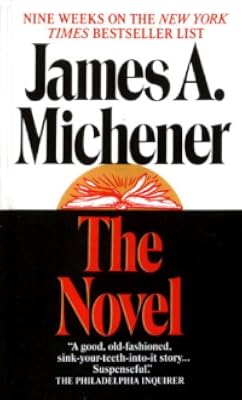
The Novel
by James A. Michener
On This Page
Description
Fiction. Literature. Thriller. Historical Fiction. HTML:In this riveting, ambitious novel from James A. Michener, the renowned chronicler of epic history turns his extraordinary imagination to a world he knew better than anyone: the world of books. Lukas Yoder, a novelist who has enjoyed a long, successful career, has finished what he believes to be his final work. Then a tragedy strikes in his community, and he becomes obsessed with writing about it. Meanwhile, Yoder’s editor fights to show more preserve her integrity—and her author—as her firm becomes the target of a corporate takeover; a local critic who teaches literature struggles with his ambitions and with his feelings about Yoder’s success; and a devoted reader holds the key to solving the mystery that haunts Yoder’s hometown.BONUS: This edition includes an excerpt from James A. Michener's Hawaii.
Praise for The Novel
“Michener explores some of the deepest issues raised by narrative literature.”—The New York Times
“A good, old-fashioned, sink-your-teeth-into-it story . . . The Novel lets us see an unfamiliar side of the author, at the same time portraying the delicate, complex relationship among editors, agents and writers.”—The Philadelphia Inquirer
“Michener loves literature, and his information about some of his favorite reading is almost as alluring as his explanation of how to handle a manuscript.”—Associated Press
“So absorbing you simply will not want [it] to end.”—Charleston News & Courier. show less
Tags
Recommendations





















Member Reviews
Four interlinked novellas centered on an author's completing his final novel in a popular series about the Pennsylvania Dutch. As someone who dabbles with writing, I found this very compelling despite its age. Michener had all of the qualifications required to write it. He was born and raised a Quaker in Pennsylvania, became a vigorous author who regularly made the bestseller lists, and had also been a teacher. He was not merely a crowd-pleaser, his very first novel having won him a Pulitzer Prize. Around the same period he wrote this novel (1991), he also wrote a number of non-fiction works that recounted various parts of his life. This was a period of reflection for him, just as it is for the characters in his story.
The Writer - show more depicts the author in his environment, visiting his Pennsylvania Dutch neighbours, and (in Michener style) some history about this tight-knit community. Lukas is an author who remains stubbornly true to his work, rebutting his publisher's concerns. His first loyalty is to the people he is writing about, determined to be faithful to their heritage with his chosen themes and messages. This creates tensions that serve to shake his confidence, despite the many promising signs of impending success.
The Editor - a young Jewish girl from the Bronx makes good in the world of publishing, stemming largely from the guidance of an encouraging uncle. This section has more and better writing tips to offer than the first one did, as she learns her trade. Her story becomes more complicated when she becomes personally involved with a struggling writer. In the background is the story of how she continued to stand by Lukas through his early unsuccessful efforts.
The Critic - an English professor in the author's neighbourhood acquires the same editor, and a distaste for the author's works. There's some good introspection here, about the challenge the critic faces between honesty in his assessments and the many variables in his life that pressure him to steer off course.
The Reader - introduced during the critic's story, we meet a significant member of the community and a long-time fan of the author. She gets to know the editor and critic as well, and her story mostly serves as a means of bringing the other character arcs to a close.
There's a fun reference to procuring the talents of a J. P. Tremblay to produce the maps for the endpapers as the author's book enters production. That name is drawn from real life, the actual artist who produced the endpaper maps for Michener's novel. There is also a fun quote: "The time may come, and very soon when ... [the manuscript] might leapfrog in some mysterious way right into the home of the intended reader." That's a pretty good prediction of Amazon self-publishing. show less
The Writer - show more depicts the author in his environment, visiting his Pennsylvania Dutch neighbours, and (in Michener style) some history about this tight-knit community. Lukas is an author who remains stubbornly true to his work, rebutting his publisher's concerns. His first loyalty is to the people he is writing about, determined to be faithful to their heritage with his chosen themes and messages. This creates tensions that serve to shake his confidence, despite the many promising signs of impending success.
The Editor - a young Jewish girl from the Bronx makes good in the world of publishing, stemming largely from the guidance of an encouraging uncle. This section has more and better writing tips to offer than the first one did, as she learns her trade. Her story becomes more complicated when she becomes personally involved with a struggling writer. In the background is the story of how she continued to stand by Lukas through his early unsuccessful efforts.
The Critic - an English professor in the author's neighbourhood acquires the same editor, and a distaste for the author's works. There's some good introspection here, about the challenge the critic faces between honesty in his assessments and the many variables in his life that pressure him to steer off course.
The Reader - introduced during the critic's story, we meet a significant member of the community and a long-time fan of the author. She gets to know the editor and critic as well, and her story mostly serves as a means of bringing the other character arcs to a close.
There's a fun reference to procuring the talents of a J. P. Tremblay to produce the maps for the endpapers as the author's book enters production. That name is drawn from real life, the actual artist who produced the endpaper maps for Michener's novel. There is also a fun quote: "The time may come, and very soon when ... [the manuscript] might leapfrog in some mysterious way right into the home of the intended reader." That's a pretty good prediction of Amazon self-publishing. show less
This is not the typical Michener book. Basically this is a book about writing and publishing a book as told by a variety of characters. Frist - the writer: Lucas Yoder, a Mennonite writer in Pennsylvania who has achieved much success with his stories set in Pennsylvania Dutch country. Second, Yvonne Marmette, his editor in New York City. Yvonne's back story involves a troubled marriage during a rising career. Third, the critic - Karl Streibert, a young man also from the Pennsylvania Dutch country who achieves success as a literary professor and critic in nearby Mecklenbery College. Lastly, Jane Garland, an elderly wealthy woman who loves Yoder's books and is a benefactor at the college.
The idea of reading the back story of these people show more was really good - what I didn't like was a murder of Jane's very talented grandson thrown in during the last chapter.
I felt much of this book was to explain the process of writing and publishing which was interesting and most of the characters were believable. The author just got off line during the last section by trying to pull too much together. Still a pretty good read with lots of references to literature and authors. show less
The idea of reading the back story of these people show more was really good - what I didn't like was a murder of Jane's very talented grandson thrown in during the last chapter.
I felt much of this book was to explain the process of writing and publishing which was interesting and most of the characters were believable. The author just got off line during the last section by trying to pull too much together. Still a pretty good read with lots of references to literature and authors. show less
A great story for anyone who enjoys the world of writing or even reading for that matter. However, after the first 'book' which follows the life of the books novelist, the following characters the editor, the critic and the reader are more and more just devices to keep the novels structure moving. As a Berks County native (the books setting) I can vouch for Michener's accurate portrayal of the landscape and the people. Overall, not the greatest book I've ever read but a nice ride through the world of writing and publishing, with all the intrigues and struggles of perhaps more action oriented books.
B/C
B/C
Confession time... this was my first James Michener book. I learned of it while reading 'WILD' by Cheryl Strayed. It was even more intriguing when I read the New York Time and Los Angeles Times reviews of this book when it was published. It was not considered a literary find - actually they said the dialogue was quite disappointing. While I will agree there were parts of the books that I didn't feel were up to the caliber that I would expect from an award winning writer, I am glad he wrote it and that I read it. The book is broken up into four segments and allows you into the mind of the author, the publisher, the critic, and the reader.
It is an easy read and enjoyable enough. Give it a spin especially if you are interested in show more uncovering and exploring other possible writers or writing styles discussed in the novel.
I have placed one of James Michener's other books in my reading list, I will be interested to explore the difference in the style. show less
It is an easy read and enjoyable enough. Give it a spin especially if you are interested in show more uncovering and exploring other possible writers or writing styles discussed in the novel.
I have placed one of James Michener's other books in my reading list, I will be interested to explore the difference in the style. show less
Anyone who loves reading books needs to read this. For some time now, in addition to reading books the normal way, I've been listening to one novel or another on tape (the full, unabridged versions rented from Books On Tape) in the car going to and from work. I don't know why, but I haven't reviewed any of them here. But, this one was so outstanding that I couldn't not tell you about it. Michener tells the tale in the early 90's in four parts - the first is the perspective of the novel author, then the editor. The third part is the literary critic and the fourth is the reader. Each is a fully developed character and story on it's own but they all weave together. The end result articulates perfectly why my life would be so flat and show more impoverished without books. show less
James Michener the novelist, writes a novel about novel-making. This reality fiction suspense story takes place in the 20th century college campus and a rural barn village in real life Berks County. Many families are Mennonites, Pennsylvania Dutch (Germans). The publishing takes place with Jews and offshore corporations, where the editor is from New York City. Michener weaves accurate information about these locales into the story.
Lukas Yoder is a successful novelist writing what he believes will be his last book. He is also a painter -- with a folkloristic "Shunning", and "Hex series" -- as well. Then, he is utterly distracted by the fact that a violent tragedy takes place in the community. Interestingly, Yoder understands this as a show more chance to write "a new kind of fiction". [388,431] Show how the "stolid, unyielding ways of the Dutch could produce a murderer". [434] But he would marry the new skills -- action without explanations, realistic dialogue -- to the old craft of simple story-telling.
After the brutal murder, the literate grandmother tries to read her comforting literature, and "a frightening thing happened". She realized that the familiar lines of Longfellow no longer had the vitality and relevance they once had. She realizes she faces a prospect of seeing "better and better novels read by fewer and fewer people", herself included. [438] But Michener provides a return to the Writer in a quiet moment, as he answers the mail he receives from...readers.
This book is written in the voices of the four roles critical to fiction -- the writer, the editor, the critic, and the reader. We learn that a Professor Streibert, at the local Mecklenberg College, the "critic" in this book , writes a review which raises a storm among some of the readers. The readers include the President and members of the Board of the College. Great dialogues between women "who prefer books that can be read, against you and Streibert, who advocate books that nobody can read!" And the critic's student defender is ironically penning a new work with the title "DIALOGUE". Excerpts are provided.
The critic regales us with which four English writers can teach the "secrets of meaningful narration". [203] Which four classic English are "entertaining" but provide no substance. [204] And "who would you choose, and why?"
One of the most important perspectives a writer must understand is the drill which the critics--who genuinely believe novels are "treasure beyond compare". [220] (To understand this, it helps to have brilliant company on a whirlwind tour of Rome, through Venice and Greece, followed by a live performance of the Agamemnon trilogy--all of which are provided here.) It also reminded me of how much "civilization" owes to people who are gay.
A trifecta of "love" stories is woven into the suspense, providing additional tension in a subtle way -- subtle because well-developed characters are boldly projected outside of the expectations of small-town or college proprieties. The expert on literature, who has the most to teach us, is clearly fabulous but not ridiculous. I am trying to remember if Michener ever actually uses a label -- "gay".
Michener deals with loneliness -- the subject at the heart of Thomas Wolfe's neomodern bildungsroman, "Look Homeward, Angel". Michener sets the stage with various characters finding themselves lonely, as the Christmas season opens up for New Years' Eve. Older man/younger woman, visa versa. The long-term bond with a strong-willed woman which enabled the Writer to focus on his work. Excitement of dreams fulfilled. AIDs brings death but there is the peace of having been loved. A dear old widow helping young career-woman find romance. We find heart-break, and the joys of good companionship.
We even get a white-knuckle detailed account of investment bankers taking over a publishing house without the publishers actually knowing they were doing it. [330]
Nota bene--Michener is presciently spelling out how ten thousand writers can step up and investigate the way rich predators pirated the greatest hoard of wealth in the world in 2008. In the decade after this book was written, bankers securitizing worthless "investment products" removed $40 trillion from the American middle class. Remember the "Bonfire of Vanities" by the other "Wolfe" of Wall Street, Tom Wolfe? We did not "get it" did we! Michener even suggests some working titles -- "Murder of a Publisher", or "Assassination of an American Business", or "Kidnapping the Economy", or "Killing Kinko's" etc. So he tells us how to do it and we have a trillion-dollar crime to write about!
The critics' student defender is the reader's son. He is articulate and talented: "In a time of growing cultural darkness, men like Streibert--in Universities across the nation--are beginning to believe that the job of serious fiction is to maintain a dialogue of exalted meaning among the elite--the rare few who will be making the decisions that will keep society alive." [350] As Ezra Pound expounded, "Ignore the general public. They always follow false gods." And further, a kind of "blinding light" is cast on Pound's treason. [389]
Michener tells us about other novels and "stories" in world literature and about the craft of writing. You don't really understand the sharpness of the need for style in writing, until you read what goes on among the editors, critics, and readers. And the industry of publishing. "In our league it's not completed till it's published..." [381] Also about making pies -- bits of ham in lemon meringue. [383].
And in addition to authentic clipped dialect, much about the culture and belief-worship of the Mennonite and local community: "I was reminded that Christmas in America was essentially a German tradition and that only the Pennsylvania Dutch knew how to celebrate it properly." [430] An indictment of the empty materialist ritual of wrapping gifts made in China.
Michener reveals the "secret" of the Writer: "he became the people he wrote about, lived in their skins, suffered in their hearts, shared their mental confusion". [430] That is not a spoiler, you knew it already.
In the final chapters, a female book reader narrates from her journal the sad mystery of the events that brutalized the Pennsylvania Dutch community. A brilliant writer is murdered, with defensive wounds on his body. [394] His family seek to complete his unfinished novel. The circumstances in this community actually CALL for this novel to be written, and we are placed AT that call. The police have no clues. [405] But a close examination of a barn hex collected for Art, reveals a somewhat hidden gash--"frakture" -- that points to the murderer.
In a gentle ending we find exactly the launch point, and the mapping, and the absorption that is required behind The Novel. And...the love.
~~~~~~~~~~~
Michener died in 1997, a full decade before his beloved country and world were destroyed by the 2001-2009 economic plunder of criminal monopolists. He was one of the great liberals whose mighty shoulders built an exceptional civilization. More than a mere writer, he was teacher, investigator, and fighter for justice. Each of his 43 books stand as an ax-blow against tyranny, ignorance, and idiocy. His axe is never dull. show less
Lukas Yoder is a successful novelist writing what he believes will be his last book. He is also a painter -- with a folkloristic "Shunning", and "Hex series" -- as well. Then, he is utterly distracted by the fact that a violent tragedy takes place in the community. Interestingly, Yoder understands this as a show more chance to write "a new kind of fiction". [388,431] Show how the "stolid, unyielding ways of the Dutch could produce a murderer". [434] But he would marry the new skills -- action without explanations, realistic dialogue -- to the old craft of simple story-telling.
After the brutal murder, the literate grandmother tries to read her comforting literature, and "a frightening thing happened". She realized that the familiar lines of Longfellow no longer had the vitality and relevance they once had. She realizes she faces a prospect of seeing "better and better novels read by fewer and fewer people", herself included. [438] But Michener provides a return to the Writer in a quiet moment, as he answers the mail he receives from...readers.
This book is written in the voices of the four roles critical to fiction -- the writer, the editor, the critic, and the reader. We learn that a Professor Streibert, at the local Mecklenberg College, the "critic" in this book , writes a review which raises a storm among some of the readers. The readers include the President and members of the Board of the College. Great dialogues between women "who prefer books that can be read, against you and Streibert, who advocate books that nobody can read!" And the critic's student defender is ironically penning a new work with the title "DIALOGUE". Excerpts are provided.
The critic regales us with which four English writers can teach the "secrets of meaningful narration". [203] Which four classic English are "entertaining" but provide no substance. [204] And "who would you choose, and why?"
One of the most important perspectives a writer must understand is the drill which the critics--who genuinely believe novels are "treasure beyond compare". [220] (To understand this, it helps to have brilliant company on a whirlwind tour of Rome, through Venice and Greece, followed by a live performance of the Agamemnon trilogy--all of which are provided here.) It also reminded me of how much "civilization" owes to people who are gay.
A trifecta of "love" stories is woven into the suspense, providing additional tension in a subtle way -- subtle because well-developed characters are boldly projected outside of the expectations of small-town or college proprieties. The expert on literature, who has the most to teach us, is clearly fabulous but not ridiculous. I am trying to remember if Michener ever actually uses a label -- "gay".
Michener deals with loneliness -- the subject at the heart of Thomas Wolfe's neomodern bildungsroman, "Look Homeward, Angel". Michener sets the stage with various characters finding themselves lonely, as the Christmas season opens up for New Years' Eve. Older man/younger woman, visa versa. The long-term bond with a strong-willed woman which enabled the Writer to focus on his work. Excitement of dreams fulfilled. AIDs brings death but there is the peace of having been loved. A dear old widow helping young career-woman find romance. We find heart-break, and the joys of good companionship.
We even get a white-knuckle detailed account of investment bankers taking over a publishing house without the publishers actually knowing they were doing it. [330]
Nota bene--Michener is presciently spelling out how ten thousand writers can step up and investigate the way rich predators pirated the greatest hoard of wealth in the world in 2008. In the decade after this book was written, bankers securitizing worthless "investment products" removed $40 trillion from the American middle class. Remember the "Bonfire of Vanities" by the other "Wolfe" of Wall Street, Tom Wolfe? We did not "get it" did we! Michener even suggests some working titles -- "Murder of a Publisher", or "Assassination of an American Business", or "Kidnapping the Economy", or "Killing Kinko's" etc. So he tells us how to do it and we have a trillion-dollar crime to write about!
The critics' student defender is the reader's son. He is articulate and talented: "In a time of growing cultural darkness, men like Streibert--in Universities across the nation--are beginning to believe that the job of serious fiction is to maintain a dialogue of exalted meaning among the elite--the rare few who will be making the decisions that will keep society alive." [350] As Ezra Pound expounded, "Ignore the general public. They always follow false gods." And further, a kind of "blinding light" is cast on Pound's treason. [389]
Michener tells us about other novels and "stories" in world literature and about the craft of writing. You don't really understand the sharpness of the need for style in writing, until you read what goes on among the editors, critics, and readers. And the industry of publishing. "In our league it's not completed till it's published..." [381] Also about making pies -- bits of ham in lemon meringue. [383].
And in addition to authentic clipped dialect, much about the culture and belief-worship of the Mennonite and local community: "I was reminded that Christmas in America was essentially a German tradition and that only the Pennsylvania Dutch knew how to celebrate it properly." [430] An indictment of the empty materialist ritual of wrapping gifts made in China.
Michener reveals the "secret" of the Writer: "he became the people he wrote about, lived in their skins, suffered in their hearts, shared their mental confusion". [430] That is not a spoiler, you knew it already.
In the final chapters, a female book reader narrates from her journal the sad mystery of the events that brutalized the Pennsylvania Dutch community. A brilliant writer is murdered, with defensive wounds on his body. [394] His family seek to complete his unfinished novel. The circumstances in this community actually CALL for this novel to be written, and we are placed AT that call. The police have no clues. [405] But a close examination of a barn hex collected for Art, reveals a somewhat hidden gash--"frakture" -- that points to the murderer.
In a gentle ending we find exactly the launch point, and the mapping, and the absorption that is required behind The Novel. And...the love.
~~~~~~~~~~~
Michener died in 1997, a full decade before his beloved country and world were destroyed by the 2001-2009 economic plunder of criminal monopolists. He was one of the great liberals whose mighty shoulders built an exceptional civilization. More than a mere writer, he was teacher, investigator, and fighter for justice. Each of his 43 books stand as an ax-blow against tyranny, ignorance, and idiocy. His axe is never dull. show less
there are interesting parts of this - i enjoyed seeing how a novel used to go from writer to editor and publisher and agent to press. i know it's totally different now, not 25 years later, but it was fun to see how it was done from someone who knows.
some of the character development was good, and the picture of that part of rural pennsylvania dutch country was good, if underdeveloped. a lot of the writing was good, but there was some that missed the mark for me. the dialogue at the opening of the book turned me off, and much of the dialogue throughout was unrealistic. though he did a good job of effectively having the four different narrators be easily distinguishable in their style and point of view.
it's a decent book, a relatively fun show more read, with some mistakes. not vintage michener, though.
"...for a book comes to life not on the date it was published in New York, but on the happy day when it falls into the hands of a reader..." show less
some of the character development was good, and the picture of that part of rural pennsylvania dutch country was good, if underdeveloped. a lot of the writing was good, but there was some that missed the mark for me. the dialogue at the opening of the book turned me off, and much of the dialogue throughout was unrealistic. though he did a good job of effectively having the four different narrators be easily distinguishable in their style and point of view.
it's a decent book, a relatively fun show more read, with some mistakes. not vintage michener, though.
"...for a book comes to life not on the date it was published in New York, but on the happy day when it falls into the hands of a reader..." show less
Members
- Recently Added By
Lists

Best books about books
209 works; 106 members
Author Information

James A. Michener, 1907 - 1997 James Albert Michener was born on February 3, 1907 in Doylestown, Pa. He earned an A.B. from Swarthmore College, an A.M. from Colorado State College of Education, and an M.A. from Harvard University. He taught for many years and was an editor for Macmillan Publishing Company. His first book, "Tales of the South show more Pacific," derived from Michener's service in the Pacific in World War II, won the 1947 Pulitzer Prize for Fiction and was the basis for the Rodgers and Hammerstein Broadway musical South Pacific, which won the 1950 Pulitzer Prize for Drama. Michener completed close to 40 novels. Some other epic works include "Hawaii," "Centennial," "Space," and "Caribbean." He also wrote a significant amount of nonfiction including his autobiography "The World Is My Home." Among his many other honors, James Michener received the Presidential Medal of Freedom in 1977. He was married to Patti Koon in 1935; they divorced in 1948. He married Vange Nord in 1948 (divorced 1955) and Mari Yoriko Sabusawa in 1955 (deceased 1994). He died in 1997 in Austin, Texas. (Bowker Author Biography) show less
Awards and Honors
Distinctions
Work Relationships
Is contained in
Common Knowledge
- Canonical title
- The Novel
- Original publication date
- 1991
- People/Characters
- Lukas Yoder; Emma Yoder; Yvonne Marmelle; Hilda Crane; Karl Streibert; Professor Devlan (show all 8); Timothy Tull; Jenny Sorkin
- Important places
- Dresden, New Jersey, USA
- Dedication
- To the Pennsylvania Dutch students who attended school with me
- First words
- This Tuesday morning, 3 October 1990, at half after ten, I typed the last sentence of the novel that will complete what the critics have taken to calling 'The Grenzler Octet,' as if I had planned from the beginning to write e... (show all)ight interrelated books on the same theme.
- Quotations
- A book comes to life not on the date it was published in New York, but on the happy day when it falls into the hands of a reader ...
- Last words
- (Click to show. Warning: May contain spoilers.)'I still felt as tired as I had in the argumentative days before Christmas, but I remembered his cry: "Writing is what I do. I have to do it," and when he climbed into bed I leaned over and tucked the blankets about him.'
Classifications
- Genres
- Fiction and Literature, General Fiction, Historical Fiction
- DDC/MDS
- 813.54 — Literature & rhetoric American literature in English American fiction in English 1900-1999 1945-1999
- LCC
- PS3525 .I19 .N68 — Language and Literature American literature American literature Individual authors 1900-1960
- BISAC
Statistics
- Members
- 1,033
- Popularity
- 25,066
- Reviews
- 19
- Rating
- (3.58)
- Languages
- 6 — Dutch, English, French, German, Korean, Spanish
- Media
- Paper, Audiobook, Ebook
- ISBNs
- 21
- ASINs
- 5