On This Page
Description
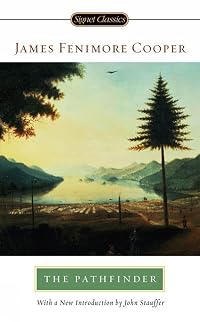
Gear up for a stiff dose of frontier life with The Pathfinder, the third novel in James Fenimore Cooper's beloved Leatherstocking Tales series. Focusing on the pioneer hero Natty Bumppo and his efforts to help the scattered members of a frontier community in the American Midwest, the novel is rich in historical detail, conflict, and adventure..
Tags
Recommendations


















Member Reviews
A nice edition, with few typos and excellent critical apparatus. You don't, strictly speaking, need the notes (unless you must know the meaning of every nautical term), but you'll come to appreciate them for providing welcome breaks in the text of what must surely be one of the worst novels ever written; and I say this as someone who has read the Lensman series.
Much of the problem stems from Cooper's inability to shut up. Take this from chapter III (page 36 in this edition). The paragraph beginning “The Oswego...”. He expands on his subject for 159 words (it wouldn't be so bad but it's not even beautiful language) before summarising those words by saying “In short...” That sentence itself is 43 words long. Except he still cannot show more shut up and he then continues for a further 142 words. What a waste of my time.
Or take this cracker from chapter XVII (page 250): “…the indefinable and controlling sense of womanly diffidence, made her suppress her womanly curiosity.” Now, if womanly diffidence is two things, and one of them is controlling, it must be possible to define the other thing. It's lazy writing and this is not the only time when I wondered if what we had here was a first draft. Particularly telling is Cooper's comment in his introduction that Mabel was first named Agnes, but that he changed it during the writing. Apparently the first edition called her by Agnes until the fifth or sixth chapter. Why was he submitting a half revised manuscript for publication and why did he not bother to proofread the text?
I found myself asking not only why I was reading the book, but why it was written. What is it about? There seems to be a theme of trust and betrayal, and this is reflected in several sub-plots, or perhaps more accurately plot fragments, but I am forced to conclude, with astonishment, that this is the story of how Mabel got married. Why is this story about getting married been set against a background of nautical adventure and why is Natty Bumppo in it at all? Why is the heroine so boring? Why is Cooper's attitude to women so creepy? Why why why? show less
Much of the problem stems from Cooper's inability to shut up. Take this from chapter III (page 36 in this edition). The paragraph beginning “The Oswego...”. He expands on his subject for 159 words (it wouldn't be so bad but it's not even beautiful language) before summarising those words by saying “In short...” That sentence itself is 43 words long. Except he still cannot show more shut up and he then continues for a further 142 words. What a waste of my time.
Or take this cracker from chapter XVII (page 250): “…the indefinable and controlling sense of womanly diffidence, made her suppress her womanly curiosity.” Now, if womanly diffidence is two things, and one of them is controlling, it must be possible to define the other thing. It's lazy writing and this is not the only time when I wondered if what we had here was a first draft. Particularly telling is Cooper's comment in his introduction that Mabel was first named Agnes, but that he changed it during the writing. Apparently the first edition called her by Agnes until the fifth or sixth chapter. Why was he submitting a half revised manuscript for publication and why did he not bother to proofread the text?
I found myself asking not only why I was reading the book, but why it was written. What is it about? There seems to be a theme of trust and betrayal, and this is reflected in several sub-plots, or perhaps more accurately plot fragments, but I am forced to conclude, with astonishment, that this is the story of how Mabel got married. Why is this story about getting married been set against a background of nautical adventure and why is Natty Bumppo in it at all? Why is the heroine so boring? Why is Cooper's attitude to women so creepy? Why why why? show less
I read The Deerslayer and The Last of the Mohicans many years ago, and was interested to discover this version of Natty Bumppo. In keeping with his era, Cooper is quite long-winded and didactic at times. I still enjoyed this story, although I probably won't read it again.
The Pathfinder embodies what many would describe as the 'noble savage' except he's white. He is noble and virtuous, a solitary man of the woods except for his Indian friend Chingachgook, who plays a much smaller role in this story. He falls in love, but is doomed to disappointment, which isn't really a spoiler as it is clear from the beginning that in order for the Pathfinder to marry Mable he would have to become something other than he is. He would have to leave off show more being a nomadic woodsman, which he himself recognizes would change him utterly. His chivalric attitudes almost guarantee that he will be single and celibate for life.
Although the Pathfinder plays a large role, the story is really about the adventures surrounding Mable, her father Sgt. Dunham, and Jasper Western, the captain of a boat on Lake Ontario. I liked dipping into this moment of pre-revolutionary history, when the French and their Indian allies still had designs on the American territory, and Americans were still subjects of the British. show less
The Pathfinder embodies what many would describe as the 'noble savage' except he's white. He is noble and virtuous, a solitary man of the woods except for his Indian friend Chingachgook, who plays a much smaller role in this story. He falls in love, but is doomed to disappointment, which isn't really a spoiler as it is clear from the beginning that in order for the Pathfinder to marry Mable he would have to become something other than he is. He would have to leave off show more being a nomadic woodsman, which he himself recognizes would change him utterly. His chivalric attitudes almost guarantee that he will be single and celibate for life.
Although the Pathfinder plays a large role, the story is really about the adventures surrounding Mable, her father Sgt. Dunham, and Jasper Western, the captain of a boat on Lake Ontario. I liked dipping into this moment of pre-revolutionary history, when the French and their Indian allies still had designs on the American territory, and Americans were still subjects of the British. show less
The Pathfinder shows Natty at his old trick of guiding tender damsels through the dangerous woods, and the siege at the blockhouse and the storm on Lake Ontario are considerably like other of Cooper's sieges and storms. Natty, in this novel commonly called the Pathfinder, keeps in a hardy middle age his simple and honest nature, which is severely tested by his love for a nineteen-year-old young woman, Mabel Dunham. She is a conventional heroine of romance. A certain soft amiability about her turns for a time all the thoughts of the scout to the world of domestic affections. More talkative than ever before, he reveals new mental and moral traits.
One has to be in the proper mood to enjoy these books. A bit of romance, a bit of adventure, quite a bit of moralizing. I enjoyed them when I read them, but have no desire to read them again. I've since read enough history to realize just how fictional these are. If you read them for the adventure and the descriptions of the Northeastern woodlands, I don't think you will be disappointed. Sadly, the plot of each has sort of blended together and I can't remember the details of any.
An excellent book! I quite enjoyed this story of the American frontier on the Great Lakes. Natty Bumppo (called Pathfinder in this book) falls in love. Can such a thing succeed when he is such a wild man? A great story, though sometimes the dialogue gets a bit wordy. Descriptions are lovely. I look forward to readin gmore of Cooper.
4617. The Pathfinder, by James Fenimore Cooper (read 9 Sep 2009) This is the third sequentially of the Cooper's Leatherstocking saga. I read the first two (The Deerslayer and The Last of the Mohicans) in November and December 1967 and decided now I better read the other three volumes or I wouldn't get them read in my lifetime. This is an exciting book, at times, and while it does not require a detective to know how it will turn out--and who will get the girl--it was fun to read and to see how Cooper works the story out. A bit sententious towards the end especially, but not offensively so.
A tale of a noble woodsman and a fair damsel as he guides her past the perils of Indians and the French in the wilderness on Lake Ontario. Suspense, intriguing characters and adventure.
Members
- Recently Added By
Lists

Fiction (Mostly) in Selective Bibliography of American Literature 1775-1900
431 works; 3 members
Works in the game of Authors
44 works; 2 members
Author Information

503+ Works 30,683 Members
James Fenimore Cooper, acclaimed as one of the first American novelists, was born in Burlington, N.J., on September 15, 1789. When he was one year old, his family moved to Cooperstown, N.Y., which was founded by his father. Cooper attended various grammar schools in Burlington, Cooperstown, and Albany, and entered Yale University in 1803 at the show more age of 13. In 1806, Cooper was expelled from Yale for pushing a rag with gunpowder under a classmate's door, causing it to explode. He then spent some time as a merchant seaman and served as a midshipman in the U.S. Navy from 1808-1811. In 1811, Cooper married Susan De Lancey, and lived the life of a country gentleman until one day in 1820. Cooper and his wife were reading a book together. When Cooper told Susan that he could write a better book than the one they were reading, she challenged him to do so. Thus began his career as an author, with Precaution (first published anonymously). Cooper is known for writing more than 50 works under his own name, Jane Morgan, and Anonymous. His works included fiction, nonfiction, history, and travel sketches. He gained insight for his travel works while the Cooper family lived in Europe from 1826 to 1833. Cooper is best known for the novel The Last of The Mohicans, which has been made into several motion picture adaptations, the most recent starring Daniel Day-Lewis as Hawkeye. The Last of the Mohicans is part of The Leatherstocking Tales, which includes the other novels, The Pioneers, The Deerslayer, and The Pathfinder. Hawkeye, whose given name is Nathaniel Bumpo, is a recurring character in the series which accurately chronicles early American pioneering life and events during the French and Indian War. In 1851, Cooper developed a liver condition, dying on September 14th of that year, just one day before his 62nd birthday. (Bowker Author Biography) show less
Some Editions
Awards and Honors
Series

Belongs to Publisher Series
Work Relationships
Is contained in
Has the adaptation
Is abridged in
Has as a student's study guide
Common Knowledge
- Canonical title
- The Pathfinder; or, The Inland Sea; The Pathfinder
- Original title
- The Pathfinder
- Original publication date
- 1840
- People/Characters
- Natty Bumppo; Chingachgook; Jasper Western; Mabel; Cap
- Important places
- Fort Oswego, Oswego, New York, USA; Station Island, New York, USA
- Important events
- French and Indian War
- Related movies
- The Pathfinder (1952 | IMDb); The Pathfinder (1996 | IMDb)
- Epigraph
- The turf shall be my fragrant shrine;
My temple, Lord! that arch of thine;
My censer's breath the mountain airs,
And silent thoughts my only prayers.
MOORE - First words
- The sublimity connected with vastness is familiar to every eye.
- Last words
- (Click to show. Warning: May contain spoilers.)Lundie lived to marry his ancient love, and retired a war-worn and
battered veteran; but his name has been rendered illustrious in our own
time by the deeds of a younger brother, who succeeded to his territorial
title, which, however, was shortly after merged in one earned by his
valor on the ocean. - Canonical DDC/MDS
- 813.3
Classifications
- Genres
- General Fiction, Fiction and Literature, Historical Fiction
- DDC/MDS
- 813.3 — Literature & rhetoric American literature in English American fiction in English Middle 19th Century 1830-1861
- LCC
- PS1410 .A2 .S73 — Language and Literature American literature American literature Individual authors 19th century
- BISAC
Statistics
- Members
- 1,603
- Popularity
- 14,191
- Reviews
- 13
- Rating
- (3.65)
- Languages
- 17 — Catalan, Czech, Danish, Dutch, English, Estonian, Finnish, French, German, Hungarian, Italian, Lithuanian, Norwegian (Bokmål), Norwegian, Russian, Spanish, Swedish
- Media
- Paper, Audiobook, Ebook
- ISBNs
- 147
- UPCs
- 1
- ASINs
- 104