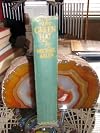
The Green Hat
by Michael Arlen
On This Page
Description
'The Green hat' perfectly reflects the atmosphere of the 1920s - the post-war fashion for verbal smartness, youthful cynicism and the spirit of rebellion of the 'bright young things' of Mayfair.Tags
Recommendations
















Member Recommendations
Member Reviews
I so wanted to read this book when I was a teenager greedily devouring Evelyn Waugh, Harold Acton, Nancy Mitford, and all those characters of that mad jazz age in the 1920s. It was a legendary book, cited in the pages of everyone who was everyone, but sadly missing from Gloucestershire libraries at the time.
So... imagine a novel written by Antony Blanche from Brideshead, and you've pretty much got the Green Hat. Most of the prose would benefit enormously from being read with a drawly speech impediment between brandy alexanders - filthy rich, daringly shocking, the novel visits all the best places (from the Paris convent where all the best inconvenient pregnancies go to the nightclub of the night (sure to close down next week) to the show more stateliest of homes). And it is seen with all the best people, drinks the best drinks - and is ultimately a book that only an outsider could have written. Comparing anyone to Evelyn Waugh is unfair, but I think the main contrast is that Waugh never stops laughing, while Arlen is desperately serious at all times. show less
So... imagine a novel written by Antony Blanche from Brideshead, and you've pretty much got the Green Hat. Most of the prose would benefit enormously from being read with a drawly speech impediment between brandy alexanders - filthy rich, daringly shocking, the novel visits all the best places (from the Paris convent where all the best inconvenient pregnancies go to the nightclub of the night (sure to close down next week) to the show more stateliest of homes). And it is seen with all the best people, drinks the best drinks - and is ultimately a book that only an outsider could have written. Comparing anyone to Evelyn Waugh is unfair, but I think the main contrast is that Waugh never stops laughing, while Arlen is desperately serious at all times. show less
This isn't a great book, but it is a curiosity. I picked it up from the perspective of a die-hard Greta Garbo fan. The Green Hat served as source material for the 1928 silent A Woman of Affairs (arguably one of Garbo's best silent films). Considering how rotten some film adaptations were at that time in comparison to the books they were based off of (e.g. both Garbo versions of Tolstoy's Anna Karenina), it's interesting to see how Bess Meredyth and Clarence Brown did with this novel. The film adaptation is, in some ways, more compelling than the novel, which sometimes smacks of an irritating cross between John Galsworthy and Graham Greene. If you're into the movie, though, it is worth reading the book to decide for yourself.
Another show more point of interest lies in the fact that The Green Hat was the bestselling sensation of 1924. One can't but help reflecting on how much the general public has changed its taste as it has transitioned from a culture that made this book into a sensation into one now in which Harry Potter is the talk of the town. show less
Another show more point of interest lies in the fact that The Green Hat was the bestselling sensation of 1924. One can't but help reflecting on how much the general public has changed its taste as it has transitioned from a culture that made this book into a sensation into one now in which Harry Potter is the talk of the town. show less
Sat on the To Read pile for 12 years (not quite a personal record, sadly). I was hesitant having read the reviews, and probably wouldn't have persevered if it hadn't been on the 1001 list.
After all that time, it was actually better than I'd expected. Some very arch, dry humour, and lots of epigrammatic sentences - particularly at chapter openings. The story itself is melodramatic, which I don't dislike, and interesting enough.
With that said, it does have significant weaknesses, and I'm not convinced it deserves its role on the 1001 list. There is a lack of rounded or likeable characters, and (though this is praised in the foreword) its sense of place is oddly shallow - carried along solely by allusions to aristocratic 1920s London, show more without any real granularity or realism.
Its main weakness is a prose style that is far too arch - whilst being simultaneously meandering. Told direct, this could have been a short story. Ulysses is referenced in the opening chapter, but if Arlen had pretences being Joyce, it isn't shown in his prose here.
3 stars for the few sentences that made me gasp. show less
After all that time, it was actually better than I'd expected. Some very arch, dry humour, and lots of epigrammatic sentences - particularly at chapter openings. The story itself is melodramatic, which I don't dislike, and interesting enough.
With that said, it does have significant weaknesses, and I'm not convinced it deserves its role on the 1001 list. There is a lack of rounded or likeable characters, and (though this is praised in the foreword) its sense of place is oddly shallow - carried along solely by allusions to aristocratic 1920s London, show more without any real granularity or realism.
Its main weakness is a prose style that is far too arch - whilst being simultaneously meandering. Told direct, this could have been a short story. Ulysses is referenced in the opening chapter, but if Arlen had pretences being Joyce, it isn't shown in his prose here.
3 stars for the few sentences that made me gasp. show less
First published in 1924, The Green Hat seems to be a reflection on a generation that came through the first world war and is now living a shallow life of gaiety, and non-purpose. The book was very popular during the 1920s, a melodrama that is centred around Iris Storm, a woman who has caused death and destruction but seems to have a fatal appeal for men. The writing was dense and poetic but the author had clearly studied British society in order to have produced this well drawn picture of the upper classes.
Iris, who wears a green hat and drives a yellow Hispano-Suiza is presented as a woman of easy virtue but in fact, has a dark secret in her past. It is obvious that the narrator of the book is totally fascinated by her and apparently show more the author based her on Nancy Cunard, who I now feel that I need to investigate. I simply wasn’t in the right mood to enjoy this book, although I can see it’s merit and appreciate the author’s talent for writing.
I had to push myself through the first few chapters but after that the story did pull me in. There were plenty of “hot button” issues such as suicide, homosexuality, venereal disease, and excessive drinking touched upon but, for me, the tragic story was a little too dark, without the sparkle that Fitzgerald can add or the humour of Waugh. show less
Iris, who wears a green hat and drives a yellow Hispano-Suiza is presented as a woman of easy virtue but in fact, has a dark secret in her past. It is obvious that the narrator of the book is totally fascinated by her and apparently show more the author based her on Nancy Cunard, who I now feel that I need to investigate. I simply wasn’t in the right mood to enjoy this book, although I can see it’s merit and appreciate the author’s talent for writing.
I had to push myself through the first few chapters but after that the story did pull me in. There were plenty of “hot button” issues such as suicide, homosexuality, venereal disease, and excessive drinking touched upon but, for me, the tragic story was a little too dark, without the sparkle that Fitzgerald can add or the humour of Waugh. show less
This book was a smash when it was published in 1924, and shows up on some lists of novels you absolutely must read. For me, however, it was a bit of a dud. The novel recounts the adventures of its beautiful, damned, and doomed heroine, Iris Storm, whose most notable feature is that she drives around London in a massive yellow Hispano-Suiza. She and her alcoholic twin brother are the last of a long line of nobility; the family is financially ruined, but Iris has managed to keep up her end (and the Hispano Suiza) by two marriages rapidly followed by widowhood. In its time, the story was shocking -- Iris sleeps around, even though she feels dreadful about it.
Why didn't I like this book? First, the prose struck me a generally overwrought, show more and sometimes needlessly confusing. True, there are some nicely pointed bits, but in general the lush style struck me as altogether too much of a good thing. Secondly, the novel is dated, in a bad way. Most novels that survive do become dated in one or another aspect, but there is something about many of them that transcends their time and place, which can make the "datedness" a plus rather than a minus -- another lens through which to view the human condition. This one, for me, does not acheive that --the characters are to a large extent caricatures of their time and place, and they don't emerge as human beings. Finally, the story -- again for me -- got dull, lots and lots of dashing about without much being revealed until the "shock" ending. Having guessed what that was going to be, I sped through the second half of the novel at top speed.
This novel treats on some of the themes of "Brideshead Revisited". The aristocracy is revered, simply for being aristocratic (yes, one is tempted to observe, the aristocracy is different from you and me. They have more ancestors"). The family at the center of the story is seriously troubled, and the narrator is an outsider who becomes involved in the story. And this book shares some of the linguistic opulence of "Brideshead". Waugh, however, did it much, much better than Arlen. Besides, one ends up caring about the characters in "Brideshead". I never did have much sense of the characters in "The Green Hat", let alone an interest in them. show less
Why didn't I like this book? First, the prose struck me a generally overwrought, show more and sometimes needlessly confusing. True, there are some nicely pointed bits, but in general the lush style struck me as altogether too much of a good thing. Secondly, the novel is dated, in a bad way. Most novels that survive do become dated in one or another aspect, but there is something about many of them that transcends their time and place, which can make the "datedness" a plus rather than a minus -- another lens through which to view the human condition. This one, for me, does not acheive that --the characters are to a large extent caricatures of their time and place, and they don't emerge as human beings. Finally, the story -- again for me -- got dull, lots and lots of dashing about without much being revealed until the "shock" ending. Having guessed what that was going to be, I sped through the second half of the novel at top speed.
This novel treats on some of the themes of "Brideshead Revisited". The aristocracy is revered, simply for being aristocratic (yes, one is tempted to observe, the aristocracy is different from you and me. They have more ancestors"). The family at the center of the story is seriously troubled, and the narrator is an outsider who becomes involved in the story. And this book shares some of the linguistic opulence of "Brideshead". Waugh, however, did it much, much better than Arlen. Besides, one ends up caring about the characters in "Brideshead". I never did have much sense of the characters in "The Green Hat", let alone an interest in them. show less
The Green hat was a huge international bestseller in the 1920s and must have been quite scandalous at the time. Few books in that era featured an 18-year-old heroine who declared that she needed to have sex and would do so whether she married her true love or not. It's the story of Iris, the daughter of decayed English aristocracy whose life is plagued by tragedy. The book is a hoot to read, not that the author intended it to be. Arlen's prose is mostly turgid and convoluted with the occasional pretty turn of phrase and astute observation. (I like the definition of casual elegance: the combination of a good tailor and a lean Englishman.) Moreover, most of the characters talk in the stiff-upper-lip, no-letting-down-the-side parlance that show more sounds ridiculous to modern ears. Arlen was an ethnic Armenian who was raised in Bulgaria and he brings an outsider's perspective to British upper class society that is fawning and dismissive by turns. It was like a cheap date: I had fun, but wouldn't care to do it again. show less
The Green Hat was written by a Armenian author, naturalized citizen of the United Kingdom and published in the London and the US in 1924. I read a 1924 edition, ILL loan book. As I mentioned, the pages were quite fragile. I am so thankful for libraries and ILL loans that make it possible to read these books. The Green Hat tells the story of Iris Storm. It is a satirical romance set in London. Iris is prevented from marrying her childhood sweetheart Napier Harpenden. She is widowed twice and suffers through several love affairs. There is so much tragedy that you just know there is going to be more and therefore there is an element of suspense in this modernistic novel. The narrator is a writer and introduces self, “writes the show more author”. Many authors and literary works are mentioned in the early chapters. I just finished reading Tono-Bongay by H. G. Wells and this book mentions H. G. Wells and mentions his book Tono-Bongay. It also mentions The Good Soldier and Ulysses. Also of note is the bigotry in the book. The author refers to Jews, Red Indians and glorious n……
***contains some spoilers***
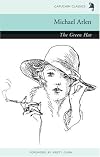
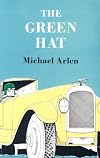
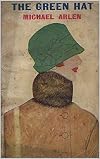
Iris is of the March family. Her twin brother is a drunk and she meets the author when she tries to visit her twin brother. This book is full of suicides and telling lies to save honor. After her first husband dies by suicide, Iris tells everyone he died “for purity”. Everyone assumes that Iris wasn’t pure when she went to her marriage bed and her husband therefore jumped out the window. Her second husband gives her an emerald that doesn’t fit and tells her that she must learn to keep the ring on as she must learn to keep herself from affairs. That husband dies too. So Iris wears a large brimmed green hat and wears a green ring. There is a lot of green in the descriptions of clothing and scenes. Iris drove a yellow Hispano-Suiza car with a stork hood adornment. She drove fast. Iris decides that she will not let anyone keep her from Napier any longer. They are going to run away together and finally enjoy the love they have for each other. Only Napier is too much like his father and his concern for his own reputation makes him tell everyone what Iris meant when she told everyone her husband had died “for purity”. In the end, Napier fails her and Napier’s father wins the battle. Iris leaves with her green hat in her exotic car that “can do 76 if you like”. This book may have been written in 1924 I still found it to be very enjoyable story of high-speed modernity. The book has been republished by it has been republished by Capuchin Classics and I would recommend it if you like tragedy, romance and modernity. show less
***contains some spoilers***
Iris is of the March family. Her twin brother is a drunk and she meets the author when she tries to visit her twin brother. This book is full of suicides and telling lies to save honor. After her first husband dies by suicide, Iris tells everyone he died “for purity”. Everyone assumes that Iris wasn’t pure when she went to her marriage bed and her husband therefore jumped out the window. Her second husband gives her an emerald that doesn’t fit and tells her that she must learn to keep the ring on as she must learn to keep herself from affairs. That husband dies too. So Iris wears a large brimmed green hat and wears a green ring. There is a lot of green in the descriptions of clothing and scenes. Iris drove a yellow Hispano-Suiza car with a stork hood adornment. She drove fast. Iris decides that she will not let anyone keep her from Napier any longer. They are going to run away together and finally enjoy the love they have for each other. Only Napier is too much like his father and his concern for his own reputation makes him tell everyone what Iris meant when she told everyone her husband had died “for purity”. In the end, Napier fails her and Napier’s father wins the battle. Iris leaves with her green hat in her exotic car that “can do 76 if you like”. This book may have been written in 1924 I still found it to be very enjoyable story of high-speed modernity. The book has been republished by it has been republished by Capuchin Classics and I would recommend it if you like tragedy, romance and modernity. show less
Members
- Recently Added By
Lists

1001 Books You Must Read Before You Die
1,448 works; 1,132 members

1,001 BYMRBYD Concensus
723 works; 27 members

Books referenced in A Very Great Profession: The Woman's Novel 1914-39
199 works; 6 members

My TBR
371 works; 3 members

Publisher's Weekly Bestsellers Part I - 1895-1939
399 works; 8 members
Author Information

26+ Works 586 Members
Awards and Honors
Series
Belongs to Publisher Series
Work Relationships
Common Knowledge
- Canonical title
- The Green Hat
- Original publication date
- 1924
- Important places
- England, UK; London, England, UK; Paris, France
- Important events
- Jazz Age
- Related movies
- A Woman of Affairs (1928 | IMDb)
Classifications
Statistics
- Members
- 312
- Popularity
- 102,326
- Reviews
- 10
- Rating
- (3.09)
- Languages
- 6 — Danish, English, French, Italian, Spanish, Swedish
- Media
- Paper, Ebook
- ISBNs
- 13
- ASINs
- 15