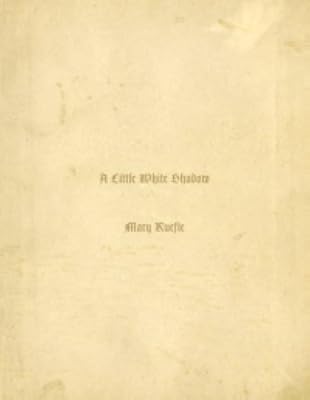
A Little White Shadow
by Mary Ruefle
On This Page
Description
Selectively painting over much of a forgotten nineteenth-century book, Ruefle's ninth publication brings new meaning to an old story. What remains visible is delicate poetry: artfully rendered, haunted by its former self, yet completely new. A high-quality replica of the original aged, delicate book in which Ruefle "erased" the text, this book will appeal to fans of poetry as well as visual art. Mary Ruefle is the author ofMadness, Rack, and Honey: Collected Lectures, a finalist for the 2012 show more National Book Critics Circle Award in criticism (Wave Books, 2012), andSelected Poems (Wave Books, 2010), winner of the William Carlos Williams Award. She has published ten other books of poetry, a book of prose (The Most of It, Wave Books, 2008), and a comic book,Go Home and Go to Bed!, (Pilot Books/Orange Table Comics, 2007); she is also an erasure artist, whose treatments of nineteenth century texts have been exhibited in museums and galleries, and include the publication ofA Little White Shadow (Wave Books, 2006). Ruefle is the recipient of numerous honors, including an Award in Literature from the American Academy of Arts and Letters, a Guggenheim fellowship, a National Endowment for the Arts fellowship, and a Whiting Award. She lives in Bennington, Vermont, and teaches in the MFA program at Vermont College. show lessTags
Recommendations



Member Reviews
I found this unique little book, while I was scanning the poetry section of the library. The book was so small and so cute, with its plain clean cover, that I just had to take it with me.
Inside, A Little White Shadow is something of a mystery. In the tradition of found poetry, Rueffle has taken a document, called "A Little White Shadow" (which was apparently created in honor of a children's shelter in the late 1800s), and has whited out all of the text, except for a few phrases on each page. (It's not really clear whether the original text was in fact original, or if it was fabricated, but in the end it doesn't really matter.) The entire book is a single poem, created from the clips and phrases that have survived the whiting out. show more
Typically a found poem will use only words from an original document, which are then rearranged and collaged onto a new clean sheet of paper. By leaving the original text, Rueffle creates an entirely different feeling. We know the text is absent, and we feel its absence floating in our mind as we read what's left behind. The absence of the whited out text is a physical part of the poem. Some letters and words peek through like ghosts themselves.
The words that we can read manage to flow from one slightly disjointed image and thought to the next. There are genuinely beautiful lines that come through with a word at the top of the page joining and combining with a phrase at the bottom through the act of reading (we the readers are the glue that holds it together), and it's beautiful. Sometimes words and phrases on the page can be read in different ways, sometimes it's crystal clear. This book offers multi-levels of interpretation and meaning, and by not including any explanation, Rueffle leaves the reader to discover those meanings on their own.
I am deeply fascinated by this book. It's one of those creative choices on the part of a poet that I consider brilliant, almost genius. It's the kind of beauty that makes me jealous to have not thought of it myself, knowing that no replication can achieve the same. I only wish I didn't have to send it back to the library.
You can see more of this kind of work at her website: http://www.maryruefle.com/ show less
Inside, A Little White Shadow is something of a mystery. In the tradition of found poetry, Rueffle has taken a document, called "A Little White Shadow" (which was apparently created in honor of a children's shelter in the late 1800s), and has whited out all of the text, except for a few phrases on each page. (It's not really clear whether the original text was in fact original, or if it was fabricated, but in the end it doesn't really matter.) The entire book is a single poem, created from the clips and phrases that have survived the whiting out. show more
Typically a found poem will use only words from an original document, which are then rearranged and collaged onto a new clean sheet of paper. By leaving the original text, Rueffle creates an entirely different feeling. We know the text is absent, and we feel its absence floating in our mind as we read what's left behind. The absence of the whited out text is a physical part of the poem. Some letters and words peek through like ghosts themselves.
The words that we can read manage to flow from one slightly disjointed image and thought to the next. There are genuinely beautiful lines that come through with a word at the top of the page joining and combining with a phrase at the bottom through the act of reading (we the readers are the glue that holds it together), and it's beautiful. Sometimes words and phrases on the page can be read in different ways, sometimes it's crystal clear. This book offers multi-levels of interpretation and meaning, and by not including any explanation, Rueffle leaves the reader to discover those meanings on their own.
I am deeply fascinated by this book. It's one of those creative choices on the part of a poet that I consider brilliant, almost genius. It's the kind of beauty that makes me jealous to have not thought of it myself, knowing that no replication can achieve the same. I only wish I didn't have to send it back to the library.
You can see more of this kind of work at her website: http://www.maryruefle.com/ show less
Loves me some erasure. And also Mary Ruefle. So we're really good here.
Very enjoyable.
Ratings
Members
- Recently Added By
Lists

Gimmicks
56 works; 12 members
Author Information

23+ Works 1,326 Members
Classifications
Statistics
- Members
- 88
- Popularity
- 364,056
- Reviews
- 3
- Rating
- (3.83)
- Languages
- English
- Media
- Paper
- ISBNs
- 2