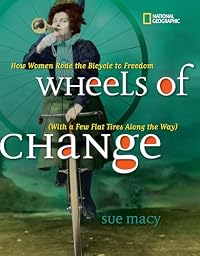
Wheels of Change: How Women Rode the Bicycle to Freedom (With a Few Flat Tires Along the Way)
by Sue Macy
On This Page
Description
Explore the role the bicycle played in the women's liberation movement.Tags
Recommendations












































Member Reviews
Do you remember the freedom you felt once you were old enough to get a two-wheeled bike and allowed to zoom around your neighborhood? Wheels of Change: How Women Rode the Bicycle to Freedom (With a Few Flat tires Along the Way) by Sue Macy recalls when women first got their own set of wheels and set off unescorted into the world.
And that whole unescorted thing really ticked off conservatives at the time. As Macy notes in chapter 2, The Devil's Advance Agent, in the late 1800s women and men dated while being chaperoned by adults, usually in the home of the young woman. With the advent of the bicycle and society's approval for women to jump on board with this new fad, the reach of chaperones was cut. Thus begins the spiral to fogged up show more car windows on a Friday night. One has to remember that this was at the same time most physical activity, especially sporting activities, was seen as bad for women's bodies and especially their reproductive systems.
One also must remember that in the late 1800s women were wearing HUGE dresses. How is a lady supposed to ride a bicycle? Macy shows photos of bicycles that were designed for side-saddle as well as with contraptions so that dresses wouldn't get caught in the wheels or gears. Then the young women of the late 1800s rediscovered Amelia Bloomers invention - Lady Pants! - or bloomers.
This is a fun trip through the joint history of the bicycle and women's rights. From wheels to bloomers to votes for women, it's all interconnected. You'll be amazed at how similar the conversations we are having today about women's rights sound a lot like the ones in the late 1800s about women riding bicycles.
This a National Geographic book for kids. But don't let that stop those without kids from not buying this book.
Disclaimers: A publicist offered me a copy for review for women's history month. Obviously, I'm late writing this baby up. show less
And that whole unescorted thing really ticked off conservatives at the time. As Macy notes in chapter 2, The Devil's Advance Agent, in the late 1800s women and men dated while being chaperoned by adults, usually in the home of the young woman. With the advent of the bicycle and society's approval for women to jump on board with this new fad, the reach of chaperones was cut. Thus begins the spiral to fogged up show more car windows on a Friday night. One has to remember that this was at the same time most physical activity, especially sporting activities, was seen as bad for women's bodies and especially their reproductive systems.
One also must remember that in the late 1800s women were wearing HUGE dresses. How is a lady supposed to ride a bicycle? Macy shows photos of bicycles that were designed for side-saddle as well as with contraptions so that dresses wouldn't get caught in the wheels or gears. Then the young women of the late 1800s rediscovered Amelia Bloomers invention - Lady Pants! - or bloomers.
This is a fun trip through the joint history of the bicycle and women's rights. From wheels to bloomers to votes for women, it's all interconnected. You'll be amazed at how similar the conversations we are having today about women's rights sound a lot like the ones in the late 1800s about women riding bicycles.
This a National Geographic book for kids. But don't let that stop those without kids from not buying this book.
Disclaimers: A publicist offered me a copy for review for women's history month. Obviously, I'm late writing this baby up. show less
Bicycle history and first-wave feminism are deftly woven into a five-chapter narrative tracing the impact of the "silent steed" on 19th-century America. The historical tour begins in the 1870s, when Albert Pope imported the bicycle industry from England, and then navigates the social commentary of the 1890s concerning women on bicycles. Next the book delves into the significant fashion changes wrought by this new form of transportation and the daring exploits of the first female competitive cyclists. The concluding chapter situates the bicycle amid the broad social change at the turn of the century. Stops along the way feature women inventors, activists, and athletes, and also highlight the role of bicycles in the pop culture of the show more era. Fascinating archival images illustrate the text at every turn, and the author carefully attributes each quote and picture in captions and appendices. The intriguing focus of this history may provide a strong draw, but it is the rich detail that will ultimately captivate readers and inspire further exploration in a number of directions.
My VOYA ratings: 4Q ("Better than most, marred by occasional lapses") and 4P ("Broad general or genre YA appeal").
I love the way this book got me excited about history from so many different angles: bicycle design, transportation infrastructure, fashion, women's suffrage, poster art, and biographies galore! It also inspired me to look at the present world with renewed curiosity and enthusiasm. I can't wait to introduce it to many potential readers.
The only disappointing aspect is its somewhat restrictive design. The scrapbook layout works hard to cram as much content as possible into a slim volume of 100 pages and average height, with the result that many background images are compromised. I wish the publisher had let the format expand in height or girth and allowed the rich detail room to breathe. show less
My VOYA ratings: 4Q ("Better than most, marred by occasional lapses") and 4P ("Broad general or genre YA appeal").
I love the way this book got me excited about history from so many different angles: bicycle design, transportation infrastructure, fashion, women's suffrage, poster art, and biographies galore! It also inspired me to look at the present world with renewed curiosity and enthusiasm. I can't wait to introduce it to many potential readers.
The only disappointing aspect is its somewhat restrictive design. The scrapbook layout works hard to cram as much content as possible into a slim volume of 100 pages and average height, with the result that many background images are compromised. I wish the publisher had let the format expand in height or girth and allowed the rich detail room to breathe. show less
It's helpful and comforting at times to read about the bizarre ideas people not long ago had about women and the chaos that would ensue if women did reckless things like exercise or wear clothing that didn't restrict breathing or the ability to pass through doorways. It puts progress in perspective. I should have gotten the physical copy of this book because I suspect the illustrations are amusing.
Macy, Sue. (2011). Wheels of Change: How Women Rode the Bicycle to Freedom (With a Few Flat Tires Along the Way). Washington D.C.: National Geographic. 96 pp. ISBN 978-1-4263-0761-4 (Hard Cover); $18.95.
Impeccable research, vintage archival images, and an engaging narrative flow characterize Macy’s scintillating and often humorous look at how the bicycle pumps up our view of women in our society. I especially enjoy the long list of “don’ts” for women wheelers in the Omaha Daily Bee. “Don’t carry a flask,” is one of over 20 don’ts for women. Macy has a book that will serve as a model for how to use primary sources to tell your own story about history. When we consider the page layout and the quality of the paper and show more images, we have nonfiction at its best. Students will be interested in Annie Cohen Kopchovsky’s trip around the world, in which she not only changes out of her heavy skirts but also changes her name, which is emblematic of the gradual change in the way women view their own place in society. During her bike trip around the world, Annie becomes a celebrity, complete with sponsorship contracts. Students will also appreciate the way Macy integrates facts about women cyclists and compares them with the way in which women are viewed in society at the time. Especially interesting is the ending chapter in which Elizabeth Cady Stanton discusses the place of the bicycle in the women’s movement. Not only are people like Annie Kopchovsky Londonderry removing heavy skirts, but corsets are going away and women are no longer as dependent upon men for transportation. This is a book to make us all appreciate our bikes all the more. A timeline, resources, references for the quotes, and an index make this nonfiction book reliable and accurate, as well as entertaining. Recommended for all middle school and high school libraries. show less
Impeccable research, vintage archival images, and an engaging narrative flow characterize Macy’s scintillating and often humorous look at how the bicycle pumps up our view of women in our society. I especially enjoy the long list of “don’ts” for women wheelers in the Omaha Daily Bee. “Don’t carry a flask,” is one of over 20 don’ts for women. Macy has a book that will serve as a model for how to use primary sources to tell your own story about history. When we consider the page layout and the quality of the paper and show more images, we have nonfiction at its best. Students will be interested in Annie Cohen Kopchovsky’s trip around the world, in which she not only changes out of her heavy skirts but also changes her name, which is emblematic of the gradual change in the way women view their own place in society. During her bike trip around the world, Annie becomes a celebrity, complete with sponsorship contracts. Students will also appreciate the way Macy integrates facts about women cyclists and compares them with the way in which women are viewed in society at the time. Especially interesting is the ending chapter in which Elizabeth Cady Stanton discusses the place of the bicycle in the women’s movement. Not only are people like Annie Kopchovsky Londonderry removing heavy skirts, but corsets are going away and women are no longer as dependent upon men for transportation. This is a book to make us all appreciate our bikes all the more. A timeline, resources, references for the quotes, and an index make this nonfiction book reliable and accurate, as well as entertaining. Recommended for all middle school and high school libraries. show less
What a fun book! This book really understands the power of visual learning and uses images in a fun, creative, and non-distracting way. There is so much information jam packed into under 100 pages of text and even though the book is written to inform reader about the history of bicycles from the perspective of women, it’s more of a narrative than dry list of names, dates, and places. Not only can readers learn a lot about the evolution of the bicycle as a machine and as a factor in urbanization, but they can also uncover the beginnings of feminism from a completely new perspective. SO GOOD!
A delightful and engaging look into women's early struggles for equality through the history of the bicycle and its emergence in the late 19th century. Wheels of Change captures the excitement and enthusiasm for cycling pervasive in the late 1800s while poking fun at the rigid conservatism that led to arguments over the appropriate weight of women's "wheeling" undergarments, among other comically true topics. The book is effective in its use of a scrapbook-like style, using images from advertisements, newspaper clippings, photographs, and notable quotes alongside historical descriptions of cycling and its influence on the changing roles of women in society.
This interesting micro history is full of fascinating tidbits and and packed with period photography and ephemera. But will kids read it?
Macy begins with the invention and gradual improvement of the bicycle, moving naturally into the changes it made in women's lives and society in general, from improved roads to advertising. She looks at the responses from women who encouraged the use of the bicycle for health and independence, from men who felt it made women too independent, and from women who thought it encouraged loose morals. Reactions from police, changes in fashion, professional cyclists and races, every conceivable aspect is addressed here.
The book includes excerpts from newspapers and magazines of the day, photographs, show more advertising, maps, quotes, and more. There is also a timeline, resources, and index, and sources of quotes and illustrations.
It's not a lengthy book - only 95 pages - and written in a brisk, fast-paced style. Large sections of text are broken up with insets of various information and ephemera, as well as illustrations.
I found it interesting, but how many kids are interested in the history of cycling and its effect on women's rights? I think we're back again to the public vs. school library. When kids check out nonfiction at my library, it's casual; they like animals or sports or books about machines or war, so they check them out. A small portion of circulation is kids who need books for specific assignments; biographies of a certain length, obscure inventors, weird animals, or biomes are the main topics. But kids are reading more challenging nonfiction - especially history, which doesn't circulate much. I fairly sure they're checking out more nonfiction from their school libraries, where they have a closer relationship with the school librarian and more immediate access to materials for assignments.
Verdict: Not a good fit for my library, due to lack of interest, but I would recommend this to a school library, especially a middle school or high school library, or to a large public library.
ISBN: 9781426307621; Published January 11, 2011 by National Geographic; Borrowed from another library show less
Macy begins with the invention and gradual improvement of the bicycle, moving naturally into the changes it made in women's lives and society in general, from improved roads to advertising. She looks at the responses from women who encouraged the use of the bicycle for health and independence, from men who felt it made women too independent, and from women who thought it encouraged loose morals. Reactions from police, changes in fashion, professional cyclists and races, every conceivable aspect is addressed here.
The book includes excerpts from newspapers and magazines of the day, photographs, show more advertising, maps, quotes, and more. There is also a timeline, resources, and index, and sources of quotes and illustrations.
It's not a lengthy book - only 95 pages - and written in a brisk, fast-paced style. Large sections of text are broken up with insets of various information and ephemera, as well as illustrations.
I found it interesting, but how many kids are interested in the history of cycling and its effect on women's rights? I think we're back again to the public vs. school library. When kids check out nonfiction at my library, it's casual; they like animals or sports or books about machines or war, so they check them out. A small portion of circulation is kids who need books for specific assignments; biographies of a certain length, obscure inventors, weird animals, or biomes are the main topics. But kids are reading more challenging nonfiction - especially history, which doesn't circulate much. I fairly sure they're checking out more nonfiction from their school libraries, where they have a closer relationship with the school librarian and more immediate access to materials for assignments.
Verdict: Not a good fit for my library, due to lack of interest, but I would recommend this to a school library, especially a middle school or high school library, or to a large public library.
ISBN: 9781426307621; Published January 11, 2011 by National Geographic; Borrowed from another library show less
Members
- Recently Added By
Author Information

21 Works 1,569 Members
Awards and Honors
Awards
Common Knowledge
- Original publication date
- 2012
Classifications
- Genres
- Nonfiction, Tween, Kids, Sports and Leisure
- DDC/MDS
- 796.6082 — Arts & recreation Recreation, sports, and performing arts Sports Cycling standard subdivisions
- LCC
- GV1057 .M33 — Geography, Anthropology and Recreation Recreation. Leisure Recreation. Leisure Sports Cycling. Bicycling. Motorcycling
- BISAC
Statistics
- Members
- 314
- Popularity
- 100,955
- Reviews
- 34
- Rating
- (4.11)
- Languages
- English
- Media
- Paper, Audiobook
- ISBNs
- 13