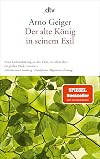
The Old King in His Exile
by Arno Geiger
On This Page
Description
International Bestseller Shortlisted for the Helen and Kurt Wolff Prize and Schlegel-Tieck Prize What makes us who we are? Arno Geiger's father was never an easy man to know and when he developed Alzheimer's, Arno realised he was not going to ask for help. "As my father can no longer cross the bridge into my world, I have to go over to his." So Arno sets out on a journey to get to know him at last. Born in 1926 in the Austrian Alps, into a farming family who had an orchard, kept three cows, show more and made schnapps in the cellar, his father was conscripted into World War II as a "schoolboy soldier" - an experience he rarely spoke about, though it marked him. Striking up a new friendship, Arno walks with him in the village and the landscape they both grew up in and listens to his words, which are often full of unexpected poetry. Through his intelligent, moving and often funny account, we begin to see that whatever happens in old age, a human being retains their past and their character. Translated into nearly 30 languages,The Old King in His Exile will offer solace and insight to anyone coping with a loved one's aging. show lessTags
Recommendations

































Member Recommendations


JuliaMaria Tochter-Mutter und Vater-Sohn im Angesicht des Verschwindens der Lebenstüchtigkeit durch Alzheimer
Member Reviews
This memoir surprised me so much. It mapped out a new definition of "honest" for me. Most of the time reviewers call a memoir "honest" when it tells everything, every tiny excruciating detail of what (usually bad) thing happened to the memoirist. This writing is honest because of its restraint. It's honest for the way Geiger elucidates his own frequent failings--failing to always be patient with a father with Alzheimers, for example--as being normal, and human. He doesn't blame himself, or defend himself, either. He just records, with loving compassion, what happened between him and his father in his father's last years.
Extraordinary also for the way Geiger interweaves scenes from his father's childhood and early youth and how his show more father's experiences during the war years changed him for life. All of this is presented with great love that is never sentimental or false. Somehow too Geiger has written a book about loss that ends up being a celebration of humanity. show less
Extraordinary also for the way Geiger interweaves scenes from his father's childhood and early youth and how his show more father's experiences during the war years changed him for life. All of this is presented with great love that is never sentimental or false. Somehow too Geiger has written a book about loss that ends up being a celebration of humanity. show less
https://msarki.tumblr.com/post/154458464683/the-old-king-in-his-exile-by-arno-ge...
Written in a relaxed and informal manner, Arno Geiger manages to soberly show the ravages on family and loved ones due to dementia and Alzheimer’s disease. Though stricken by such a terrible long and drawn-out death sentence, his father August, being extremely intelligent and clever, offers several moments of joy, clarity, and fascination with what remains of his shrinking world and love for language. But no longer able to care for their sick father, and finding few caregivers who can actually handle him, they resort to placing him in an “old folks” home. The siblings then proceed to clear out years of clutter from the family home, a house built by show more hand by their father August. Surprisingly, it took two dumpsters to achieve their final goal as August never threw anything away in case one day he might need them. And the many rooms their father occupied throughout his life were now reduced to two he might visit on Sundays and special occasions. In this fine memoir Arno Geiger composes an interesting story about a terrible disease and Geiger’s failure in lessening degrees in getting to know his father as intimately as he determines to. Time will eventually take his father completely from him, but not before a gallant attempt at possibility; to pick up where they left off so many years ago and recapture a deeper meaning to their relationship. Written while his father was still alive, this book is a testament to love and what can still be recovered in its remains. show less
Written in a relaxed and informal manner, Arno Geiger manages to soberly show the ravages on family and loved ones due to dementia and Alzheimer’s disease. Though stricken by such a terrible long and drawn-out death sentence, his father August, being extremely intelligent and clever, offers several moments of joy, clarity, and fascination with what remains of his shrinking world and love for language. But no longer able to care for their sick father, and finding few caregivers who can actually handle him, they resort to placing him in an “old folks” home. The siblings then proceed to clear out years of clutter from the family home, a house built by show more hand by their father August. Surprisingly, it took two dumpsters to achieve their final goal as August never threw anything away in case one day he might need them. And the many rooms their father occupied throughout his life were now reduced to two he might visit on Sundays and special occasions. In this fine memoir Arno Geiger composes an interesting story about a terrible disease and Geiger’s failure in lessening degrees in getting to know his father as intimately as he determines to. Time will eventually take his father completely from him, but not before a gallant attempt at possibility; to pick up where they left off so many years ago and recapture a deeper meaning to their relationship. Written while his father was still alive, this book is a testament to love and what can still be recovered in its remains. show less
The author up with his family in Wolford, Austria. His father always had his quirks, his own way of doing things so when he first started exhibiting strange behavior, the author thought it had to do with stress and the fact that his long marriage to his mother had broken. He freely admits the family was frustrated and sometimes impatient with these new behaviors. It, of course turned out to be much more serious, Alzheimer disease, and the author had to adjust his own thinking, find a new way to have a relationship with his father. He found a way, by entering into his fathers new reality and getting to know and acknowledge the man he now was.
A very heartfelt book, not written at all emotionally, though of course the situation itself show more provides its own emotion. Often humorous, the disease moved slowly, his father often said insightful, and meaningful, things about his life as it was now. An interesting look at how a family pulled together Inman time of crisis, some more understanding than others. We also learn of his fathers past life, how he was as a father, a husband.
A lovingly written homage from a son to a father. show less
A very heartfelt book, not written at all emotionally, though of course the situation itself show more provides its own emotion. Often humorous, the disease moved slowly, his father often said insightful, and meaningful, things about his life as it was now. An interesting look at how a family pulled together Inman time of crisis, some more understanding than others. We also learn of his fathers past life, how he was as a father, a husband.
A lovingly written homage from a son to a father. show less
A very moving account of the life of Geiger's father as an old man with Alzheimer's. He portrays not only the changes in his father, but also the accomadations the family has to make to deal with the sickness.
Trotz der schrecklichen Diagnose Alzheimer gelingt Arno Geiger ein wunderbares Portrait seines Vaters. Sehr berührende Erzählung.
Arno Geiger ist ein wunderbares, zutiefst menschliches Buch gelungen, in dem er die Geschichte seines Vaters und dessen Alzheimererkrankung erzählt. Sanft schwebt Geigers Sprache, und aus den vielen kleinen Geschichten, die er erzählt, ergibt sich das Bild eines Mannes, der trotz der Krankheit weise geblieben ist und man erkennt, wie wenig es im Leben darauf ankommt, ob man immer den Überblick behalten kann.
Feb 17, 2011German
1
Arno Geiger hat ein berührendes Werk über seinen an Alzheimer erkrankten Vater geschaffen. Angereichert mit zahlreichen Zitaten beschreibt Geiger in einzelnen Episoden das Zusammenleben (und erneute Kennenlernen) mit seinem Vater während dem von Krankheit geprägten Lebensabschnitt. In Rückblicken lässt er das Leben seines Vaters und die eigene Kindheit Revue passieren.
Das Buch ist ein ruhiges Stück Literatur, Geiger kommt ohne große Höhepunkte aus und fesselt den Leser dennoch. Trotz des ernsten Themas ist es aber kein trauriges, schwermütiges Buch; ganz im Gegenteil, phasenweise strotzt es regelrecht vor Witz und Lebensbejahung. Nicht Mitleid oder Hilflosigkeit angesichts der unaufhaltsam fortschreitenden show more Krankheitsentwicklung stehen im Vordergrund, sondern gegenseitige Liebe, Respekt und die wirklich wichtigen Dinge des Lebens. show less
Das Buch ist ein ruhiges Stück Literatur, Geiger kommt ohne große Höhepunkte aus und fesselt den Leser dennoch. Trotz des ernsten Themas ist es aber kein trauriges, schwermütiges Buch; ganz im Gegenteil, phasenweise strotzt es regelrecht vor Witz und Lebensbejahung. Nicht Mitleid oder Hilflosigkeit angesichts der unaufhaltsam fortschreitenden show more Krankheitsentwicklung stehen im Vordergrund, sondern gegenseitige Liebe, Respekt und die wirklich wichtigen Dinge des Lebens. show less
Mar 6, 2015German
Members
- Recently Added By
Lists

Books Read in 2015
3,299 works; 127 members

Books Read in 2018
4,360 works; 110 members
Author Information

25 Works 1,179 Members
Some Editions
Awards and Honors
Awards
Distinctions
Series
Belongs to Publisher Series
Common Knowledge
- Canonical title
- The Old King in His Exile
- Original title
- Der alte König in seinem Exil
- Original publication date
- 2011
- People/Characters
- Arno Geiger; August Geiger
- Epigraph*
- Man muss auch das Allgemeinste persönlich darstellen.
Hokusai - Dedication
- none
- First words*
- Als ich sechs Jahre alt war, hörte mein Grossvater auf mich zu erkennen.
- Last words*
- (Click to show. Warning: May contain spoilers.)Es heisst: wer lange genug wartet, kann König werden.
- Original language
- German
*Some information comes from Common Knowledge in other languages. Click "Edit" for more information.
Classifications
- Genres
- Biography & Memoir, Fiction and Literature
- DDC/MDS
- 830 — Literature & rhetoric German & related literatures German literature and literatures of related languages
- LCC
- PT2667 .E4516 .A65 — Language and Literature German, Dutch and Scandinavian literatures German literature Individual authors or works 1961-2000
- BISAC
Statistics
- Members
- 345
- Popularity
- 91,375
- Reviews
- 16
- Rating
- (4.27)
- Languages
- 10 — Catalan, Czech, Danish, Dutch, English, Finnish, French, German, Italian, Swedish
- Media
- Paper, Audiobook, Ebook
- ISBNs
- 22
- ASINs
- 4