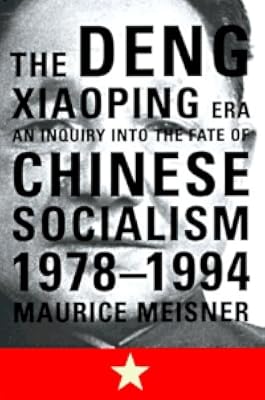
The Deng Xiaoping Era: An Inquiry into the Fate of Chinese Socialism, 1978-1994
by Maurice Meisner
On This Page
Description
"In the past decade, the world has become familiar with the image of Communist powers struggling in economic and political crisis. The crisis in China, whose economy is now the world's second largest and fastest growing, is perhaps the most serious of all, and Maurice Meisner's important new book shows how it stems from a deep spiritual and political dispute between capitalist realities and lingering socialist values and ideas." "The Deng Xiaoping Era is Meisner's analysis of that crisis and show more of how Deng Xiaoping's promise of socialist democracy degenerated into bureaucratic capitalism. He shows the ways in which the Deng regime grossly violated the social contract between the Chinese Communist Party and Chinese people, and how capitalism emerged as the dynamic force in today's socioeconomic and cultural life. Now, Meisner argues, after more than a decade of capitalist reforms, the Chinese spiritual malaise is deepening with the brutal suppression of the 1989 Democracy Movement and its politically repressive aftermath." "This indispensable study of contemporary Chinese politics - from the 1949 Revolution and the founding of the Maoist state to the establishment of Deng's regime and the social consequences of his reforms - is, as well, a formidable analysis of the failure of the world's greatest socialist experiment."--BOOK JACKET. show lessTags
Recommendations










Member Reviews
Now, it could be argued that Meisner was just stating the obvious in this book: that China, during Deng Xiaoping's rule, ceased to be even a quasi-socialist country except in name. Fortunately for the reader who has committed himself to finishing this dry and considerably lengthy work, it's a little more nuanced than that. At first glance the bleak authoritarianism of Deng appears more or less identical to the bleak authoritarianism of Mao, but Meisner notes the Chairman's support for the "four great freedoms" (to "speak out freely, air views freely, hold great debates, and write big character posters") near the end of his reign. These freedoms were added to the new state constitution in 1975, but mercilessly suppressed by Deng when he show more took power. The author's argument that Mao was motivated by even a vague approximation of genuine revolutionary spirit is unconvincing (as Meisner himself concedes, Mao had a history of encouraging criticism and even open revolt against party bureaucracy, only to crack down again when his whim shifted), but the fact remains that when Mao died there was at least a rudimentary constitutional foundation on which a democratic and fully socialist society might have been built. Deng wasted no time in smothering this possibility, cruelly turning against the young members of the Democracy Movement who had supported him during his ascendancy...and foreshadowing the grim events at Tiananmen Square in June 1989. Meanwhile, the end of rural collectivization also meant the end of job security, creating an entire class of "surplus" (i.e., unemployed) workers in the countryside: more than 100 million, according to the government's own reckoning in 1993.
Meisner held out some faint hope that the revolutionary tradition in China might be rekindled. Sadly this has not been the case, and the pro-capitalist economic reforms spearheaded by Deng have created (as capitalism inevitably does) a widening gap between a wealthy, corrupt minority and the masses of impoverished Chinese citizens. show less
Meisner held out some faint hope that the revolutionary tradition in China might be rekindled. Sadly this has not been the case, and the pro-capitalist economic reforms spearheaded by Deng have created (as capitalism inevitably does) a widening gap between a wealthy, corrupt minority and the masses of impoverished Chinese citizens. show less
Ratings
Members
- Recently Added By
Lists

"the china pill"
96 works; 2 members
Author Information
10 Works 380 Members
Classifications
- Genres
- Nonfiction, History, General Nonfiction, Politics and Government
- DDC/MDS
- 951.057 — History & geography History of Asia East Asia: China, Taiwan, Hong Kong, Korea History 1949- (People's Republic, 20th century) 1970-1979
- LCC
- DS779.26 — History of Europe, Asia, Africa and Oceania Asia History of Asia China History
- BISAC
Statistics
- Members
- 26
- Popularity
- 1,042,290
- Reviews
- 1
- Rating
- (4.00)
- Languages
- English
- Media
- Paper
- ISBNs
- 1