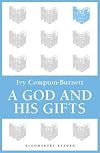
A God and His Gifts
by Ivy Compton-Burnett
On This Page
Description
First published in 1963, A God and his Gifts was the last of Ivy Compton-Burnett's novels to be published in her lifetime and is considered by many to be one of her best. Set in the claustrophobic world of Edwardian upper-class family life, it is the story of the self-willed and arrogant Hereward Egerton. In his marriage to Ada Merton he maintains a veneer of respectability but through his intimate relationships with his sister, Emmeline, and his son's future wife, Hetty, he steps beyond the show more bounds of conventional morality with both comic and tragic results... show lessTags
Recommendations


















Member Reviews
This was Compton-Burnett's last novel published during her lifetime, a complicated multi-generation family saga set in what seems to be a big Edwardian country house, although there are no references to external events that could give us any real clue to when it is set. The story centres around Hereward Egerton, heir to the estate and title and also a successful popular novelist. As we gradually discover, he is shamelessly exploiting everyone in his extended family (and beyond), with all sorts of dire consequences that keep coming to light as the story goes on, but his psychological power over the family is such that they just have to keep on forgiving him and adapting their lives to the new situation he has put them in. Whether or not show more she had anyone specific in mind, there are plenty of real-life examples of the "great artist" who behaved like that and mostly got away with it: Eric Gill would be an obvious example.
The book is written throughout in Compton-Burnett's notoriously stylised manner, in which there is no narratorial exposition at all, and almost all the work is done by direct speech. The speeches are tagged only when absolutely necessary. Most of the time you have to work out who is speaking from the content of the speech (sometimes you have to wait for the reply to be sure). The speeches themselves make no attempt to mimic natural conversation: they are there to tell us what the characters are thinking and trying to communicate with each other, not to mimic the way they say it. Each chapter is conspicuously structured like an act of a play (but without the helpful programme note that says "Act II: Seven years later"). We start off with two or three characters on stage discussing something, then gradually almost the whole cast comes on to give us their opinions, and the act closes with a few banal (but ever so slightly ambiguous...) platitudes from Galleon the butler, who serves chiefly as a Greek Chorus.
The idea of all this seems to be to create a kind of Brechtian Verfremdungseffekt - to put all the stage machinery of the novel in plain view so that the reader can't drift off into comforting preconceptions about Edwardian families, but looks critically at what is going on in this one as though seeing it for the first time. Given the metaphor of the god that runs through the story, there is obviously also a more conventional pattern of allusion to Greek drama going on as well. I'm not sure if I'm a complete convert, but it was an interesting experience, and certainly I was left with very little sympathy for Hereward by the end of the book! show less
The book is written throughout in Compton-Burnett's notoriously stylised manner, in which there is no narratorial exposition at all, and almost all the work is done by direct speech. The speeches are tagged only when absolutely necessary. Most of the time you have to work out who is speaking from the content of the speech (sometimes you have to wait for the reply to be sure). The speeches themselves make no attempt to mimic natural conversation: they are there to tell us what the characters are thinking and trying to communicate with each other, not to mimic the way they say it. Each chapter is conspicuously structured like an act of a play (but without the helpful programme note that says "Act II: Seven years later"). We start off with two or three characters on stage discussing something, then gradually almost the whole cast comes on to give us their opinions, and the act closes with a few banal (but ever so slightly ambiguous...) platitudes from Galleon the butler, who serves chiefly as a Greek Chorus.
The idea of all this seems to be to create a kind of Brechtian Verfremdungseffekt - to put all the stage machinery of the novel in plain view so that the reader can't drift off into comforting preconceptions about Edwardian families, but looks critically at what is going on in this one as though seeing it for the first time. Given the metaphor of the god that runs through the story, there is obviously also a more conventional pattern of allusion to Greek drama going on as well. I'm not sure if I'm a complete convert, but it was an interesting experience, and certainly I was left with very little sympathy for Hereward by the end of the book! show less
Ivy Compton-Burnett? How coincidental that her name scans like Amy Farrah Fowler, the girlfriend of Dr.Sheldon Cooper of Big Bang Theory. If, via some bizarre steampunk experiment gone awry, you could transduce those two personalities back to the Edwardian era...and flesh out their immediate family to include sons and illegitimate daughters and paramours and bastard grand children, and get them all to sit down in the same room (like on a sit-com) and hold a serious, yet inadvertently humorous discussion, of their moral shortfalls...well, then, you'd have a veritable facsimile of A God and His Gifts.
The novel reads more like a play. It's almost entirely dialogue. And each new chapter lurches forward about five years, like a man in leg show more braces staggering downhill. The most outrageous, witty, and unnatural observations are exchanged in deadpan manner - much like Sheldon and Amy discussing nuances of sarcasm. It's a novel that cannot be scanned or speed read. You almost have to read it aloud. In fact, if you had a sufficent number of eccentric friends, it might be fun to read aloud in a group.
The theme, essentially, is the strength and failures of a patriarchal Victorian household where much is expected of one, and consequently, much is repressed and hidden, and where mistakes/secrets are shuffled off to a town a day's journey away. The plot develops in a classical manner...much like a Greek tragedy. Concerning modern times, it much reminded me of the Clinton-Lewinsky affair wherein our national patriarch continued to press on, reviled, embarrassed, and yet begrudging admired to a second and third and fourth act politically. Some of the dialogue in the novel was achingly appropriate to those sordid times.
In short, the novel is a challenging but rewarding read, but like Proust or Joyce, be prepared to work a bit to get your money's worth. show less
The novel reads more like a play. It's almost entirely dialogue. And each new chapter lurches forward about five years, like a man in leg show more braces staggering downhill. The most outrageous, witty, and unnatural observations are exchanged in deadpan manner - much like Sheldon and Amy discussing nuances of sarcasm. It's a novel that cannot be scanned or speed read. You almost have to read it aloud. In fact, if you had a sufficent number of eccentric friends, it might be fun to read aloud in a group.
The theme, essentially, is the strength and failures of a patriarchal Victorian household where much is expected of one, and consequently, much is repressed and hidden, and where mistakes/secrets are shuffled off to a town a day's journey away. The plot develops in a classical manner...much like a Greek tragedy. Concerning modern times, it much reminded me of the Clinton-Lewinsky affair wherein our national patriarch continued to press on, reviled, embarrassed, and yet begrudging admired to a second and third and fourth act politically. Some of the dialogue in the novel was achingly appropriate to those sordid times.
In short, the novel is a challenging but rewarding read, but like Proust or Joyce, be prepared to work a bit to get your money's worth. show less
Another story where the dark underbelly of family life and individual consciences is glimpsed through a layer of incessant polyphonic chatter.
Ratings
Members
- Recently Added By
Lists

Books I've Read More Than Once
602 works; 49 members

Books Read in 2016
4,666 works; 199 members

Philip Ward's Lifetime Reading Plan
592 works; 22 members
Author Information

26 Works 2,654 Members
Ivy Compton-Burnett was born in Pinner, Middlesex, England on June 5, 1884. She studied classics at Royal Holloway College, London University, where she graduated in 1906. After publishing her first novel, Dolores, in 1911 she went on to become a prolific writer. Her other works include Pastors and Masters, Brothers and Sisters, Men and Wives, The show more Mighty and Their Fall, More Women Than Men, A House and Its Head, Manservant and Maidservant, and Two Worlds and Their Ways. In 1956, she won the James-Tait Black Memorial Award for Fiction for Mother and Son. In 1967, she was made a Dame Commander of the Order of the British Empire. She died on August 27, 1969. (Bowker Author Biography) show less
Awards and Honors
Notable Lists
Work Relationships
Is contained in
Common Knowledge
- Canonical title
- A God and His Gifts
- Original publication date
- 1963
- People/Characters*
- Hereward Egerton
- First words
- "I will ask you once more. It is the last time. Will you or will you not?"
*Some information comes from Common Knowledge in other languages. Click "Edit" for more information.
Classifications
Statistics
- Members
- 132
- Popularity
- 248,522
- Reviews
- 3
- Rating
- (4.10)
- Languages
- 5 — Dutch, English, French, Italian, Spanish
- Media
- Paper
- ISBNs
- 8
- ASINs
- 4