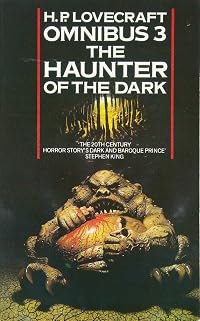
The H.P. Lovecraft Omnibus 3: The Haunter of the Dark and Other Tales
by H. P. Lovecraft
H. P. Lovecraft Omnibus (3)
On This Page
Description
H. P. Lovecraft was one of the greatest horror writers of all time. His seminal work appeared in the pages of legendary Weird Tales and has influenced countless writer of the macabre. This is one of those stories..
Tags
Recommendations
















Member Reviews
I awaked each morning in a fever, sometimes frantically trying to verify or discredit such information as fell within the range of modern human knowledge. Traditional facts took on new and doubtful aspects, and I marvelled at the dream fancy which could invent such surprising addenda to history and science.
I shivered at the mysteries the past may conceal, and trembled at the menaces the future may bring forth. What was hinted in the speech of post-human entities of the fate of mankind produced such an effect on me that I will not set it down here.
After man there would be the mighty beetle civilization, the bodies of whose members the cream of the Great Race would seize when the monstrous doom overtook the elder world. Later, as the show more earth’s span closed, the transferred minds would again migrate through time and space - to another stopping place in the bodies of the bulbous vegetable entities of Mercury. But there would be races after them, clinging pathetically to the cold planet and burrowing to its horror-filled core, before the utter end.
I have been reading the stories of H. P. Lovecraft one or two at a time, in more or less chronological order, as they came up in the H. P. Lovecraft Literary podcast. "The Haunter of the Dark" was the last of his stories to be covered in the podcast, so I have finally finished all three volumes of the omnibus.
According to the introduction by August Derlath , the stories in the third volume are some of Lovecraft's best, and it does include one of my favourites, "The Color Out of Space", which features a truly alien extraterrestrial being, one that couldn't be played by an actor in a rubber suit.. Another of the stories I really enjoyed is "The Shadow Out of Time", with it's time-travelling, body-switching aliens. On the other hand I didn't really like The Thing on the Doorstep", whose narrator tells the tale of his weak-willed friend's downfall at the hands of a scheming fellow-student. show less
I shivered at the mysteries the past may conceal, and trembled at the menaces the future may bring forth. What was hinted in the speech of post-human entities of the fate of mankind produced such an effect on me that I will not set it down here.
After man there would be the mighty beetle civilization, the bodies of whose members the cream of the Great Race would seize when the monstrous doom overtook the elder world. Later, as the show more earth’s span closed, the transferred minds would again migrate through time and space - to another stopping place in the bodies of the bulbous vegetable entities of Mercury. But there would be races after them, clinging pathetically to the cold planet and burrowing to its horror-filled core, before the utter end.
I have been reading the stories of H. P. Lovecraft one or two at a time, in more or less chronological order, as they came up in the H. P. Lovecraft Literary podcast. "The Haunter of the Dark" was the last of his stories to be covered in the podcast, so I have finally finished all three volumes of the omnibus.
According to the introduction by August Derlath , the stories in the third volume are some of Lovecraft's best, and it does include one of my favourites, "The Color Out of Space", which features a truly alien extraterrestrial being, one that couldn't be played by an actor in a rubber suit.. Another of the stories I really enjoyed is "The Shadow Out of Time", with it's time-travelling, body-switching aliens. On the other hand I didn't really like The Thing on the Doorstep", whose narrator tells the tale of his weak-willed friend's downfall at the hands of a scheming fellow-student. show less
A collection of the gothic horror tales of New England's precursor to Stephen King. The scariest special effects are the ones in your imagination: Lovecraft simply calls everything "horrifying" or "soul-chilling" and lets your own mind fill in the worst things it can imagine. A neat trick and, if you let it work, these books are just...horrifying. I bought this book around age twelve, and I've never found much to match it in print.
In intelligent and discerning selection of Lovecraft's best and/or most important short stories, this is the best jumping on point I've found for anyone wanting to discover one of Horror's most influential authors. Certainly a better route than trying to wade through one of the many complete collections on the market.
These stories deserve a place on the shelves of any horror fan.
These stories deserve a place on the shelves of any horror fan.
This is the third omnibus volume in a series of three, and contains all Lovecraft's best short stories. As typical with this genre, my rating of five stars really depends on one's task for pulp.
The volume contains 14 short stories, the stand outs being The Call of Cthulhu itself (the foundation for leagions of imitators, and very popular role-playing game; The Colour of of Space; The Thing on the Doorstep (possibly my favourite); and The Whisperer i Darkness
The volume contains 14 short stories, the stand outs being The Call of Cthulhu itself (the foundation for leagions of imitators, and very popular role-playing game; The Colour of of Space; The Thing on the Doorstep (possibly my favourite); and The Whisperer i Darkness
Ratings
Members
- Recently Added By
Author Information

1,917+ Works 73,693 Members
Howard Phillips Lovecraft, 1890 - 1937 H. P. Lovecraft was born on August 20, 1890 in Providence, Rhode Island. His mother was Sarah Susan Phillips Lovecraft and his father was Winfield Scott Lovecraft, a traveling salesman for Gorham & Co. Silversmtihs. Lovecraft was reciting poetry at the age of two and when he was three years old, his father show more suffered a mental breakdown and was admitted to Butler Hospital. He spent five years there before dying on July 19, 1898 of paresis, a form of neurosyphillis. During those five years, Lovecraft was told that his father was paralyzed and in a coma, which was not the case. His mother, two aunts and grandfather were now bringing up Lovecraft. He suffered from frequent illnesses as a boy, many of which were psychological. He began writing between the ages of six and seven and, at about the age of eight, he discovered science. He began to produce the hectographed journals, "The Scientific Gazette" (1899-1907) and "The Rhode Island Journal of Astronomy" (1903-07). His first appearance in print happened, in 1906, when he wrote a letter on an astronomical matter to The Providence Sunday Journal. A short time later, he began writing a monthly astronomy column for The Pawtuxet Valley Gleaner - a rural paper. He also wrote columns for The Providence Tribune (1906-08), The Providence Evening News (1914-18), The Asheville (N.C.) Gazette-News (1915). In 1904, his grandfather died and the family suffered severe financial difficulties, which forced him and his mother to move out of their Victorian home. Devastated by this, he apparently contemplated suicide. In 1908, before graduating from high school, he suffered a nervous breakdown. He didn't receive a diploma and failed to get into Brown University, both of which caused him great shame. Lovecraft was not heard from for five years, re-emerging because of a letter he wrote in protest to Fred Jackson's love story in The Argosy. His letter was published in 1913 and caused great controversy, which was noted by Edward F. Daas, President of the United Amateur Press Association (UAPA). Daas invited Lovecraft to join the UAPA, which he did in early 1914. He eventually became President and Official Editor of the UAPA and served briefly as President of the rival National Amateur Press Association (NAPA). He published thirteen issues of his own paper, The Conservative (1915-23) and contributed poetry and essays to other journals. He also wrote some fiction which titles include "The Beast in the Cave" (1905), "The Alchemist" (1908), "The Tomb" and "Dagon" (1917). In 1919, Lovecraft's mother was deteriorating, mentally and physically, and was admitted to Butler Hospital. On May 24, 1921, his mother died from a gall bladder operation. While attending an amateur journalism convention in Boston, Lovecraft met his future wife Sonia Haft Greene, a Russian Jew. They were married on March 3, 1924 and Lovecraft moved to her apartment in Brooklyn. Sonia had a shop on Fifth Avenue that went bankrupt. In 1925, Sonia went to Cleveland for a job and Lovecraft moved to a smaller apartment in the Red Hook district of Brooklyn. In 1926, he decided to move back to Providence. Lovecraft had his aunts bar his wife, Sonia, from going to Providence to start a business because he couldn't have the stigma of a tradeswoman wife. They were divorced in 1929. After his return to Providence, he wrote his greatest fiction, which included the titles "The Call of Cthulhu" (1926), "At the Mountains of Madness" (1931), and "The Shadow Out of Time" (1934-35). In 1932, his aunt, Mrs. Clark, died; and he moved in with his other aunt, Mrs. Gamwell, in 1933. Suffering from cancer of the intestine, Lovecraft was admitted to Jane Brown Memorial Hospital and on March 15, 1937 he died. (Bowker Author Biography) show less
Some Editions
Series

Work Relationships
Contains
Common Knowledge
- Canonical title
- The H.P. Lovecraft Omnibus 3: The Haunter of the Dark and Other Tales
- Original publication date
- 1999 (1st edition) (1st edition); 2006 (2nd edition) (2nd edition); 1963
- Important places
- Arkham, Massachusetts, USA; Dunwich, Massachusetts, USA
- First words
- Unhappy is he to whom the memories of childhood bring only fear and sadness.
- Last words
- (Click to show. Warning: May contain spoilers.)They were, instead, the letters of our familiar alphabet, spelling out the words of the English language in my own handwriting.
- Original language
- English
- Canonical DDC/MDS
- 813.087340
Classifications
- Genres
- Horror, Fiction and Literature, Fantasy
- DDC/MDS
- 813.087340 — Literature & rhetoric American literature in English American fiction in English By type Genre fiction Adventure fiction Horror fiction; Ghost fiction Weird fiction Cosmic horror
- LCC
- PS3523 .O833 — Language and Literature American literature American literature Individual authors 1900-1960
- BISAC
Statistics
- Members
- 647
- Popularity
- 44,611
- Reviews
- 4
- Rating
- (4.20)
- Languages
- English, German, Greek
- Media
- Paper, Audiobook, Ebook
- ISBNs
- 13
- ASINs
- 12