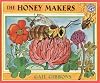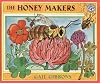
The Honey Makers
by Gail Gibbons
On This Page
Description
Covers the physical structure of honeybees and how they live in colonies, as well as how they produce honey and are managed by beekeepers.Tags
Recommendations



Member Reviews
In The Honey Makers by Gail Gibbons, the life of a bee is looked at as if under a microscope. Gibbons does an immaculate job of portraying the role of every type of bee in the colony. I learned a lot of interesting facts that I had previously not been aware of. For instance, the cells which comprise the bee hive are chiefly used for honey, with the exception of those cells which are devoted to the queen bee to lay her eggs. The worker bee is in charge of taking care of the larvae and can also be called a nurse bee. As students read this book, they can relate to the bee as it correlates to their lives with their family. Each member of their family is responsible for a different role in the house, much as the bees in a bee colony.
Bees show more are funny, curious, and extremely interesting insects to observe and can evoke a lot of inquisitive questions students might have. As they delve deeper into the contents of this book, they begin to learn that bees do much more than simply produce honey. As with other insects, we have also have bees to thank for the pollination of flowers that we see flourishing in the spring time. A wonderful activity that I was privileged enough to take part in a student in elementary was a pollination exercise. Each student had a bee attached to the end of a stick (the bee was no longer living and had been donated by a local bee farm), as the middle of the year rolled around, we were asked to pollinate flowers in the classroom. At the beginning of the year, each student was given a seed and was in charge of observing it until it budded with flowers. By the springtime, the plants had budded with flowers. This was when the teacher introduced the bees on sticks to the class. At this time, students were asked to pollinate the flowers with the bees and asked to observe how the pollen was carried from plant to plant.
The information is this book is valid and is proven towards the end of the book with results of the authors findings. The second to last page shows the Beekeeper’s Yearbook, which catalogs the life of a beekeeper throughout the course of a year. show less
Bees show more are funny, curious, and extremely interesting insects to observe and can evoke a lot of inquisitive questions students might have. As they delve deeper into the contents of this book, they begin to learn that bees do much more than simply produce honey. As with other insects, we have also have bees to thank for the pollination of flowers that we see flourishing in the spring time. A wonderful activity that I was privileged enough to take part in a student in elementary was a pollination exercise. Each student had a bee attached to the end of a stick (the bee was no longer living and had been donated by a local bee farm), as the middle of the year rolled around, we were asked to pollinate flowers in the classroom. At the beginning of the year, each student was given a seed and was in charge of observing it until it budded with flowers. By the springtime, the plants had budded with flowers. This was when the teacher introduced the bees on sticks to the class. At this time, students were asked to pollinate the flowers with the bees and asked to observe how the pollen was carried from plant to plant.
The information is this book is valid and is proven towards the end of the book with results of the authors findings. The second to last page shows the Beekeeper’s Yearbook, which catalogs the life of a beekeeper throughout the course of a year. show less
At first, I liked that there was so much information in this book about bees. After a while, this book seemed to me to be far too long to hold the attention of a child. It couldn't be a read aloud (too long) but could sit on the shelf of a class library. Possibly pages could be copied and used in a unit on insects when discussing honeybees.
Genre: Nonfiction
Reading Level: grades3-5
Summary:
This book takes you through the bee hive. It tells you the parts of the hive and about the different kinds of bees. Each bee has its own role in the bee hive and will only live for about 2-3 months. This book has a ton of information about bees, from how they collect the pollen to how they reproduce. By the time the reader is done with this book, they will have an abundant amount of information about bee life.
Commentary:
This book would be great to use in a classroom because it goes into such great detail about the bee hive and all the roles of each individual bee. The textbook will not go into that much detail. The illustrations would be helpful for the students to see what the book is show more talking about as well. show less
Reading Level: grades3-5
Summary:
This book takes you through the bee hive. It tells you the parts of the hive and about the different kinds of bees. Each bee has its own role in the bee hive and will only live for about 2-3 months. This book has a ton of information about bees, from how they collect the pollen to how they reproduce. By the time the reader is done with this book, they will have an abundant amount of information about bee life.
Commentary:
This book would be great to use in a classroom because it goes into such great detail about the bee hive and all the roles of each individual bee. The textbook will not go into that much detail. The illustrations would be helpful for the students to see what the book is show more talking about as well. show less
This book it great giving students a look on how something is made that they eat at home. Children will get a kick out of this.
Large format book about bees and beekeeping with warm, clear, well researched, and perhaps somewhat whimsical illustrations.
this is a cute informational book about bees and what they do. No real plot here but beautiful drawings. good for ages 3-6 found in tacoma public library.
A very informative book about honeybees. It walks the reader through the bee's life cycle, the worker bee's many jobs, how bees communicate , different types of hive and how beekeepers harvest honey. It includes everything you could possibly want to know about bees and more.
Members
- Recently Added By
Lists

Children's Books About Science and Math
461 works; 12 members
Author Information

165+ Works 57,747 Members
Gail Gibbons was born in 1944 in Oak Park, Illinois. She received a degree in graphic design from the University of Illinois. She got a job doing artwork for television shows in New York City. She was eventually offered a job creating art for a children's show, where some of the children asked her if she had ever considered doing a children's show more books. Her first book, Willy and His Wheel Wagon, was published in 1975. Since then she has written and illustrated more than 170 non-fiction books for children including Nature's Green Umbrella: Tropical Rain Forests. (Bowker Author Biography) show less
Awards and Honors
Common Knowledge
- Dedication
- Special thanks to Dr. Gordon R. Nielsen, entomologist, Hinesburg, Vermont.
- First words
- It is springtime.
- Last words
- (Click to show. Warning: May contain spoilers.)The United States ranks third in the world in honey production.
Classifications
Statistics
- Members
- 725
- Popularity
- 38,873
- Reviews
- 21
- Rating
- (4.23)
- Languages
- English
- Media
- Paper
- ISBNs
- 11
- ASINs
- 2