Now You See It: How the Brain Science of Attention Will Transform the Way We Live, Work, and Learn
by Cathy N. Davidson 
On This Page
Description
Documents a 2003 experiment at Duke University where the author had free iPods issued to the freshman class to see how the device could be used academically, in a report that reveals other technological ideas that are revolutionizing education.Tags
Recommendations







Member Reviews
Davidson begins with a fascinating premise. What if we seriously considered the ways in which we think, especially the ways in which we selectively pay attention to and ignore the world around us, and then formed our educational and workplace environments around our brains, rather than trying to hammer our polygonal personalities into round holes?
It's an idea so simple you'll be shocked you didn't have it. Anybody who's in school or the workplace will tell that something is rotten in the state of Denmark, and as Davidson reveals, our standardized test obsessed education system is the historical legacy of a system designed to take farm kids and immigrants and get them ready for assembly line industrial jobs. The modern office complex, show more with cubicles and corner offices and HR departments, is the white collar equivalent. The problem is that standardized education is pointless and alienating, it lacks rigor, relevance, and relationships, and assembly line careers are as dead as the Edsel. Rather, the future is collaborative and creative. Videogames and internet culture are far better models for productive endeavors than the old top-heavy bureaucracies.
Davidson's exploration of education, and her own experiences as a professor at Duke teaching radically new classes is very well done. Unlike certain people (Jane McGonigal *cough* *cough*) she isn't drinking her own kool-aid. The periphrial material, on the science of attention and on new business models, is less inspiring, more in the genre of 'superficial TED-talks a la Malcolm Gladwell and Howard Rheingold' (why isn't that a real genre yet?) But the central message of the book, that standardized tests measure only what they measure, and not anything externally worthwhile, is something that should be hammered into the heads of every politician, educator, and parent on the planet. Your kids know what's up, why don't know? show less
It's an idea so simple you'll be shocked you didn't have it. Anybody who's in school or the workplace will tell that something is rotten in the state of Denmark, and as Davidson reveals, our standardized test obsessed education system is the historical legacy of a system designed to take farm kids and immigrants and get them ready for assembly line industrial jobs. The modern office complex, show more with cubicles and corner offices and HR departments, is the white collar equivalent. The problem is that standardized education is pointless and alienating, it lacks rigor, relevance, and relationships, and assembly line careers are as dead as the Edsel. Rather, the future is collaborative and creative. Videogames and internet culture are far better models for productive endeavors than the old top-heavy bureaucracies.
Davidson's exploration of education, and her own experiences as a professor at Duke teaching radically new classes is very well done. Unlike certain people (Jane McGonigal *cough* *cough*) she isn't drinking her own kool-aid. The periphrial material, on the science of attention and on new business models, is less inspiring, more in the genre of 'superficial TED-talks a la Malcolm Gladwell and Howard Rheingold' (why isn't that a real genre yet?) But the central message of the book, that standardized tests measure only what they measure, and not anything externally worthwhile, is something that should be hammered into the heads of every politician, educator, and parent on the planet. Your kids know what's up, why don't know? show less
Cathy Davidson is an engaging, thoughtful, and thought-provoking writer; she also is a justifiably admired educator (former vice provost for interdisciplinary studies at Duke University) who clearly puts her attention on the learners she serves. And she has plenty to teach all trainer-teacher-learners about what we're doing right as well as what we're failing miserably to achieve. Her goal, she tells us right up front in "Now You See It," is to provide "a positive, practical, and even hopeful story about attention in our digital age" by exposing us to "research in brain science, education, and workplace psychology to find the best ways to learn and change in challenging times" (p. 6). And she delivers. Convincingly. Starting with a show more summary of an experiment that shows how much we miss around us by focusing too closely on certain details because we have learned to block out the overwhelming amount of stimulation that routinely comes our way, Davidson suggests that our learning process needs to include at least three steps: learning, unlearning, and relearning--and the sort of collaboration that allows us to rely on others to help us see what we otherwise would miss. We travel with Davidson through studies of how gaming can effectively be used in learning. How engaging learners in the learning process by making them partners recreates the learning experience to produce tremendously positive results. And there are also wonderful stories illustrating the difference in attitudes between young learners in a failing magnet school and those in a demographically similar school that "exemplifies the best in public education" (p. 97). Those of us who take the time to read--and reread--what she offers in "Now You See It," giving it the attention it deserves, may be able to help others past those feelings of loss and deficit and failure. And help ourselves as well. show less
This book makes a strong case for collaboration and diversity if you want to see a big picture. I've seen this to be true in both work and social situations. Some things I’m thinking about as a result of reading it:
• Sometimes “pilot” can be just a label you give a project when you want a soft launch—might be better to leave expectations more open so that you won’t overlook unanticipated findings?
• She has a “strengths based” approach to a happy life, which I agree with. But I wonder if specializing too early, saying “I’m not good at that, interested in that” might cut off options later? Don't most jobs, relationships require that you be out of your comfort zone some of the time?
• Everyone needs to think "how show more can I jolt myself out of my routines so that I might see other options, areas for growth based on new technologies and opportunities?"
• Many of her examples of good environments for learning and working seem to come down to having truly engaged teachers and bosses—the exact techniques may matter less than just having someone thinking, aware, trying?
• It's a hopeful idea that if you think you are good at something you may actually be better at it than if you don’t. Believing clichés and excuses about getting older actually could make them come true?
Quotes:
• “When you think of learning as something external to yourself, learning becomes a levy—an assessment, not an asset. The assessment no longer matters after the schooling stops. The asset is a resource one draws on for a lifetime. “
• "If there is any word that defines the twentieth century, it might be normative: a defining and enforcing of standards of what counts as correct." show less
• Sometimes “pilot” can be just a label you give a project when you want a soft launch—might be better to leave expectations more open so that you won’t overlook unanticipated findings?
• She has a “strengths based” approach to a happy life, which I agree with. But I wonder if specializing too early, saying “I’m not good at that, interested in that” might cut off options later? Don't most jobs, relationships require that you be out of your comfort zone some of the time?
• Everyone needs to think "how show more can I jolt myself out of my routines so that I might see other options, areas for growth based on new technologies and opportunities?"
• Many of her examples of good environments for learning and working seem to come down to having truly engaged teachers and bosses—the exact techniques may matter less than just having someone thinking, aware, trying?
• It's a hopeful idea that if you think you are good at something you may actually be better at it than if you don’t. Believing clichés and excuses about getting older actually could make them come true?
Quotes:
• “When you think of learning as something external to yourself, learning becomes a levy—an assessment, not an asset. The assessment no longer matters after the schooling stops. The asset is a resource one draws on for a lifetime. “
• "If there is any word that defines the twentieth century, it might be normative: a defining and enforcing of standards of what counts as correct." show less
This is a very interesting book, but I feel the title is a little misleading. It’s not so much that brain science will transform how we do things; it’s more that technology will. In a world where the boundaries between work and personal life have been broken down by constant email, texts, and cell phones; where classrooms have been infiltrated by iPods and homework over the internet; where people all over the world are working to produce the largest, constantly changing, encyclopedia; and where many jobs require skill sets that didn’t even exist 25 years ago, the way people are educated has to change. That seemed to me to be the main thrust of the book.
This is not the first time that technology has changed the way people learned show more and thought. The steam powered press and machine made ink and paper put books and magazines into the hands of the middle class for the first time. Everyday people could learn things that they had no direct physical contact with. This was a revolution in education.
The education system we use today was designed near the start of the machine age, an age of factories that created identical things, and wanted workers who behaved in identical ways. That’s not the way the world works today. In a lot of jobs, people need the ability to create, not do the same task over and over again- although these are higher paying jobs for the college educated, not the McJobs that so many of us are stuck in; the author is dealing with ‘thinking’ jobs in this book, not service jobs. Davidson believes that the schools must change to make education fun and interesting for the students; children usually feel that ‘learning’ is unpleasant when asked about it, but will happily learn from a video game, and in fact deny that they were learning from it. The author also feels that many of the children diagnosed with ADHD are simply not being taught things that interest them, and are far from hopeless in the classroom- provided the classroom changes to meet their needs. She’s not denying the need for learning basic skills- reading, writing, math- but feels these things need to be taught differently. Sadly, in an era where funding for schools is being cut back, I don’t see that these changes will take place in the near future.
She also points out that our beliefs changes how we perceive things; the student that we feel has ADHD and should be medicated if we see them in a reading class we might think was a genius if we see them first in an art class; memory lapses are ignored when young people make them but are seen as signs of dementia when someone over 45 has them. We need to become more aware of our preset beliefs to see things as they really are.
I think it’s a valuable book for educators and business managers, but a lot of changes- expensive ones in some cases- will have to be made for her ideas to be made real. I think that will be very slow in coming. show less
This is not the first time that technology has changed the way people learned show more and thought. The steam powered press and machine made ink and paper put books and magazines into the hands of the middle class for the first time. Everyday people could learn things that they had no direct physical contact with. This was a revolution in education.
The education system we use today was designed near the start of the machine age, an age of factories that created identical things, and wanted workers who behaved in identical ways. That’s not the way the world works today. In a lot of jobs, people need the ability to create, not do the same task over and over again- although these are higher paying jobs for the college educated, not the McJobs that so many of us are stuck in; the author is dealing with ‘thinking’ jobs in this book, not service jobs. Davidson believes that the schools must change to make education fun and interesting for the students; children usually feel that ‘learning’ is unpleasant when asked about it, but will happily learn from a video game, and in fact deny that they were learning from it. The author also feels that many of the children diagnosed with ADHD are simply not being taught things that interest them, and are far from hopeless in the classroom- provided the classroom changes to meet their needs. She’s not denying the need for learning basic skills- reading, writing, math- but feels these things need to be taught differently. Sadly, in an era where funding for schools is being cut back, I don’t see that these changes will take place in the near future.
She also points out that our beliefs changes how we perceive things; the student that we feel has ADHD and should be medicated if we see them in a reading class we might think was a genius if we see them first in an art class; memory lapses are ignored when young people make them but are seen as signs of dementia when someone over 45 has them. We need to become more aware of our preset beliefs to see things as they really are.
I think it’s a valuable book for educators and business managers, but a lot of changes- expensive ones in some cases- will have to be made for her ideas to be made real. I think that will be very slow in coming. show less
This is one of those social science books that are very interesting but not particularly practical. I found the author's main thesis intriguing. She asserts that we are indeed becoming more distracted due to technology, but that's a good thing. She believes our emphasis on concentration was a late 19th century / 20th century anomaly. I don't agree with her, but the idea is interesting.
The book is a bit unfocused. Not surprising I suppose. It's got some neuroscience in it, as well as a lot of social science and interesting anecdotes to demonstrate her points. I would have liked some more concrete organization to the book. The organization seemed a bit fuzzy.
I appreciate her enthusiasm for technology. However, I wonder if she has a bit show more too much faith in our use of it. Sure some people will use the technology to change the world or use a blog to gain a following they never would have enjoyed before the Internet. However, I suspect most of us will use the technology mostly to browse Facebook., upload pictures and watch silly YouTube videos.
MS show less
The book is a bit unfocused. Not surprising I suppose. It's got some neuroscience in it, as well as a lot of social science and interesting anecdotes to demonstrate her points. I would have liked some more concrete organization to the book. The organization seemed a bit fuzzy.
I appreciate her enthusiasm for technology. However, I wonder if she has a bit show more too much faith in our use of it. Sure some people will use the technology to change the world or use a blog to gain a following they never would have enjoyed before the Internet. However, I suspect most of us will use the technology mostly to browse Facebook., upload pictures and watch silly YouTube videos.
MS show less
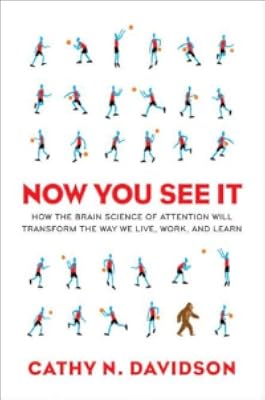
An "ok" book. Basically 70% of the information it contains (starting from the opening example of the "did you spot the gorilla" video) has been around for quite a while. It starts from the topic of attention but doesn't stick very strictly to it, sometimes indulging too much in correlated digression (e.g. the American education system). Useful read nonetheless.
This is my favorite quote from the book: «Learning is the cartography of cultural value, indistinguishable from the landscape of our attention—and our blindness».
This is my favorite quote from the book: «Learning is the cartography of cultural value, indistinguishable from the landscape of our attention—and our blindness».
I follow Cathy Davidson on Twitter, and read the reviews of this book in the NYT when it came out. So far, fascinating, and inspiring. Reassessing the importance of attention in the classroom, and the ways in which the traditional "industrial age" classroom has become obsolete are extremely important observations in this, the Information Age. Ms. Davidson is documenting a revolution in the way we think; it would be wise for educational institutions to be aware of (and act on) her commentary.
Members
- Recently Added By
Lists

Books for Educators
164 works; 6 members
Author Information

19+ Works 1,418 Members
Cathy N. Davidson directs the Futures Initiative at CUNY. She is the author of many books, including Now You See It, and has written for The Wall Street Journal and Fast Company, among others. Davidson lives in New York City.
Cathy N. Davidson is a LibraryThing Author, an author who lists their personal library on LibraryThing.
Classifications
Statistics
- Members
- 350
- Popularity
- 90,411
- Reviews
- 13
- Rating
- (3.60)
- Languages
- English, German
- Media
- Paper, Audiobook, Ebook
- ISBNs
- 10
- ASINs
- 7