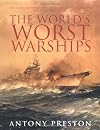
The World's Worst Warships: The Failures and Repercussions of Naval Design and Construction, 1860 to the present day
by Antony Preston
On This Page
Description
A serious study of the reasons why some warships have achieved bad reputations. It covers the period from 1860 to the present day, and looks at a wide range of nationalities and ship-types. Some examples are the Russian Popoffkas; the French battleship 'Brennus'; and the British vessel 'Captain'.Tags
Recommendations
















Member Reviews
Preston is so damn cranky, and he lets it all out in this very idiosyncratic list of crappy warships. Some of them are hilariously bad: early ironclads that flipped over after a 20 degree list; the circular Popovkas which spun when firing their guns and could not make way against even a mild current; hydrogen-peroxide powered submarines that mostly choked their crews. However, the hilarious follies are outnumbered by the banally bad-pricey cruisers that couldn't take heavy seas, attempts to outmatch falsely reported speeds on foreign ships, and way too many attempts to "fit a quart into a pint glass" by second-rate powers like the French and Japanese.
Unfortunately, this book is caught halfway between freakshow and system. Preston knows show more what kinds of ships he likes: tough, moderately-sized, seagoing ships, with conservative armor and armament. He is merciless on anything innovative, sometimes rightfully with a Swedish combined cruiser-aircraft carrier-minelayer, and sometimes unfairly as when he dismisses missile armed corvettes as a class. He hates it whenever "enthusiasts" get ahold of naval procurement, but I get the feeling he'd be happiest with 72 gun ships of the line, and damn this newfangled steam. show less
Unfortunately, this book is caught halfway between freakshow and system. Preston knows show more what kinds of ships he likes: tough, moderately-sized, seagoing ships, with conservative armor and armament. He is merciless on anything innovative, sometimes rightfully with a Swedish combined cruiser-aircraft carrier-minelayer, and sometimes unfairly as when he dismisses missile armed corvettes as a class. He hates it whenever "enthusiasts" get ahold of naval procurement, but I get the feeling he'd be happiest with 72 gun ships of the line, and damn this newfangled steam. show less
Ratings
Members
- Recently Added By
Author Information
69+ Works 2,095 Members
Antony Preston was the first editor of Warship and resumed his duties in 1996. He has written numerous books on naval technology and history Peter Brook is a retired Psychiatrist who began writing on warships thirty years ago Dr John Brooks is an historian of technology, particularly naval fire control. His University of London doctoral thesis show more argues for radical revisions to current assessments of the Dreyer and Pollen fire control systems David K Brown spent the whole of his working life as a member of the Royal Corps of Naval Constructors retiring as Deputy Chief Naval Architect in 1988. He is currently President of the World Ship Society. He has written many books Pierre Hervieux has been interested in warships since 1945. His work concentrates on the naval operations of various nations during the Second World War John Jordan has written widely on the post-Soviet Russian Navy and the modern navies of Western Europe. His current major interest is in the French Marine Nationale of the inter-war period Iain McCallum worked for the British Council in various parts of the world, before returning to England to pursue his researches in military and naval history Captain Guillermo J. Montenegro joined the Argentinean Naval College, Rio Santiago, in 1950 and retired in 1985. After qualifying as a submariner, he commanded two submarines and held several staff posts, including that of Chief of Staff of the Argentinean Submarine Group. Upon his retirement, he joined the faculty of the Argentine Naval War College, Buenos Aires, where he is currently Career Director, Postgraduate Course in Strategic Studies George Moore is researching the warship building programmes of the Royal Navy, which evolved in the Second World War. He has previously contributed articles on wartime cruiser projects and steam gunboats show less
Common Knowledge
- Original publication date
- 2002
- People/Characters
- Admiral of the Fleet Sir John Fisher; Edward Reed
- Important events
- sinking of the Bismarck; Sinking of the Hood; Battle of Tsushima; Washington Naval Treaty
- Dedication
- To my grandson Jonathan
- First words
- IntroductionAlthough the subject of warship-design might be dismissed as a pastime for professionals and an even smaller nerdish audience, this reflects nothing more than ignorance among many 'mainstream' naval histori... (show all)ans.
Classifications
Statistics
- Members
- 59
- Popularity
- 525,100
- Reviews
- 1
- Rating
- (3.50)
- Languages
- English
- Media
- Paper
- ISBNs
- 3