On This Page
Description
Hannay is married to Mary and living peacefully in the Cotswolds, when he receives a request to help solve the mysterious kidnapping of the children of three prominent people. Given nothing to go on but a few mysterious clues, Hannay, assisted by friends like Sandy Arbuthnot, must track down the dastardly villains behind the plot before it's too late...Tags
Recommendations

















Member Reviews
"Dick, have you ever considered what diabolical weapon that can be—using all the channels of modern publicity to poison and warp men's minds? It is the most dangerous thing on earth. You can use it cleanly—as I think on the whole we did during the War—but you can also use it to establish the most damnable lies. Happily in the long run it defeats itself, but only after it has sown the world with mischief."
"He said that the great offensives of the future would be psychological, and he thought the Governments should get busy about it and prepare their defence...He considered that the most deadly weapon in the world was the power of mass-persuasion, and he wanted to meet it at the source, by getting at the mass-persuader."
This show more remarkably prescient book was published in 1924, but the author seemed to have a direct line on today. Sir Richard Hannay believes he has retired from service to his country, only to be pulled back in by a most desperate case. People seem to agree that this is the best of the Hannay novels and while I haven't yet read them all, it's certainly my favorite so far. Despite the highly technical climax where Hannay is scaling cliffs and outwitting his enemy with his woodcraft, I found this a gripping spy-thriller. Yes, it has its share of politically incorrect references and language, and your sensitivity to that content may vary. But if you can get past that, there's a fine adventure here. show less
"He said that the great offensives of the future would be psychological, and he thought the Governments should get busy about it and prepare their defence...He considered that the most deadly weapon in the world was the power of mass-persuasion, and he wanted to meet it at the source, by getting at the mass-persuader."
This show more remarkably prescient book was published in 1924, but the author seemed to have a direct line on today. Sir Richard Hannay believes he has retired from service to his country, only to be pulled back in by a most desperate case. People seem to agree that this is the best of the Hannay novels and while I haven't yet read them all, it's certainly my favorite so far. Despite the highly technical climax where Hannay is scaling cliffs and outwitting his enemy with his woodcraft, I found this a gripping spy-thriller. Yes, it has its share of politically incorrect references and language, and your sensitivity to that content may vary. But if you can get past that, there's a fine adventure here. show less
Ultimately thin stuff but strangely compelling. I read to the end though really I set out to dip in and test the water. The eponymous three hostages play only marginal roles. The main theme is Hannay out to get the mastermind behind the hostage taking (the purpose of which is rather unclear, taking over the world or something like that) This mastermind, of course, has a foreign name, but is a member of Parliament and of every club you might care to name and generally rather charming, if evil. He’s acquired a hypnotic technique which has enabled him to gather quite a crowd of collaborators. Hannay undergoes the hypnotic process but undercover keeps his own mind clear (which stretches the imagination). The finale is even more show more improbable. They’re out in the mountains somewhere in Scotland. Mastermind comes chasing after Hannay (in person as they always do in fiction, rather than sending an agent). Hannay climbs up some kind of rocky promontory . Mastermind manages a lucky shot to his hand so our hero has lost his own weapon and much blood. Mastermind clambers up after him but gets into difficulty. Hannay, being a decent sort of chap and in a forgiving mood, drops him a rope with his one still functioning hand. Mastermind doesn’t quite manage and hurtles to his death. Hannay is found and rescued next morning, somewhat weak from his experience. He was already weak with loss of blood the previous evening but, no worries, he’s managed not to bleed to death and returns to his quiet retirement.
The text is elegantly written apart from all the nasty people being foreigners dubbed with the classic nicknames: dago, nigger, et cetera. The hypnotic technique comes from somewhere in central Asia. Lots of clubs and being a sportsman equates with being a morally upright person. show less
The text is elegantly written apart from all the nasty people being foreigners dubbed with the classic nicknames: dago, nigger, et cetera. The hypnotic technique comes from somewhere in central Asia. Lots of clubs and being a sportsman equates with being a morally upright person. show less
gripping adventure, but one must put aside its pervasive racism against any ethnic group other than the scots and english. other than that, issues and world trouble-spots seem strangely contemporary, given that the book was written in 1924. in its own nearer future, seems to predict new german war, economic collapse, etc.
I read this many years ago, but this time saw all the easy racism, the false narratives of WWI that enabled appeasement. From the perspective of wanting to understand why the Brits engaged in appeasement, this is a perfect book.
While a few aspects of this 4th installment in the Richard Hannay series show their age (this was first published in 1924), most of it is surprisingly still relevant. The use of propaganda to get fanatics or troubled youngsters to stir up trouble is something we can see today.
The only thing that really holds me back from a 5 star rating is the abruptness of the ending. I would have liked one or two more pages although in reality, there was nothing more that needed to be said.
The only thing that really holds me back from a 5 star rating is the abruptness of the ending. I would have liked one or two more pages although in reality, there was nothing more that needed to be said.
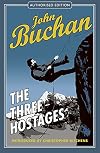
Complete with an introduction by Christopher Hitchings that firmly places this in the 'guilty pleasure' category, Buchan digs out Richard Hannay from his comfortable retreat in the country to - yet again - be involved in devious global plots. Hannay's utterly unimpressionable nature turns out to be a major advantage as he proves impervious to the most dastardly of attempts to influence and overpower him, while at the same time - and with help from his old friends and plucky spouse - solving devilishly cunning tricks and ruses. I agree with Hitch - it's a lot of fun...
A great adventure story - fantastic characters, a real page turner. From a plot perspective, this is a brilliant book, my only plot criticism is that I found the last couple of chapters had a bit of a 'tacked-on-as-an-afterthought' feel to them.
Others have mentioned the pervasive racism in The Three Hostages. I would say that this is more marked than I remember it being in the first three books of the series. However, if you can overlook this, it's a great read.
Others have mentioned the pervasive racism in The Three Hostages. I would say that this is more marked than I remember it being in the first three books of the series. However, if you can overlook this, it's a great read.
Members
- Recently Added By
Lists

Literature of Honor for Boys
91 works; 3 members

Used books to buy next
565 works; 1 member

Books Read in 2023
5,547 works; 145 members
Author Information

280+ Works 17,557 Members
John Buchan was born in Perth on 26th August, 1875. Educated at Glasgow University and Brasenose College, Oxford, in 1898 Buchan won the Newdigate Prize for poetry. Although trained as a lawyer, Buchan became private secretary to Lord Alfred Milner, high commissioner for South Africa. In 1903 he returned to England where he became a director of show more the publishing company, Thomas Nelson & Sons. In 1910 Buchan had his first novel, Prester John, published. In July 1914, Blackwood's Magazine began serializing Buchan's The Thirty-Nine Steps. With Britain on the verge of war, the nation was obsessed with German spy fever and its subject matter made it an immediate success. When it was published in book form, it sold over 25,000 copies in three months. Charles Masterman, the journalist, was appointed head of the government's War Propaganda Bureau. Masterman recruited Buchan and asked him to organise the publication of a history of the war in the form of a monthly magazine. Published by his own company, the first installment of the Nelson's History of the War appeared in February, 1915. A further twenty-three appeared at regular intervals throughout the war. In the spring of 1915, Buchan agreed to become one of the five journalists attached to the British Army. He was given responsibility for providing articles for The Times and the Daily News. In June 1916, Buchan was recruited by the British Army to draft communiqués for Sir Douglas Haig and other members of the General Headquarters Staff. Given the rank of Second Lieutenant in the Intelligence Corps, Buchan was also provided with the documents needed to write the Nelson's History of the War. Buchan's History of the War provided the public with a completely false impression of what was going on the Western Front. Buchan also wrote a series of propoganda pamphlets published by Oxford University Press. In February, 1917, the government established a Department of Information. Given the rank Lieutenant Colonel, Buchan was put in charge on the department on an annual salary of £1,000 a year. After the war Buchan continued to write adventures stories such as Huntingtower, The Three Hostages, and Witch Wood (1927). He also became involved in politics and in 1927 was elected Conservative MP for the Scottish Universities. Buchan held the seat until granted the title Baron Tweedsmuir in 1935. Buchan was president of the Scottish History Society from 1929 to 1932, and wrote biographies of Montrose and Sir Walter Scott. Buchan also served as governor-general of Canada from 1935 to 1937 and chancellor of Edinburgh University from 1937 to 1940. John Buchan died on 12th February, 1940. (Bowker Author Biography) show less
Some Editions
Series

Belongs to Publisher Series
Work Relationships
Is contained in
Common Knowledge
- Original publication date
- 1924
- People/Characters
- Richard Hannay; Sandy Arbuthnot; Archie Roylance; Peter John Hannay; Mary Lamington; Edward Leithen (show all 15); John Palliser-Yeates; Macgillivray; Oliver Pugh; David Warcliff; Sir Arthur Warcliff; Mike, Duke of Burminster; Ralph Collatt; Dominick Medina; Madame Breda
- Important places
- Cotswolds, England, UK; Norway; Glenaicill, Scotland, UK (fictional); Thursday Club; London, England, UK
- Dedication
- To a Young Gentleman of Eton College HONOURED SIR, On your last birthday a well-meaning godfather presented you with a volume of mine, since you had been heard on occasion to express approval of my works.....
- First words
- That evening, I remember, as I came up through the Mill Meadow, I was feeling peculiarly happy and contented.
- Last words
- (Click to show. Warning: May contain spoilers.)There in the morning Mary and Angus found me.
- Original language
- English
Classifications
Statistics
- Members
- 618
- Popularity
- 46,888
- Reviews
- 15
- Rating
- (3.63)
- Languages
- English, French, German
- Media
- Paper, Audiobook, Ebook
- ISBNs
- 29
- ASINs
- 56