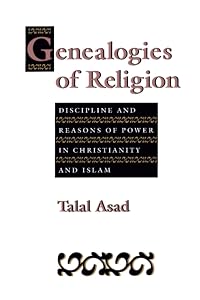
Genealogies of Religion: Discipline and Reasons of Power in Christianity and Islam
by Talal Asad
On This Page
Description
In Geneologies of Religion, Talal Asad explores how religion as a historical category emerged in the West and has come to be applied as a universal concept. The idea that religion has undergone a radical change since the Christian Reformation--from totalitarian and socially repressive to private and relatively benign--is a familiar part of the story of secularization. It is often invokved to explain and justify the liberal politics and world view of modernity. And it leads to the view that show more "politicized religions" threaten both reason and liberty. Asad's essays explore and question all these assumptions. He argues that "religion" is a construction of European modernity, a construction that authorizes--for Westerners and non-Westerners alike--particular forms of "history making." show lessTags
Recommendations




















Member Reviews
Albeit powerful and eloquent, Asad becomes inaccessible at times. The essays in the category of Translations and Archaism would not seem relevant to most of the readers without catching up with some of the references and background study on diversified topics. The last two essays and the one on Pain and Truth are excellent expositions.
You want to give it a try, take time and read it with patience; read again some of the parts and it'll make your day.
You want to give it a try, take time and read it with patience; read again some of the parts and it'll make your day.
In Geneologies of Religion, Talal Asad explores how religion as a historical category emerged in the West and has come to be applied as a universal concept.
The idea that religion has undergone a radical change since the Christian Reformation―from totalitarian and socially repressive to private and relatively benign―is a familiar part of the story of secularization. It is often invokved to explain and justify the liberal politics and world view of modernity. And it leads to the view that "politicized religions" threaten both reason and liberty. Asad's essays explore and question all these assumptions. He argues that "religion" is a construction of European modernity, a construction that authorizes―for Westerners and non-Westerners show more alike―particular forms of "history making." show less
The idea that religion has undergone a radical change since the Christian Reformation―from totalitarian and socially repressive to private and relatively benign―is a familiar part of the story of secularization. It is often invokved to explain and justify the liberal politics and world view of modernity. And it leads to the view that "politicized religions" threaten both reason and liberty. Asad's essays explore and question all these assumptions. He argues that "religion" is a construction of European modernity, a construction that authorizes―for Westerners and non-Westerners show more alike―particular forms of "history making." show less
Sep 12, 2018Dutch
Ratings
Members
- Recently Added By
Lists

Recommendations by Tim Keller
50 works; 2 members
Author Information

19+ Works 752 Members
Talal Asad is Distinguished Professor of Anthropology at the Graduate Center of the City University of New York
Classifications
- Genres
- Nonfiction, Anthropology, Religion & Spirituality, History
- DDC/MDS
- 306.6 — Society, government, & culture Social sciences, sociology & anthropology Social Behavior - Dating, Marriage, Divorce Religious institutions
- LCC
- BL50 .A85 — Philosophy, Psychology and Religion Religions. Mythology. Rationalism Religions. Mythology. Rationalism Religion (General)
- BISAC
Statistics
- Members
- 210
- Popularity
- 156,329
- Reviews
- 2
- Rating
- (3.67)
- Languages
- English
- Media
- Paper, Ebook
- ISBNs
- 4
- ASINs
- 2