Mr Briggs' Hat: A Sensational Account of Britain's First Railway Murder
by Kate Colquhoun
On This Page
Description
"In July 1864, Thomas Briggs was traveling home after visiting his niece and her husband for dinner. He boarded a first-class carriage on the 9:45 pm Hackney service of the North London railway. At Hackney, two bank clerks discovered blood in the seat cushions as well as on the floor, windows, and sides of the carriage. A bloodstained hat was found on the seat along with a broken link from a watch chain. The race to identify the killer and catch him as he fled on a boat to America was show more eagerly followed by the public on both sides of the Atlantic."--Publisher's website. show lessTags
Recommendations




Member Reviews
In 1864, a train's first-class carriage was discovered to be empty of passengers but liberally smeared in blood. Some hours later, the original occupant was found--dead, his body discarded near the train tracks. The police tracked his stolen top hat and watch chain through the pawn shops of London, and quickly zeroed in on a suspect: a poor German tailor. But by the time they discovered his identity, Franz Müller had already gotten on a ship to America (currently in the throes of their Civil War). The lead detective tracked him down and, though there was some political & legal trouble over the extradition (both sides in America wishing for more aid from the UK at the time, and insulted that they weren't getting it), brought him back to show more London for a swift trial. On the basis of his owning a hat and watch chain that were probably the banker's, Müller was convicted of murder and hanged.
This is mostly useful in revealing the types of investigative, journalistic, and legal procedures of the time. The detectives were hampered by being a fairly new profession (established only twenty-two years earlier), and still without the ability to even definitively tell animal blood from human. So instead, they mostly relied on evidence that modern courts would call circumstantial. Meanwhile, the papers went mad for this murder, to the extent that mobs waited for hours for the chance to see Müller. And in terms of the trial, the accused was not allowed to speak in his own defense, and trials were customarily very short.
The truth of what truly happened that night in 1864 may never be known--certainly Colquhoun doesn't really know. So for readers looking for a murder mystery, this might feel a little dissatisfying. But as a snap-shot of mid-Victorian English justice, it's fascinating. show less
This is mostly useful in revealing the types of investigative, journalistic, and legal procedures of the time. The detectives were hampered by being a fairly new profession (established only twenty-two years earlier), and still without the ability to even definitively tell animal blood from human. So instead, they mostly relied on evidence that modern courts would call circumstantial. Meanwhile, the papers went mad for this murder, to the extent that mobs waited for hours for the chance to see Müller. And in terms of the trial, the accused was not allowed to speak in his own defense, and trials were customarily very short.
The truth of what truly happened that night in 1864 may never be known--certainly Colquhoun doesn't really know. So for readers looking for a murder mystery, this might feel a little dissatisfying. But as a snap-shot of mid-Victorian English justice, it's fascinating. show less
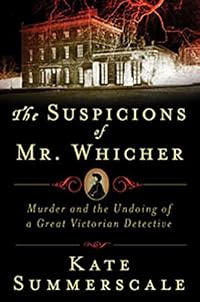
I must admit to a certain initial prejudice against purchasing this book because, having read the blurb, it seemed to me an attempt to cash in on the success of Kate Summerscale's excellent 'The Suspicions of Mr Whicher'. Indeed Jack Whicher is mentioned in these pages as a contemporary of the detective Inspector Richard Tanner who is the chief investigator of the murder of Thomas Briggs in a Victorian railway carriage, the subject of Kate Colquhon's book. It's certainly true that the Colquhon story covers the same period of history, tracks the investigation of a real-life high-profile murder and treats its subject in a very similar style to Kate Summerscale, but I came to the conclusion that I couldn't blame the author for the show more publisher's opportunism and that her own credentials were anyway impeccable. So I bought the book.
I'm glad I did. As with 'Mr Whicher' I was transported to mid-Victorian England and was as thoroughly engaged with the murder, the investigation, the chase, trial and aftermath as newspaper readers of the time obviously were, though Colquhon writes with far more restraint than many of those journalists covering the story. Ms Colquhoun's admirable research allows us not only to become steeped in the details of the case but also to have a tangible sense of the lived context, with plenty of rich descriptive background to place the reader in the territory. We do hear the occasional riffle of research notes but in general the learning is presented subtly and in tune with the narrative.
Tanner is not brought to life as effectively as Summerscale's Whicher, but the difficult-to-pin-down Francis Muller - the supposed villain of the piece - is very carefully drawn in all his ambiguities.
This being real life, there is no fully realised close-the-book resolution, but Colquhon makes that a strength of her book, particularly in the final chapters. I won't say more than that, not wishing to give too much of the game away, but I do warn readers not to take too close a look at the picture captions before you've finished the narrative, otherwise you will discover more than you may wish to know at that point. show less
I'm glad I did. As with 'Mr Whicher' I was transported to mid-Victorian England and was as thoroughly engaged with the murder, the investigation, the chase, trial and aftermath as newspaper readers of the time obviously were, though Colquhon writes with far more restraint than many of those journalists covering the story. Ms Colquhoun's admirable research allows us not only to become steeped in the details of the case but also to have a tangible sense of the lived context, with plenty of rich descriptive background to place the reader in the territory. We do hear the occasional riffle of research notes but in general the learning is presented subtly and in tune with the narrative.
Tanner is not brought to life as effectively as Summerscale's Whicher, but the difficult-to-pin-down Francis Muller - the supposed villain of the piece - is very carefully drawn in all his ambiguities.
This being real life, there is no fully realised close-the-book resolution, but Colquhon makes that a strength of her book, particularly in the final chapters. I won't say more than that, not wishing to give too much of the game away, but I do warn readers not to take too close a look at the picture captions before you've finished the narrative, otherwise you will discover more than you may wish to know at that point. show less
This book started out very interesting, but it got somewhat tiresome by the time I got to the end. It is the story of the first murder in a railway private car in England. The manhunt comes all the way to the United States during the Civil War. As another commenter I read pointed out, the book's author makes a better case than the British Crown representatives ever did with the man accused of the crime.
Readers who enjoy Victorian crime fiction may like this book. Readers of true crime books may like it as well. The book at moments reads like a crime fiction novel. It was also interesting because you get a lot of insights into Victorian society, especially the press of the time. I will say this: Nancy Grace and her ilk of vultures have show more nothing on Victorian newspapers. The press pretty much made it a sport to condemn the man, often with little evidence, in order to sell papers. As I said, the modern crime vultures on TV who try cases on the court of public opinion have nothing on those folks.
The reason I did not rate it higher is that the book does get a bit tiresome, especially during the trial stage. Some things do get a bit repetitive, and you find yourself skimming a bit, especially since you know how things will end. And in the end, you get a summary of how the case did help shape some laws later.
So, for me, it was an ok book. For others, it may be a good find. show less
Readers who enjoy Victorian crime fiction may like this book. Readers of true crime books may like it as well. The book at moments reads like a crime fiction novel. It was also interesting because you get a lot of insights into Victorian society, especially the press of the time. I will say this: Nancy Grace and her ilk of vultures have show more nothing on Victorian newspapers. The press pretty much made it a sport to condemn the man, often with little evidence, in order to sell papers. As I said, the modern crime vultures on TV who try cases on the court of public opinion have nothing on those folks.
The reason I did not rate it higher is that the book does get a bit tiresome, especially during the trial stage. Some things do get a bit repetitive, and you find yourself skimming a bit, especially since you know how things will end. And in the end, you get a summary of how the case did help shape some laws later.
So, for me, it was an ok book. For others, it may be a good find. show less
Compared sometimes unfavourably with the Suspicions of Mr Wicher but this is a good book in its own right. Well researched and written.
I have been fascinated by the idea of a murder occurring on a train ever since Murder on the Orient Express. Being a true crime buff, because truth is often stranger than fiction, and also a fan of Victorian London, I thought this would be right up my alley. In truth it was very dry, like week old toast dry. Not even butter and jelly could have saved it.
The novel relates the true tale of poor Mr. Briggs. One night while heading home on a train he never reaches his destination. All that is left behind is a hat, not his, and his bloody railway car. He is soon located but is mortally wounded and unable to describe his assailant. Through some dogged detective work and circumstantial evidence a likely suspect is found but he is able to flee show more before the net is closed. The chase is on and the book goes on to lay out the facts of the case.
While some interesting facts were presented, the author repeated herself a lot. It was clear from the copious notes in the back that the author did her research but the detectives conclusions were repeated in the trial portion of the book too closely. In addition the book suffered from the case itself not being very interesting. As far as I could make out it seemed that Mr. Briggs was just in the wrong place at the wrong time. The motive for the crime was rather murky and I don't think fully established. If the killer had been tried today any lawyer worth his salt would have gotten the defendant off based on the case as it was presented here. Since there wasn't any forensic evidence tested like it would be today, the true guilt of the person who murdered Mr. Briggs can never fully be determined which is a draw back to the book.
This kind of true crime historical novel is the type that author Erik Larson does so well. I just don't think there was enough of a story here for a whole novel and the additional information added in for padding was not interesting enough for anything but a brief skimming over or putting you to sleep. show less
The novel relates the true tale of poor Mr. Briggs. One night while heading home on a train he never reaches his destination. All that is left behind is a hat, not his, and his bloody railway car. He is soon located but is mortally wounded and unable to describe his assailant. Through some dogged detective work and circumstantial evidence a likely suspect is found but he is able to flee show more before the net is closed. The chase is on and the book goes on to lay out the facts of the case.
While some interesting facts were presented, the author repeated herself a lot. It was clear from the copious notes in the back that the author did her research but the detectives conclusions were repeated in the trial portion of the book too closely. In addition the book suffered from the case itself not being very interesting. As far as I could make out it seemed that Mr. Briggs was just in the wrong place at the wrong time. The motive for the crime was rather murky and I don't think fully established. If the killer had been tried today any lawyer worth his salt would have gotten the defendant off based on the case as it was presented here. Since there wasn't any forensic evidence tested like it would be today, the true guilt of the person who murdered Mr. Briggs can never fully be determined which is a draw back to the book.
This kind of true crime historical novel is the type that author Erik Larson does so well. I just don't think there was enough of a story here for a whole novel and the additional information added in for padding was not interesting enough for anything but a brief skimming over or putting you to sleep. show less
An entertaining and informative, relatively well paced narrative, describing not the crime, trial and execution of a criminal involved in the first ever rail way murder in the British Isles. Interesting and intriguing at times, it revealed a lot of the inconsistencies in Victorian England and society. Good, but not going to tell the ardent Victorian scholar anything new about the period.
I truly enjoy these out of the ordinary slightly unusual historical tales.
This first murder in a railcar had many very extraordinary circumstances and the author has done excellent research and laid out the investigations, discoveries, court proceedings in a chronological basis and gives you as much info as possible.
But it got to be too much for me - felt like I was slogging through the same info, recountings again and again and again . . .
I know this is what happens in crime solving - facts that seem the same, info that has been heard previously takes on a different slant, witnesses change slightly, and there were no clear cut absolutes.
I only wonder if this could have been told somehow in a shorter version - I was hoping for a show more 'story' that I could read, not a crime that I had to solve, and so it became a struggle for me. show less
This first murder in a railcar had many very extraordinary circumstances and the author has done excellent research and laid out the investigations, discoveries, court proceedings in a chronological basis and gives you as much info as possible.
But it got to be too much for me - felt like I was slogging through the same info, recountings again and again and again . . .
I know this is what happens in crime solving - facts that seem the same, info that has been heard previously takes on a different slant, witnesses change slightly, and there were no clear cut absolutes.
I only wonder if this could have been told somehow in a shorter version - I was hoping for a show more 'story' that I could read, not a crime that I had to solve, and so it became a struggle for me. show less
Members
- Recently Added By
Published Reviews
ThingScore 75
added by doomjesse
Author Information

Kate Colquhoun is the author of The Busiest Man in England, The Thrifty Cookbook, and Taste. As well as writing for several newspapers and magazines, she appears regularly on radio and television. She lives in London with her husband and two sons.
Some Editions
Awards and Honors
Common Knowledge
- Canonical title
- Mr Briggs' Hat: A Sensational Account of Britain's First Railway Murder
- Original title
- Mr Briggs' Hat: A Sensational Account of Britain's First Railway Murder
- Alternate titles
- Murder In The First-Class Carriage: The First Victorian Railway Killing
- Original publication date
- 2011
- People/Characters
- Thomas Briggs; Franz Müller; Jonathan Matthews; Richard Tanner; Benjamin Ames; Harry Vernez (show all 31); Sydney Jones; George Greenwood; Alfred Brereton; Walter Kerressey; John Death; Thomas Lee; Daniel Howie; Jonathan Matthews; John Hoffa; Frederick Adolphus Williamson; Alfred Swaine Taylor; Richard Mayne; Francis Marbury; Robert Murray; Chas Newton; Thomas Beard; Hardinge Giffard; Robert Collier; William Ballantine; John Humffreys Parry; Daniel Digance; Louis Cappel; William Calcraft; George Grrey; Frederick Pollock
- Important places
- Hackney, London, England, UK; New York, USA
- Dedication
- For those who shine light into dark corners
- First words
- On the evening of 9 July 1864, Benjamin Ames, a thirty-eight-year-old train guard, was on edge.
- Last words
- (Click to show. Warning: May contain spoilers.)It suggested that the price to be paid for modernity was, even for the most privileged in society, vulnerability and death.
- Blurbers
- Seymour, Miranda
Classifications
- Genres
- Nonfiction, History
- DDC/MDS
- 364.15230941 — Society, Government, and Culture Social problems and social services Crime Criminal offenses Offenses against the person Homicide Murder History, geographic treatment, biography Europe British Isles
- LCC
- HV6535 .G6 .L526 — Social sciences Social pathology. Social and public welfare. Criminology Social pathology. Social and public welfare. Criminology Crimes and offenses
- BISAC
Statistics
- Members
- 294
- Popularity
- 108,904
- Reviews
- 12
- Rating
- (3.47)
- Languages
- 5 — Danish, Dutch, English, French, Italian
- Media
- Paper, Audiobook, Ebook
- ISBNs
- 17
- ASINs
- 8