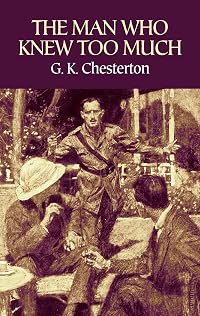
The Man Who Knew Too Much
by G. K. Chesterton
On This Page
Description
The Man Who Knew Too Much is a collection of short stories by British writer Gilbert K. Chesterton, featuring his detective Horne Fisher. From the upper-classes himself, Fisher has a unique insight into political power—a position which complicates his investigations when they approach the higher levels of corrupt government. Chesterton's witty, paradoxical work, published in 1922, gives an interesting view of the pre-Great War era..
Tags
Recommendations



















Member Recommendations

ari.joki Non-typical detective work from the sidelines, not for the benefit of the police or a client. For Chesterton, please be warned that the author doesn't hide his abhorrence of atheism, which he calls skepticism.
11
Member Reviews
The Man Who Knew Too Much in not a unified novel, but a collection of short stories that some have compared to the adventures of Sherlock Holmes, in part I think due to the presence of a Dr. Watson type companion and in in part due to the complex reasoning on the part of the main protagonist that invariably untangles a series of knots that keeps the reader guessing the solution right to the end or almost to the end of each tale.
The protagonist is a gentleman named Horne Fisher. I don't believe his first name ever gets mentioned. His occasional companion is a political journalist named Harold March who, in a way, represents the reader as Horne Fisher responds to his questions and comments thereby using March as a vehicle for show more communicating his methods and conclusions along the way.
A common thread across all of the stories is their political context. Horne Fisher and March represent the point of view of the Reform Party, although Horne Fisher in the penultimate story, The Temple of Silence, stands for Parliament as a third party candidate, seems to have won, but never takes his seat. In that story he runs on a platform dedicated to redistribution of great landed estates in order to expand the population of property owners in England, saying that if you want people to respect property give them some property to respect. Here Chesterton inserts his economic philosophy known as Distriibutism, a third way intended to ameliorate the defects of both capitalism and socialism and based in part on the famous encyclical Rerum Novarum by Pope Leo XIII.
Horne Fisher seems to be a member of the minor nobility and claims to be the black sheep of his family all of whom seem to have made their mark in politics and industry with Horne Fisher being a disappointment and comparative failure. He knows "everything" yet nothing that seems to be of use or what we now might call "actionable". And in fact, there are pragmatic considerations at work in almost all of the stories that prevent him and March from doing anything to prosecute the wrongdoers unless they meet a fatal end in the denouement. Horne Fisher is an unprepossessing type, tall, thin, balding, and very laid back, presumably living off the family money. But he wins you over as easily as he gains the friendship of March.
"I know too much', he (Horne Fisher) said. "That's what's the matter with me. That's what's the matter with all of us, and the whole show; we know too much. Too much about one another, too much about ourselves. That's why I'm really interested, just now, about one thing that I don't know."
"And that is?" inquired the other.
"Why that poor fellow is dead" (The Face in the Target)
"I have been in that room ever since", said Horne Fisher. "I am in it now. I won the election but I never went to the House. My life has been a life in that little room on that lonely island. Plenty of books, cigars and luxuries, plenty of knowledge and interest and information, but never a voice outside of that tomb to reach the world outside. I shall die there." And he smiled as he looked across the vast green park to the gray horizon. (The Vengeance of the Statue)
All in all, a very entertaining and stimulating collection of short stories.
P.S. Although Alfred Hitchcock made two movies based on Chesterton's title, neither film makes any use of the plots or characters from the book. He owned the film rights but only used the title. show less
The protagonist is a gentleman named Horne Fisher. I don't believe his first name ever gets mentioned. His occasional companion is a political journalist named Harold March who, in a way, represents the reader as Horne Fisher responds to his questions and comments thereby using March as a vehicle for show more communicating his methods and conclusions along the way.
A common thread across all of the stories is their political context. Horne Fisher and March represent the point of view of the Reform Party, although Horne Fisher in the penultimate story, The Temple of Silence, stands for Parliament as a third party candidate, seems to have won, but never takes his seat. In that story he runs on a platform dedicated to redistribution of great landed estates in order to expand the population of property owners in England, saying that if you want people to respect property give them some property to respect. Here Chesterton inserts his economic philosophy known as Distriibutism, a third way intended to ameliorate the defects of both capitalism and socialism and based in part on the famous encyclical Rerum Novarum by Pope Leo XIII.
Horne Fisher seems to be a member of the minor nobility and claims to be the black sheep of his family all of whom seem to have made their mark in politics and industry with Horne Fisher being a disappointment and comparative failure. He knows "everything" yet nothing that seems to be of use or what we now might call "actionable". And in fact, there are pragmatic considerations at work in almost all of the stories that prevent him and March from doing anything to prosecute the wrongdoers unless they meet a fatal end in the denouement. Horne Fisher is an unprepossessing type, tall, thin, balding, and very laid back, presumably living off the family money. But he wins you over as easily as he gains the friendship of March.
"I know too much', he (Horne Fisher) said. "That's what's the matter with me. That's what's the matter with all of us, and the whole show; we know too much. Too much about one another, too much about ourselves. That's why I'm really interested, just now, about one thing that I don't know."
"And that is?" inquired the other.
"Why that poor fellow is dead" (The Face in the Target)
"I have been in that room ever since", said Horne Fisher. "I am in it now. I won the election but I never went to the House. My life has been a life in that little room on that lonely island. Plenty of books, cigars and luxuries, plenty of knowledge and interest and information, but never a voice outside of that tomb to reach the world outside. I shall die there." And he smiled as he looked across the vast green park to the gray horizon. (The Vengeance of the Statue)
All in all, a very entertaining and stimulating collection of short stories.
P.S. Although Alfred Hitchcock made two movies based on Chesterton's title, neither film makes any use of the plots or characters from the book. He owned the film rights but only used the title. show less
What an odd little book. Eight short stories, connected only by the presence of the protagonist Horne Fisher, he who knows too much, and (often) of his friend, the journalist Harold March. The first and last stories bookend the set chronologically; the others don't have much internal chronology, save that Marsh's reputation as a journalist grows steadily through his appearances.
The mysteries in each story were themselves not particularly compelling for me. Much more interesting are the philosophical conversations Fisher has with Marsh, leading generally to the conclusion that the crime that's been committed should not be punished, that the true perpetrator should not be revealed, and was acting for the greater good or was otherwise show more justified. I found this an interesting contrast to other mysteries where the detective manipulates evidence to ensure that the guilty party will be caught and punished appropriately for their crimes.
The writing is often quite lovely and lyrical, although at one or two points I found it somewhat overblown. Still, a charming read that would have gotten four stars from me if I'd found the mysteries more intriguing.
Aside: Alfred Hitchcock made two fairly different movies with this title. Neither of them has anything to do with these stories, or these characters. show less
The mysteries in each story were themselves not particularly compelling for me. Much more interesting are the philosophical conversations Fisher has with Marsh, leading generally to the conclusion that the crime that's been committed should not be punished, that the true perpetrator should not be revealed, and was acting for the greater good or was otherwise show more justified. I found this an interesting contrast to other mysteries where the detective manipulates evidence to ensure that the guilty party will be caught and punished appropriately for their crimes.
The writing is often quite lovely and lyrical, although at one or two points I found it somewhat overblown. Still, a charming read that would have gotten four stars from me if I'd found the mysteries more intriguing.
Aside: Alfred Hitchcock made two fairly different movies with this title. Neither of them has anything to do with these stories, or these characters. show less
I just finished up this set of short stories starring the laconic, encyclopedic Horne Fisher. With any "series" of formulaic fiction, the question isn't quite what you do with it, but in the dance to get there. So, a basic run down of a Chesterton story of the fishing persuasion -
Horne Fischer is an upper-class intellectual who seems to have an absolute acquaintance with the ruling government of Britain and an omnipotence on all subjects, such as fish, art, magic, and politics. Hence the title, "The Man Who Knew Too Much". This knowledge amounts to rather little in the way of an individual story's plot but it does add an amount of wit and charm to what would be an irritating old chap of a protagonist.
In most stories, we follow Harold show more March, a yellow newspaper man with a disturbing lack of personality, morals and lines of dialogue, as he follows Fisher around and acts like Fisher's personal cipher and memory-hole. In most stories, someone's killed, rich people fret anxiously and Fisher concludes the truth via "deduction", or as I like to call it "detective writer's deus ex machina!". Very few of these pieces pass the sniff test, but really, no one who reads "deduction" stories cares about the sniff test, just the "clever" test -- and by golly, Chesterton writes some clever tales.
Sometimes, Fisher covers up crime. Sometimes, the crime just goes unpunished. Usually, I didn't care that the story actually ended.
All of these stories take place in rich people's houses, rich people's golf clubs, rich people's countryside estates. England's political landscape in the WWI and early twenties forms the most important background, as each story seemingly builds on the previous piece. Brick by brick, Chesterton's Fisher of Men alludes to the world-shattering importance to the lewd, petty murders he investigates. Brick-by-brick, as each villain escapes from true justice into a murky, amoral conspiracy theory, Chesterton builds up to outbreak of world war. And when war happens, according to Fisher, and maybe therefore to Chesterton (I'm no scholar of his), it seems the Jews started it by being moneylenders.
What a complete load of crap. It kills the book for me really and turns me off to Chersterton about as much as "White Man's Burden" killed Kipling for me. Which is to say, I've read a novel and I won't really dip into that well again.
As a historical piece of fiction, I think I can see the worth in "The Man Who Knew Too Much" - we have a bridge between the Victorian "rightness" of Doyle's Sherlock and the amoral (but usually moral) reflection of life found in Block's Scudder series, to shades of Clancy's political thrillers and Law & Order: Criminal Intent's Detective Goren's similar mixture of psychology, confrontation and esoteric knowledge. The turns of phrase can stop a reader cold in appreciation. The plots fit together as tight and well greased as a good British naval gun. I just wish it didn't show the flaws of the age and maybe the man. show less
Horne Fischer is an upper-class intellectual who seems to have an absolute acquaintance with the ruling government of Britain and an omnipotence on all subjects, such as fish, art, magic, and politics. Hence the title, "The Man Who Knew Too Much". This knowledge amounts to rather little in the way of an individual story's plot but it does add an amount of wit and charm to what would be an irritating old chap of a protagonist.
In most stories, we follow Harold show more March, a yellow newspaper man with a disturbing lack of personality, morals and lines of dialogue, as he follows Fisher around and acts like Fisher's personal cipher and memory-hole. In most stories, someone's killed, rich people fret anxiously and Fisher concludes the truth via "deduction", or as I like to call it "detective writer's deus ex machina!". Very few of these pieces pass the sniff test, but really, no one who reads "deduction" stories cares about the sniff test, just the "clever" test -- and by golly, Chesterton writes some clever tales.
Sometimes, Fisher covers up crime. Sometimes, the crime just goes unpunished. Usually, I didn't care that the story actually ended.
All of these stories take place in rich people's houses, rich people's golf clubs, rich people's countryside estates. England's political landscape in the WWI and early twenties forms the most important background, as each story seemingly builds on the previous piece. Brick by brick, Chesterton's Fisher of Men alludes to the world-shattering importance to the lewd, petty murders he investigates. Brick-by-brick, as each villain escapes from true justice into a murky, amoral conspiracy theory, Chesterton builds up to outbreak of world war. And when war happens, according to Fisher, and maybe therefore to Chesterton (I'm no scholar of his), it seems the Jews started it by being moneylenders.
What a complete load of crap. It kills the book for me really and turns me off to Chersterton about as much as "White Man's Burden" killed Kipling for me. Which is to say, I've read a novel and I won't really dip into that well again.
As a historical piece of fiction, I think I can see the worth in "The Man Who Knew Too Much" - we have a bridge between the Victorian "rightness" of Doyle's Sherlock and the amoral (but usually moral) reflection of life found in Block's Scudder series, to shades of Clancy's political thrillers and Law & Order: Criminal Intent's Detective Goren's similar mixture of psychology, confrontation and esoteric knowledge. The turns of phrase can stop a reader cold in appreciation. The plots fit together as tight and well greased as a good British naval gun. I just wish it didn't show the flaws of the age and maybe the man. show less
I'm another person who "read" this book by listening to BJ Harrison's Classic Tales podcast. Without Harrison I probably would never have gotten through it, based on my experience with the Man Who WasThursday, which I stopped after a chapter or two. Chesterton is a pretty decent writer, but like many political/ideological writers (Orwell being an exception) he is way too didactic. His moral perspective (in this case Catholicism and hyper nationalism) often turns the storyline juvenile, over-wrought and maudlin. After a couple of the stories, figuring out the mystery isn't all that difficult - Chesterton tends to re-use the same plot twists each time. The last in the series is almost unbearably awful and embarrassing. Fortunately, show more Harrison carried me through it to the end. So, as in the HP series, if you really are interested, get the audio book from Harrison.
PS normally xenophobia in these classic tales doesn't bother me at all - different times, different perspectives. But precisely because in this book it was so obviously an expression of Chesterton's ideology, I found it very jarring and off-putting. I know Chesterton was anti-fascist and not a bad man, but I don't find him the least bit admirable. show less
PS normally xenophobia in these classic tales doesn't bother me at all - different times, different perspectives. But precisely because in this book it was so obviously an expression of Chesterton's ideology, I found it very jarring and off-putting. I know Chesterton was anti-fascist and not a bad man, but I don't find him the least bit admirable. show less
Short stories by GK Chesterton, better-known for his 'Father Brown' mysteries. In these tales, the sleuth is Horne Fisher, a young man who solves problems because he 'knows too much'. He understands psychology and spots details that are missed by others - and there are some interesting stories, with rather a philosophical twist here and there. Unfortunately, they became increasingly political towards the end, with some rather nasty violent images, and a thoroughly miserable ending. I'm glad I read the free Kindle edition; worth reading once, but I doubt if I'll do so again.
I picked up this book because I thought it may be a story that was the basis for the the movie of the same name. While that wasn't true, the stories themselves were a delight. What I liked the most was that once the solution to each mystery, I could look back over the story and see that, if I'd pieced the clues together properly, I could have solved the mystery myself. Each clue was there.
Pleaeant, articulate writing, with a title character a little like a cross between Sherlock Holmes and a very sad Basset hound. Eventually the progression of stories take on an increasingly prejudiced, xenophobic tone.
Members
- Recently Added By
Lists

Books mentioned in The Diary of a Provincial Lady
59 works; 4 members

Books mentioned in Julian Symons’ Bloody Murder
438 works; 6 members

Books Read in 2022
5,168 works; 114 members
Author Information

799+ Works 59,737 Members
Gilbert Keith Chesterton was born in London, England, in 1874. He began his education at St Paul's School, and later went on to study art at the Slade School, and literature at University College in London. Chesterton wrote a great deal of poetry, as well as works of social and literary criticism. Among his most notable books are The Man Who Was show more Thursday, a metaphysical thriller, and The Everlasting Man, a history of humankind's spiritual progress. After Chesterton converted to Catholicism in 1922, he wrote mainly on religious topics. Chesterton is most known for creating the famous priest-detective character Father Brown, who first appeared in "The Innocence of Father Brown." Chesterton died in 1936 at the age of 62. (Bowker Author Biography) show less
Some Editions
Series
Belongs to Publisher Series
Work Relationships
Is contained in
The Collected Works of G. K. Chesterton, Vol. 08: The Return of Don Quixote, Tales of the Long Bow, The Man Who Knew Too Much by G. K. Chesterton
The Wit, Whimsy, and Wisdom of G. K. Chesterton, Volume 2: The Club of Queer Trades, The Man Who Was Thursday, The Man Who Knew Too Much by G. K. Chesterton
Chesterton's Mysteries: 3-The Man Who Knew Too Much, the Trees of Pride & Tales of the Long Bow by G. K. Chesterton
Chesterton Fiction Collection: The Napoleon of Notting Hill, The Man Who Was Thursday, The Ball and the Cross, Manalive, The Man Who Knew Too Much by G. K. Chesterton
Tales of Mystery from G. K. Chesterton: Containing The Club of Queer Trades, The Man Who Was Thursday, and The Man Who Knew Too Much by G. K. Chesterton
Common Knowledge
- Canonical title
- The Man Who Knew Too Much
- Original title
- The Man Who Knew Too Much
- Original publication date
- 1922
- People/Characters
- Home Fisher; Harold March
- First words
- Harold March, the rising reviewer and social critic, was walking vigorously across a great tableland of moors and commons, the horizon of which was fringed with the far-off woods of the famous estate of Torwood Park.
- Last words
- (Click to show. Warning: May contain spoilers.)Something lay in the shadow at the foot of the ridge, as stiff as the stick of the fallen rocket; and the man who knew too much knew what is worth knowing.
- Original language
- English
- Disambiguation notice
- ASIN: B0026P4DQE MirMar Publishing
This is NOT a movie. This is a DVD book. You read it on your TV, PC or personal DVD player. These eight tales trace the activities of Horne Fisher, the man who knew too much.
Classifications
Statistics
- Members
- 1,127
- Popularity
- 22,437
- Reviews
- 38
- Rating
- (3.51)
- Languages
- 5 — English, German, Italian, Spanish, Turkish
- Media
- Paper, Audiobook, Ebook
- ISBNs
- 157
- UPCs
- 1
- ASINs
- 49