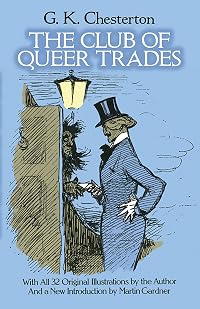
The Club of Queer Trades
by G. K. Chesterton
On This Page
Description
Equally well-known for his sophisticated philosophy tracts and his top-notch detective fiction, G.K. Chesterton was himself something of a literary jack-of-all-trades. This beloved collection of detective stories and mysteries is based on a club that is only open to those who rely on unusual or extraordinary lines of work as their main source of income. A fast-paced, purely enjoyable collection that is sure to tickle the fancy of classic detective fiction fans..
Tags
Recommendations



















Member Reviews
These six short stories are light and amusing, but not shallow. Swinburne relates adventures with his friend Basil Grant, who is a retired and reclusive former judge, described as mad, mystical, and a poet, with almost no friends, but who “would talk to any one anywhere”. They discover people with a peculiar (“queer” in the old sense) and unique way of making a living, which makes them eligible for the select and secretive club of the title. I love the concept, and I enjoyed the individual cases.
Each character is delightfully and distinctly drawn, especially in their manner of speech, and the fifth story has a linguistic angle.
Chesterton’s writing is sometimes similar to Wodehouse, though I’m not sure either would show more appreciate the comparison. In “Mr. Mulliner Speaking”, PGW wrote “The drowsy stillness of the afternoon was shattered by what sounded to his strained senses like GK Chesterton falling on a sheet of tin.”. There are also Wildean flourishes of counter-intuitive epigrams and philosophical musings on truth, logic, and meaning.
The stories unfold with nods to detective fiction, especially when Basil’s much younger brother, Rupert, is involved: he's a private detective.
1. The Tremendous Adventures of Major Brown, 5*
Major Brown, “a man with the natural beliefs and tastes of an old maid” and a passion for pansies (the flowers) comes to them with “one of the most astounding stories in the world”. That’s setting the bar high! But it is an extraordinary sequence of increasingly odd, alarming, puzzling, and surreal events: a shocking message spelled out in flowers, a mysterious woman, inexplicable references to property deeds and jackals, a violent attack, things vanishing, a letter, and an itemised bill.
Grant rejects the narrator’s obvious explanation:
“I never could believe in that man - what's his name, in those capital stories? - Sherlock Holmes. Every detail points to something, certainly; but generally to the wrong thing. Facts point in all directions, it seems to me, like the thousands of twigs on a tree.“
The revelation is both fantastical and realistic. Brilliant. The biggest surprise is that what was imagined in 1905 now happens for “real” in the digital world:
“There is no element in modern life that is more lamentable than the fact that the modern man has to seek all artistic existence in a sedentary state. If he wishes to float into fairyland, he reads a book; if he wishes to dash into the thick of battle, he reads a book…”
2. The Painful Fall of a Great Reputation, 2*
This opens with good and thoughtful descriptions of “the real horror of the poor parts of London, the horror that is so totally missed and misrepresented by the sensational novelists”, Dickensian darkness and gaslight, and the excitement of a glimpse of “the wickedest man in England”. But soon there was too much running around, with too many brief appearances of characters that I didn’t really distinguish, all for a less-interesting revelation. A disappointment after the first story.
Image: "Basil bent suddenly down and tore a paper out of Sir Walter's breast-pocket." (Source.)
3. The Awful Reason of the Vicar's Visit, 4*
A “flappy and floppy” and excessively apologetic elderly clergyman turns up on an urgent matter of life and death, just as Swinburne is dressing to go out for dinner.
“I have never been forcibly dressed up as an old woman and made to take part in a crime in the character of an old woman.”
That tickles Swinburne’s interest, but by the end of Rev Ellis Shorter’s tale, Swinburne is baffled, and they both go to Basil Grant’s to figure it out, which Basil does, instantly. As a detective story, it’s weak: there isn’t a trail of clues and red-herrings. But as an amusing character study and a delightfully unexpected “queer trade”, I enjoyed it.
4. The Singular Speculation of the House-Agent, 4*
“He was a man who told the kind of adventures which win a man admiration, but not respect.”
Drummond Keith is an “elegant”, “nomadic”, and “very impecunious” middle-aged retired lieutenant who continually changes lodgings, and is “a teller of tall tales”. A house-agent finds him a house. A green house, that is very inconspicuous. Extraordinarily so. Or maybe just extraordinary.
“When you are guessing about any one who is sane, the sanest thing is the most likely; when you are guessing about any one who is, like our host, insane, the maddest thing is the most likely.”
5. The Noticeable Conduct of Professor Chadd, 4*
Professor Chadd is an ethnologist with an interest in primitive culture and languages. Yes, the terminology is dated, but the underlying attitudes are more benevolent.
Basil Grant asserts that Zulu culture is not evolutionarily inferior. “Suppose it is we who are the idiots because we are not afraid of devils in the dark?”, and he goes on to assert that “you know more about Zulus in the sense that you are a scientist, I know more about them in the sense that I am a savage”. The next day, Grant is summoned by Chadd’s sisters, who are distraught that he seems to have gone mad. It’s a very original story, with a thought-provoking angle for those interested in linguistics.
Image: "Basil Grant talking to Mr Bingham of the British Museum." (The original caption is a spoiler.)) (Source.)
6. The Eccentric Seclusion of the Old Lady, 4*
Rupert Grant is prone to “long fantasias of detective deduction” and “with this mad logic in his brain, seeing a conspiracy in a cab accident”. He spots a suspicious milkman and follows him, with Swinburne in tow. What they find is unexpected, and the reaction to their intervention even more so. Unusually, this mystery isn’t solved until months later. This is the last story in the collection, so the final section wraps up the book.
So what are the six queer trades?
1. The Tremendous Adventures of Major Brown
"The Adventure and Romance Agency has been started to meet a great modern desire. On every side, in conversation and in literature, we hear of the desire for a larger theatre of events for something to waylay us and lead us splendidly astray. Now the man who feels this desire for a varied life pays a yearly or a quarterly sum to the Adventure and Romance Agency; in return, the Adventure and Romance Agency undertakes to surround him with startling and weird events."
It sounds rather like Consumer Recreation Services in the 1997 film, The Game, starring Michael Douglas and Sean Penn (which I’ve not yet seen).
Image: "The cries appeared to come from a decapitated head resting on the pavement.." (Source.)
2. The Painful Fall of a Great Reputation
“A trifle immoral, I admit, but still great, like piracy… the great new trade of the Organizer of Repartee… He hires himself out at dinner-parties to lead up to other people's repartees. According to a preconcerted scheme… he says the stupid things he has arranged for himself, and his client says the clever things arranged for him.”
3. The Awful Reason of the Vicar's Visit
This particular “queer trade” is one I would use occasionally, if I could afford it.
“Professional Detainers… It doesn't do any one the least harm. It's only a social fiction. A result of our complex society… We are paid by our clients to detain in conversation, on some harmless pretext, people whom they want out of the way for a few hours.”
4. The Singular Speculation of the House-Agent
The house-agent “has a special line in arboreal villas.” Tree houses! Nice and cheap compared with more conventional lodgings.
“My people wanted me very much to go into the house-agency business. But I never cared myself for anything but natural history and botany… I thought somehow that an arboreal villa agency was a sort of—of compromise between being a botanist and being a house-agent.”
5. The Noticeable Conduct of Professor Chadd
”He has worked out a system of language of his own… And he has sworn that till people understand it, till he can speak to us in this language, he will not speak in any other. And he shall not. I have understood, by taking careful notice; and, by heaven, so shall the others. This shall not be blown upon. He shall finish his experiment. He shall have £800 a year from somewhere till he has stopped dancing. To stop him now is an infamous war on a great idea. It is religious persecution.”
6. The Eccentric Seclusion of the Old Lady
The final queer trade is Basil Grant’s.
“I offered myself privately as a purely moral judge to settle purely moral differences… People were tried before me not for the practical trifles for which nobody cares, such as committing a murder, or keeping a dog without a licence. My criminals were tried for the faults which really make social life impossible. They were tried before me for selfishness, or for an impossible vanity, or for scandalmongering, or for stinginess to guests or dependents. Of course these courts had no sort of real coercive powers. The fulfilment of their punishments rested entirely on the honour of the ladies and gentlemen involved, including the honour of the culprits.”
Quotes
• “He welcomed a human face as he might welcome a sudden blend of colour in a sunset; but he no more felt the need of going out to parties than he felt the need of altering the sunset clouds.”
• “The peculiar speech, which consisted of only saying about a quarter of each sentence, and that sharply, like the crack of a gun.”
• “She was a graceful, green-clad figure, with fiery red hair and a flavour of Bedford Park.” and “one of the queerest and yet most attractive faces he had ever seen in his life; open, and yet tantalising, the face of an elf.”
• “The most perfect place for talking on earth—the top of a tolerably deserted tramcar. To talk on the top of a hill is superb, but to talk on the top of a flying hill is a fairy tale.”
• “‘No, thank you, no, thank you; not just now,’ he repeated with that hysterical eagerness with which people who do not drink at all often try to convey that on any other night of the week they would sit up all night drinking rum-punch.”
• “Truth must of necessity be stranger than fiction… for fiction is the creation of the human mind, and therefore is congenial to it.”
• “A solitary old gentleman… He had an egglike head, froglike jaws, and a grey hairy fringe of aureole round the lower part of his face; the whole combined with a reddish, aquiline nose. He wore a shabby black frock-coat, a sort of semi-clerical tie worn at a very unclerical angle, and looked, generally speaking, about as unlike a house-agent as anything could look, short of something like a sandwich man or a Scotch Highlander.”
• He “had remained throughout the proceedings in a state of Napoleonic calm, which might be more accurately described as a state of Napoleonic stupidity.”
• “Buttering his toast with an energy that was somewhat exultant.”
• “A livid sunset seemed to look at us with a sort of sickly smile before it died.”
• “[We] exchanged a few words about the weather. Then we had talked for about an hour about politics and God; for men always talk about the most important things to total strangers.”
• “Miracles should always happen in broad daylight. The night makes them credible and therefore commonplace.”
• “His reasoning is particularly cold and clear, and invariably leads him wrong. But his poetry comes in abruptly and leads him right.”
• “The house… stood up ponderous and purple against the last pallor of twilight. It looked like an ogre's castle.”
• “I know of nothing that is safe… except, possibly - death”
Other humorous short stories
I read the first of these in Paul Merton’s anthology, Funny Ha Ha, and enjoyed it so much, I sought out the rest. See my review of Funny Ha Ha, HERE), for other such stories, by 60 different authors.
You can read all six stories on Gutenberg.org, HERE. show less
Each character is delightfully and distinctly drawn, especially in their manner of speech, and the fifth story has a linguistic angle.
Chesterton’s writing is sometimes similar to Wodehouse, though I’m not sure either would show more appreciate the comparison. In “Mr. Mulliner Speaking”, PGW wrote “The drowsy stillness of the afternoon was shattered by what sounded to his strained senses like GK Chesterton falling on a sheet of tin.”. There are also Wildean flourishes of counter-intuitive epigrams and philosophical musings on truth, logic, and meaning.
The stories unfold with nods to detective fiction, especially when Basil’s much younger brother, Rupert, is involved: he's a private detective.
1. The Tremendous Adventures of Major Brown, 5*
Major Brown, “a man with the natural beliefs and tastes of an old maid” and a passion for pansies (the flowers) comes to them with “one of the most astounding stories in the world”. That’s setting the bar high! But it is an extraordinary sequence of increasingly odd, alarming, puzzling, and surreal events: a shocking message spelled out in flowers, a mysterious woman, inexplicable references to property deeds and jackals, a violent attack, things vanishing, a letter, and an itemised bill.
Grant rejects the narrator’s obvious explanation:
“I never could believe in that man - what's his name, in those capital stories? - Sherlock Holmes. Every detail points to something, certainly; but generally to the wrong thing. Facts point in all directions, it seems to me, like the thousands of twigs on a tree.“
The revelation is both fantastical and realistic. Brilliant. The biggest surprise is that what was imagined in 1905 now happens for “real” in the digital world:
“There is no element in modern life that is more lamentable than the fact that the modern man has to seek all artistic existence in a sedentary state. If he wishes to float into fairyland, he reads a book; if he wishes to dash into the thick of battle, he reads a book…”
2. The Painful Fall of a Great Reputation, 2*
This opens with good and thoughtful descriptions of “the real horror of the poor parts of London, the horror that is so totally missed and misrepresented by the sensational novelists”, Dickensian darkness and gaslight, and the excitement of a glimpse of “the wickedest man in England”. But soon there was too much running around, with too many brief appearances of characters that I didn’t really distinguish, all for a less-interesting revelation. A disappointment after the first story.
Image: "Basil bent suddenly down and tore a paper out of Sir Walter's breast-pocket." (Source.)
3. The Awful Reason of the Vicar's Visit, 4*
A “flappy and floppy” and excessively apologetic elderly clergyman turns up on an urgent matter of life and death, just as Swinburne is dressing to go out for dinner.
“I have never been forcibly dressed up as an old woman and made to take part in a crime in the character of an old woman.”
That tickles Swinburne’s interest, but by the end of Rev Ellis Shorter’s tale, Swinburne is baffled, and they both go to Basil Grant’s to figure it out, which Basil does, instantly. As a detective story, it’s weak: there isn’t a trail of clues and red-herrings. But as an amusing character study and a delightfully unexpected “queer trade”, I enjoyed it.
4. The Singular Speculation of the House-Agent, 4*
“He was a man who told the kind of adventures which win a man admiration, but not respect.”
Drummond Keith is an “elegant”, “nomadic”, and “very impecunious” middle-aged retired lieutenant who continually changes lodgings, and is “a teller of tall tales”. A house-agent finds him a house. A green house, that is very inconspicuous. Extraordinarily so. Or maybe just extraordinary.
“When you are guessing about any one who is sane, the sanest thing is the most likely; when you are guessing about any one who is, like our host, insane, the maddest thing is the most likely.”
5. The Noticeable Conduct of Professor Chadd, 4*
Professor Chadd is an ethnologist with an interest in primitive culture and languages. Yes, the terminology is dated, but the underlying attitudes are more benevolent.
Basil Grant asserts that Zulu culture is not evolutionarily inferior. “Suppose it is we who are the idiots because we are not afraid of devils in the dark?”, and he goes on to assert that “you know more about Zulus in the sense that you are a scientist, I know more about them in the sense that I am a savage”. The next day, Grant is summoned by Chadd’s sisters, who are distraught that he seems to have gone mad. It’s a very original story, with a thought-provoking angle for those interested in linguistics.
Image: "Basil Grant talking to Mr Bingham of the British Museum." (The original caption is a spoiler.)) (Source.)
6. The Eccentric Seclusion of the Old Lady, 4*
Rupert Grant is prone to “long fantasias of detective deduction” and “with this mad logic in his brain, seeing a conspiracy in a cab accident”. He spots a suspicious milkman and follows him, with Swinburne in tow. What they find is unexpected, and the reaction to their intervention even more so. Unusually, this mystery isn’t solved until months later. This is the last story in the collection, so the final section wraps up the book.
So what are the six queer trades?
1. The Tremendous Adventures of Major Brown
It sounds rather like Consumer Recreation Services in the 1997 film, The Game, starring Michael Douglas and Sean Penn (which I’ve not yet seen).
Image: "The cries appeared to come from a decapitated head resting on the pavement.." (Source.)
2. The Painful Fall of a Great Reputation
3. The Awful Reason of the Vicar's Visit
This particular “queer trade” is one I would use occasionally, if I could afford it.
4. The Singular Speculation of the House-Agent
“My people wanted me very much to go into the house-agency business. But I never cared myself for anything but natural history and botany… I thought somehow that an arboreal villa agency was a sort of—of compromise between being a botanist and being a house-agent.”
5. The Noticeable Conduct of Professor Chadd
6. The Eccentric Seclusion of the Old Lady
“I offered myself privately as a purely moral judge to settle purely moral differences… People were tried before me not for the practical trifles for which nobody cares, such as committing a murder, or keeping a dog without a licence. My criminals were tried for the faults which really make social life impossible. They were tried before me for selfishness, or for an impossible vanity, or for scandalmongering, or for stinginess to guests or dependents. Of course these courts had no sort of real coercive powers. The fulfilment of their punishments rested entirely on the honour of the ladies and gentlemen involved, including the honour of the culprits.”
Quotes
• “He welcomed a human face as he might welcome a sudden blend of colour in a sunset; but he no more felt the need of going out to parties than he felt the need of altering the sunset clouds.”
• “The peculiar speech, which consisted of only saying about a quarter of each sentence, and that sharply, like the crack of a gun.”
• “She was a graceful, green-clad figure, with fiery red hair and a flavour of Bedford Park.” and “one of the queerest and yet most attractive faces he had ever seen in his life; open, and yet tantalising, the face of an elf.”
• “The most perfect place for talking on earth—the top of a tolerably deserted tramcar. To talk on the top of a hill is superb, but to talk on the top of a flying hill is a fairy tale.”
• “‘No, thank you, no, thank you; not just now,’ he repeated with that hysterical eagerness with which people who do not drink at all often try to convey that on any other night of the week they would sit up all night drinking rum-punch.”
• “Truth must of necessity be stranger than fiction… for fiction is the creation of the human mind, and therefore is congenial to it.”
• “A solitary old gentleman… He had an egglike head, froglike jaws, and a grey hairy fringe of aureole round the lower part of his face; the whole combined with a reddish, aquiline nose. He wore a shabby black frock-coat, a sort of semi-clerical tie worn at a very unclerical angle, and looked, generally speaking, about as unlike a house-agent as anything could look, short of something like a sandwich man or a Scotch Highlander.”
• He “had remained throughout the proceedings in a state of Napoleonic calm, which might be more accurately described as a state of Napoleonic stupidity.”
• “Buttering his toast with an energy that was somewhat exultant.”
• “A livid sunset seemed to look at us with a sort of sickly smile before it died.”
• “[We] exchanged a few words about the weather. Then we had talked for about an hour about politics and God; for men always talk about the most important things to total strangers.”
• “Miracles should always happen in broad daylight. The night makes them credible and therefore commonplace.”
• “His reasoning is particularly cold and clear, and invariably leads him wrong. But his poetry comes in abruptly and leads him right.”
• “The house… stood up ponderous and purple against the last pallor of twilight. It looked like an ogre's castle.”
• “I know of nothing that is safe… except, possibly - death”
Other humorous short stories
I read the first of these in Paul Merton’s anthology, Funny Ha Ha, and enjoyed it so much, I sought out the rest. See my review of Funny Ha Ha, HERE), for other such stories, by 60 different authors.
You can read all six stories on Gutenberg.org, HERE. show less
'The Club of Queer Trades' (1903) is a light hearted collection of six anecdotal tales strung together within a framework worthy of the British tradition of absurdist humour that goes from Tristram Shandy through to Spike Milligan and Monty Python.
Of course, while the humour is still there, the laugh out loud element will have gone although I chuckled, I have to admit, at the image of a gang of transvestite criminals (no more details for the sake of spoilers). Our po-faced millennial generation will no doubt simply be outraged.
Chesterton cannot avoid his Christian didacticism but not overly so. It is worn very lightly and restricted to the constant theme that reason is not to be confused with reality and that one should never take what show more appears to be as what actually is the case.
In this endeavour his inventiveness and wit carries matters off brilliantly. Although dated. it should be a pleasant read with good reason to smile at mostly likeable characters often making utter fools of themselves. Chesterton stands up as an Edwardian humorist. show less
Of course, while the humour is still there, the laugh out loud element will have gone although I chuckled, I have to admit, at the image of a gang of transvestite criminals (no more details for the sake of spoilers). Our po-faced millennial generation will no doubt simply be outraged.
Chesterton cannot avoid his Christian didacticism but not overly so. It is worn very lightly and restricted to the constant theme that reason is not to be confused with reality and that one should never take what show more appears to be as what actually is the case.
In this endeavour his inventiveness and wit carries matters off brilliantly. Although dated. it should be a pleasant read with good reason to smile at mostly likeable characters often making utter fools of themselves. Chesterton stands up as an Edwardian humorist. show less
I didn't like reading this at all. I have read three other works by Chesterton, all of which I didn't like very much. I am not a great fan of detective stories, and I hadn't liked his Father Brown stories. The concept of each of these seven stories is kind of complex: the action takes place in a strange, bewildering (a weird guild), the detective is an ideosyncratic, puzzling person and the problem of each story is a mystery which is to be solved.
However, it must be said that perhaps I wasn't fully concentrated because I was travelling, and that's why perhaps I should read this slim work another time, just to be fair.
However, it must be said that perhaps I wasn't fully concentrated because I was travelling, and that's why perhaps I should read this slim work another time, just to be fair.
This was a very sweet little read. I believe my favorite character—other than of course the prodigy mystic and former Judge, Basil Grant—was Major Brown. I can only imagine my own horror if I climbed a wall to see pansies arranged in such a malevolent and personal pattern of growth.
Basil Grant's brother, the rather cynical, or at least pessimistic, Rupert Grant—a private detective, whose logic is always shown to be flawed—very much reminded me of many other "# 2s" of the Mystery genre. Funny that Mr. Swinburne was Rupert's own "#2" man, as well as the narrator.
The real target of Chesterton's satire was Mr. Doyle's Holmes. I do wish to make it known that Chesterton was quite the intellectual fellow. He often debated his close show more friend George Bernard Shaw alongside many others. I give you one of Chesterton's most memorable Holmesian quotes:
[...] to realize that Sherlock Holmes is not really a real logician. He is an ideal logician imagined by an illogical person. [...] But Sherlock Holmes is an ideal figure, and in an imaginative sense a very effective one. He does embody the notion which unreasonable people entertain of what pure reason would be like.
This witty and quite humorous little novel was a pleasure to read. There is much commentary on the modernity of man, which is not at all outdated, nor will it ever become so.
Paradox runs rampant throughout, as it was one of Chesterton's favorite toys. There also is a great many memorable quotes within, viz.,
"What is the modern mind?" asked Grant.
"Oh, it's enlightened, you know, and progressive --and faces the facts of life seriously." At this moment another roar of laughter came from within."
The six short stories within are interconnected, sequential, yet independent. Each presents us with a trade, or way of making a living, that the world has never seen before. Brilliant!! show less
Basil Grant's brother, the rather cynical, or at least pessimistic, Rupert Grant—a private detective, whose logic is always shown to be flawed—very much reminded me of many other "# 2s" of the Mystery genre. Funny that Mr. Swinburne was Rupert's own "#2" man, as well as the narrator.
The real target of Chesterton's satire was Mr. Doyle's Holmes. I do wish to make it known that Chesterton was quite the intellectual fellow. He often debated his close show more friend George Bernard Shaw alongside many others. I give you one of Chesterton's most memorable Holmesian quotes:
[...] to realize that Sherlock Holmes is not really a real logician. He is an ideal logician imagined by an illogical person. [...] But Sherlock Holmes is an ideal figure, and in an imaginative sense a very effective one. He does embody the notion which unreasonable people entertain of what pure reason would be like.
This witty and quite humorous little novel was a pleasure to read. There is much commentary on the modernity of man, which is not at all outdated, nor will it ever become so.
Paradox runs rampant throughout, as it was one of Chesterton's favorite toys. There also is a great many memorable quotes within, viz.,
"What is the modern mind?" asked Grant.
"Oh, it's enlightened, you know, and progressive --and faces the facts of life seriously." At this moment another roar of laughter came from within."
The six short stories within are interconnected, sequential, yet independent. Each presents us with a trade, or way of making a living, that the world has never seen before. Brilliant!! show less
Lovely surreal detection puzzles.
Our narrator and his friend, the mad judge, and his amateur detective brother embark on a series adventures all stemming from a mysterious club, a club that only people with bizarre jobs can join.
Chesterton is fast becoming one of my favourite writers. These series of linked short stories are all wildly inventive and wonderfully surreal, a sort of antidote to factual Sherlock Holmes detective stories. There is feeling of joy in his novels, a celebration of life even while it is delving into darkness. His odd way of looking at things gives you the space to think about them from a different point of view and while I don't always agree with him I am always intrigued and entertained.
Our narrator and his friend, the mad judge, and his amateur detective brother embark on a series adventures all stemming from a mysterious club, a club that only people with bizarre jobs can join.
Chesterton is fast becoming one of my favourite writers. These series of linked short stories are all wildly inventive and wonderfully surreal, a sort of antidote to factual Sherlock Holmes detective stories. There is feeling of joy in his novels, a celebration of life even while it is delving into darkness. His odd way of looking at things gives you the space to think about them from a different point of view and while I don't always agree with him I am always intrigued and entertained.
So much fun. Basil Grant always figures things out way ahead of any of the other characters, and generally before the reader (except in the case of the elms, it has to be admitted). The idea is simple - there are many, many clubs in London, but the most interesting of all is the club of queer trades, of forms of gainful employment that are in some way unique. Each chapter explores another of these companies, though the secret to that company must be figured out like a Sherlock Holmes riddle. Very inventive.
Good fun - in some ways feels like a warm-up for Father Brown, but these stories are all ultimately silly and amusing, with no real crimes ever being committed. Ingenious though.
Extra points for this Dover edition for having GKC's illustrations included, which I was delighted by.
Extra points for this Dover edition for having GKC's illustrations included, which I was delighted by.
Members
- Recently Added By
Lists

Detective Stories
343 works; 5 members

Books mentioned in Julian Symons’ Bloody Murder
438 works; 6 members

Best Mysteries With a Historical Setting
292 works; 160 members
Author Information

797+ Works 59,802 Members
Gilbert Keith Chesterton was born in London, England, in 1874. He began his education at St Paul's School, and later went on to study art at the Slade School, and literature at University College in London. Chesterton wrote a great deal of poetry, as well as works of social and literary criticism. Among his most notable books are The Man Who Was show more Thursday, a metaphysical thriller, and The Everlasting Man, a history of humankind's spiritual progress. After Chesterton converted to Catholicism in 1922, he wrote mainly on religious topics. Chesterton is most known for creating the famous priest-detective character Father Brown, who first appeared in "The Innocence of Father Brown." Chesterton died in 1936 at the age of 62. (Bowker Author Biography) show less
Some Editions
Awards and Honors
Awards
Notable Lists
Series
Belongs to Publisher Series
Work Relationships
Is contained in
The Collected Works of G. K. Chesterton, Vol. 06: The Club of Queer Trades, The Napoleon of Notting Hill, The Man Who Was Thursday by G. K. Chesterton
The Wit, Whimsy, and Wisdom of G. K. Chesterton, Volume 2: The Club of Queer Trades, The Man Who Was Thursday, The Man Who Knew Too Much by G. K. Chesterton
Tales of Mystery from G. K. Chesterton: Containing The Club of Queer Trades, The Man Who Was Thursday, and The Man Who Knew Too Much by G. K. Chesterton
Common Knowledge
- Canonical title
- The Club of Queer Trades
- Original publication date
- 1905
- People/Characters
- Rupert Grant; Basil Grant; Major Brown; P. G. Northover; Jasper Drummond; Swinburne
- Important places
- London, England, UK; Berkeley Square, London, England, UK; Buxton Common, Surrey, England, UK
- First words
- Rabelais, or his wild illustrator Gustave Dore, must have had something to do with the designing of the things called flats in England and America.
- Last words
- (Click to show. Warning: May contain spoilers.)Thus our epic ended where it had begun, like a true cycle.
Classifications
Statistics
- Members
- 1,103
- Popularity
- 23,059
- Reviews
- 29
- Rating
- (3.74)
- Languages
- 12 — Catalan, Czech, Dutch, English, French, German, Greek, Italian, Portuguese, Spanish, Swedish, Turkish
- Media
- Paper, Audiobook, Ebook
- ISBNs
- 116
- UPCs
- 2
- ASINs
- 36