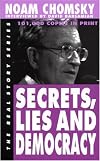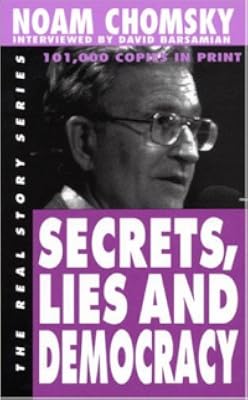
Secrets, Lies and Democracy
by Noam Chomsky
On This Page
Description
Another illusion-shattering piece from the man The New York Times called arguably the most important intellectual alive . In 1970, about 90 per cent of international capital was used for trade and long-term investment - more or less productive things - and 10 per cent for speculation. By 1990, these figures had reversed. Haiti, a starving island, is exporting food to the US - about 35 times as much under Clinton as under Bush. The US government spent more money per capita to get the show more presidential candidate it favoured in Chile in 1964 than was spent by both candidates (John and Goldwater) in the 1964 election in the US. The gap between how much income is held by the richest and the poorest 20 per cent has increased dramatically over the past 30 years - about double for rich versus poor countries and far more for rich versus poor people. What the public wants is called politically unrealistic . Translated into English, that means power and privilege are opposed to it. show lessTags
Recommendations




Member Reviews
If I were going to be churlish (and I DID notice that look of surprise that I could be anything other!) I would say that this book is too America fixated but, as the text is taken from discourses on American radio stations, such a complaint would be, well... churlish.
There is certainly plenty in this book that is well worth reading and pertinent to us, whatever nation in which we choose to reside. It is frightening to realise that the book was written in 1994: it means that the system, which is slowly strangling the way of life in both first and third world countries, has been gathering pace for over twenty years. I very much like people such as Chomsky, who illustrate the problem simply and cogently, without the need for exaggerated show more language and name calling. It means that, whilst one may disagree with him, it is impossible to dismiss him as an old reactionary. Were more people to read this book, I feel sure that the TNC's would not be able to sneak through their pernicious changes to all our lives so, if you haven't read it, it may be bought incredibly cheaply (don't get me started upon how undervalued books are!) on line.
Are you still here? Why aren't you logging in to your preferred book dealer???? show less
There is certainly plenty in this book that is well worth reading and pertinent to us, whatever nation in which we choose to reside. It is frightening to realise that the book was written in 1994: it means that the system, which is slowly strangling the way of life in both first and third world countries, has been gathering pace for over twenty years. I very much like people such as Chomsky, who illustrate the problem simply and cogently, without the need for exaggerated show more language and name calling. It means that, whilst one may disagree with him, it is impossible to dismiss him as an old reactionary. Were more people to read this book, I feel sure that the TNC's would not be able to sneak through their pernicious changes to all our lives so, if you haven't read it, it may be bought incredibly cheaply (don't get me started upon how undervalued books are!) on line.
Are you still here? Why aren't you logging in to your preferred book dealer???? show less
Secrets, Lies and Democracy, Naom Chomsky, interviewed by David Barsamian (pp 106). 1994. Chomsky is—from an online profile—“an author of over 100 books on topics such as linguistics, war, politics, and mass media. Ideologically, he aligns with anarcho-syndicalism and libertarian socialism.”
This book of interviews is highly critical of corporations and other authoritarian entities (never thought of them that way before), including most forms of government, including pseudo-democracies. While his criticisms are often harsh and suffer from overstatement, they are no more outrageous than what we hear from big business and government. Many of his ideas have at least a grain of truth and oftentimes much more. His ideas are worth show more reading regardless of one’s political beliefs. The interviews are wide ranging, cover a lot of societal territory, so there’s probably something of interest for everyone: corporate and special interests’ control of government, growing income gaps, interference in sovereign governments, and more. show less
This book of interviews is highly critical of corporations and other authoritarian entities (never thought of them that way before), including most forms of government, including pseudo-democracies. While his criticisms are often harsh and suffer from overstatement, they are no more outrageous than what we hear from big business and government. Many of his ideas have at least a grain of truth and oftentimes much more. His ideas are worth show more reading regardless of one’s political beliefs. The interviews are wide ranging, cover a lot of societal territory, so there’s probably something of interest for everyone: corporate and special interests’ control of government, growing income gaps, interference in sovereign governments, and more. show less
Edição da Ed. Universidade de Brasilia, 1999
Ratings
Members
- Recently Added By
Author Information

585+ Works 47,705 Members
Noam Chomsky was born in Philadelphia, Pennsylvania on December 7, 1928. Son of a Russian emigrant who was a Hebrew scholar, Chomsky was exposed at a young age to the study of language and principles of grammar. During the 1940s, he began developing socialist political leanings through his encounters with the New York Jewish intellectual show more community. Chomsky received his Ph.D. from the University of Pennsylvania, where he studied linguistics, mathematics, and philosophy. He conducted much of his research at Harvard University. In 1955, he began teaching at MIT, eventually holding the Ferrari P. Ward Chair of Modern Language and Linguistics. Today Chomsky is highly regarded as both one of America's most prominent linguists and most notorious social critics and political activists. His academic reputation began with the publication of Syntactic Structures in 1957. Within a decade, he became known as an outspoken intellectual opponent of the Vietnam War. Chomsky has written many books on the links between language, human creativity, and intelligence, including Language and Mind (1967) and Knowledge of Language: Its Nature, Origin, and Use (1985). He also has written dozens of political analyses, including Manufacturing Consent: The Political Economy of the Mass Media (1988), Chronicles of Dissent (1992), and The Prosperous Few and the Restless Many (1993). (Bowker Author Biography) show less
Series
Belongs to Publisher Series
Work Relationships
Is contained in
Common Knowledge
- Canonical title
- Secrets, Lies and Democracy
Classifications
- Genres
- Nonfiction, General Nonfiction, Politics and Government, History, Philosophy
- DDC/MDS
- 330.9049 — Society, government, & culture Economics Jobs & Careers Economic geography and history Standard subdivisions and By Period 20th Century 1990-1999
- LCC
- D860 .C467 — History of Europe, Asia, Africa and Oceania History (General) Post-war history (1945- )
- BISAC
Statistics
- Members
- 419
- Popularity
- 73,971
- Reviews
- 4
- Rating
- (3.70)
- Languages
- 5 — English, Hungarian, Italian, Portuguese, Spanish
- Media
- Paper
- ISBNs
- 5
- ASINs
- 6