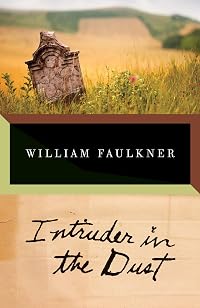
Intruder in the Dust
by William Faulkner
On This Page
Description
At once an engrossing murder mystery and an unflinching portrait of racial injustice in the Reconstruction South, Intruder in the Dust stands out as a true classic of Southern literature. A classic Faulkner novel which explores the lives of a family of characters in the South. An aging black who has long refused to adopt the black's traditionally servile attitude is wrongfully accused of murdering a white man.Tags
Recommendations































Member Reviews
Told through the eyes of a teenage Charles Mallison, this is a murder mystery wrapped up in race. Lucas Beauchamp, the mixed-race independent minded descendent of the white McCaslins, is arrested for murder, shooting a white man in a very closed rural community ten miles outside Jefferson Mississippi. A lynching feels imminent, leaving anxious energy throughout the un-protesting town. Lucas is one of Faulkner's best characters, and he's at his best here in the opening sections, but he's ultimately not really a main character. Instead we have Charles, who is largely listening to his uncle, Gavin Stevens, the Harvard educated country attorney whose strong sense of common-sense has only one problem - it's always wrong.
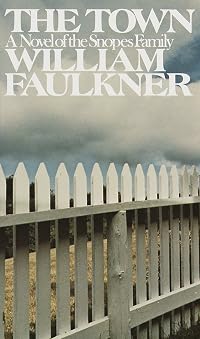
So, reader, we spend show more a lot of time listening to Gavin rant, in wordy, thick, Faulknerese. That, to me, is Faulkner as his most unpleasant. Charles and Gavin also narrate The Town, my least favorite Faulkner novel. But this is much better than The Town. As Gavin's rants roll along, he begins to lay out several of Faulkner's life-long philosophies - on race, the south, history, and the eternal presence of history here, now, always. (As Faulkner said elsewhere, "The past is never dead. It’s not even past."). Faulkner's sense of the legacy of the Civil War is fronted here in one of these rants in a very revealing way, one that feels central to all his work. Faulkner always talks around the central dramatic issues. You aren't likely to see a gun go off, but you will hear the lead up and after affects. And you aren't likely to hear about the Civil War and southern audacity, but it's woven into the text, altering and coding everything. Here, waxing on the moment before Pickett's charge, when that southern audacity had its highest promising moment, just a decision away from destruction on Gettysburg, had General Lee merely chosen not to attack...
The problem with all this is, of course, it's fucking racist. The southern audacity was a white-supremacist slave culture. And Faulkner knows better. Through most of Faulkner's writing, his better writer-voice comes out, instead of his far too conservative, racism-permitting real voice. Here it wavers hard. This is a book that gets closer to Faulkner's true senses. They're way outdated. But they're presented in Gavin Steven's voice, and he's confident and always wrong. So, a game is in there.
As a moment in history, this book was published in 1948. Hiroshima was 3 years past. Gavin includes 1933 and post-War Europe in his rants. The Portable Faulkner came out in 1946, sparking Faulkner's 1st widespread sales. His previous novel, Go Down, Moses, had been published in 1942, six years earlier. And, in 1949, Faulkner would win the Nobel Prize. Whatever Faulkner's racist sense, American and European readers were fascinated and found him insightful on the southern mindset. And he was.
Like Faulkner's novel, my review has lost track of the mystery, and Lucas Beauchamp. The novel eventually comes around to them, if anticlimactically also satisfactorily enough. Not my favorite Faulkner by any means. But an interesting, thought-provoking, discomforting mixture of character and ranted-iffy ideas.
2025
https://www.librarything.com/topic/372264#8913368 show less
So, reader, we spend show more a lot of time listening to Gavin rant, in wordy, thick, Faulknerese. That, to me, is Faulkner as his most unpleasant. Charles and Gavin also narrate The Town, my least favorite Faulkner novel. But this is much better than The Town. As Gavin's rants roll along, he begins to lay out several of Faulkner's life-long philosophies - on race, the south, history, and the eternal presence of history here, now, always. (As Faulkner said elsewhere, "The past is never dead. It’s not even past."). Faulkner's sense of the legacy of the Civil War is fronted here in one of these rants in a very revealing way, one that feels central to all his work. Faulkner always talks around the central dramatic issues. You aren't likely to see a gun go off, but you will hear the lead up and after affects. And you aren't likely to hear about the Civil War and southern audacity, but it's woven into the text, altering and coding everything. Here, waxing on the moment before Pickett's charge, when that southern audacity had its highest promising moment, just a decision away from destruction on Gettysburg, had General Lee merely chosen not to attack...
"It's all now you see. Yesterday won't be over until tomorrow and tomorrow began ten thousand years ago. For every Southern boy fourteen years old, not once but whenever he wants it, there is the instant when it's still not yet two o'clock on that July afternoon in 1863, the brigades are in position behind the rail fence, the guns are laid and ready in the woods and the furled flags are already loosened to break out and Pickett himself with his long oiled ringlets and his hat in one hand probably and his sword in the other looking up the hill waiting for Longstreet to give the word and it's all in the balance, it hasn't happened yet, it hasn't even begun yet, it not only hasn't begun yet but there is still time for it not to begin against that position ..."
The problem with all this is, of course, it's fucking racist. The southern audacity was a white-supremacist slave culture. And Faulkner knows better. Through most of Faulkner's writing, his better writer-voice comes out, instead of his far too conservative, racism-permitting real voice. Here it wavers hard. This is a book that gets closer to Faulkner's true senses. They're way outdated. But they're presented in Gavin Steven's voice, and he's confident and always wrong. So, a game is in there.
As a moment in history, this book was published in 1948. Hiroshima was 3 years past. Gavin includes 1933 and post-War Europe in his rants. The Portable Faulkner came out in 1946, sparking Faulkner's 1st widespread sales. His previous novel, Go Down, Moses, had been published in 1942, six years earlier. And, in 1949, Faulkner would win the Nobel Prize. Whatever Faulkner's racist sense, American and European readers were fascinated and found him insightful on the southern mindset. And he was.
Like Faulkner's novel, my review has lost track of the mystery, and Lucas Beauchamp. The novel eventually comes around to them, if anticlimactically also satisfactorily enough. Not my favorite Faulkner by any means. But an interesting, thought-provoking, discomforting mixture of character and ranted-iffy ideas.
2025
https://www.librarything.com/topic/372264#8913368 show less
Eu procurava um livro para ler essa semana quando li esse trecho na contracapa de Intruders in the Dust:
"Some things you must always be unable to bear. Some things you must never stop refusing to bear. Injustice and outrage and dishonor and shame. No matter how young you are or how old you have got. Not for kudos and not for cash: your picture in the paper nor money in the bank either. Just refuse to bear them."
Eu me lembrei de como dizem que um bom livro muitas vezes consegue por em palavras o que o leitor reconhece como algo que ele sempre pensou e nunca soube expressar. Há uma semana, eu estava discutindo um caso terrível e isso era exatamente o que eu queria dizer, mas não fui capaz de expressar.
A linguagem de Faulkner me fascina show more desde o primeiro livro que li, e Intruder in the Dust não é exceção. A primeira vista, a história parece conhecida: um homem negro (Lucas Beauchamp) é injustamente acusado de um crime e um adolescente branco (Chick Mallison) acredita nele e tenta salvá-lo. Porém, o negro não é o passivo objeto dessa defesa, e o menino não é escolhido por ser inocente, mas porque quem quer que algo seja feito deve pedir sempre às crianças e às mulheres - por esse motivo ele é ajudado por um adolescente negro e uma velha senhora. Além disso, Beauchamp e Mallison há anos trocam favores, depois que aquele salvou o menino durante uma caçada, e não aceitou retribuição por se recusar a agir como um negro da época deveria.
Uma novela brilhante sobre as cicatrizes da escravidão e sobre o preconceito na sociedade sulista, escrito por alguém que ama essa sociedade, mas também sobre a injustiça em qualquer época e lugar. show less
"Some things you must always be unable to bear. Some things you must never stop refusing to bear. Injustice and outrage and dishonor and shame. No matter how young you are or how old you have got. Not for kudos and not for cash: your picture in the paper nor money in the bank either. Just refuse to bear them."
Eu me lembrei de como dizem que um bom livro muitas vezes consegue por em palavras o que o leitor reconhece como algo que ele sempre pensou e nunca soube expressar. Há uma semana, eu estava discutindo um caso terrível e isso era exatamente o que eu queria dizer, mas não fui capaz de expressar.
A linguagem de Faulkner me fascina show more desde o primeiro livro que li, e Intruder in the Dust não é exceção. A primeira vista, a história parece conhecida: um homem negro (Lucas Beauchamp) é injustamente acusado de um crime e um adolescente branco (Chick Mallison) acredita nele e tenta salvá-lo. Porém, o negro não é o passivo objeto dessa defesa, e o menino não é escolhido por ser inocente, mas porque quem quer que algo seja feito deve pedir sempre às crianças e às mulheres - por esse motivo ele é ajudado por um adolescente negro e uma velha senhora. Além disso, Beauchamp e Mallison há anos trocam favores, depois que aquele salvou o menino durante uma caçada, e não aceitou retribuição por se recusar a agir como um negro da época deveria.
Uma novela brilhante sobre as cicatrizes da escravidão e sobre o preconceito na sociedade sulista, escrito por alguém que ama essa sociedade, mas também sobre a injustiça em qualquer época e lugar. show less
William Faulkner rarely gives us a character easily described as “admirable”. But in Intruder in the Dust, we meet Lucas Beauchamp, a black man whose integrity, strength and moral soundness we simply must admire. He is the focus of the mystery that forms what plot there is in this novel. After being discovered standing over the dead body of a white man, with his recently fired Saturday pistol in his pocket, Lucas is assumed to be the killer of one of the Beat Four Gowries, a seriously bad lot. Enter 16-year-old Charles “Chick” Mallison, who had an enlightening encounter with Lucas when he was 10 or 11 which he has never forgotten, and which has left him considerably unsettled in his mind about Southern culture, race, and his own show more place in the society he’s about to inherit. Lucas sees Chick and the boy’s uncle, the overeducated lawyer Gavin Stevens, as his only hope of proving the he did not shoot Vinson Gowrie. There follows a grim, nearly farcical, round of grave openings and closings as Chick and his accomplice, Miss Eunice Habersham, attempt to uncover evidence that will prevent either the townspeople or the Beat Four crowd from lynching this man who is the source of so much of his own angst. Faulkner introduces elements of the bildungsroman, as Chick moves through days and nights without sleep or food, (taking pains to avoid his mother who he assumes would stop him in his tracks) on a quest he doesn’t even fully understand, We actually see surprisingly little of Lucas, but what we do see is very revealing. He is composed, resigned to placing his fate in the hands of a confused boy and an old woman, but somehow above the commotion stirred up by his arrest. For anyone who questions Faulkner’s stance on race relations in Southern society, this book has many of the answers. Like all of his work, it gets better every time I read it. show less
William Faulkner rarely gives us a character easily described as “admirable”. But in Intruder in the Dust, we meet Lucas Beauchamp, a black man whose integrity, strength and moral soundness we simply must admire. He is the focus of the mystery that forms what plot there is in this novel. After being discovered standing over the dead body of a white man, with his recently fired Saturday pistol in his pocket, Lucas is assumed to be the killer of one of the Beat Four Gowries, a seriously bad lot. Enter 16-year-old Charles “Chick” Mallison, who had an enlightening encounter with Lucas when he was 10 or 11 which he has never forgotten, and which has left him considerably unsettled in his mind about Southern culture, race, and his own show more place in the society he’s about to inherit. Lucas sees Chick and the boy’s uncle, the overeducated lawyer Gavin Stevens, as his only hope of proving the he did not shoot Vinson Gowrie. There follows a grim, nearly farcical, round of grave openings and closings as Chick and his accomplice, Miss Eunice Habersham, attempt to uncover evidence that will prevent either the townspeople or the Beat Four crowd from lynching this man who is the source of so much of his own angst. Faulkner introduces elements of the bildungsroman, as Chick moves through days and nights without sleep or food, (taking pains to avoid his mother who he assumes would stop him in his tracks) on a quest he doesn’t even fully understand, We actually see surprisingly little of Lucas, but what we do see is very revealing. He is composed, resigned to placing his fate in the hands of a confused boy and an old woman, but somehow above the commotion stirred up by his arrest. For anyone who questions Faulkner’s stance on race relations in Southern society, this book has many of the answers. Like all of his work, it gets better every time I read it. show less
William Faulkner rarely gives us a character easily described as “admirable”. But in Intruder in the Dust, we meet Lucas Beauchamp, a black man whose integrity, strength and moral soundness we simply must admire. He is the focus of the mystery that forms what plot there is in this novel. After being discovered standing over the dead body of a white man, with his recently fired Saturday pistol in his pocket, Lucas is assumed to be the killer of one of the Beat Four Gowries, a seriously bad lot. Enter 16-year-old Charles “Chick” Mallison, who had an enlightening encounter with Lucas when he was 10 or 11 which he has never forgotten, and which has left him considerably unsettled in his mind about Southern culture, race, and his own show more place in the society he’s about to inherit. Lucas sees Chick and the boy’s uncle, the overeducated lawyer Gavin Stevens, as his only hope of proving the he did not shoot Vinson Gowrie. There follows a grim, nearly farcical, round of grave openings and closings as Chick and his accomplice, Miss Eunice Habersham, attempt to uncover evidence that will prevent either the townspeople or the Beat Four crowd from lynching this man who is the source of so much of his own angst. Faulkner introduces elements of the bildungsroman, as Chick moves through days and nights without sleep or food, (taking pains to avoid his mother who he assumes would stop him in his tracks) on a quest he doesn’t even fully understand, We actually see surprisingly little of Lucas, but what we do see is very revealing. He is composed, resigned to placing his fate in the hands of a confused boy and an old woman, but somehow above the commotion stirred up by his arrest. For anyone who questions Faulkner’s stance on race relations in Southern society, this book has many of the answers. Like all of his work, it gets better every time I read it. show less
This book feels like William Faulkner trying to write a high-spirited boy's adventure story. Only, as it's William Faulkner, it's a high-spirited boy's adventure story about the South's deeply entrenched struggle with racism, death, family, identity, and punctuation. Faulkner departs from his traditional formula by leaving out sex and dredging up some happiness, which comes off as an interesting experiment -- the reader familiar with Faulkner keeps waiting for the other shoe to drop and the racist violence to begin. But they don't, and eventually the reader realizes that it's all been disappointingly sweet.
William Faulkner rarely gives us a character easily described as “admirable”. But in Intruder in the Dust, we meet Lucas Beauchamp, a black man whose integrity, strength and moral soundness we simply must admire. He is the focus of the mystery that forms what plot there is in this novel. After being discovered standing over the dead body of a white man, with his recently fired Saturday pistol in his pocket, Lucas is assumed to be the killer of one of the Beat Four Gowries, a seriously bad lot. Enter 16-year-old Charles “Chick” Mallison, who had an enlightening encounter with Lucas when he was 10 or 11 which he has never forgotten, and which has left him considerably unsettled in his mind about Southern culture, race, and his own show more place in the society he’s about to inherit. Lucas sees Chick and the boy’s uncle, the over-educated lawyer Gavin Stevens, as his only hope of proving the he did not shoot Vinson Gowrie. There follows a grim, nearly farcical, round of grave openings and closings as Chick and his accomplice, Miss Eunice Habersham, attempt to uncover evidence that will prevent either the townspeople or the Beat Four crowd from lynching this man who is the source of so much of his own angst. Faulkner introduces elements of the bildungsroman, as Chick moves through days and nights without sleep or food, (taking pains to avoid his mother who he assumes would stop him in his tracks) on a quest he doesn’t even fully understand, We actually see surprisingly little of Lucas, but what we do see is very revealing. He is composed, resigned to placing his fate in the hands of a confused boy and an old woman, but somehow above the commotion stirred up by his arrest. For anyone who questions Faulkner’s stance on race relations in Southern society, this book has many of the answers. Like all of his work, it gets better every time I read it. show less
Members
- Recently Added By
Lists

20th Century Literature
1,161 works; 54 members

Southern Fiction
212 works; 52 members

Best First Lines
133 works; 8 members

Books mentioned in Julian Symons’ Bloody Murder
438 works; 6 members

Haycraft Queen Cornerstones
181 works; 3 members
Author Information

465+ Works 99,304 Members
Born in an old Mississippi family, William Faulkner made his home in Oxford, seat of the University of Mississippi. After the fifth grade he went to school only off and on-lived, read, and wrote much as he pleased. In 1918, refusing to enlist with the "Yankees," he joined the Canadian Air Force, and was transferred to the British Royal Air Force. show more After the war he studied a little at the University, did house painting, worked as a night superintendent at a power plant, went to New Orleans and became a friend of Sherwood Anderson, then to Europe and back home to Oxford. By this time he had written two novels. The Sound and the Fury followed in 1929. Financial success came with Sanctuary in 1931, which he assisted in filming. Faulkner 's novels are intense in their character portrayals of disintegrating Southern aristocrats, poor whites, and African Americans. A complex stream-of-consciousness rhetoric often involves Faulkner in lengthy sentences of anguished power. Most of his tales are set in the mythical Yoknapatawpha County, Mississippi, and are characterized by the use of many recurring characters from families of different social levels spanning more than a century. His best subjects are the old, dying South and the newer materialistic South. As I Lay Dying (1930), is a grotesquely tragicomic story about a family of poor southern whites. With Absalom, Absalom! (1936); the difficult parts of his famous short novel "The Bear" (published in Go Down, Moses, 1942); and the allegorical A Fable (1954), a non-Yoknapatawpha novel set in France during World War I; Faulkner returned to an innovative and difficult style that most readers have trouble with. Yet, interspersed among such works are collections of easily read stories originally published in popular magazines. There seems to be a growing sentiment among critics that the Snopes trilogy-The Hamlet (1940), The Town (1957), and The Mansion (1959)-for the most part an example of Faulkner's "moderate" style, could well be among his most important works. Faulkner was awarded the 1949 Nobel Prize for literature "for his powerful and artistically independent contribution to the new American novel," but it would appear now that he also deserved to win that honor for his contribution to world literature. When reporting his death, the Boston Globe quoted Faulkner's having once told an interviewer: "Since man is mortal, the only immortality for him is to leave something behind him that is immortal since it will always move. That is the artist's way of scribbling "Kilroy was here" on the wall of the final and irrevocable oblivion through which he must some day pass." In addition to the Nobel Prize, Faulkner received the Howells Medal of the American Academy of Arts and Letters in 1950, and in 1951 he was given the National Book Award for his Collected Stories Collected Stories. For his novel A Fable he received the National Book Award for the second time, as well as the Pulitzer Prize in 1955. The Reivers (1962) was awarded the Pulitzer Prize in 1963. In 1957 and 1958, he was the University of Virginia's first writer-in-residence, and in January 1959 he accepted an appointment as consultant on contemporary literature to the Alderman Library of that university. Although Faulkner was not without honors in his lifetime and has received world recognition since then, it is surprising to learn that, when Malcolm Cowley edited The Portable Faulkner in 1946, he found that almost all of Faulkner's books were out of print. By arranging selections from the works to form a continuous chronicle, Cowley deserves much of the credit for making readers aware of the way in which Faulkner was creating a fictive world on a scale grander than that of any novelist since Balzac. William Faulkner died in Oxford, Mississippi, in 1962. (Bowker Author Biography) show less
Awards and Honors
Distinctions
Series
Belongs to Publisher Series
Work Relationships
Is contained in
Has the adaptation
Has as a study
Has as a concordance
Has as a student's study guide
Common Knowledge
- Canonical title
- Intruder in the Dust
- Original title
- Intruder in the Dust
- Alternate titles
- Ongenode gast
- Original publication date
- 1948
- People/Characters
- Gavin Stevens; Chick Mallison; Miss Eunice Habersham; Lucas Beauchamp
- Important places
- Yoknapatawpha County, Mississippi, USA; Jefferson, Mississippi, USA; Beat Four; Mississippi, USA
- Related movies
- Intruder in the Dust (1949 | IMDb); Intruder in the Dust (2010 | IMDb)
- First words
- "It was just noon that Sunday morming when the sheriff reached the jail with Lucas Beauchamp though the whole town (the whole county too for that matter) had known since the night before that Lucas had killed a white man."
- Quotations
- "It's all now you see. Yesterday wont be over until tomorrow and tomorrow began ten thousand years ago. For every Southern boy fourteen years old, not once but whenever he wants it, there is the instant when it's sti... (show all)ll not yet two oclock on that July afternoon in 1863, the brigades are in position behind the rail fence, the guns are laid and ready in the woods and the furled flags are already loosened to break out and Pickett himself with his long oiled ringlets and his hat in one hand probably and his sword in the other looking up the hill waiting for Longstreet to give the word and it's all in the balance, it hasn't happened yet, it hasn't even begun yet, it not only hasn't begun yet but there is still time for it not to begin..."
- Last words
- (Click to show. Warning: May contain spoilers.)" 'Now what?' his uncle said. 'What are you waiting for now?'
'My receipt,' Lucas said" - Original language
- English
Classifications
Statistics
- Members
- 2,348
- Popularity
- 8,373
- Reviews
- 36
- Rating
- (3.85)
- Languages
- 14 — Catalan, Dutch, English, French, German, Hungarian, Italian, Norwegian (Bokmål), Polish, Portuguese, Romanian, Russian, Spanish, Swedish
- Media
- Paper, Audiobook, Ebook
- ISBNs
- 53
- ASINs
- 60