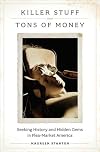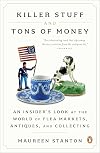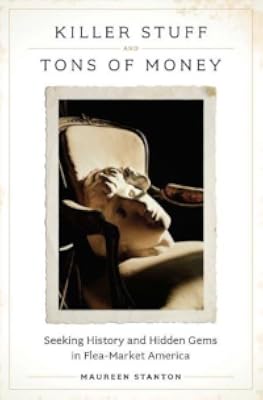
Killer Stuff and Tons of Money: Seeking History and Hidden Gems in Flea-Market America
by Maureen Stanton
On This Page
Description
Traces the efforts of master antiques dealer Curt Avery to discover valuable and historically relevant items at flea markets, discussing flea market culture and some of Avery's unlikely successes. Includes numerous observations about major east-coast antique venues such as Brimfield as well as thoughts about the PBS television program "Antiques Roadshow". Author protects the identity of the main character and many other dealers with extensive use of pseudonyms (p. 279).Tags
Recommendations















Member Recommendations
Member Reviews
I am not much for taking time picking through things at estate sales or flea markets. The only antiques I have have been handed down in the family. And yet I know there are wonderful treasures to be uncovered or purchased at these places, like the dented and filthy brass firewood bucket my grandfather discovered at a garage sale and subsequently polished back into beauty.
This fascinating creative non-fiction book introduced me to people who make a living dealing in antiques; the history behind certain kinds of antiques, auctions, flea markets, and the like; and the controversies rife in the antiques world. The author shadowed her old friend, mid-level antiques dealer Curt Avery for an insider's glimpse of the antiquing life. Stanton show more tells Curt's story as he works hard and tirelessly to support his family through his obsession. He is incredibly knowledgeable, mostly self-taught, and willing to share his information with Stanton as well as offering his customers historical tidbits about the pieces in which they show an interest. Interspersed with Curt's tale are lengthier history lessons about specific antiques and even auctions and flea markets themselves. Stanton looks at the obsession we Americans have for "stuff" and what collecting says about us, highlighting some different, even macabre collections.
The triumph of the book is the easy, casual writing and the way in which Stanton has made a somewhat esoteric topic gripping reading. She knows just when to veer from her main story and add an historical tidbit and how to raise the tension over whether Avery will win an auction or sell a piece for ten times the price he paid. She's captured the down and dirty aspects of a dealer's life and the feel of attending show after show after show, packing and unpacking wares at each of them. The book is incredibly readable, compulsively interesting and has even made me want to visit a flea market sometime despite knowing that I'd be the frustratingly ignorant customer at whom so many dealers scoff. show less
This fascinating creative non-fiction book introduced me to people who make a living dealing in antiques; the history behind certain kinds of antiques, auctions, flea markets, and the like; and the controversies rife in the antiques world. The author shadowed her old friend, mid-level antiques dealer Curt Avery for an insider's glimpse of the antiquing life. Stanton show more tells Curt's story as he works hard and tirelessly to support his family through his obsession. He is incredibly knowledgeable, mostly self-taught, and willing to share his information with Stanton as well as offering his customers historical tidbits about the pieces in which they show an interest. Interspersed with Curt's tale are lengthier history lessons about specific antiques and even auctions and flea markets themselves. Stanton looks at the obsession we Americans have for "stuff" and what collecting says about us, highlighting some different, even macabre collections.
The triumph of the book is the easy, casual writing and the way in which Stanton has made a somewhat esoteric topic gripping reading. She knows just when to veer from her main story and add an historical tidbit and how to raise the tension over whether Avery will win an auction or sell a piece for ten times the price he paid. She's captured the down and dirty aspects of a dealer's life and the feel of attending show after show after show, packing and unpacking wares at each of them. The book is incredibly readable, compulsively interesting and has even made me want to visit a flea market sometime despite knowing that I'd be the frustratingly ignorant customer at whom so many dealers scoff. show less
"If half the challenge is finding that good thing the other half is selling it."
If you enjoy Antiques Roadshow, you would probably enjoy this book. The subtitle describes it as a look at flea markets, antiquing and collecting. The author does this mostly by shadowing Curt Avery (a pseudonym), a dealer, as he sets up and mans his booth at various flea markets and antique shows, and as he acquires his stock in trade from other dealers at these events as well as at various auctions he attends. According to Avery, the key is knowing how to evaluate what you see--what is it? Is it real or a reproduction? Is it intact or rebuilt? Is it rare or common? Is it under- or over-priced? And so on. His message is that just as important as the booths show more and events he attends is the self-education and research that he does.
Along the way, the author takes us on forays into related subjects, for example EBay. We learn a lot about the history of EBay, and how it has affected the real life dealers of collectibles, and the live flea markets and antique malls. There's also a chapter taking us behind the scenes on the popular TV show Antiques Roadshow, which was fascinating. There's a chapter on collectible comic books, and so on.
I enjoyed reading this book, but at some points Avery comes across as an annoying Know-It-All. The author records his ongoing monologue as they browse through booths: "That's fake." "That's been totally reconstructed." "That's overpriced." Etc. etc.
And then, to a certain extent I began to question the stories about "I bought this for only $1X and it's actually worth $10X." And I think, "Yeah, but you still have to sell it for $10X." It also often seemed like at the various events the dealers like Avery were all buying and selling to each other--making "profits" from each other and spending their profits at another dealer. And, we learn that Avery's house is stuffed to the gills with his inventory, with rooms, garages and outbuildings he can't even walk into. He admits to sometimes fearing he may be a hoarder.
Still, this book provides an interesting look into a world I knew nothing about. (Did you know that at the time of publication of this book there were 2 1/2 million flea market vendors in the US?)
Recommended. show less
If you enjoy Antiques Roadshow, you would probably enjoy this book. The subtitle describes it as a look at flea markets, antiquing and collecting. The author does this mostly by shadowing Curt Avery (a pseudonym), a dealer, as he sets up and mans his booth at various flea markets and antique shows, and as he acquires his stock in trade from other dealers at these events as well as at various auctions he attends. According to Avery, the key is knowing how to evaluate what you see--what is it? Is it real or a reproduction? Is it intact or rebuilt? Is it rare or common? Is it under- or over-priced? And so on. His message is that just as important as the booths show more and events he attends is the self-education and research that he does.
Along the way, the author takes us on forays into related subjects, for example EBay. We learn a lot about the history of EBay, and how it has affected the real life dealers of collectibles, and the live flea markets and antique malls. There's also a chapter taking us behind the scenes on the popular TV show Antiques Roadshow, which was fascinating. There's a chapter on collectible comic books, and so on.
I enjoyed reading this book, but at some points Avery comes across as an annoying Know-It-All. The author records his ongoing monologue as they browse through booths: "That's fake." "That's been totally reconstructed." "That's overpriced." Etc. etc.
And then, to a certain extent I began to question the stories about "I bought this for only $1X and it's actually worth $10X." And I think, "Yeah, but you still have to sell it for $10X." It also often seemed like at the various events the dealers like Avery were all buying and selling to each other--making "profits" from each other and spending their profits at another dealer. And, we learn that Avery's house is stuffed to the gills with his inventory, with rooms, garages and outbuildings he can't even walk into. He admits to sometimes fearing he may be a hoarder.
Still, this book provides an interesting look into a world I knew nothing about. (Did you know that at the time of publication of this book there were 2 1/2 million flea market vendors in the US?)
Recommended. show less
Thanks to television networks such as The History Channel and A&E, hundreds of thousands of people now dream about getting rich off something they stumble on at a neighborhood garage sale. A few of them even have high hopes that someday their flea-market habit will produce a steady enough profit to free them from the nine-to-five rat race they dread so much. Maureen Stanton’s Killer Stuff and Tons of Money (subtitled: Seeking History and Hidden Gems in Flea-Market America) is here to tell you that it is not nearly as easy as American Pickers and Pawn Stars make it appear to be.
Over the years, Stanton’s longtime friend Curt Avery occasionally has taken her along when he goes to work in the morning. What makes that a rewarding show more experience for both of them is that Avery’s workplace is the multitude of flea-markets, estate sales, antique shows, and auction houses to be found on the East Coast. He tries to pass on some of the knowledge with which his years of experience have rewarded him, and Stanton provides a little bit of free labor toward unpacking, packing, and setting-up his sales area. Killer Stuff and Tons of Money is very much Avery’s life story.
Although it does a remarkable job of educating the reader via valuable tips on how to judge the authenticity and value of particular types of antiques, this is not an antique guide. It is, rather, a portrayal of what one man goes through 52 weeks of the year as he tries to pay his family’s bills and put food on the table by hustling from one flea-market or antique show to the next. It is a dose of reality for the dreamers that believe this is going to be easy.
Curt Avery has been an antique picker ever since his boyhood days of digging for bottles in some of the nation’s earliest garbage heaps. He probably, because of his reading and on-the-job studying of them, knows as much about antiques as most anyone out there. Avery readily admits, however, that his instinct and his skill in bundling numerous bits of information to reach a likely conclusion about a piece guide his purchases as much as what the books tell him. His is a world filled with con men, forgers, and fakes that fool even the most knowledgeable high-end antique dealers. Avery has, of course, been burned numerous times by fakes (scary as that thought is to amateurs like us) but chalks his losses up as part of the cost of his education.
Maureen Stanton has written a painlessly educational book that at times reads more like a novel. Following Avery’s ups and downs through the years and meeting some of the regulars with whom he competes is great fun. As one would expect, those who make their living in the world of antique hunting and reselling are a separate breed. Killer Stuff and Tons of Money allows the rest of us access to that world for a little while.
Rated at: 5.0 show less
Over the years, Stanton’s longtime friend Curt Avery occasionally has taken her along when he goes to work in the morning. What makes that a rewarding show more experience for both of them is that Avery’s workplace is the multitude of flea-markets, estate sales, antique shows, and auction houses to be found on the East Coast. He tries to pass on some of the knowledge with which his years of experience have rewarded him, and Stanton provides a little bit of free labor toward unpacking, packing, and setting-up his sales area. Killer Stuff and Tons of Money is very much Avery’s life story.
Although it does a remarkable job of educating the reader via valuable tips on how to judge the authenticity and value of particular types of antiques, this is not an antique guide. It is, rather, a portrayal of what one man goes through 52 weeks of the year as he tries to pay his family’s bills and put food on the table by hustling from one flea-market or antique show to the next. It is a dose of reality for the dreamers that believe this is going to be easy.
Curt Avery has been an antique picker ever since his boyhood days of digging for bottles in some of the nation’s earliest garbage heaps. He probably, because of his reading and on-the-job studying of them, knows as much about antiques as most anyone out there. Avery readily admits, however, that his instinct and his skill in bundling numerous bits of information to reach a likely conclusion about a piece guide his purchases as much as what the books tell him. His is a world filled with con men, forgers, and fakes that fool even the most knowledgeable high-end antique dealers. Avery has, of course, been burned numerous times by fakes (scary as that thought is to amateurs like us) but chalks his losses up as part of the cost of his education.
Maureen Stanton has written a painlessly educational book that at times reads more like a novel. Following Avery’s ups and downs through the years and meeting some of the regulars with whom he competes is great fun. As one would expect, those who make their living in the world of antique hunting and reselling are a separate breed. Killer Stuff and Tons of Money allows the rest of us access to that world for a little while.
Rated at: 5.0 show less
I'm very fond of shows like Antiques Roadshow or the British game show that gives contestants money, sends them off into a flea market to spend their money, and then whoever gets the most for the item at an auction wins. I like antique stores and junk stores and yard sales and flea markets. I love to look at the stuff and to learn about its history. What I don't want to do is collect it. I have a huge aversion to accumulating stuff just to accumulate it. I do have lots of books, but I could walk away from all of them. If I suddenly became a billionaire I'd collect art and first editions and maybe that's my real problem - my tastes are too expensive for my means.
Killer Stuff and Tons of Money provides entertaining insight into the lives show more of antique dealers as they move from show to show, collecting items for themselves and for others, and always in search of the Holy Grail of the one good thing. It's a field that has an extremely high barrier to entry, requiring encyclopedic knowledge of material objects, their makers, their historical context, and their shifting worth. Ms. Stanton's book gives those of us who can't hurdle that barrier insight to what it's like in the world of collectors.
Amsterdam flea marketAmsterdam Flea Market - Image via Wikipedia
There's an interesting conversation to be had about whether the assigned worth of an object makes it worth having or whether it's worth having just because it appeals to you. I don't typically buy objects as an investment, but intellectually I can understand why people do so. This book definitely stimulated my thinking about what people buy, how they value it, and why.
Ms. Stanton's book provides history and examination of all kinds of information related to stuff, including some tips and tricks of the trade (although I wonder how many people could really utilize these). Curt Avery, the star of the show, is engaging and interesting and full of history. The read is consistently enjoyable and the experience is much like reading a thriller as you get sucked into that search for the illusive one good thing. show less
Killer Stuff and Tons of Money provides entertaining insight into the lives show more of antique dealers as they move from show to show, collecting items for themselves and for others, and always in search of the Holy Grail of the one good thing. It's a field that has an extremely high barrier to entry, requiring encyclopedic knowledge of material objects, their makers, their historical context, and their shifting worth. Ms. Stanton's book gives those of us who can't hurdle that barrier insight to what it's like in the world of collectors.
Amsterdam flea marketAmsterdam Flea Market - Image via Wikipedia
There's an interesting conversation to be had about whether the assigned worth of an object makes it worth having or whether it's worth having just because it appeals to you. I don't typically buy objects as an investment, but intellectually I can understand why people do so. This book definitely stimulated my thinking about what people buy, how they value it, and why.
Ms. Stanton's book provides history and examination of all kinds of information related to stuff, including some tips and tricks of the trade (although I wonder how many people could really utilize these). Curt Avery, the star of the show, is engaging and interesting and full of history. The read is consistently enjoyable and the experience is much like reading a thriller as you get sucked into that search for the illusive one good thing. show less
I finally finished the book. I finished it about a week ago, but it took me a while to find the time to write the review. And I am glad I finally got to it because this is a book worth sharing with others.
Stanton spends time with and "shadows" Curt Avery (a pseudonym), a mid-range antiques dealer (you learn from reading this book that there is a hierarchy when it comes to antiques and those who deal in them). Curt may well be one of the few remaining passionate, knowledgeable, and honest dealers in a business that seems to be declining and under siege by fakes, reproductions, and less than scrupulous folks. Why does he continue? Some of it may be just habit, but a lot of it is that the man has found his passion in life. Stanton does an show more excellent job in presenting a portrait of Avery as wll as giving us an excellent look at the world of antiques trading.
Much of the book concentrates on following Avery from one antiques show to the next. This is often a cutthroat business where mistakes (buying something you thought was real but turns ou to be a fake, for instance) can be costly, and in rare times you just might find that one items out of nowhere that makes you a fortune. Between those two extremes, you have the middle of the road trading. In this middle path, you buy something, hope to resell it for a modest profit, then repeat the process again. This is a cycle that requires knowledge (often hard won knowledge), patience, a very good eye, and sometimes luck.
Traveling with Avery already makes for a pretty good book. Stanton gives us more. In between visits with Avery, the author has written good informative chapters on the trade and the history of collecting and antiques. For example, there is a chapter on the human habit of collecting things. Think about that for a moment. Odds are good you have a small collection of something in your home now. Whether it's comic books, pens, match books, stamps, or any other object, many people collect something. Most people collect things just for the fun of it with no intention to sell or make money.
Stanton does visit a comic book convention and takes a look at the comic book trade, by the way. Additionally, her chapter on the show Antiques Roadshow (AR from here on) gives an excellent discussion and a good look behind the scenes of the show. Stanton points out how AR, along with shows it has spawned, has created false expectations in viewers from thinking anything old is valuable (it is not) to just a matter of finding something in the attic. The reality is very different than what we see on television. The books goes a long way to dispel myths about antiques and collectibles and about those who trade and collect them. This is definitely a strength in the book.
Stanton covers a lot of ground, but she provides an accessible book that is a pleasure to read. There were a couple of passages, mostly in Chapter 8--the chapter on thieves and fakers--that were a little too technical and dry, but do not let that deter you. This is a book to read at a leisurely pace with your favorite relaxing beverage. You will be entertained, and you will learn a lot as well.
(In keeping disclosure rules, to keep the FCC happy, I am revealing I received this book from the publisher as part of a GoodReads giveaway). show less
Stanton spends time with and "shadows" Curt Avery (a pseudonym), a mid-range antiques dealer (you learn from reading this book that there is a hierarchy when it comes to antiques and those who deal in them). Curt may well be one of the few remaining passionate, knowledgeable, and honest dealers in a business that seems to be declining and under siege by fakes, reproductions, and less than scrupulous folks. Why does he continue? Some of it may be just habit, but a lot of it is that the man has found his passion in life. Stanton does an show more excellent job in presenting a portrait of Avery as wll as giving us an excellent look at the world of antiques trading.
Much of the book concentrates on following Avery from one antiques show to the next. This is often a cutthroat business where mistakes (buying something you thought was real but turns ou to be a fake, for instance) can be costly, and in rare times you just might find that one items out of nowhere that makes you a fortune. Between those two extremes, you have the middle of the road trading. In this middle path, you buy something, hope to resell it for a modest profit, then repeat the process again. This is a cycle that requires knowledge (often hard won knowledge), patience, a very good eye, and sometimes luck.
Traveling with Avery already makes for a pretty good book. Stanton gives us more. In between visits with Avery, the author has written good informative chapters on the trade and the history of collecting and antiques. For example, there is a chapter on the human habit of collecting things. Think about that for a moment. Odds are good you have a small collection of something in your home now. Whether it's comic books, pens, match books, stamps, or any other object, many people collect something. Most people collect things just for the fun of it with no intention to sell or make money.
Stanton does visit a comic book convention and takes a look at the comic book trade, by the way. Additionally, her chapter on the show Antiques Roadshow (AR from here on) gives an excellent discussion and a good look behind the scenes of the show. Stanton points out how AR, along with shows it has spawned, has created false expectations in viewers from thinking anything old is valuable (it is not) to just a matter of finding something in the attic. The reality is very different than what we see on television. The books goes a long way to dispel myths about antiques and collectibles and about those who trade and collect them. This is definitely a strength in the book.
Stanton covers a lot of ground, but she provides an accessible book that is a pleasure to read. There were a couple of passages, mostly in Chapter 8--the chapter on thieves and fakers--that were a little too technical and dry, but do not let that deter you. This is a book to read at a leisurely pace with your favorite relaxing beverage. You will be entertained, and you will learn a lot as well.
(In keeping disclosure rules, to keep the FCC happy, I am revealing I received this book from the publisher as part of a GoodReads giveaway). show less
One of the features of Antiques Roadshow that makes it so interesting is the historical information delivered by the experts as they discuss the provenance of some unusual item. That knowledge is what separates the amateurs from the professionals in the antique business. You have to know a lot of stuff. This is one of those ridiculously fascinating books that truly holds my interest becoming impossible to put down as I am overwhelmed with more and more trivia, e.g., in the chapter about the show, “Lint on the set is a problem, too. “We spend a lot of time picking lint off the tables, floors, the velvet-covered display racks,” Matthews says. And derrieres cause trouble. The crew often films an object set on a waist-high table. show more “Many times we cannot use the shot because in the background is someone’s ass,” Matthews says. “The Antiques Roadshow butt shot. That’s a phenomenon in this business.”
True aficionados of flea markets, for example, realize that by the time the show/market actually opens 95% of the really good stuff is already gone as the dealers use that time to search through each other's wares for the good stuff. The best target us a rental truck signaling a possible estate being sold, the owners often not recognizing what they might have and willing to let it go cheap.
It’s exciting and addicting, but it’s clear that the breadth and depth of knowledge needed to get to this point is daunting. Knowledge is what makes this robbery okay. Robbery is not the right word, though, because the information is available to anyone willing to study, to do the homework. “If you buy something off someone’s table, you don’t owe them anything,” Avery says. The dealer is responsible for setting the asking price. Caveat venditor.
Why do people start collecting stuff? Stuff that often overwhelms their lives and homes. “... from the mid-1990s to the mid-2000s storage unit rentals increased by 90 percent.” Avery’s house had become a warren of paths and finally, using yard sales and group sales shops, and lots of time, he managed to reduce the quantity somewhat. The conundrum was that in order to sell, he had to buy, and determining what to take to any given show on any given weekend was always difficult, but he had to have lots of “stuff.” The impulse to collect begins as early as age three, a tendency that fast food restaurants and toy manufacturers exploit by marketing sets of toys and urging kids to “collect them all.” And some collecting is just weird. “Photographer Amy Kubes has collected her toenails since 1995. “I’ve never missed a cutting,” she wrote. William Davies King, author of Collections of Nothing, has “seventeen to eighteen thousand labels,” including labels from forty-four brands of canned tuna. “I’ll spare you the clams, crabmeat, mussels, oysters, sardines, snails, herring, salmon, and kipper snack” labels, he writes. “
Lots of delectable information. Did you know, for example,
In a single year, 1859, just one glass factory in France produced eighty million bottles for opium. Until it was banned in 1905, opium was cheaper than beer or gin, and easily purchased in grocery stores, by mail, and over the counter at pharmacies. Parents even gave opium to fussy babies, a product like Street’s Infants’ Quietness, which “quieted” many infants through death by overdose. In Confessions of an English Opium-Eater, Thomas de Quincey called opium a “panacea for all human woes” and “the secret of happiness.” Opium addiction was so widespread that an English pharmacist, C. R. Alder Wright, formulated a derivative called diacetylmorphine, which he hoped would be less addicting. The new drug, sold by the German company Bayer, was called Heroin for its heroic ability to cure. Heroin was the best-selling drug brand of its time.
And the hint of the day: “It might surprise antiques dealers to learn that a recent study found that low starting bids yielded higher final prices, at least on the Internet. In 2006, researchers sought to discover the causes behind this “reversal of the anchoring effect,” so they set up simultaneous auctions on eBay. Their study showed that when the starting bid is low, anyone can jump in (“reduced barriers to entry”). This increases activity, causing a “sheep effect” (my term—if everyone else wants something, then it must be valuable).” show less
True aficionados of flea markets, for example, realize that by the time the show/market actually opens 95% of the really good stuff is already gone as the dealers use that time to search through each other's wares for the good stuff. The best target us a rental truck signaling a possible estate being sold, the owners often not recognizing what they might have and willing to let it go cheap.
It’s exciting and addicting, but it’s clear that the breadth and depth of knowledge needed to get to this point is daunting. Knowledge is what makes this robbery okay. Robbery is not the right word, though, because the information is available to anyone willing to study, to do the homework. “If you buy something off someone’s table, you don’t owe them anything,” Avery says. The dealer is responsible for setting the asking price. Caveat venditor.
Why do people start collecting stuff? Stuff that often overwhelms their lives and homes. “... from the mid-1990s to the mid-2000s storage unit rentals increased by 90 percent.” Avery’s house had become a warren of paths and finally, using yard sales and group sales shops, and lots of time, he managed to reduce the quantity somewhat. The conundrum was that in order to sell, he had to buy, and determining what to take to any given show on any given weekend was always difficult, but he had to have lots of “stuff.” The impulse to collect begins as early as age three, a tendency that fast food restaurants and toy manufacturers exploit by marketing sets of toys and urging kids to “collect them all.” And some collecting is just weird. “Photographer Amy Kubes has collected her toenails since 1995. “I’ve never missed a cutting,” she wrote. William Davies King, author of Collections of Nothing, has “seventeen to eighteen thousand labels,” including labels from forty-four brands of canned tuna. “I’ll spare you the clams, crabmeat, mussels, oysters, sardines, snails, herring, salmon, and kipper snack” labels, he writes. “
Lots of delectable information. Did you know, for example,
In a single year, 1859, just one glass factory in France produced eighty million bottles for opium. Until it was banned in 1905, opium was cheaper than beer or gin, and easily purchased in grocery stores, by mail, and over the counter at pharmacies. Parents even gave opium to fussy babies, a product like Street’s Infants’ Quietness, which “quieted” many infants through death by overdose. In Confessions of an English Opium-Eater, Thomas de Quincey called opium a “panacea for all human woes” and “the secret of happiness.” Opium addiction was so widespread that an English pharmacist, C. R. Alder Wright, formulated a derivative called diacetylmorphine, which he hoped would be less addicting. The new drug, sold by the German company Bayer, was called Heroin for its heroic ability to cure. Heroin was the best-selling drug brand of its time.
And the hint of the day: “It might surprise antiques dealers to learn that a recent study found that low starting bids yielded higher final prices, at least on the Internet. In 2006, researchers sought to discover the causes behind this “reversal of the anchoring effect,” so they set up simultaneous auctions on eBay. Their study showed that when the starting bid is low, anyone can jump in (“reduced barriers to entry”). This increases activity, causing a “sheep effect” (my term—if everyone else wants something, then it must be valuable).” show less
Fascinating book. If you enjoy Antiques Roadshow, you'll love this book. The author built the story around one dealer, a college friend a long time ago, attending a myriad of antique fairs and shows but branches out into side stories, including a look at the PBS show, at comic books, and a variety of related objects. She does a great job of conveying the passion of some dealers, highlighting the fakes (although some are as passionate as the honest dealers about quality) and generally diving into this world. Thoroughly enjoyable.
Members
- Recently Added By
Lists

Books To Get From The Library
115 works; 5 members
Author Information
3+ Works 208 Members
Awards and Honors
Classifications
Statistics
- Members
- 154
- Popularity
- 212,598
- Reviews
- 15
- Rating
- (4.08)
- Languages
- English
- Media
- Paper, Ebook
- ISBNs
- 6
- ASINs
- 5