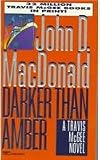
On This Page
Description
From a beloved master of crime fiction, Darker Than Amber is one of many classic novels featuring Travis McGee, the hard-boiled detective who lives on a houseboat.A fishing trip is anything but relaxing when Travis McGee is involved. As McGee and his friend Meyer settle down to some midnight casting, a woman falls into the water from the bridge above them. Her name is Evangeline, and the hints she gives about the events leading to her near drowning suggest a less than pristine past. But show more McGee has saved her, and now he wants to see her make a new life—even if it means confronting a gang of murderers that makes his blood run cold.
“John D. MacDonald is a shining example for all of us in his field.”—Mary Higgins Clark
Evangeline may be the intended target in a complex scheme, but she’s no ordinary victim. Behind her darker than amber eyes is a woman who lures men onto her boat and robs them, throwing them overboard when she’s done with them. And now she’s enlisted the resistant Travis and Meyer to rescue her “savings” from her partners in crime.
When Evangeline winds up dead, McGee and Meyer must get involved. But the stakes are high—and Evangeline may not be the only casualty of her cruel game.
Features a new Introduction by Lee Child. show less
Tags
Recommendations




































Member Reviews
“All her symptoms of near-death had been physical, but emotionally she seemed to have an acceptance of it so placid as to be a little eerie. As if she knew the world as a place where sooner or later they heaved you off a bridge.”
Once John D. MacDonald wrote A Deadly Shade of Gold, the Travis McGee series began to take on a resonance that separated it from others of its ilk. Over the course of twenty-one books, Travis McGee became one of the most enduring and beloved characters in mystery fiction. Praise for this tremendous saga comes from nearly every great mystery writer in MacDonald’s chosen genre, and many great writers outside his genre. These include many female mystery writers, who give their praise without reservation, and show more with nary a whisper about misogyny; because it simply does not exist.
Praise from these female writers, and a public still devouring this series decades after it first hit bookshelves proves, in my opinion, just how misrepresented this series and its protagonist, Travis McGee, has become in some quarters. If you know a little about life, you’ll often feel like you know some of the people in MacDonald’s influential series — both the males, and especially the females — as well as the protagonist himself. And that is certainly the case with this very dark entry in the series, part of a three-book section in the series (A Deadly Shade of Gold, Bright Orange For the Shroud, Darker Than Amber) of such high quality, that only later in the series, when the resonance was even deeper, did we get three that surpassed them (Free Fall in Crimson, Cinnamon Skin and, as it turned out, the final entry, The Lonely Silver Rain). In between there were good to great ones, always enjoyable, but never a three-book stretch like the former, or the latter.
Darker Than Amber begins with a great opening line, and lives up to it. Amber is a tawdry and unpleasant look at women pretty on the outside, but so rotten at their core, they are capable of disconnecting themselves from the crimes they commit. Meyer emerges in Amber as the important character he will be for the remainder of this legendary series. It is in fact Meyer who talks about the complete disconnect from empathy these outwardly attractive women share:
“That pair disposed of fourteen objects, not fourteen brothers. Their unease comes not from pity, not from any concern for the dead objects, but merely from their awareness that society frowns upon such actions.”
And earlier, we get this exchange between Vangie and Meyer:
“You are the nicest, Meyer. So nice you'd have to blow the whole bit, and it would mess up my girlfriends and keep the law looking for me forever. If I get my hands on that money, I want to stay dead, thank you.” — Vangie
“Knowing that your...friends are still murdering for profit?” - Meyer
“People are dying all over the place for all kinds of reasons, Meyer, and if I'm out of this one, it couldn't bother me less.” — Vangie
But that’s getting ahead of things. Before McGee gets tangled up in the affairs of Vangie/Tami Western, he reminisces about Vidge, a broken bird who had come to stay with McGee for a bit. She had married the wrong man — as women are so often prone to do — and, as McGee notes, he nearly destroyed her soul:
“Finally he had gone to work on her sexual capacities. Were the sexes reversed, you could call it emasculation. People like Charlie work toward total and perpetual domination. They feed on the mate. And Vidge didn't even realize that running away from him had been a form of self-preservation, a way of trying to hang fast to the last crumbs of identity and pride.”
McGee is patient, waiting for her to stop blaming herself for everything, and finally explode. Yes, as other readers have noted — and made far too much of — there does comes a point when he sleeps with her. McGee gives back to Vidge her self-confidence, allowing a trampled flower to spring back to life, toward the sunshine. The situation and the solution resonate with the ring of truth. There is nothing predatory here by McGee at all. MacDonald the writer simply understood the psychological underpinnings of the situation he’d created, and had his character do likewise; and I might add, at a personal cost to himself, reflected by this comment late in the narrative:
“Vidge had soured me a little, and Vangie had dropped off the bridge and accelerated the process, and then I had really put the lid on it by trapping that dumb empty punchboard into a life sentence.”
McGee's rescuing of Vangie from the water after someone has tried to kill her has no fairy-tale ending whatsoever, because Vangie, as McGee eventually discovers, is a hooker into something very nasty; so nasty that she obviously expected to come to a bad end one day:
“All her symptoms of near-death had been physical, but emotionally she seemed to have an acceptance of it so placid as to be a little eerie. As if she knew the world as a place where sooner or later they heaved you off a bridge.”
There is money involved, a lot of it, and a string of homicides to go with it. All Vangie wants is the money, and to disappear. McGee, despite his experience, develops a grudging sort of admiration for Vangie; not so much because there is more to the Hawaiian beauty than other girls like her, but because once, there might have been:
“In the silence I tried to sort her out. Her twelve years on the track had coarsened her beyond any hope of salvage. Though I know it is the utmost folly to sentimentalize or romanticize a whore, I could respect a certain toughness of spirit Vangie possessed. She had not howled as she fell to her death. She had not flinched or murmured as we cut the hooks out of her leg.”
Vangie tries to protect not only McGee and Meyer, but herself when they offer to help:
“Oh, h*ll, Travis, it isn’t so much finking out as keeping you guys from knowing how lousy I really am.”
Because McGee nearly lost his own life beneath the water simply because Vangie had grabbed his wrist, and because he eventually gets her horrific backstory — Vangie is 26 and has been a pro for 12 years — he feels an obligation when things end badly for her — very badly. There is a wonderful piece of writing as MacDonald describes a youthful dance by Vangie aboard the Busted Flush. It culminates in this melancholy observation by McGee:
“When the flesh is taut, the dance becomes strangely ceremonial. It is a rite that celebrates the future, and it was eerie to see how accurately it could be imitated by a woman who had left any chance of love so far in the past.”
What we get when McGee and Meyer decide they can’t let any more men fall prey to this deadly sea carnival, is a tawdry and violent and insightful look at the heartless and wicked. Trying to con his way into the lives of the men and women running the deadliest of games, McGee nearly loses his life right off the bat in a violent duel with one of the men involved. He buries him and tries to deal with the emotional repercussions even as he and Meyer continue pressing toward their objective. In essence, this is a dark tale of predatory men and predatory women with no conscience, at least not as the rest of us understand such. MacDonald does an especially wonderful job of capturing with honesty the essence of the women:
“It was interesting to me in a clinical way that in the distance from the table to the street door she managed to sway a tautly fabricated hip against me three separate and insistent times, though she'd had no trouble with sway or balance on the way in. With instant practicality, she'd changed masters. Now it was merely a case of firmly cementing the new relationship in the only way she knew how.”
But conning their way in is only part of the problem. McGee, though you rarely hear about it — perhaps because it doesn’t fit a narrative some want to paint — was often turning down opportunities with the opposite sex, and here does so more than once. But even then, MacDonald uses McGee’s reactions to make insightful observations every man of a certain age understands all too well:
“The thing that astounded and disheartened me was to find a very real yen to take a hack at this spooky little punchboard. There had been a lot more to Vangie in both looks and substance, but she hadn't tingled a single nerve. I wanted to grab at this one. Maybe everybody at some time or another feels the strong attraction of something rotten-sweet enough to guarantee complete degradation.”
But McGee shakes it off and goes forward. Along the way, we get to meet Merrimay Lane, a character so wonderful she almost — but not quite — offsets the bad taste left by the other women encountered in this one. From what is supposed to be a safe distance, McGee and Meyer have her impersonate Vangie, just to rattle a brutal guy named Terry. And it does, leading to a very violent end. There is some other stuff in between, including observations on the races and their interactions, and this wonderful gem about a woman’s wrist:
“The wrist of a woman and the small tidy forearm always seemed to have some tender and touching quality, a vulnerable articulation unchanged from the time she was ten or twelve, perhaps the only part of her that her flowering leaves unchanged.”
This is a terrific entry in the series, though without a doubt it’s one of the more seedy story-lines due to the parade of hideous men and women with whom McGee crosses paths. Lee Child has admitted that Jack Reacher is a stripped down version of Travis McGee, but to me the things he left out are what makes McGee stand head and shoulders above nearly all others in the genre. John D. MacDonald’s Travis McGee series resonates, and more often than not it’s deadly accurate when it comes to human interactions and motivations. Darker Than Amber, which makes reference to Vangie’s eyes, is itself very dark, but also involving. I’ll end this one with a quote from Meyer about McGee, because it sums up not only this entry, but the series itself:
“One of the last of the romantics, trying to make himself believe he’s the cynical beach bum who has it made. You permit yourself the luxury of making moral judgements, Travis, in a world that tells us man’s will is the product of background and environment. You think you’re opportunistic and flexible as all h*ll, but they’d have to kill you before they could bend you. That kind of rigidity is both strength and weakness.” show less
Once John D. MacDonald wrote A Deadly Shade of Gold, the Travis McGee series began to take on a resonance that separated it from others of its ilk. Over the course of twenty-one books, Travis McGee became one of the most enduring and beloved characters in mystery fiction. Praise for this tremendous saga comes from nearly every great mystery writer in MacDonald’s chosen genre, and many great writers outside his genre. These include many female mystery writers, who give their praise without reservation, and show more with nary a whisper about misogyny; because it simply does not exist.
Praise from these female writers, and a public still devouring this series decades after it first hit bookshelves proves, in my opinion, just how misrepresented this series and its protagonist, Travis McGee, has become in some quarters. If you know a little about life, you’ll often feel like you know some of the people in MacDonald’s influential series — both the males, and especially the females — as well as the protagonist himself. And that is certainly the case with this very dark entry in the series, part of a three-book section in the series (A Deadly Shade of Gold, Bright Orange For the Shroud, Darker Than Amber) of such high quality, that only later in the series, when the resonance was even deeper, did we get three that surpassed them (Free Fall in Crimson, Cinnamon Skin and, as it turned out, the final entry, The Lonely Silver Rain). In between there were good to great ones, always enjoyable, but never a three-book stretch like the former, or the latter.
Darker Than Amber begins with a great opening line, and lives up to it. Amber is a tawdry and unpleasant look at women pretty on the outside, but so rotten at their core, they are capable of disconnecting themselves from the crimes they commit. Meyer emerges in Amber as the important character he will be for the remainder of this legendary series. It is in fact Meyer who talks about the complete disconnect from empathy these outwardly attractive women share:
“That pair disposed of fourteen objects, not fourteen brothers. Their unease comes not from pity, not from any concern for the dead objects, but merely from their awareness that society frowns upon such actions.”
And earlier, we get this exchange between Vangie and Meyer:
“You are the nicest, Meyer. So nice you'd have to blow the whole bit, and it would mess up my girlfriends and keep the law looking for me forever. If I get my hands on that money, I want to stay dead, thank you.” — Vangie
“Knowing that your...friends are still murdering for profit?” - Meyer
“People are dying all over the place for all kinds of reasons, Meyer, and if I'm out of this one, it couldn't bother me less.” — Vangie
But that’s getting ahead of things. Before McGee gets tangled up in the affairs of Vangie/Tami Western, he reminisces about Vidge, a broken bird who had come to stay with McGee for a bit. She had married the wrong man — as women are so often prone to do — and, as McGee notes, he nearly destroyed her soul:
“Finally he had gone to work on her sexual capacities. Were the sexes reversed, you could call it emasculation. People like Charlie work toward total and perpetual domination. They feed on the mate. And Vidge didn't even realize that running away from him had been a form of self-preservation, a way of trying to hang fast to the last crumbs of identity and pride.”
McGee is patient, waiting for her to stop blaming herself for everything, and finally explode. Yes, as other readers have noted — and made far too much of — there does comes a point when he sleeps with her. McGee gives back to Vidge her self-confidence, allowing a trampled flower to spring back to life, toward the sunshine. The situation and the solution resonate with the ring of truth. There is nothing predatory here by McGee at all. MacDonald the writer simply understood the psychological underpinnings of the situation he’d created, and had his character do likewise; and I might add, at a personal cost to himself, reflected by this comment late in the narrative:
“Vidge had soured me a little, and Vangie had dropped off the bridge and accelerated the process, and then I had really put the lid on it by trapping that dumb empty punchboard into a life sentence.”
McGee's rescuing of Vangie from the water after someone has tried to kill her has no fairy-tale ending whatsoever, because Vangie, as McGee eventually discovers, is a hooker into something very nasty; so nasty that she obviously expected to come to a bad end one day:
“All her symptoms of near-death had been physical, but emotionally she seemed to have an acceptance of it so placid as to be a little eerie. As if she knew the world as a place where sooner or later they heaved you off a bridge.”
There is money involved, a lot of it, and a string of homicides to go with it. All Vangie wants is the money, and to disappear. McGee, despite his experience, develops a grudging sort of admiration for Vangie; not so much because there is more to the Hawaiian beauty than other girls like her, but because once, there might have been:
“In the silence I tried to sort her out. Her twelve years on the track had coarsened her beyond any hope of salvage. Though I know it is the utmost folly to sentimentalize or romanticize a whore, I could respect a certain toughness of spirit Vangie possessed. She had not howled as she fell to her death. She had not flinched or murmured as we cut the hooks out of her leg.”
Vangie tries to protect not only McGee and Meyer, but herself when they offer to help:
“Oh, h*ll, Travis, it isn’t so much finking out as keeping you guys from knowing how lousy I really am.”
Because McGee nearly lost his own life beneath the water simply because Vangie had grabbed his wrist, and because he eventually gets her horrific backstory — Vangie is 26 and has been a pro for 12 years — he feels an obligation when things end badly for her — very badly. There is a wonderful piece of writing as MacDonald describes a youthful dance by Vangie aboard the Busted Flush. It culminates in this melancholy observation by McGee:
“When the flesh is taut, the dance becomes strangely ceremonial. It is a rite that celebrates the future, and it was eerie to see how accurately it could be imitated by a woman who had left any chance of love so far in the past.”
What we get when McGee and Meyer decide they can’t let any more men fall prey to this deadly sea carnival, is a tawdry and violent and insightful look at the heartless and wicked. Trying to con his way into the lives of the men and women running the deadliest of games, McGee nearly loses his life right off the bat in a violent duel with one of the men involved. He buries him and tries to deal with the emotional repercussions even as he and Meyer continue pressing toward their objective. In essence, this is a dark tale of predatory men and predatory women with no conscience, at least not as the rest of us understand such. MacDonald does an especially wonderful job of capturing with honesty the essence of the women:
“It was interesting to me in a clinical way that in the distance from the table to the street door she managed to sway a tautly fabricated hip against me three separate and insistent times, though she'd had no trouble with sway or balance on the way in. With instant practicality, she'd changed masters. Now it was merely a case of firmly cementing the new relationship in the only way she knew how.”
But conning their way in is only part of the problem. McGee, though you rarely hear about it — perhaps because it doesn’t fit a narrative some want to paint — was often turning down opportunities with the opposite sex, and here does so more than once. But even then, MacDonald uses McGee’s reactions to make insightful observations every man of a certain age understands all too well:
“The thing that astounded and disheartened me was to find a very real yen to take a hack at this spooky little punchboard. There had been a lot more to Vangie in both looks and substance, but she hadn't tingled a single nerve. I wanted to grab at this one. Maybe everybody at some time or another feels the strong attraction of something rotten-sweet enough to guarantee complete degradation.”
But McGee shakes it off and goes forward. Along the way, we get to meet Merrimay Lane, a character so wonderful she almost — but not quite — offsets the bad taste left by the other women encountered in this one. From what is supposed to be a safe distance, McGee and Meyer have her impersonate Vangie, just to rattle a brutal guy named Terry. And it does, leading to a very violent end. There is some other stuff in between, including observations on the races and their interactions, and this wonderful gem about a woman’s wrist:
“The wrist of a woman and the small tidy forearm always seemed to have some tender and touching quality, a vulnerable articulation unchanged from the time she was ten or twelve, perhaps the only part of her that her flowering leaves unchanged.”
This is a terrific entry in the series, though without a doubt it’s one of the more seedy story-lines due to the parade of hideous men and women with whom McGee crosses paths. Lee Child has admitted that Jack Reacher is a stripped down version of Travis McGee, but to me the things he left out are what makes McGee stand head and shoulders above nearly all others in the genre. John D. MacDonald’s Travis McGee series resonates, and more often than not it’s deadly accurate when it comes to human interactions and motivations. Darker Than Amber, which makes reference to Vangie’s eyes, is itself very dark, but also involving. I’ll end this one with a quote from Meyer about McGee, because it sums up not only this entry, but the series itself:
“One of the last of the romantics, trying to make himself believe he’s the cynical beach bum who has it made. You permit yourself the luxury of making moral judgements, Travis, in a world that tells us man’s will is the product of background and environment. You think you’re opportunistic and flexible as all h*ll, but they’d have to kill you before they could bend you. That kind of rigidity is both strength and weakness.” show less
This 7th entry in the Travis McGee series is the first one in which McGee's neighbor & friend Meyer has a major role. I liked the dynamic between Meyer & McGee and Meyer balances out McGee's personality.
However, I find the attitudes to women & sex sometimes mildly offensive; interestingly I think McGee is much more of a "love 'em and leave 'em" guy than James Bond ever was (at least in the books). I realize that these books are very much of their times (mid 60s) but passages like
"I was a prude, in my own fashion. I had been emotionally involved a few times with women with enough of a record of promiscuity to make me vaguely uneasy. It is difficult to put much value on something the lady has distributed all too generously."
make me show more cringe especially since this standard of behavior clearly isn't intended to be applied to McGee himself! show less
However, I find the attitudes to women & sex sometimes mildly offensive; interestingly I think McGee is much more of a "love 'em and leave 'em" guy than James Bond ever was (at least in the books). I realize that these books are very much of their times (mid 60s) but passages like
"I was a prude, in my own fashion. I had been emotionally involved a few times with women with enough of a record of promiscuity to make me vaguely uneasy. It is difficult to put much value on something the lady has distributed all too generously."
make me show more cringe especially since this standard of behavior clearly isn't intended to be applied to McGee himself! show less
I don't know that I have ever read two Travis McGee books back-to-back. Usually, one can only take so much of the guy. But the previous entry in the series, Bright Orange for the Shroud, while being terribly mean to most of its women characters, is still rather happy by McGee standards. Darker than Amber, like Bright Orange, centers on a group of con men and women--but in this case, their game is deadly. The book's opening, with McGee and Meyer pleasantly fishing for snook when a girl with her feet wired to a cement block drops into the water beside them (fouling McGee's line) is a classic. From there, this is a very dark work, enlivened by the partnership of McGee and Meyer (an economist who also owns a boat), which is far different show more than any alliances McGee has formed up to this point. And unlike a few of those other alliances, the author's love for Meyer is so evidently strong that you can't imagine him meeting a tragic end. (Of course, the fact that he isn't a woman gives him a better chance of surviving any McGee novel.)
In any case, McGee, with a lot of Meyer's help, weaves a web of deception that is beautiful to behold in ensnaring the bad guys, and he does it with a malevolence and cold-bloodedness that is truly breathtaking. Along the way, we learn that McGee can hold his breath for a long time, resist bedding a beautiful woman if she is a prostitute, speak a few words of Italian, and has all sorts of other useful skills for a "salvage expert".
The character of Meyer sets this book apart, since he does most of the philosophizing and moralizing rather than it coming from McGee. Somehow, coming from Meyer, it seems a little more natural. And I subscribe wholly to Jung's theory of "The I" and "The Not I" that Meyer relates, saying he read about it in a book by a woman whose name he doesn't remember. It was Mary Esther Harding. Lots of copies available on abebooks.com. show less
In any case, McGee, with a lot of Meyer's help, weaves a web of deception that is beautiful to behold in ensnaring the bad guys, and he does it with a malevolence and cold-bloodedness that is truly breathtaking. Along the way, we learn that McGee can hold his breath for a long time, resist bedding a beautiful woman if she is a prostitute, speak a few words of Italian, and has all sorts of other useful skills for a "salvage expert".
The character of Meyer sets this book apart, since he does most of the philosophizing and moralizing rather than it coming from McGee. Somehow, coming from Meyer, it seems a little more natural. And I subscribe wholly to Jung's theory of "The I" and "The Not I" that Meyer relates, saying he read about it in a book by a woman whose name he doesn't remember. It was Mary Esther Harding. Lots of copies available on abebooks.com. show less
“Darker Than Amber” is the seventh novel in the 21-novel strong Travis McGee series. It is one of the tightest written books in the series and truly focuses like a laser beam on the problem at hand. McGee, if you are unfamiliar with the series, lives on a 52-foot houseboat, “The Busted Flush.” He works when he needs money or when someone or something drops in his lap. He is in the “salvage business,” meaning that he helps people get back money misappropriated from them and claims half the proceeds as his share. It’s a different way to make a living. He is not a detective and often operates on his own terms, outside legal boundaries.
McGee specializes in fixing wounded sparrows and other stray persons that are found on his show more doorstep. In a flashback, he explains that he had just finished spending ten days onboard his boat with Virginia (“Vidge”), who had “come rocketing down from Atlanta, in wretched shape emotionally, trying to find out who she used to be before three years of a sour marriage had turned her into somebody she didn’t even like anymore.” Again, MacDonald does a great job in describing Vidge, “like so many other mild nice people, was a natural-born victim.” McGee focuses often on people whose spirit has been not just wounded, but ground into the dirt till all the sunshine has been poured out of the person’s eyes. “After three years of Charlie, she was gaunted, shrill, shaky, and couldn’t tell you what time it was without her eyes filling with tears.” MacDonald has an art to his writing where he captures the emotional turmoil and desperation that people go through and the depths to which they travel.
But McGee’s ten days with Vidge is just a digression. This story is about the woman who drops into his lap literally while he was fishing under a bridge with his buddy, Meyer. This woman (“Vangie”) drops from the bridge with her legs tied with wire to a cement block. He and Meyer nurse her back to human life and find that she has been a call girl for twelve years, but has been involved in some horrible scheme so fantastic that the others involved have to kill her to prevent the truth from leaking. It is some scheme involving roping in persons on cruise ships and there are hundreds of thousands of dollars at stake to the operators.
There is money involved, but the con game is so chilling, so twisted, so evil, that McGee and Meyer take it upon themselves to act as the white knights in shining armor and take on the ring and expose it for what it is. This is the tightest and one of the smoothest written of the McGee stories and is highly recommended. show less
McGee specializes in fixing wounded sparrows and other stray persons that are found on his show more doorstep. In a flashback, he explains that he had just finished spending ten days onboard his boat with Virginia (“Vidge”), who had “come rocketing down from Atlanta, in wretched shape emotionally, trying to find out who she used to be before three years of a sour marriage had turned her into somebody she didn’t even like anymore.” Again, MacDonald does a great job in describing Vidge, “like so many other mild nice people, was a natural-born victim.” McGee focuses often on people whose spirit has been not just wounded, but ground into the dirt till all the sunshine has been poured out of the person’s eyes. “After three years of Charlie, she was gaunted, shrill, shaky, and couldn’t tell you what time it was without her eyes filling with tears.” MacDonald has an art to his writing where he captures the emotional turmoil and desperation that people go through and the depths to which they travel.
But McGee’s ten days with Vidge is just a digression. This story is about the woman who drops into his lap literally while he was fishing under a bridge with his buddy, Meyer. This woman (“Vangie”) drops from the bridge with her legs tied with wire to a cement block. He and Meyer nurse her back to human life and find that she has been a call girl for twelve years, but has been involved in some horrible scheme so fantastic that the others involved have to kill her to prevent the truth from leaking. It is some scheme involving roping in persons on cruise ships and there are hundreds of thousands of dollars at stake to the operators.
There is money involved, but the con game is so chilling, so twisted, so evil, that McGee and Meyer take it upon themselves to act as the white knights in shining armor and take on the ring and expose it for what it is. This is the tightest and one of the smoothest written of the McGee stories and is highly recommended. show less
Holy shit snacks. I can't believe I read the whole thing.
First off, let's get one thing straight. Reading this was a dare. All parties involved, including myself, knew I would most likely despise this book and find it a vile-coated offering with a noxious nougat center. I started to shelve this bad boy as "book rape" until I remembered that I had willingly agreed to subject myself to this slow torture and I didn't even have to be double dog dared. I'm that kid from A Christmas Story who would willingly lick the frozen flag pole just because someone thinks I won't. I may need to reassess my response to challenges after this. Oh, and I should also state that there are likely to be spoilers.
In Darker Than Amber, Travis McGee and his whip show more smart buddy Meyer are fishing under a bridge in the middle of the night when somebody drops a perfectly good whore over the bridge (people are so wasteful--she had lots of good tricks left in her), chained to a cement block. McGee rescues her and thus stumbles upon a prostitution ring that has a habit of lovin' up and then killing its johns by dumping them off cruise liners. McGee decides this must end because whoring is wrong (*cough* hypocrite *cough*) and oh, yeah, one of the prostitutes has $32,000 stashed somewhere that's his if he can find it.
So, without further adieu, let the hatin' begin:
A) You know, it's actually kind of hard to truly hate this book because it's so dated it reads almost as a parody of itself. Every man in here is all hopped up on testosterone and adrenaline, while all of the women are highly sexualized nymphettes. Men are meant for fighting and women are meant for screwing after the fighting is done. The only thing differentiating the men is whether or not there's a brain behind the brawn and athletic prowess. The only thing that differentiates the women is cup size and whether or not you will have to leave money on the nightstand after the screwing is done.
B) From what I gather, Travis McGee is a beloved literary figure. Well, I can certainly see why. Nothing is more lovable than a misogynistic sea cock (which I shall forever think of him as after he describes having a cleverly hidden stash in the boat's sea cock and I thought, "No, sir, you are the sea cock.") One might argue that, no, McGee doesn't hate women--look at how many women have had the exquisite and life changing opportunity to experience his magical sea cock. One would be a dumb ass to argue such. Sleeping with women doesn't equate respecting women. At one point, Meyer tells McGee, "You like women as people. You do not think of them as objects placed here by a benign providence for your use and pleasure." To which I say, bull shit. I don't like the cut of that gibberish. All he does is objectify them. After a lengthy description of their sexual attributes--after every swell of breast has been noted, after every curve of hip has been catalogued, after every ass has been analyzed--he immediately culls these potential sexual conquests into one of two categories: worthy of the sea cock and not worthy of the sea cock. Depending upon to which group a woman belongs, she can expect to be called "kitten," "pussycat," "honey," "broad," "punchboard," "slut," "whore," or "bitch." I detect a strong whiff of misogyny in the air.
C.a) But at least McGee uses his sexual prowess for good sometimes. In the beginning of the novel, he regales us with the story of Vidge, a housewife who worries that she has become "frigid" after her domineering husband has made her doubt her own sexuality. Poor Vidge. She'll never enjoy sex again. Paging Dr. Cock! Dr. Sea Cock! Oh, McGee has the cure for what ails her. He takes her "swimming, fishing, beachcombing, skindiving" and then takes her pants off after he's tired her out to the point of least resistance (life was so much tougher before roofies) and reminds her of why it's good to be a woman. McGee found some "pleasure in the missionary work"--pun intended?--but it's something of a sacrifice because "dealing at close range with a batch of acquired neuroses can make your ears ring for a week."
C.b) What's good for the gander apparently isn't good for the goose. Despite his admission that he's done his fair share of sleeping around, McGee seems to think that too much sex can ruin a good woman. From the philosophical musings of McGee: "I have the feeling there is some mysterious quota, which varies with each woman. And whether she gives herself or sells herself, once she reaches her own number, once X pairs of hungry hands have been clamped tightly upon her rounded undersides, she suffers a sea change wherein her juices alter from honey to acid, her eyes change to glass, her heart becomes a stone, and her mouth a windy cave from whence, with each moisturous gasping, comes a tiny stink of death." Right. So we women apparently die a little each time we sleep with someone new. But maybe that's because our morals have been compromised, whereas, when McGee shags nasty, he's just out there doing the Lord's work amongst the frigid masses. What an asshat.
C.c) Sleeping with hundreds of women? Living on a houseboat? Specializing in frigidity reduction therapy? Does anyone else see a connection between Travis McGee and Leon "The Ladies Man" Phelps? I fully expected McGee to proposition a woman with the old, "Hey, sweet thang. Can I buy you a fish sandwich?"
D) After saving Vangie (the aforementioned whore), McGee seems to have respect for her intelligence and is actually proud of her refusal to scream after being tossed to her death. However, after a second and more successful attempt is made to kill Vangie, McGee seems to suffer from "When they're dead, they're just hookers!" syndrome. Suddenly, he begins rhapsodizing about how "she was a cheap, sloppy, greedy slut" and philosophically wondering, "Wasn't the world maybe just a little bit better off minus one slut?" This inconsistency in character continued throughout the novel and really made me dislike McGee because I felt I could never really get a firm hold on the character. Is he meant to be a likable scofflaw, a salty Casanova, a greedy knight in somewhat tarnished armor? And this isn't the result of complexity of character. What he would say or do at one point in the novel was often at complete odds with something he said or did at another point in the novel. If anything, I'd say he suffers from a lack of definition and is often as 2 dimensional as the female characters.
E) I was baffled by the whole plan to bring down the prostitution ring in the end. It seems like Meyer and McGee go to some ridiculously complicated lengths when simpler ones would have sufficed. Like the whole hiring an actress to play Vangie bit or the buying a doll and making it look like Vangie to freak out her killer. Yeah, because nothing messes with the mind of a stone cold killer like the old Madame Alexander porcelain doll scheme. Those dolls are creepy as shit.
After finishing this book and giving an audible sigh of relief, I noticed the promo for the next book: "Now that you've finished this Travis McGee adventure, we bet you can't wait for another exciting case. To satisfy your craving, please turn the page . . . " In case you're wondering, I did not turn the page as this is where I and Travis "Sea Cock" McGee shall forever part ways. show less
First off, let's get one thing straight. Reading this was a dare. All parties involved, including myself, knew I would most likely despise this book and find it a vile-coated offering with a noxious nougat center. I started to shelve this bad boy as "book rape" until I remembered that I had willingly agreed to subject myself to this slow torture and I didn't even have to be double dog dared. I'm that kid from A Christmas Story who would willingly lick the frozen flag pole just because someone thinks I won't. I may need to reassess my response to challenges after this. Oh, and I should also state that there are likely to be spoilers.
In Darker Than Amber, Travis McGee and his whip show more smart buddy Meyer are fishing under a bridge in the middle of the night when somebody drops a perfectly good whore over the bridge (people are so wasteful--she had lots of good tricks left in her), chained to a cement block. McGee rescues her and thus stumbles upon a prostitution ring that has a habit of lovin' up and then killing its johns by dumping them off cruise liners. McGee decides this must end because whoring is wrong (*cough* hypocrite *cough*) and oh, yeah, one of the prostitutes has $32,000 stashed somewhere that's his if he can find it.
So, without further adieu, let the hatin' begin:
A) You know, it's actually kind of hard to truly hate this book because it's so dated it reads almost as a parody of itself. Every man in here is all hopped up on testosterone and adrenaline, while all of the women are highly sexualized nymphettes. Men are meant for fighting and women are meant for screwing after the fighting is done. The only thing differentiating the men is whether or not there's a brain behind the brawn and athletic prowess. The only thing that differentiates the women is cup size and whether or not you will have to leave money on the nightstand after the screwing is done.
B) From what I gather, Travis McGee is a beloved literary figure. Well, I can certainly see why. Nothing is more lovable than a misogynistic sea cock (which I shall forever think of him as after he describes having a cleverly hidden stash in the boat's sea cock and I thought, "No, sir, you are the sea cock.") One might argue that, no, McGee doesn't hate women--look at how many women have had the exquisite and life changing opportunity to experience his magical sea cock. One would be a dumb ass to argue such. Sleeping with women doesn't equate respecting women. At one point, Meyer tells McGee, "You like women as people. You do not think of them as objects placed here by a benign providence for your use and pleasure." To which I say, bull shit. I don't like the cut of that gibberish. All he does is objectify them. After a lengthy description of their sexual attributes--after every swell of breast has been noted, after every curve of hip has been catalogued, after every ass has been analyzed--he immediately culls these potential sexual conquests into one of two categories: worthy of the sea cock and not worthy of the sea cock. Depending upon to which group a woman belongs, she can expect to be called "kitten," "pussycat," "honey," "broad," "punchboard," "slut," "whore," or "bitch." I detect a strong whiff of misogyny in the air.
C.a) But at least McGee uses his sexual prowess for good sometimes. In the beginning of the novel, he regales us with the story of Vidge, a housewife who worries that she has become "frigid" after her domineering husband has made her doubt her own sexuality. Poor Vidge. She'll never enjoy sex again. Paging Dr. Cock! Dr. Sea Cock! Oh, McGee has the cure for what ails her. He takes her "swimming, fishing, beachcombing, skindiving" and then takes her pants off after he's tired her out to the point of least resistance (life was so much tougher before roofies) and reminds her of why it's good to be a woman. McGee found some "pleasure in the missionary work"--pun intended?--but it's something of a sacrifice because "dealing at close range with a batch of acquired neuroses can make your ears ring for a week."
C.b) What's good for the gander apparently isn't good for the goose. Despite his admission that he's done his fair share of sleeping around, McGee seems to think that too much sex can ruin a good woman. From the philosophical musings of McGee: "I have the feeling there is some mysterious quota, which varies with each woman. And whether she gives herself or sells herself, once she reaches her own number, once X pairs of hungry hands have been clamped tightly upon her rounded undersides, she suffers a sea change wherein her juices alter from honey to acid, her eyes change to glass, her heart becomes a stone, and her mouth a windy cave from whence, with each moisturous gasping, comes a tiny stink of death." Right. So we women apparently die a little each time we sleep with someone new. But maybe that's because our morals have been compromised, whereas, when McGee shags nasty, he's just out there doing the Lord's work amongst the frigid masses. What an asshat.
C.c) Sleeping with hundreds of women? Living on a houseboat? Specializing in frigidity reduction therapy? Does anyone else see a connection between Travis McGee and Leon "The Ladies Man" Phelps? I fully expected McGee to proposition a woman with the old, "Hey, sweet thang. Can I buy you a fish sandwich?"
D) After saving Vangie (the aforementioned whore), McGee seems to have respect for her intelligence and is actually proud of her refusal to scream after being tossed to her death. However, after a second and more successful attempt is made to kill Vangie, McGee seems to suffer from "When they're dead, they're just hookers!" syndrome. Suddenly, he begins rhapsodizing about how "she was a cheap, sloppy, greedy slut" and philosophically wondering, "Wasn't the world maybe just a little bit better off minus one slut?" This inconsistency in character continued throughout the novel and really made me dislike McGee because I felt I could never really get a firm hold on the character. Is he meant to be a likable scofflaw, a salty Casanova, a greedy knight in somewhat tarnished armor? And this isn't the result of complexity of character. What he would say or do at one point in the novel was often at complete odds with something he said or did at another point in the novel. If anything, I'd say he suffers from a lack of definition and is often as 2 dimensional as the female characters.
E) I was baffled by the whole plan to bring down the prostitution ring in the end. It seems like Meyer and McGee go to some ridiculously complicated lengths when simpler ones would have sufficed. Like the whole hiring an actress to play Vangie bit or the buying a doll and making it look like Vangie to freak out her killer. Yeah, because nothing messes with the mind of a stone cold killer like the old Madame Alexander porcelain doll scheme. Those dolls are creepy as shit.
After finishing this book and giving an audible sigh of relief, I noticed the promo for the next book: "Now that you've finished this Travis McGee adventure, we bet you can't wait for another exciting case. To satisfy your craving, please turn the page . . . " In case you're wondering, I did not turn the page as this is where I and Travis "Sea Cock" McGee shall forever part ways. show less
A chance encounter causes the hero infiltrates a complex and deadly con game in one of the better Travis McGee novels. I liked the details of the con game and how each of the supporting characters was their own person with their own motivations and personality, and the bittersweetness of the ending.
I read and loved many of John D. MacDonald's Travis McGee novels in my high school and college years. I read most of the titles and wrapped up with a hardcover purchase of The Lonely Silver Rain.
While it has an exciting opening sequence, Darker Than Amber (1966) somehow lost me when I started it back in the day, having secured a paperback copy from The Book Nook in Alexandria, LA, where I often scanned the shelves for detective works I'd read about.
My dad read it through and liked it, but I guess the opening passage was a bit slow for me in my younger years.
McGee, you probably know, was a houseboat-dwelling beach bum who took his ongoing retirement in chunks. When funds grew low, he'd take on a salvage job. Recover money or property show more for someone in exchange for half the value to fund a little more free time of boating, fishing and otherwise enjoying life. McGee had frequent female guests aboard, often for complex though brief relationships.
When Darker Than Amber opens, he's fishing with his pal Meyer. Meyer's an economist who occupies a boat called the John Maynard Keynes a few slips away from Trav's F-18 at the Fort Lauderdale marina known as Bahia Mar marina.
Meyer and Trav's motorboat is anchored beneath a South Florida bridge when a girl's hurled over the railing with weights on her feet. Trav dives to save her and manages to unfurl the wires holding the weights in place, ripping of his shirt to help with the tightly-wrapped metal. Fortunately her would-be killers didn't have time for concrete galoshes.
He takes her back to his houseboat, The Busted Flush and soon learns she's named Vangie, short for Evangeline, though she has about as many aliases as Brigid O'Shaughnessy in The Maltese Falcon.
The color of the title
Vangie seems to be of Hawaiian island lineage and has eyes that provide the book's color title, a conceit devised by MacDonald to help buyers differentiate the books they'd already read.
A former prostitute, we learn Vangie gained a conscience while serving as bait in a con game she's a little vague about as she hangs out aboard the Flush, donning duds left behind by previous guests. She bonds a bit with McGee though he turns down a sexual encounter and winds up posing for a few photos for Meyer.
Then she's off to pick up dough she siphoned off from the con games from a hiding place she's hopeful her former accomplices haven't discovered.
Mild spoilers past this point
McGee's soon at the morgue using a ruse to check the body of a hit-and-run victim, and yes it's Vangie.
Feeling a sense of duty as well as a desire to pick up the funds she might not have accessed, McGee sets off to find out what Vangie was a part of.
Soon, McGee's got her hidden cash and is unraveling the con game with a murderous component and devising an elaborate scheme of his own to rattle the bad guys and exact justice. That includes a dangerous character named Ans Terry, who has a touch of a conscience but a brutal side as well. He was kind of forced to throw Vangie off the bridge.
I guess originally the opening dragged a little for me. On this reading at a more patient age, it flowed well and overall it offers an interesting and different entry point into the adventure for McGee.
The scheme Vangie was part of is a bit complicated, and the pains and lengths McGee and Meyer go to in order to rattle the culprits make up the latter part of the action. This is not my favorite McGee because it all seems just a little shaky and strained, but it eventually comes together well with some satisfying action, a bit of McGee role playing and an exciting climax.
The book features many South Florida locations and offers a look into the cruise industry of the mid-sixties as well. Any McGee is a fun and rich reading experience. I'm happy to have returned and taken this additional step toward being a McGee completist. I still have a few steps to go.
I should note I saw the movie version with Rod Taylor on TV in the early '80s with a trimmed version of the famous fight scene between Taylor as McGee and William Smith as the Terry character sans the Ans.
I didn't care for the film either back in the day. Re-watching it today in uncut form, I think it does a good job overall with the novel, is pretty true to the McGee spirit and dishes up a pretty cool fight scene directed by Robert Clouse who was destined for Bruce Lee's Enter the Dragon.
Taylor's a pretty good McGee as well. Makes me a little sad the planned movie series didn't pan out. show less
While it has an exciting opening sequence, Darker Than Amber (1966) somehow lost me when I started it back in the day, having secured a paperback copy from The Book Nook in Alexandria, LA, where I often scanned the shelves for detective works I'd read about.
My dad read it through and liked it, but I guess the opening passage was a bit slow for me in my younger years.
McGee, you probably know, was a houseboat-dwelling beach bum who took his ongoing retirement in chunks. When funds grew low, he'd take on a salvage job. Recover money or property show more for someone in exchange for half the value to fund a little more free time of boating, fishing and otherwise enjoying life. McGee had frequent female guests aboard, often for complex though brief relationships.
When Darker Than Amber opens, he's fishing with his pal Meyer. Meyer's an economist who occupies a boat called the John Maynard Keynes a few slips away from Trav's F-18 at the Fort Lauderdale marina known as Bahia Mar marina.
Meyer and Trav's motorboat is anchored beneath a South Florida bridge when a girl's hurled over the railing with weights on her feet. Trav dives to save her and manages to unfurl the wires holding the weights in place, ripping of his shirt to help with the tightly-wrapped metal. Fortunately her would-be killers didn't have time for concrete galoshes.
He takes her back to his houseboat, The Busted Flush and soon learns she's named Vangie, short for Evangeline, though she has about as many aliases as Brigid O'Shaughnessy in The Maltese Falcon.
The color of the title
Vangie seems to be of Hawaiian island lineage and has eyes that provide the book's color title, a conceit devised by MacDonald to help buyers differentiate the books they'd already read.
A former prostitute, we learn Vangie gained a conscience while serving as bait in a con game she's a little vague about as she hangs out aboard the Flush, donning duds left behind by previous guests. She bonds a bit with McGee though he turns down a sexual encounter and winds up posing for a few photos for Meyer.
Then she's off to pick up dough she siphoned off from the con games from a hiding place she's hopeful her former accomplices haven't discovered.
Mild spoilers past this point
McGee's soon at the morgue using a ruse to check the body of a hit-and-run victim, and yes it's Vangie.
Feeling a sense of duty as well as a desire to pick up the funds she might not have accessed, McGee sets off to find out what Vangie was a part of.
Soon, McGee's got her hidden cash and is unraveling the con game with a murderous component and devising an elaborate scheme of his own to rattle the bad guys and exact justice. That includes a dangerous character named Ans Terry, who has a touch of a conscience but a brutal side as well. He was kind of forced to throw Vangie off the bridge.
I guess originally the opening dragged a little for me. On this reading at a more patient age, it flowed well and overall it offers an interesting and different entry point into the adventure for McGee.
The scheme Vangie was part of is a bit complicated, and the pains and lengths McGee and Meyer go to in order to rattle the culprits make up the latter part of the action. This is not my favorite McGee because it all seems just a little shaky and strained, but it eventually comes together well with some satisfying action, a bit of McGee role playing and an exciting climax.
The book features many South Florida locations and offers a look into the cruise industry of the mid-sixties as well. Any McGee is a fun and rich reading experience. I'm happy to have returned and taken this additional step toward being a McGee completist. I still have a few steps to go.
I should note I saw the movie version with Rod Taylor on TV in the early '80s with a trimmed version of the famous fight scene between Taylor as McGee and William Smith as the Terry character sans the Ans.
I didn't care for the film either back in the day. Re-watching it today in uncut form, I think it does a good job overall with the novel, is pretty true to the McGee spirit and dishes up a pretty cool fight scene directed by Robert Clouse who was destined for Bruce Lee's Enter the Dragon.
Taylor's a pretty good McGee as well. Makes me a little sad the planned movie series didn't pan out. show less
Members
- Recently Added By
Lists

A Rainbow of Books: Colors in the Title
570 works; 24 members
Author Information

John D. MacDonald was born in Sharon, Pennsylvania on July 24, 1916. He received a B.S. from Syracuse University in 1938 and an M.B.A. from the Harvard Graduate School of Business Administration in 1939. During World War II, he served in the Army. His first novel, Brass Cupcake, was published in 1950. He wrote about 70 books during his lifetime show more including the Travis McGee series, Condominium, No Deadly Drug, Nothing Can Go Wrong, and A Friendship: The Letters of Dan Rowan and John Dann MacDonald. A Flash of Green was adapted into a movie by the same name and The Excuse was adapted into a movie entitled Cape Fear. He received numerous awards including the Ben Franklin Award for the best American short story in 1955, the Grand Prix de Litterature Policiere for A Key to the Suite in 1964, the Mystery Writers of America's Grand Master Award in 1972, the American Book Award for The Green Ripper in 1980. He died from complications of an earlier heart bypass surgery on December 28, 1986 at the age of 70. (Bowker Author Biography) show less
Series

Belongs to Publisher Series
Work Relationships
Is contained in
Best of Travis McGee: Darker Than Amber | The Girl in the Plain Brown Wrapper | Dress Her In Indigo by John D. MacDonald
Has the adaptation
Common Knowledge
- Canonical title
- Darker Than Amber
- Original title
- Darker than amber
- Original publication date
- 1966-06
- People/Characters
- Evangeline Bridget Tanaka Bellemer (Vangie, Tami Western); Jake Karlo; Merrimay Lane; Travis McGee; Meyer the economist; Noreen Walker
- Important places
- Marathon, Florida, USA; Fort Lauderdale, Florida, USA; Broward Beach, Florida, USA; Nassau, Bahamas; Bahamas; Broward County, Florida, USA
- Related movies
- Darker Than Amber (1970 | IMDb)
- First words
- We were about to give up and call it a night when somebody dropped the girl off the bridge.
- Quotations
- "I'm in the logic business, McGee. I deduce possibilities and probabilities from what I can observe. My God, man, compared to the mists and smokes of economic theory and practice, the world of actual events seems almost overs... (show all)implified. A corporate financial statement is the most nonspecific thing there is. If a man can't read the lines between the lines between the lines, he might as well stuff his money into a hollow tree."
- Last words
- (Click to show. Warning: May contain spoilers.)Just smiling.
Classifications
Statistics
- Members
- 922
- Popularity
- 28,835
- Reviews
- 10
- Rating
- (3.80)
- Languages
- English, Italian, Spanish
- Media
- Paper, Audiobook, Ebook
- ISBNs
- 25
- UPCs
- 1
- ASINs
- 21