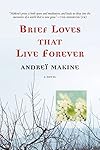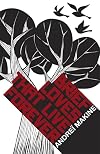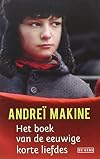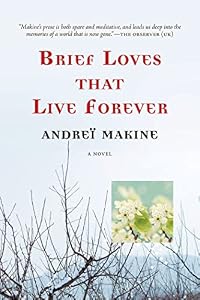
Brief Loves That Live Forever
by Andreï Makine
On This Page
Description
An orphan reflects on the unbreakable bond between love and freedom in the Soviet Union.Tags
Recommendations



















Member Reviews
"The fatal mistake we make is looking for a paradise that endures.... The obsession with what lasts causes us to overlook many a fleeting paradise. "
This book reads like a poem! As always, I am overwhelmed by Makine's writing, and this time is no different; still, it's one of his best works, I would say. This book of 8 mini novellas (connected in theme) is a nostalgic, bitter/sweet lyrical gem and is one more example of Makine's undeniable talent. Here he is a romantic and a realist at the same time. His unique eloquence (even in translation!) feels so compelling that one is immediately thrown into the milieu of the place/time/moment; a gesture that says it "all", a facial expression or just "when the leaves on the trees all converse in show more their own languages" is described to such spellbinding perfection that one simply stops and marvels. His "grandstand" description and his protagonist being trapped under one as a child is a potent metaphor in one of the stories here, one of the glimpses into the past of his hero (in many ways, it seems, autobiographical, because of the way he presents these incidents, so true to life). Plus, to me, it's all highly relatable and acutely understandable - his hero being of my generation, era, and place.
A writer, born Russian, writing in French in such a way that even the French are highly impressed - it's quite a literary achievement. The fact that Makine was elected to Academie francaise (that only has 40 members and is a "council for matters pertaining to the French language") says it all. I wish someday ALL his books are translated in English (or into Russian...), can't wait.... He has also written under a pseudonym "Gabriel Osmonde", but those works are only in French, as far as I can tell.
A highly recommended read. show less
This book reads like a poem! As always, I am overwhelmed by Makine's writing, and this time is no different; still, it's one of his best works, I would say. This book of 8 mini novellas (connected in theme) is a nostalgic, bitter/sweet lyrical gem and is one more example of Makine's undeniable talent. Here he is a romantic and a realist at the same time. His unique eloquence (even in translation!) feels so compelling that one is immediately thrown into the milieu of the place/time/moment; a gesture that says it "all", a facial expression or just "when the leaves on the trees all converse in show more their own languages" is described to such spellbinding perfection that one simply stops and marvels. His "grandstand" description and his protagonist being trapped under one as a child is a potent metaphor in one of the stories here, one of the glimpses into the past of his hero (in many ways, it seems, autobiographical, because of the way he presents these incidents, so true to life). Plus, to me, it's all highly relatable and acutely understandable - his hero being of my generation, era, and place.
A writer, born Russian, writing in French in such a way that even the French are highly impressed - it's quite a literary achievement. The fact that Makine was elected to Academie francaise (that only has 40 members and is a "council for matters pertaining to the French language") says it all. I wish someday ALL his books are translated in English (or into Russian...), can't wait.... He has also written under a pseudonym "Gabriel Osmonde", but those works are only in French, as far as I can tell.
A highly recommended read. show less
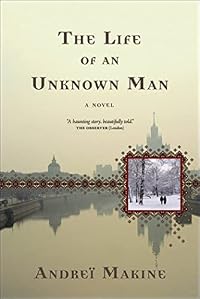
This is an interesting hybrid of memoir, novel and short story collection. Each chapter or story picks out a moment of beauty as a sort of epiphany standing out among the greyness of a youth spent in Soviet Russia. Makine's writing is stylish and moving. For me this one didn't quite have the impact of his previous book The Life of an Unknown Man, but it was still well worth reading.
The language in this short novel is so stunning that it's hard to know whether to praise the writer or translator more. It's a gorgeous, evocative meander through one man's life from the days of the Soviet Union through its fall and beyond.
Classic Makine. Several short accounts, in a chronological sequence from childhood in an ophanage to adulthood (and sometimes referring back to each other), of episodes in the narrator's life involving an awareness of feelings which were often fleeting and ill-understood at the time but which end up lasting a lifetime.
hauntingly poetic, achingly beautiful
hauntingly poetic, achingly beautiful
Members
- Recently Added By
Lists

International IMPAC Dublin Literary Award
179 works; 6 members

Literature in Translation
113 works; 5 members

Kirkus Starred Fiction Reviews of Books Published in 2015
310 works; 6 members
Author Information

32+ Works 4,451 Members
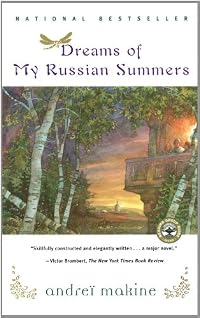
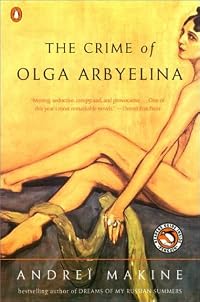
Andrei Makine was born in Siberia in 1957. Although raised in the Soviet Union, he learned about France and came to love that country through the stories told by his French grandmother. He now lives in Paris himself, having been granted political asylum by France in 1987, and writes in French. His grandmother figures prominently in the show more autobiographical novel, "Dreams of My Russian Summers," for which Makine received both the Goncourt Prize and the Medicis Prize, becoming the first author to simultaneously receive both of these prestigious French awards. In the U.S., the English translation of "Dreams of My Russian Summers" has also received recognition, including the Boston Book Review Fiction Prize and the Los Angeles Times Best Book of the Year award. Andrei Makine is also the author of "Once Upon the River Love" and "The Crime of Olga Arbelina." (Bowker Author Biography) show less
Some Editions
Awards and Honors
Common Knowledge
- Canonical title
- Brief Loves That Live Forever
- Original title
- Le livre des brèves amours éternelles
- Original publication date
- 2011
- People/Characters
- Dmitri Ress
- Dedication
- To the memory of Dick Seaver
- First words
- From my youth onwards the memory of that chance encounter returns, at once insistent and elusive, like a riddle one never gives up hoping of solving.
- Last words
- (Click to show. Warning: May contain spoilers.)For that day, perhaps without his knowing it, it was the poet in him who spoke.
- Original language
- French
Classifications
Statistics
- Members
- 136
- Popularity
- 239,639
- Reviews
- 10
- Rating
- (4.05)
- Languages
- 8 — Dutch, English, Finnish, French, Hungarian, Italian, Lithuanian, Spanish
- Media
- Paper, Ebook
- ISBNs
- 17
- ASINs
- 4