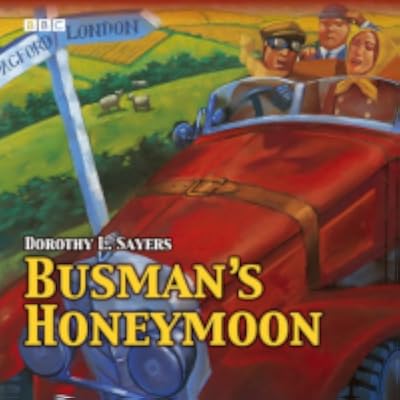
Busman's Honeymoon (BBC Audio Collection: Crime)
by Dorothy L. Sayers
Lord Peter Wimsey: BBC Audio (11)
On This Page
Description
Society s eligible women are in mourning. Lord Peter Wimsey has married at last, having finally succeeded in his ardent pursuit of the lovely mystery novelist Harriet Vane. The two depart for a tranquil honeymoon in a country farmhouse but find, instead of a well-prepared love nest, the place left in a shambles by the previous owner. His sudden appearance, dead from a broken skull in the cellar, only prompts more questions. Why would anyone have wanted to kill old Mr Noakes? What dark show more secrets had he to hide? The honeymoon is over, as Lord Peter and Harriet Vane start their investigations. Suspicion is rife and everyone seems to have something to hide, from the local constable to the housekeeper. Wimsey and his wife can think of plenty of theories, but it s not until they discover a vital fact that the identity of the murderer becomes clear.2 CDs. 2 hrs 25 mins." show lessTags
Recommendations













Member Reviews
There is an amazing wealth of …stuff to listen to out there. The BBC Radio website alone could keep me happy for months.
As, for example: the three-hour BBC Radio adaptation of Busman's Honeymoon. (It's not available on the site as of this writing, unfortunately.) It's always a little iffy when a beloved book is dramatized – things are going to be lost, of course, as a 400-odd page book is pared down to fit six half-hour slots; but this worked very nicely.
The cast is lovely. Ian Carmichael, of course, does a marvelous job with Peter – he can piffle up a storm, and then a minute later put real emotion in his voice as he allows himself to realize that he has his Harriet, he truly does. And I really like Sarah Badel as Harriet, show more showing genuine affection for her Peter and holding up her end of the piffle. I didn't remember Superintendent Kirk being so adept at piffle himself in the book – what fun. And Bunter sounded very Bunter indeed.
I'd forgotten about the dreadful case of Miss Twitterton. Her deeply misplaced love for Frank Crutchley is portrayed as both pathetic and hilarious. I honestly don't remember how it was handled in the book – has it been that long since I read it? That must be remedied! – but it's initially a joke to Peter and Harriet, with sympathy and empath only being aroused in them when more facts come out. Hers is a horrible story, though, almost a throwaway. show less
As, for example: the three-hour BBC Radio adaptation of Busman's Honeymoon. (It's not available on the site as of this writing, unfortunately.) It's always a little iffy when a beloved book is dramatized – things are going to be lost, of course, as a 400-odd page book is pared down to fit six half-hour slots; but this worked very nicely.
The cast is lovely. Ian Carmichael, of course, does a marvelous job with Peter – he can piffle up a storm, and then a minute later put real emotion in his voice as he allows himself to realize that he has his Harriet, he truly does. And I really like Sarah Badel as Harriet, show more showing genuine affection for her Peter and holding up her end of the piffle. I didn't remember Superintendent Kirk being so adept at piffle himself in the book – what fun. And Bunter sounded very Bunter indeed.
I'd forgotten about the dreadful case of Miss Twitterton. Her deeply misplaced love for Frank Crutchley is portrayed as both pathetic and hilarious. I honestly don't remember how it was handled in the book – has it been that long since I read it? That must be remedied! – but it's initially a joke to Peter and Harriet, with sympathy and empath only being aroused in them when more facts come out. Hers is a horrible story, though, almost a throwaway. show less
Runs a bit fast and ends up a bit confusing. The overt uxoriousness is annoying. I expect the book is a bit better, but it may be a bit worse as well. The murder is well-done and the clues are set right before the reader very nicely.
Ratings
Members
- Recently Added By
Author Information

277+ Works 70,811 Members
Dorothy Sayers's impressive reputation as a contemporary master of the classic detective story is eclipsed only by Agatha Christie's. Sayers was born in Oxford and attended Somerville College, where she received a B.A. in 1915 and an M.A. in 1920. During that period, Sayers worked as an instructor of modern languages at Hull High School for Girls show more in Yorkshire and as a reader for a publisher in Oxford. Her early literary work was in poetry; she published several volumes and served as an editor for the journal Oxford Poetry from 1917 to 1919. Sayers also worked as a copywriter for a major advertising firm in London. She was president of the Modern Language Association from 1939 to 1945 and of the Detection Club in the 1950s. Around 1920 Sayers developed the idea for her detective hero Lord Peter Wimsey, and she soon published her first mystery, Whose Body? (1923), in which Lord Peter is introduced. For the next dozen or so years, Sayers wrote prolifically about Wimsey, creating in the process what many critics of the genre consider to be the finest detective novels in the English language. Perhaps her most famous Wimsey mystery was The Nine Tailors (1934). Although Sayers essentially followed the classic form in her detective fiction---a formula in which the plot assumes a greater importance than do the characters---Sayers maintained that a detective hero's greatness depended on how effectively the character was portrayed. All but one of Sayers's mysteries feature Lord Peter Wimsey. By the late 1930s, Sayers had apparently tired of writing detective fiction. She stated in 1947 that she would write no more mysteries, that she wrote detective fiction only when she was young and in need of money. Thus saying, Sayers turned her attention to her early loves, medieval and religious literature, spending her remaining years lecturing on and translating Dante (see Vol. 2). (Bowker Author Biography) show less
All Editions
Some Editions
Series

Belongs to Publisher Series
Work Relationships
Common Knowledge
- Original publication date
- 1983
- People/Characters
- Peter Death Bredon Wimsey (Lord Peter Wimsey); Mervyn Bunter; Harriet Vane; William Noakes; Agnes Twitterton; Frank Crutchley (show all 10); Martha Ruddle; Kirk; Joseph Sellon; Simon Goodacre
- Important places
- Talboys, Hertfordshire, England, UK
- Original language
- English
- Disambiguation notice
- The is the BBC radio drama. Please do not combine it with the novel.
Classifications
Statistics
- Members
- 39
- Popularity
- 745,070
- Reviews
- 2
- Rating
- (3.89)
- Languages
- English
- Media
- Audiobook
- ISBNs
- 2
- ASINs
- 2