
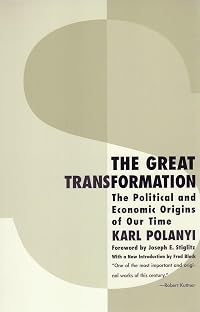
The Great Transformation: The Political and Economic Origins of Our Time
by Karl Polanyi
On This Page
Description
In this classic work of economic history and social theory, Karl Polanyi analyzes the economic and social changes brought about by the "great transformation" of the Industrial Revolution. His analysis explains not only the deficiencies of the self-regulating market, but the potentially dire social consequences of untempered market capitalism. New introductory material reveals the renewed importance of Polanyi's seminal analysis in an era of globalization and free trade.Tags
Recommendations


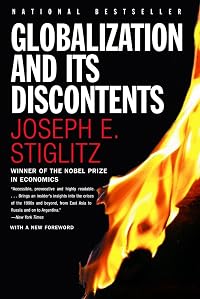









Member Recommendations
The Revolution of Civil Society. Challenging Neo-Liberal Orthodoxy: The Development of the Progressive State by Michael Lloyd
M_Clark Michael Lloyd's book, although difficult to read, provides a more comprehensive critique of neo-liberal thinking.

M_Clark Ramp Hollow expands upon many of the points made by Polanyi in its in-depth look at the economic development of Appalachia.

x_hoxha Wide-ranging history that presents a critique of Polanyi's account.
Member Reviews
The ideology of economic liberalism is a bankrupt utopia. Private enterprise, "sound" currency, libertarianism, deregulation--the still familiar ideas that originated with Malthus, Smith, and Ricardo are shown here to be based wholly on fictions that defy the evidence of all human history.
Among those fictions are that:
* the motive of economic gain governs all "rational" social behavior--conclusively disproved by mountains of ethnographic evidence from all over the world;
* human labor, land, and money are actually "commodities" produced for sale--an obvious falsehood in each case (just look at non-market societies)
* and the world is strictly divided into economic and political spheres--this contradicts our actual experience of society, show more as a world of continuous human interaction.
Despite their absurdity, these fictions were nonetheless enforced by the liberal state in the midst of the industrial revolution, eventually supplanting traditional economic practices all over Europe (and beyond) and leading predictably to social chaos and suffering for the most vulnerable classes.
According to Polanyi, industrialization seemed to proceed independently of any ideology; the fictions of economic liberalism merely filled this ideological vacuum, becoming the axioms of economic life for a century.
By the close of the 19th century, these fictions increasingly gave way to the social reality (as Polanyi sees it), and social protections against destructive market forces were widely implemented.
The transformation the title refers to was the overall social outcome of those protective measures that he claims culminated in the interwar period, decisively ending the era of the self-regulating market, and giving rise to the New Deal, Fascism, and Stalinism.
A conventional teleology of progress is disappointingly apparent in Polanyi's conception of industrialization (Weber has a much more disinterested approach), and he makes it explicit in the final chapter.
Writing in 1944, he predicts that a balance will be found between the traditional ideals of peace and freedom on the one hand and the "demands" of industrial civilization on the other. The only alternative he saw was total surrender to industry--in short, Fascism.
Polanyi's faith in progress looks more than a little ridiculous now. I guess this is what people mean when they refer to "the post-war dream." He envisioned the development of a post-liberal society. He could not imagine that in a few decades we would in fact be living in a neo-liberal society based on the resurrected image of the same utopia that he was certain had already passed.
Yet, for the same reason that his prognostications are now useless, his insight into the theory and practice of economic liberalism is now more relevant than ever. The fictions of the market may now be approaching a breaking point once again. show less
Among those fictions are that:
* the motive of economic gain governs all "rational" social behavior--conclusively disproved by mountains of ethnographic evidence from all over the world;
* human labor, land, and money are actually "commodities" produced for sale--an obvious falsehood in each case (just look at non-market societies)
* and the world is strictly divided into economic and political spheres--this contradicts our actual experience of society, show more as a world of continuous human interaction.
Despite their absurdity, these fictions were nonetheless enforced by the liberal state in the midst of the industrial revolution, eventually supplanting traditional economic practices all over Europe (and beyond) and leading predictably to social chaos and suffering for the most vulnerable classes.
According to Polanyi, industrialization seemed to proceed independently of any ideology; the fictions of economic liberalism merely filled this ideological vacuum, becoming the axioms of economic life for a century.
By the close of the 19th century, these fictions increasingly gave way to the social reality (as Polanyi sees it), and social protections against destructive market forces were widely implemented.
The transformation the title refers to was the overall social outcome of those protective measures that he claims culminated in the interwar period, decisively ending the era of the self-regulating market, and giving rise to the New Deal, Fascism, and Stalinism.
A conventional teleology of progress is disappointingly apparent in Polanyi's conception of industrialization (Weber has a much more disinterested approach), and he makes it explicit in the final chapter.
Writing in 1944, he predicts that a balance will be found between the traditional ideals of peace and freedom on the one hand and the "demands" of industrial civilization on the other. The only alternative he saw was total surrender to industry--in short, Fascism.
Polanyi's faith in progress looks more than a little ridiculous now. I guess this is what people mean when they refer to "the post-war dream." He envisioned the development of a post-liberal society. He could not imagine that in a few decades we would in fact be living in a neo-liberal society based on the resurrected image of the same utopia that he was certain had already passed.
Yet, for the same reason that his prognostications are now useless, his insight into the theory and practice of economic liberalism is now more relevant than ever. The fictions of the market may now be approaching a breaking point once again. show less
Karl Polanyi sadly passed away before his writing could find its natural format, a 100+ tweet thread beginning with "It's Time For Some Game Theory..."
This book is nominally an account of the development of laissez faire capitalism, and a rebuttal to the arguments of Ludwig Von Mises that free markets naturally develop in the absence of political intervention, with a kicker about capitalism's responsibility for the rise of fascism (the book was published in 1944).
What this book is is a rambling series of vaguely linked essays and tangents, with a few sparkling epigrams buried in a mass of economical-historical mush. Polanyi is vague about his timeline, switching the exact period under study repeatedly through the book, which hinders show more comparisons of pre-transformation 18th century England with various policy innovations in the 19th century, and mature capitalism in the 20th. The thread, as much as I can follow it, is that pre-modern people always distinguished between domestic production, which was limited by traditional feudal and guild structures to protect livelihoods, and production for foreign trade, which was used to exploit any community foolish enough to let it in. Through the 19th century, Britain enacted a series of reforms that destroyed the old order, ushering in a period of dramatic capitalist growth based on promises of profit for the bourgeois, and the lash of hunger to motivate workers.
More broadly, classical liberalism can never work, because three key commodities: land, labor, and money, are "fictitious", and under pure free market influences immediately collapse into some sort of disastrous singularity. Labor is human life, land is nature, the gold standard a false idol, and these things must be protected from society and vice versa. As evidence for this, Polanyi puts forth the masses of regulatory laws that followed laissez-fair reforms. Even in the absence of a program, Chartist or Marxist in ideology, people instinctively realized that market logic was corrosive, and restricted pure market functioning. Liberty is built on society, and society is a matter of submitting to limits.
I'm intensely frustrated. I mostly agree with Polanyi politically, but he connects evidence to argument in a way that feels entirely opaque. This may be a foundational work in economic history, but it reads with all the relevance of last centuries flamewars. The basic dyad of the debate between capital and society remains, but the contours and points of argument have shifted so rapidly this book feel archaic. show less
This book is nominally an account of the development of laissez faire capitalism, and a rebuttal to the arguments of Ludwig Von Mises that free markets naturally develop in the absence of political intervention, with a kicker about capitalism's responsibility for the rise of fascism (the book was published in 1944).
What this book is is a rambling series of vaguely linked essays and tangents, with a few sparkling epigrams buried in a mass of economical-historical mush. Polanyi is vague about his timeline, switching the exact period under study repeatedly through the book, which hinders show more comparisons of pre-transformation 18th century England with various policy innovations in the 19th century, and mature capitalism in the 20th. The thread, as much as I can follow it, is that pre-modern people always distinguished between domestic production, which was limited by traditional feudal and guild structures to protect livelihoods, and production for foreign trade, which was used to exploit any community foolish enough to let it in. Through the 19th century, Britain enacted a series of reforms that destroyed the old order, ushering in a period of dramatic capitalist growth based on promises of profit for the bourgeois, and the lash of hunger to motivate workers.
More broadly, classical liberalism can never work, because three key commodities: land, labor, and money, are "fictitious", and under pure free market influences immediately collapse into some sort of disastrous singularity. Labor is human life, land is nature, the gold standard a false idol, and these things must be protected from society and vice versa. As evidence for this, Polanyi puts forth the masses of regulatory laws that followed laissez-fair reforms. Even in the absence of a program, Chartist or Marxist in ideology, people instinctively realized that market logic was corrosive, and restricted pure market functioning. Liberty is built on society, and society is a matter of submitting to limits.
I'm intensely frustrated. I mostly agree with Polanyi politically, but he connects evidence to argument in a way that feels entirely opaque. This may be a foundational work in economic history, but it reads with all the relevance of last centuries flamewars. The basic dyad of the debate between capital and society remains, but the contours and points of argument have shifted so rapidly this book feel archaic. show less
Written just after WW II, Polanyi's book provides a strong criticism of the market liberalism of people like Hayek. He explains that market liberalism's belief in pure self-regulating markets is a myth that has never existed or even been tested in practice. Market liberals explain away all of the failures their theories encounter in the real world as being the fault of not following their ideas with enough purity.
Polanyi begins by attacking the principles of many of the classical economists by examining the anthropological record showing that their assertions about how primitive societies worked has been shown to be pure fantasy. He then criticizes the market liberal approach to labor by looking at English economic history during the show more 18th and 19th centuries. This will make his book difficult for those totally unfamiliar with English history; however, those with patience will be rewarded with observations from these times that fit with today's political discussions.
For example, the Speenhamland Laws of 1795, which topped up worker's wages so they would not starve, resulted in employer's actually lowering wages since they knew that the public sector would keep them from starving. This can, of course, by compared to the wages policies of Walmart where many employees need to collect Food Stamps in order to make ends meet. After many years, the English abolished the Speenhamland approach and offered no support to able-bodied workers. Discussions of this at the time, saw major benefits in people suffering from hunger since it would force them to work for lower wages. it would also force them to become cannon fodder in English wars. This can be compared to recent Republican ideas for reforming welfare.
The book also has an outstanding introductions by Joesph Stiglitz and Fred Block who point out the relevance of the book to today. show less
Polanyi begins by attacking the principles of many of the classical economists by examining the anthropological record showing that their assertions about how primitive societies worked has been shown to be pure fantasy. He then criticizes the market liberal approach to labor by looking at English economic history during the show more 18th and 19th centuries. This will make his book difficult for those totally unfamiliar with English history; however, those with patience will be rewarded with observations from these times that fit with today's political discussions.
For example, the Speenhamland Laws of 1795, which topped up worker's wages so they would not starve, resulted in employer's actually lowering wages since they knew that the public sector would keep them from starving. This can, of course, by compared to the wages policies of Walmart where many employees need to collect Food Stamps in order to make ends meet. After many years, the English abolished the Speenhamland approach and offered no support to able-bodied workers. Discussions of this at the time, saw major benefits in people suffering from hunger since it would force them to work for lower wages. it would also force them to become cannon fodder in English wars. This can be compared to recent Republican ideas for reforming welfare.
The book also has an outstanding introductions by Joesph Stiglitz and Fred Block who point out the relevance of the book to today. show less
This is a fascinating book, I'm astonished I haven't heard of it earlier.
Polanyi is not your run of the mill economist - he does not use equations - he uses context and does not describe events in a vacuum, integrating various disciplines from the social sciences. He describes four elements which comprised 19th century civilization, and which have all been swept away by the great bloodbaths of the early 20th century - the gold standard, the international balance of power, the classical liberal state, and the self-regulating market. The first three are elements of the final element.
That is, Polanyi posits that the free market is not free, nor is it self-perpetuating, nor is it a natural state of affairs - instead, governments have had to show more act in order to create economies on a national scale. Before this, there were community markets, and some distant trade, but nothing uniquely like this. The 'free market' is a creation of states and interests.
The 'free market revolution' was staged. The government has had to act in order to create the free market. Economy and society are inextricably linked, an apparatus which he calls the 'Market Society'. Massive societal extraction and mass upheavals are necessary. Vast populations are moved around, forced to work, thrown out, in ways which were wholly alien to our experience, and still crack and grumble at the bottom of society. Labour is an abstract term used to treat persons as commodities.
Polanyi uses historical examples and some abstract thinking to reach his conclusions. He is disappointing in his advocacy of the Soviet model of centralization, and some of his lines of reasoning. Some might go after his characterization of the pre-industrial era, calling it a rehash of the 'noble savage'. He does not deny that on a simple level of raw productivity or GDPs, the 'free-market' system works. But that, of course, is not the whole story.
This book is not easy to read or simple as Ayn Rand or Hayek or Mises are. It is perhaps even more turgid than Marx. His complexity makes it far too difficult to slap an ideological label onto him. He shares some things with John Maynard Keynes and the Christian socialists and the Humanists. He does, however, provide a stunning criticism of the ideas of the free market, and of some of the ideas of neoliberalism. People should be treated as more than statistics or economic figures, these cannot possibly tell the whole story. show less
Polanyi is not your run of the mill economist - he does not use equations - he uses context and does not describe events in a vacuum, integrating various disciplines from the social sciences. He describes four elements which comprised 19th century civilization, and which have all been swept away by the great bloodbaths of the early 20th century - the gold standard, the international balance of power, the classical liberal state, and the self-regulating market. The first three are elements of the final element.
That is, Polanyi posits that the free market is not free, nor is it self-perpetuating, nor is it a natural state of affairs - instead, governments have had to show more act in order to create economies on a national scale. Before this, there were community markets, and some distant trade, but nothing uniquely like this. The 'free market' is a creation of states and interests.
The 'free market revolution' was staged. The government has had to act in order to create the free market. Economy and society are inextricably linked, an apparatus which he calls the 'Market Society'. Massive societal extraction and mass upheavals are necessary. Vast populations are moved around, forced to work, thrown out, in ways which were wholly alien to our experience, and still crack and grumble at the bottom of society. Labour is an abstract term used to treat persons as commodities.
Polanyi uses historical examples and some abstract thinking to reach his conclusions. He is disappointing in his advocacy of the Soviet model of centralization, and some of his lines of reasoning. Some might go after his characterization of the pre-industrial era, calling it a rehash of the 'noble savage'. He does not deny that on a simple level of raw productivity or GDPs, the 'free-market' system works. But that, of course, is not the whole story.
This book is not easy to read or simple as Ayn Rand or Hayek or Mises are. It is perhaps even more turgid than Marx. His complexity makes it far too difficult to slap an ideological label onto him. He shares some things with John Maynard Keynes and the Christian socialists and the Humanists. He does, however, provide a stunning criticism of the ideas of the free market, and of some of the ideas of neoliberalism. People should be treated as more than statistics or economic figures, these cannot possibly tell the whole story. show less
It's difficult to review this book. I can see why it has been considered a classic and why it is still read today. The author is very knowledgeable in the economic history of the 19th century and his breadth of vision is impressive enough to captivate even critical readers. On three accounts, he criticizes the idea of a society organized solely on free market principles: (1) labour, (2) land and (3) money cannot be bought or sold as commodities. Attempts to supply them through free markets were made in the 19th century and early 20th, and this book is an attempt to illustrate and emphasize how destructive those attempts were.
However, although the book is fine as far as illustration and emphasis are concerned, I think it falls short on show more explanation. The writing is superb but the logic of the arguments often seems flimsy. The author discusses a number of events from the history of British industrialization in the 19th century and compares them occasionally to anthropological studies of primitive societies. But far too often the discussion yields no clear conclusion. It seems like the author then skips ahead without having established any cause-consequence relationship, and states his preferred conclusion as a matter of fact: the consequences of this or that policy were disastrous. Considering the breadth of the author's arguments and the consequences he attributes to them, the explanations he provides are far too brief.
I don't mean to say that I was not convinced. As far as I could tell, the author's three main points are valid criticisms of free-market liberalism. But this book needed to be at least twice as long if the author wanted to present truly convincing arguments for his main points. In comparison to the writers whom the author criticizes, such as Hayek and von Mises, his biggest failure is that he does not present any clear theoretical framework for the transformation he describes. I'm not sure if that framework should have been an economic theory or a theory in social or political philosophy, but something theoretical needed to be said to truly make this book a work for the ages. It still stands as a fine intellectual achievement in economic history and a pleasure to read 75 years after it was written, but it's also a product of its age. I could not see what practical implications it might have for societies in the 21st century. show less
However, although the book is fine as far as illustration and emphasis are concerned, I think it falls short on show more explanation. The writing is superb but the logic of the arguments often seems flimsy. The author discusses a number of events from the history of British industrialization in the 19th century and compares them occasionally to anthropological studies of primitive societies. But far too often the discussion yields no clear conclusion. It seems like the author then skips ahead without having established any cause-consequence relationship, and states his preferred conclusion as a matter of fact: the consequences of this or that policy were disastrous. Considering the breadth of the author's arguments and the consequences he attributes to them, the explanations he provides are far too brief.
I don't mean to say that I was not convinced. As far as I could tell, the author's three main points are valid criticisms of free-market liberalism. But this book needed to be at least twice as long if the author wanted to present truly convincing arguments for his main points. In comparison to the writers whom the author criticizes, such as Hayek and von Mises, his biggest failure is that he does not present any clear theoretical framework for the transformation he describes. I'm not sure if that framework should have been an economic theory or a theory in social or political philosophy, but something theoretical needed to be said to truly make this book a work for the ages. It still stands as a fine intellectual achievement in economic history and a pleasure to read 75 years after it was written, but it's also a product of its age. I could not see what practical implications it might have for societies in the 21st century. show less
I really didn't like this book, mostly because I felt that it was poorly formulated and based on a lot of incomplete examples. Every time Polanyi tried to prove something he'd give 4 examples of random indigenous populations in which the event occurred. All of his examples seemed like exceptions rather than base cases for a rule, and his strange statements like "previously to our time (the 1940s/Industrial Revolution period in general) no economy has ever existed that, even in principle, was controlled by markets" made me question if we were even living in the same world. Because of this I wasn't able to accept any of his statements, even when they seemed logical, and the book generally fell flat.
I know of no work more important to understanding the rise of modern capitalism than this one. It is the antidote to Hayek, von Mises, and Friedman. The work should mark Polanyi as one of the greatest thinkers of all time and certainly he ranks as a great historian. If you want to understand how we are where we are, this is the book to read.
Members
- Recently Added By
Lists

My List
302 works; 1 member
Talk Discussions
Past Discussions
Karl Polanyi - The Great Transformation - for it or against it? in Non-Fiction Readers (July 2013)
Author Information

31+ Works 2,093 Members
Karl Polanyi (1886-1964) was one of the most influential political economists of recent times. His book The Great Transformation is generally acclaimed as being among the most important works of economic history in the twentieth century.
Some Editions
Awards and Honors
Notable Lists
Series
Belongs to Publisher Series
Common Knowledge
- Canonical title
- The Great Transformation: The Political and Economic Origins of Our Time
- Original title
- The Great Transformation: The Political and Economic Origins of Our Time
- Original publication date
- 1944
- Original language
- English
Classifications
- Genres
- Economics, Sociology, Nonfiction, History, General Nonfiction, Philosophy, Politics and Government
- DDC/MDS
- 330.9 — Society, government, & culture Economics Jobs & Careers Economic geography and history
- LCC
- HC53 .P6 — Social sciences Economic history and conditions Economic history and conditions
- BISAC
Statistics
- Members
- 1,820
- Popularity
- 11,931
- Reviews
- 17
- Rating
- (4.14)
- Languages
- 14 — Chinese, English, Finnish, French, German, Greek, Italian, Japanese, Korean, Polish, Portuguese, Spanish, Swedish, Turkish
- Media
- Paper, Ebook
- ISBNs
- 47
- UPCs
- 2
- ASINs
- 15