On This Page
Description
A classic mystery featuring dogged detective Philo Vance. "An intricate puzzle . . . [Vance] has an uncanny insight into the subtler aspects of crime." --The New York Times Given all the rich people getting bumped off in Philo Vance's Manhattan, it's amazing there are enough left to support the symphony. Latest up: Arthur Coe, found dead in his own locked bedroom. Suicide? The ever-perceptive Philo doesn't buy that theory for a second. The presence in Coe's house of a strange, show more prize-winning terrier only adds to the mystery, although Philo's fabulously in-depth knowledge of dogs does not in fact solve the crime; his fabulously in-depth knowledge of the murder of the Empress Elizabeth of Austria in 1898 proves much more useful. Like most of the Philo Vance novels, Kennel was made into a movie, directed this time by Michael Curtiz, who a few years later would turn his hand to a little number known as Casablanca. At least one critic has called the film a "masterpiece," and though we make no similar claim for the book, GoodMysteries.com, dedicated to the art of the classic whodunit, calls Kennel "one of the best locked-room setups ever written." Praise for the Philo Vance series "With his highbrow manner and his parade of encyclopedic learning, Philo Vance is not only a detective; he is a god out of the machine." --The New York Times "Well-crafted puzzlers that captivated readers . . . the works of S.S. Van Dine serve to transport the reader back to a long-gone era of society and style of writing." --Mystery Scene "Outrageous cleverness . . . among the finest fruits of the Golden Age." --Bloody Murder show lessTags
Recommendations

















Member Reviews
“Almost any man may be a murderer, but only a certain type of man can injure a dog the way Scottie was injured here the other night.”
Literate, incredibly intelligent, insufferably smug and deeply flawed, one has to wonder, with all that we know about culturally influential art critic Willard Huntington Wright in our day, if Philo Vance is not the softened version of the writer himself, or perhaps what he saw when he passed by a mirror. Disgraced and abandoned by a few old friends for his Prussian sympathies during the first World War, and trying to recover from an addiction to cocaine, he began devouring mysteries as a lark. He finally approached the famous Maxwell Perkins about writing a detective series with a character very show more similar to himself. Because the highbrow Wright could not bear the thought of the friends he had left discovering he had sold out his highbrow intellectual ideals by dipping into the waters of detective fiction for the uneducated, and not as "enlightened" masses, however, he initially used the pseudonym S.S. Van Dine.
His meticulously plotted and literate detective fiction was firmly steeped in the Jazz Age, and immediately became so popular that Wright was unmasked as the author. He even wrote a self-deprecating article, “I Used to be a Highbrow and Look at Me Now” while he was at the zenith of his fame and wealth brought to him by his creation, Philo Vance. But then came the hardboiled stuff like Race Williams and Sam Spade, and suddenly the public wanted grit and guts and gats, not a sophisticated amateur detective who could drone on about art, dogs, languages, and arcane history while solving the most elaborate and intricately conceived murder cases.
Today, however, reading one of the better Philo Vance novels feels nostalgic. Van Dine’s Philo Vance novels had been viewed as outdated, difficult to read, and only of historical interest in the evolution of the mystery and detective novel form for a very long time. The person who changed that was actor William Powell. He had portrayed the dapper detective in some highly successful films during both the silent and sound eras, and when film buffs rediscovered him — and in some cases the actual films were found — the renaissance of S.S. Van Dine began. It didn’t hurt that the best of the films, The Kennel Murder Case, filmed shortly before Powell began playing Hammett’s Nick Charles in all those wonderful Thin Man films, had fallen into the public domain, making it easily accessible to — ironically for Wright — the masses. It also didn’t hurt that Michael Curtiz, the director of Casablanca, filmed it, turning it into a classic in the locked-room variety of mystery.
This is the book that film was based on, and the reason I picked it to read first. I must admit that I’ve read Van Dine many years ago, and found his detective nearly insufferable, and unrealistic — though his narratives were well-plotted and well-written. But now, with that image of Powell that I can’t get out of my head, the urbane and sophisticated Vance holds a certain charm that softens the snobbery, and makes this quite fun. In fact, solving the murder of Archer Coe, found dead in a room locked from the inside, with no other access but the door, is kind of a blast. It’s like stepping into a time machine when Manhattan was glamorous rather than gauche, solving mysteries was a hobby for gentleman as much as tennis, and the sleuth led the police around in circles as he picked up on one arcane or seemingly insignificant clue after another until he’d figured it out. Because it’s all a game, you see, even though it’s a murder, serious business.
Coe’s shoes and a fountain pen lead Vance to believe it was murder, and boy, was it. In more than one way! Hilda Lake is one of the suspects, but so is the entire house. Then another murder occurs. A vase of no value is conspicuously placed among finer pieces, and there’s blood on it. A dagger is found, and a dog was attacked on the night in question. And while Vance is helping New York’s Distict Attorney, Markham, with the case, we’re privy to Vance informing us about proper breeding in the Scottish terrier so snobbishly it’ll make your eyes roll. But it will also bring forth a chuckle, because this is William Powell talking, and that makes it all okay. You’ll hear some highfalutin jargon in both dialog and narrative on occasion, yet it’s softened just enough to give it a nostalgic kind of charm when read today.
The ending to this one is good, and it reads faster than you’d think with all the talk and the puzzling over this clue and that one. For a belligerent highbrow, Wright could write. Terrific stuff in its own way, if you’re in the mood for something of this nature in the mystery genre. A very late 1920s, early '30s feel of men-about-town in Manhattan, and a frighteningly smart, dapper and erudite amateur detective who enjoys the challenge. Great stuff when you’re in the mood. show less
Literate, incredibly intelligent, insufferably smug and deeply flawed, one has to wonder, with all that we know about culturally influential art critic Willard Huntington Wright in our day, if Philo Vance is not the softened version of the writer himself, or perhaps what he saw when he passed by a mirror. Disgraced and abandoned by a few old friends for his Prussian sympathies during the first World War, and trying to recover from an addiction to cocaine, he began devouring mysteries as a lark. He finally approached the famous Maxwell Perkins about writing a detective series with a character very show more similar to himself. Because the highbrow Wright could not bear the thought of the friends he had left discovering he had sold out his highbrow intellectual ideals by dipping into the waters of detective fiction for the uneducated, and not as "enlightened" masses, however, he initially used the pseudonym S.S. Van Dine.
His meticulously plotted and literate detective fiction was firmly steeped in the Jazz Age, and immediately became so popular that Wright was unmasked as the author. He even wrote a self-deprecating article, “I Used to be a Highbrow and Look at Me Now” while he was at the zenith of his fame and wealth brought to him by his creation, Philo Vance. But then came the hardboiled stuff like Race Williams and Sam Spade, and suddenly the public wanted grit and guts and gats, not a sophisticated amateur detective who could drone on about art, dogs, languages, and arcane history while solving the most elaborate and intricately conceived murder cases.
Today, however, reading one of the better Philo Vance novels feels nostalgic. Van Dine’s Philo Vance novels had been viewed as outdated, difficult to read, and only of historical interest in the evolution of the mystery and detective novel form for a very long time. The person who changed that was actor William Powell. He had portrayed the dapper detective in some highly successful films during both the silent and sound eras, and when film buffs rediscovered him — and in some cases the actual films were found — the renaissance of S.S. Van Dine began. It didn’t hurt that the best of the films, The Kennel Murder Case, filmed shortly before Powell began playing Hammett’s Nick Charles in all those wonderful Thin Man films, had fallen into the public domain, making it easily accessible to — ironically for Wright — the masses. It also didn’t hurt that Michael Curtiz, the director of Casablanca, filmed it, turning it into a classic in the locked-room variety of mystery.
This is the book that film was based on, and the reason I picked it to read first. I must admit that I’ve read Van Dine many years ago, and found his detective nearly insufferable, and unrealistic — though his narratives were well-plotted and well-written. But now, with that image of Powell that I can’t get out of my head, the urbane and sophisticated Vance holds a certain charm that softens the snobbery, and makes this quite fun. In fact, solving the murder of Archer Coe, found dead in a room locked from the inside, with no other access but the door, is kind of a blast. It’s like stepping into a time machine when Manhattan was glamorous rather than gauche, solving mysteries was a hobby for gentleman as much as tennis, and the sleuth led the police around in circles as he picked up on one arcane or seemingly insignificant clue after another until he’d figured it out. Because it’s all a game, you see, even though it’s a murder, serious business.
Coe’s shoes and a fountain pen lead Vance to believe it was murder, and boy, was it. In more than one way! Hilda Lake is one of the suspects, but so is the entire house. Then another murder occurs. A vase of no value is conspicuously placed among finer pieces, and there’s blood on it. A dagger is found, and a dog was attacked on the night in question. And while Vance is helping New York’s Distict Attorney, Markham, with the case, we’re privy to Vance informing us about proper breeding in the Scottish terrier so snobbishly it’ll make your eyes roll. But it will also bring forth a chuckle, because this is William Powell talking, and that makes it all okay. You’ll hear some highfalutin jargon in both dialog and narrative on occasion, yet it’s softened just enough to give it a nostalgic kind of charm when read today.
The ending to this one is good, and it reads faster than you’d think with all the talk and the puzzling over this clue and that one. For a belligerent highbrow, Wright could write. Terrific stuff in its own way, if you’re in the mood for something of this nature in the mystery genre. A very late 1920s, early '30s feel of men-about-town in Manhattan, and a frighteningly smart, dapper and erudite amateur detective who enjoys the challenge. Great stuff when you’re in the mood. show less
The Kennel Murder Case is the basis for the Wm Powell film. Van Dine complicates somewhat the basic setup of a classic Locked Room Mystery, and references purportedly historical cases through characters citing casebooks and detective manuals.
Ethnic prejudice figures prominently. The Sergeant is racist, suspecting the cook for no other reason than he's Chinese. Vance, allegedly more enlightened, doesn't understand the difference between cultural traits (principles held in esteem by a population) and personal traits, making assumptions about suspects based on these generalizations. Perhaps that's all you can do without knowing the individual, but it doesn't come across that way. Vance interviews individuals to get facts about the case, show more for example, so there's an opportunity to investigate rather than assume certain cultural traits. It also doesn't come across as Van Dine's depiction of a character, so much as the way he writes. It undermines my respect for Vance, frankly.
As written, Vance is not interesting in the way of Poirot or Guenther. Worth revisiting this book, esp in reference to the film, but no real need to explore the series.
There are 4 diagrams included: a publishing extravagance in 1933? Perhaps an indication of how well the Philo Vance series sold.
//
Michael Curtiz's film adaption also released 1933. While the screenplay necessarily simplifies the character interaction, it also changes the plot timeline and development, to the marked detriment of the film. Powell does little to capture the characteristic diction of Vance: perhaps he was as bewildered as I was in what Van Dine was after. show less
Ethnic prejudice figures prominently. The Sergeant is racist, suspecting the cook for no other reason than he's Chinese. Vance, allegedly more enlightened, doesn't understand the difference between cultural traits (principles held in esteem by a population) and personal traits, making assumptions about suspects based on these generalizations. Perhaps that's all you can do without knowing the individual, but it doesn't come across that way. Vance interviews individuals to get facts about the case, show more for example, so there's an opportunity to investigate rather than assume certain cultural traits. It also doesn't come across as Van Dine's depiction of a character, so much as the way he writes. It undermines my respect for Vance, frankly.
As written, Vance is not interesting in the way of Poirot or Guenther. Worth revisiting this book, esp in reference to the film, but no real need to explore the series.
There are 4 diagrams included: a publishing extravagance in 1933? Perhaps an indication of how well the Philo Vance series sold.
//
Michael Curtiz's film adaption also released 1933. While the screenplay necessarily simplifies the character interaction, it also changes the plot timeline and development, to the marked detriment of the film. Powell does little to capture the characteristic diction of Vance: perhaps he was as bewildered as I was in what Van Dine was after. show less
A well-written, fast paced locked room mystery that tried entirely too hard to be too clever. Van Dine seemed determined to write a mystery that the reader couldn't solve, and in the process went entirely over the top.
Originally written in 1933, the writing suffers from the casual racism of the age (specifically against Chinese), with the sergeant assigned to the case coming across as the most ignorant - even interrogating all the suspects like he was in a bad noir detective novel. Vance was entirely too suave and expert at positively everything; the author's attempt to have him appear at times humble and stumped a complete failure, as he refuses to speculate wit the detectives or share the 'clues' he's ferreted out.
Still and all, it show more was entertaining to read and it didn't drag. I could have done without the animal cruelty and death, but both instances happened so fast and were over, but still, had I known about them, I'd have likely skipped reading this altogether, even if the rest of it entertained. show less
Originally written in 1933, the writing suffers from the casual racism of the age (specifically against Chinese), with the sergeant assigned to the case coming across as the most ignorant - even interrogating all the suspects like he was in a bad noir detective novel. Vance was entirely too suave and expert at positively everything; the author's attempt to have him appear at times humble and stumped a complete failure, as he refuses to speculate wit the detectives or share the 'clues' he's ferreted out.
Still and all, it show more was entertaining to read and it didn't drag. I could have done without the animal cruelty and death, but both instances happened so fast and were over, but still, had I known about them, I'd have likely skipped reading this altogether, even if the rest of it entertained. show less
Who Let the Dog Out?
Review of the Avarang Kindle eBook edition (May 30, 2023) of the Scribner’s hardcover original (1933).
This would have been a great locked room mystery, but the final show more explanation is ridiculously complicated and the appropriate fate of the culprit is diminished by a deus ex machina finale. I'm finding increasing diminishing returns in these Philo Vance mysteries even if the banter between the amateur sleuth and the authorities is still entertaining.
This case opens with the body of Arthur Coe apparently dead by suicide inside a locked room of his own house. Then a wounded dog is also located whimpering behind a curtain. Then yet another body is found. The complications pile on one by one. The solution to the mystery of the dog (which did not belong to the household) leads to the final revelation of the identity of the culprit.
An enormous amount of detail about Scottish Terrier dog breeding is provided by Vance in what is now an evident trademark of the novels. The amateur detective is also an expert is whatever subject matter is related to the case, e.g. chess & mathematics, Egyptology and archeology, tropical fish and dragon myths etc.
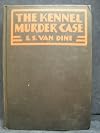
See book cover at https://upload.wikimedia.org/wikipedia/en/d/d8/Kennel-murder-case-cover.jpg
Front cover of the original Scribner’s first edition (1933). Image sourced from Wikipedia.
Trivia and Links
See movie poster at https://upload.wikimedia.org/wikipedia/en/b/bb/The-kennel-murder-case-1933.jpg
The Kennel Murder Case was adapted as the same-titled film The Kennel Murder Case (1933) directed by Michael Curtiz and starring William Powell as Philo Vance. You can watch the entire film on YouTube here.
Willard Huntington Wright aka S.S. Van Dine is also the author of the Twenty Rules for Writing Detective Stories. show less
Review of the Avarang Kindle eBook edition (May 30, 2023) of the Scribner’s hardcover original (1933).
Philo Vance
Needs a kick in the pance. - Ogden Nash
"And the facts here seem pretty clean-cut. That door was bolted on the inside; there's no other means of entrance or exit to this room; Coe is sitting here with the lethal weapon -."
"Oh, call it a revolver," interrupted Vance. "Silly phrase, 'lethal weapon.'"
Markham snorted.
"Very well... With a revolver in his hand, and a hole in his right temple. There are no signs of a struggle; the windows and shades are down, and the lights burning... How, in Heaven's name, could it have been anything but suicide?"
This would have been a great locked room mystery, but the final show more explanation is ridiculously complicated and the appropriate fate of the culprit is diminished by a deus ex machina finale. I'm finding increasing diminishing returns in these Philo Vance mysteries even if the banter between the amateur sleuth and the authorities is still entertaining.
This case opens with the body of Arthur Coe apparently dead by suicide inside a locked room of his own house. Then a wounded dog is also located whimpering behind a curtain. Then yet another body is found. The complications pile on one by one. The solution to the mystery of the dog (which did not belong to the household) leads to the final revelation of the identity of the culprit.
An enormous amount of detail about Scottish Terrier dog breeding is provided by Vance in what is now an evident trademark of the novels. The amateur detective is also an expert is whatever subject matter is related to the case, e.g. chess & mathematics, Egyptology and archeology, tropical fish and dragon myths etc.
See book cover at https://upload.wikimedia.org/wikipedia/en/d/d8/Kennel-murder-case-cover.jpg
Front cover of the original Scribner’s first edition (1933). Image sourced from Wikipedia.
Trivia and Links
See movie poster at https://upload.wikimedia.org/wikipedia/en/b/bb/The-kennel-murder-case-1933.jpg
The Kennel Murder Case was adapted as the same-titled film The Kennel Murder Case (1933) directed by Michael Curtiz and starring William Powell as Philo Vance. You can watch the entire film on YouTube here.
Willard Huntington Wright aka S.S. Van Dine is also the author of the Twenty Rules for Writing Detective Stories. show less
It is interesting how deeply entwined into the Philo Vance mysteries is the importance of class. It is not only that the DA (Markham) and Vance are without doubt of a different class that the detectives who work for them--it is not even that the stories are set in the world of wealthy. What really stands out is the way in which the principals in these cases are people who, upon the first problem they encounter, can speak directly to the DA. In The Scarab Murder Case the first person to find the body did not call the police he went over to Vance’s place. Vance, in turn, called the DA rather than the police. In The Greene Murder Case one of the Greene family directly requests that Markham intervene in the apparent burglary/murder show more investigation. And now, here, at the beginning of The Kennel Murder Case, a butler finds a man dead calls one of the man’s acquaintances who then calls the DA. It is the DA himself who calls the police. There are two possible inferences: one, that the only truly interesting murders takes place within the upper class (and the behaviour mentioned is just the way they act rather than something to be commented on); or two, that if such an intricate murder took place within the other classes no one would case or notice.
Van Dine also faces in these books the problem of convincing the reader that his detective, Vance, is indeed smarter or better at rationcination, than the men who work for the New York police department. The more one reads Van Dine the more one becomes convinced that the reason that there is such a gap in intellect and acumen between Vance and the New York homicide detectives is not that Vance is brilliant but that the detectives, individually and collectively, are deeply stupid and do not grasp the fundamentals of their profession. For example, in this book a murder has taken place. The body has been found, the coroner come and gone, the individuals we would call today the CSI or CSU unit have done their work and left, an injured dog that does not belong to anyone in the household has been found on the main floor of the house and Vance has questioned two of the people who live in the house -- and yet the house has not yet been searched. Thus Vance can appear to be brilliant when he wonders if a missing individual might be somewhere in the house and when that person’s dead body is found in a closet. The real mystery of this series is that the New York police ever solve any crime except when they find the perpetrator, holding a still smoking gun, standing over the victim’s body. Nor is it just the homicide detectives who are incompetent. The police doctor arrives at the scene and announces without so much as performing a preliminary examination that it is a suicide. He has to be pushed and cajoled to look at the body at which point he announces it is clearly a murder. Yet we can presume that either no appropriate autopsy was done, or that his report was woefully incomplete or that Vance, Markham and the homicide detectives all failed to read it since a simple knowledge of the difference between internal and external bleeding and the range of responses to stabbings that result in internal bleeding would have put a very different light on when and where the murder could have been done.
This may seem to be a case of twenty-twenty hindsight on the part of the reviewer but for all the reader is made to read through long lists of the “classic” books on detection and medical forensics owned by Vance and one of the murder victims the key piece of medical/forensic information with which Vance astounds Markham in the last pages of the book was commonly known enough to be used in a number of other detective stories roughly contemporary this book. Indeed this reader immediately recalled this information and waited impatiently throughout the entire book for it to pay off.
The reader will come away from this book suspecting that Van Dine had a real passion for Chinese art and dog breeding. This reader came away from the book with a real suspicion that Van Dine was far more interested in writing on those subjects than he was on writing another detective story show less
Van Dine also faces in these books the problem of convincing the reader that his detective, Vance, is indeed smarter or better at rationcination, than the men who work for the New York police department. The more one reads Van Dine the more one becomes convinced that the reason that there is such a gap in intellect and acumen between Vance and the New York homicide detectives is not that Vance is brilliant but that the detectives, individually and collectively, are deeply stupid and do not grasp the fundamentals of their profession. For example, in this book a murder has taken place. The body has been found, the coroner come and gone, the individuals we would call today the CSI or CSU unit have done their work and left, an injured dog that does not belong to anyone in the household has been found on the main floor of the house and Vance has questioned two of the people who live in the house -- and yet the house has not yet been searched. Thus Vance can appear to be brilliant when he wonders if a missing individual might be somewhere in the house and when that person’s dead body is found in a closet. The real mystery of this series is that the New York police ever solve any crime except when they find the perpetrator, holding a still smoking gun, standing over the victim’s body. Nor is it just the homicide detectives who are incompetent. The police doctor arrives at the scene and announces without so much as performing a preliminary examination that it is a suicide. He has to be pushed and cajoled to look at the body at which point he announces it is clearly a murder. Yet we can presume that either no appropriate autopsy was done, or that his report was woefully incomplete or that Vance, Markham and the homicide detectives all failed to read it since a simple knowledge of the difference between internal and external bleeding and the range of responses to stabbings that result in internal bleeding would have put a very different light on when and where the murder could have been done.
This may seem to be a case of twenty-twenty hindsight on the part of the reviewer but for all the reader is made to read through long lists of the “classic” books on detection and medical forensics owned by Vance and one of the murder victims the key piece of medical/forensic information with which Vance astounds Markham in the last pages of the book was commonly known enough to be used in a number of other detective stories roughly contemporary this book. Indeed this reader immediately recalled this information and waited impatiently throughout the entire book for it to pay off.
The reader will come away from this book suspecting that Van Dine had a real passion for Chinese art and dog breeding. This reader came away from the book with a real suspicion that Van Dine was far more interested in writing on those subjects than he was on writing another detective story show less
One of the better Van Dines, especially since I am prejudiced in favor of Scotties. The locked room mystery and the inclusion of a Scottie make it a wonderful read with a reasonable conclusion.
La prima cosa da dire su Il caso del terrier scozzese è che ho trovato adorabili le attenzioni di Vance nei confronti della povera cagnolina che, suo malgrado, si è ritrovata implicata in questi delitti e in queste indagini – pressoché ignorata da chiunque a parte il buon Vance che tra lo sconcerto generale la ritiene subito un elemento fondamentale per risolvere il caso.
Poi anche questa volta, complice la stanchezza, non sono riuscita a stare dietro alle indagini ed è stato interessante scoprire come e perché sono avvenuti i delitti.
Infine – e questo vale anche per La dea della vendetta – sono contenta di non dovermi ricredere sull’intelligenza di Vance, che ai miei occhi avrebbe perso diversi punti se avesse seguito i show more vari pregiudizi razziali che sono disseminati nei romanzi – il che immagino sia il massimo ottenibile da romanzi scritti negli anni Trenta del Novecento. show less
Poi anche questa volta, complice la stanchezza, non sono riuscita a stare dietro alle indagini ed è stato interessante scoprire come e perché sono avvenuti i delitti.
Infine – e questo vale anche per La dea della vendetta – sono contenta di non dovermi ricredere sull’intelligenza di Vance, che ai miei occhi avrebbe perso diversi punti se avesse seguito i show more vari pregiudizi razziali che sono disseminati nei romanzi – il che immagino sia il massimo ottenibile da romanzi scritti negli anni Trenta del Novecento. show less
Jan 14, 2024 (Edited)Italian
Members
- Recently Added By
Lists

Must Read Detective Stories (Nick Fuller)
278 works; 2 members
Author Information

81+ Works 2,820 Members
Series

Belongs to Publisher Series
Work Relationships
Is contained in
Has the adaptation
Common Knowledge
- Canonical title
- The Kennel Murder Case
- Original title
- The Kennel Murder Case
- Alternate titles*
- Il caso del terrier scozzese
- Original publication date
- 1933
- People/Characters
- Philo Vance; John F.-X. Markham; Dr. Doremus
- Important places*
- New York, New York, USA
- Related movies
- The Kennel Murder Case (1933); Calling Philo Vance (1940 | IMDb)
- Dedication
- TO THE SCOTTISH TERRIER CLUB OF AMERICA
- First words
- It was exactly three months after the startling termination of the Scarab murder case tha Philo Vance was drawn in toe subtlest and the perplexing of all the criminal problems that came his was during the four years of John F... (show all).-X. Markham's incumbenacy as District Attorney of New York County.
- Last words
- (Click to show. Warning: May contain spoilers.)Sometimes I think that Vance would rather part with one of his treasured Cézannes than with little Miss MacTavish.
*Some information comes from Common Knowledge in other languages. Click "Edit" for more information.
Classifications
Statistics
- Members
- 138
- Popularity
- 236,919
- Reviews
- 7
- Rating
- (3.45)
- Languages
- 6 — English, French, German, Italian, Portuguese, Spanish
- Media
- Paper, Ebook
- ISBNs
- 17
- ASINs
- 13