Saving Strawberry Farm
by Deborah Hopkinson
On This Page
Description
During the Great Depression, Davey learns that a neighbor's property is about to be auctioned, and he rallies his friends, neighbors, and family to help save Strawberry Farm.Tags
Recommendations






Member Reviews
A young boy witnesses his community come together to save a neighbor's farm in this work of picture book historical fiction, set in the American Midwest during the hot summer of 1933. When Miss Elsie's strawberry farm is threatened with foreclosure, because she can no longer make her payments to the bank, the people in Davey's small town decide to hold a penny auction, keeping the price low enough that she can afford to buy it again. Davey, who for his part had been thinking of spending the penny he earned at the general store while carrying Miss Elsie's bags, uses the special coin to launch the auction...
I originally sought out Saving Strawberry Farm because I found it on a list of picture books about the Fourth of July, which just show more recently passed. As it happens, although the story is set around the holiday, and although Davey's family plans at one point to hold a Fourth of July picnic, the book is not really concerned with this topic, and is more about the ravages of the Great Depression on a midwestern farming community. I found the story here engaging, and thought it was interesting to see a picture book about a penny auction. That said, I didn't find myself as emotionally involved as I expected to be, and I'm not sure why. This is the fifth picture book I have read from author Deborah Hopkinson, and with the exception of her A Letter To My Teacher, I find that I enjoy her work, but that it doesn't make a deep impression on me. I have similar feelings about illustrator Rachel Isadora, whose work I have encountered in a number of picture books. With the exception of her illustrations for Hans Christian Andersen's The Little Match Girl, I have found her work pleasant, but not especially memorable. Tastes vary of course, so other readers and listeners may have stronger positive reactions. I'd recommend this one to picture book audiences that enjoy historical fiction, and to anyone seeking children's stories about the Great Depression. show less
I originally sought out Saving Strawberry Farm because I found it on a list of picture books about the Fourth of July, which just show more recently passed. As it happens, although the story is set around the holiday, and although Davey's family plans at one point to hold a Fourth of July picnic, the book is not really concerned with this topic, and is more about the ravages of the Great Depression on a midwestern farming community. I found the story here engaging, and thought it was interesting to see a picture book about a penny auction. That said, I didn't find myself as emotionally involved as I expected to be, and I'm not sure why. This is the fifth picture book I have read from author Deborah Hopkinson, and with the exception of her A Letter To My Teacher, I find that I enjoy her work, but that it doesn't make a deep impression on me. I have similar feelings about illustrator Rachel Isadora, whose work I have encountered in a number of picture books. With the exception of her illustrations for Hans Christian Andersen's The Little Match Girl, I have found her work pleasant, but not especially memorable. Tastes vary of course, so other readers and listeners may have stronger positive reactions. I'd recommend this one to picture book audiences that enjoy historical fiction, and to anyone seeking children's stories about the Great Depression. show less
"Saving Strawberry Farm" is set in 1933, in a small country town. We start off by seeing Davey and his sister, who are reminiscing of life before the Great Depression. The children then come in contact with Miss Elsie, who is upset that she lost her Strawberry farm, and Davey sets up a plan to save it. Rallying up the town, Davey manages to et everyone to join together in a penny auction, and through this, Miss. Elsie can buy back her farm.
I appreciated the fact that the author told the story of the Great Depression from the view of family who didn't have much before this era began. The way this book is set up, it would be a great teaching tool, as it shows contrast between the lifestyle the family lived before the Great Depression, show more and during this time. The illustrations gave a uplifting spirit to a story of a time that was bleak. The story also displays a positive message of coming together to help a friend, as Davey got his town to save Miss Elsie's farm. Also, being set in a small country town, this story could be relatable to kids in this type of area, rather than a book about a major city. show less
I appreciated the fact that the author told the story of the Great Depression from the view of family who didn't have much before this era began. The way this book is set up, it would be a great teaching tool, as it shows contrast between the lifestyle the family lived before the Great Depression, show more and during this time. The illustrations gave a uplifting spirit to a story of a time that was bleak. The story also displays a positive message of coming together to help a friend, as Davey got his town to save Miss Elsie's farm. Also, being set in a small country town, this story could be relatable to kids in this type of area, rather than a book about a major city. show less
One penny.
In the hot, mean summer of 1933, a penny is enough to buy caramels or red hots or peppermint sticks or licorice strings. Is it enough to buy Miss Elsie's Strawberry Farm?
There's only one way to find out. Davey takes a deep breath and shouts, "One penny for Strawberry Farm!"
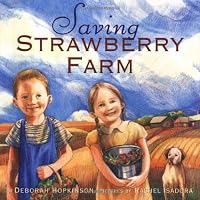
Set during the Great Depression, and illustrated by Caldecott Honor artist Rachel Isadora, Saving Strawberry Farm brings Davey's Midwestern town to life as friends and neighbors plan to save the farm the only way they can -- with a secret penny auction!
In the hot, mean summer of 1933, a penny is enough to buy caramels or red hots or peppermint sticks or licorice strings. Is it enough to buy Miss Elsie's Strawberry Farm?
There's only one way to find out. Davey takes a deep breath and shouts, "One penny for Strawberry Farm!"
Set during the Great Depression, and illustrated by Caldecott Honor artist Rachel Isadora, Saving Strawberry Farm brings Davey's Midwestern town to life as friends and neighbors plan to save the farm the only way they can -- with a secret penny auction!
"Saving Strawberry Farm" is an incredible book for children when they are learning about the Great Depression. The book is told from a young boy's point of view so it is easier for the children to connect with. The setting of the story was during the Great Depression and how Americans struggled and dealt with their problems. A young boy held onto a penny that helped save his favorite strawberry farm that belonged to one of the nicest ladies in town. One theme of the story is how important helping other in need is and friendships. Another theme of this story is how it teaches us the value of a dollar and how far a little penny can take us.
Davey and his family are having some trouble growing their crops which means that they are very low on money. Unfortunately, they are not the only ones. Everyone in his neighborhood is in the same boat. One person that stood out was Miss Elsie since she was know to have the best strawberry farm. Davey and his neighbors agree to help her buy back her farm at the auction by keeping the bids low. This story demonstrates the difference that can be made when everyone works together to help a person. They had to stand together during those times and that is exactly what they did.
This was a very cute book. I loved the valuable lesson in this book. I think about the will power it must have taken those little kids to not buy candy at the store when they went to buy ice. In addition, I love the will power Davey had to not spend the penny that Mrs. Elsie gave to him. He was very courageous also to stand up and speak out at the auction and bid a penny for the strawberry farm. It was very refreshing and I really enjoyed this story.
This was a beautiful book. "Saving Strawberry Farm" is about Miss Elsie's strawberry farm that is being auctioned off because she can no longer afford to keep it. With the help of two neighborhood children, they rally around Miss Elsie to help save her farm, and they are successful. This story is set in 1933 during the Great Depression. Times were hard and people like Miss Elsie could not afford to keep their farms. This story shows how with the help of others, even during hard times, it is possible to keep going. This is a wonderful story for children, It teaches kindness, and a wonderful lesson about hard times during the Great Depression. I love this book and its lesson. I would love to read this book to my future students and while show more teaching them history. show less
Members
- Recently Added By
Author Information

91+ Works 15,968 Members
Deborah Hopkinson is the author of over 40 highly acclaimed nonfiction books, including NCTE Orbis Pictus Honor and Jane Addams Honor Book Shutting Out the Sky: Carter G. Woodson Honor Book UP Before Daybreak; Sibert Honor Book and YALSA Award for Excellence in Nonfiction Finalist Titanic: Voices from the Disaster: Sydney Taylor Notable Book show more Courage Defiance: Dive!; D-Day; Sydney Taylor Notable Book We Has to Be Brave; and We Must Not Forget. Deborah lives with her family near Portland, Oregon. show less
All Editions
Awards and Honors
Notable Lists
Classifications
Statistics
- Members
- 103
- Popularity
- 312,892
- Reviews
- 20
- Rating
- (4.20)
- Languages
- English
- Media
- Paper
- ISBNs
- 2
- ASINs
- 1