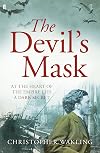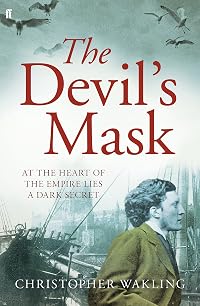
The Devil's Mask
by Christopher Wakling
On This Page
Description
The Georgian terraces are rising. In the aftermath of the abolition of the slave trade, the port of Bristol is awash with the commercial gains of the Empire. But in the midst of all the grand building projects something is rotten at the heart of the city. The first victim is discovered. News of the mutilated body speads quickly. And as further horrifically charred corpses are found, the new streets are gripped with a primal sense of fear. The city fathers decide to step in to suppress the show more rising panic. An innocent is drawn into the tangled net. A lowly legal clerk with a taste for coffee, Inigo Bright has been charged with investigating customs fees in the great port. Yet this routine investigation will drag him down in a net of violence and deception that puts not only his life but that of those closest to him in deadly danger... show lessTags
Recommendations












Member Reviews
I relished my journey to Bristol in the days immediately following the abolition of slavery. I picked my way through filthy, stinking streets in the company of narrator Inigo Bright. Its splendid terraces for the wealthy are currently being erected, but that doesn't mean that the city isn't choked in corruption and vice. Inigo is a young, bored lawyer who's mainly engaged in checking and verifying documents. Until one set of documents plunges him into dangerous territory, though he hardly, at first, knows where this will lead him.
I found the actual story a little confusing at times, especially towards the end. But as a way of approaching an understanding of the city of Bristol, in the aftermath of the slaving industry, it's worth a read.
I found the actual story a little confusing at times, especially towards the end. But as a way of approaching an understanding of the city of Bristol, in the aftermath of the slaving industry, it's worth a read.
The story is set in Bristol, shortly after the abolition of the slave trade, but does such a lucrative and emotionally freighted trade disappear without leaving marks on the port that it built? Inigo Bright, a young lawyer with his own roots in the merchant class, is assigned to check the records of a recently arrived ship, The Belsize. When people begin dying and his own employer is kidnapped, Bright realizes that the slave trade is not buried deeply enough. A capable mystery, with a likeable hero, an excellent subplot involving a female poet (surely set to develop over subsequent books) and a really sharp twist at the end make this well worth reading.
 This review was written for LibraryThing Early Reviewers.
Note - I received a free review copy through the LibraryThing Early Reviewers programme.
Historical mystery set in Bristol just after the abolition of the slave trade. Inigo Bright comes from a wealthy mercantile family, but has gone into law rather than shipping. Newly qualified, he still works for the man he was legal clerk to, on one of the practice's major sources of income -- the nitpicking investigation on behalf of the port officials of customs fees owed and paid. What seems like a routine investigation of one ship's petty smuggling gives Inigo a minor problem with torn loyalties, because his family's business has some investment in the ship.
He sets that aside and goes on with his investigation, only to be led into a tangle of show more deception, threats and finally outright violence against himself and his master. And it seems to be linked with the murdered women who have been found in the city. Inigo does the sensible thing and tries to put his information before the authorities, but finds a suspicious lack of interest. If the truth is to be brought to light, he'll have to do the digging.
I enjoyed it enormously, but more as a historical novel with a literary bent than as a mystery. The mystery's good, but the book's structure gives away a lot of the solution just a little too soon for my taste if approaching it purely as a mystery. The reverse side of this is that Wakling has done an excellent job of laying out the clues and leaving the reader to draw their own conclusions about not just the solution to the mystery, but the society Inigo lives in. I'm partial to world-building via long, lingering descriptions when done well, as it is here, and found the book to have a good balance between plot and evoking a sense of place. The one criticism I'd have was that several characters seemed to start off as being intended to be significant players in the tale, and then more or less fizzled out. Inigo himself is an appealing character. He's young and uncertain of himself, but has the strength of character to make difficult choices once he's thought them through. At book's end I was satisfied with the closure given, but wanted to know what happened to him next, which is always a good sign.
A page-turner that brings to life the physical and moral price paid for the profits of the slave trade, even after abolition. show less
Historical mystery set in Bristol just after the abolition of the slave trade. Inigo Bright comes from a wealthy mercantile family, but has gone into law rather than shipping. Newly qualified, he still works for the man he was legal clerk to, on one of the practice's major sources of income -- the nitpicking investigation on behalf of the port officials of customs fees owed and paid. What seems like a routine investigation of one ship's petty smuggling gives Inigo a minor problem with torn loyalties, because his family's business has some investment in the ship.
He sets that aside and goes on with his investigation, only to be led into a tangle of show more deception, threats and finally outright violence against himself and his master. And it seems to be linked with the murdered women who have been found in the city. Inigo does the sensible thing and tries to put his information before the authorities, but finds a suspicious lack of interest. If the truth is to be brought to light, he'll have to do the digging.
I enjoyed it enormously, but more as a historical novel with a literary bent than as a mystery. The mystery's good, but the book's structure gives away a lot of the solution just a little too soon for my taste if approaching it purely as a mystery. The reverse side of this is that Wakling has done an excellent job of laying out the clues and leaving the reader to draw their own conclusions about not just the solution to the mystery, but the society Inigo lives in. I'm partial to world-building via long, lingering descriptions when done well, as it is here, and found the book to have a good balance between plot and evoking a sense of place. The one criticism I'd have was that several characters seemed to start off as being intended to be significant players in the tale, and then more or less fizzled out. Inigo himself is an appealing character. He's young and uncertain of himself, but has the strength of character to make difficult choices once he's thought them through. At book's end I was satisfied with the closure given, but wanted to know what happened to him next, which is always a good sign.
A page-turner that brings to life the physical and moral price paid for the profits of the slave trade, even after abolition. show less
This review was written for LibraryThing Early Reviewers.Received May 2011 from Faber and Faber via the Early Reviewers on Librarything.com. Will assume it's an Uncorrected Proof when reviewing, though this has not been explicitly stated.[return][return][return]Review:[return]I read the prologue the day I got the book, then put it aside to concentrate on the current read (The Children's Book by A.S. Byatt - zzzzzzzzz). Anyway gave up on that book yesterday in favour of this, and I'm glad I did. Starting with chapter 1, I initially thought it had forwarded onto a 21st Century setting - the main character descending into his favourite coffee shop and being served ahead of the irregulars who were already there. It wasn't until later in the chapter that you realised the story was set not long show more after the abolition of slavery. I don't think it's necessarily a bad thing that during the whole story you dont actually know what year it's set in.[return][return]Anyway, the story progresses on in a fast paced measure, as Inigo starts to investigate the discrepancies in the port ledgers for one trading company in particular (with which his family have a vested interest) and the disappearance of his lawyer mentor.[return][return]When I put my name in for this book I had recently read March by Geraldine Brooks which was set during the slavery period in America and had some quite brutal depictions of how slaves were treated on the plantations. The transportation of slaves in tight, cramped conditions was covered in The Devil's Mask but was less confrontational - the focussing on woman was a suitable touch.[return][return]One thing I was struck with today: During the story, Inigo gets beaten up (several times), has walked through rain, mud and sewage, stayed up all night over several nights. I think there's one mention of changing a shirt (but no shoes or trousers); One quip about his hair after walking in rain; however, no other changes of clothes, no "Inigo, what's with the thick ear?" after the fight in the pub, no little children running away/making fun of beaten up faces; One mention about a bruise on his belly (but his face pretty enough to have escaped any damage whatsoever) and apart from multiple cups of coffee and one meal with his father, apparently Inigo doesnt eat, doesnt wash or change his clothes and rarely sleeps. At all. And considering the lack of other description of either Inigo or any other major character, the multiple reference to Inigo's hair did begin to grate after a while[return][return]Overall, I enjoyed it, it was well written and suitably paced show less
This review was written for LibraryThing Early Reviewers.Note to authors everywhere - giving your protagonist a quirky hairdo does not constitute character development. By the time I had struggled to the end of The Devil's Mask I was so sick of hearing that Inigo Bright needed a haircut I'd have happily performed it myself with a guillotine.
This isn't a bad book by any means if you like two dimentional characters and a plot that could almost have been pieced together from newspaper cuttings and I'm sure it will make a satisfactory beach read for many people this summer but it is very much the equivalent of a fast-food snack as compared to a good four course meal. Even the victims were hard to care about as Bright and his sidekick, Blue (another character who should be much more sympathetic show more than the author is able to make him) unearth the connection between three murdered women and the recently abolished slave trade in Georgian Bristol. Thankfully, the connections are finally made, the good prevail and the bad are punished (or killed) and Bright is last seen on his way to the barber's. The perfect summer read for hairdressers everywhere. show less
This isn't a bad book by any means if you like two dimentional characters and a plot that could almost have been pieced together from newspaper cuttings and I'm sure it will make a satisfactory beach read for many people this summer but it is very much the equivalent of a fast-food snack as compared to a good four course meal. Even the victims were hard to care about as Bright and his sidekick, Blue (another character who should be much more sympathetic show more than the author is able to make him) unearth the connection between three murdered women and the recently abolished slave trade in Georgian Bristol. Thankfully, the connections are finally made, the good prevail and the bad are punished (or killed) and Bright is last seen on his way to the barber's. The perfect summer read for hairdressers everywhere. show less
This review was written for LibraryThing Early Reviewers.Christopher Wakling's The Devil's Mask (Faber and Faber, 2011) is a historical mystery (think something along the lines of David Liss' books, though this one is not at the same level), set in Bristol during the first years of the nineteenth century. The slave trade has been abolished, but young lawyer Inigo Bright discovers that the practice may not be quite eradicated. When he gets too close to some uncomfortable truths, he finds his very life may be in danger.
While an entertaining, fast read, The Devil's Mask lacked contextual details, and some of the side-plots went undeveloped (Bright's relationship with his bride-to-be and her family could have used some fleshing out, for example). Short interludes from a different perspective show more pretty much give away the game right from the outset, so by the end there's little mystery left.
Overall, good for a weekend afternoon's entertainment, but there are certainly better books in the genre.
http://philobiblos.blogspot.com/2011/05/book-review-devils-mask.html show less
While an entertaining, fast read, The Devil's Mask lacked contextual details, and some of the side-plots went undeveloped (Bright's relationship with his bride-to-be and her family could have used some fleshing out, for example). Short interludes from a different perspective show more pretty much give away the game right from the outset, so by the end there's little mystery left.
Overall, good for a weekend afternoon's entertainment, but there are certainly better books in the genre.
http://philobiblos.blogspot.com/2011/05/book-review-devils-mask.html show less
I enjoyed this historical mystery, with it's extremely strong sense of both time and place. (There were a couple of things that conflicted with my preconceptions about the period, but when I checked it would seem that my assumptions were in error,not the author) The foregrounding of Inigo's personal and family life takes some weight off the mystery plot, which provides a number of twists and turns, and a strong emotional pay off, without ever completely convincing. The occasional sections from the perspectives of some of the victims added a visceral eeriness to the descriptions of the murders, though. If you're looking for a tightly plotted murder mystery, this may disappoint, but as an interesting historical it's an enjoyable read.
This review was written for LibraryThing Early Reviewers.Members
- Recently Added By
Author Information

7 Works 206 Members
Common Knowledge
- Dedication
- For Carole and Balazs
- First words
- The seagull sidestepped along the rail. Against the dull water its back, neck and head were a phosphorescent white.
- Last words
- (Click to show. Warning: May contain spoilers.)I have resolved to stick with a fuller head of curls, but they need trimming all the same.
Classifications
Statistics
- Members
- 50
- Popularity
- 605,294
- Reviews
- 24
- Rating
- (3.18)
- Languages
- English
- Media
- Paper, Ebook
- ISBNs
- 7
- ASINs
- 1