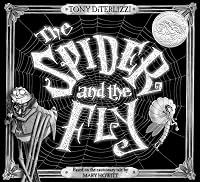
The Spider and the Fly
by Mary Howitt
On This Page
Description
An illustrated version of the well-known poem about a wily spider who preys on the vanity and innocence of a little fly.Tags
Recommendations


Member Reviews
4yo took one look at the cover and said "too scary." And indeed, that is the point! Black-and-white illustrations in a noir style (inspired by Hollywood noir, Edward Gorey, Chaz Addams, and Tim Burton), along with the inevitable yet gruesome end of the poem, work perfectly together. A good read for Halloween time or for kids who love to feel the shivers.
Taking the famous English children's poem, "The Spider and the Fly," as his text, talented American artist Tony DiTerlizzi creates an immensely engaging picture-book, one which was chosen as a Caldecott Honor Book in 2003. The poem itself tells the tale of a cunning spider who manages to eventually capture his prey, using a judicious mixture of flattery and tempting offers of refreshment and rest. The artwork, created using gouache and pencil and reproduced in silver and black duotone, with graphite ghosts superimposed upon the paintings later, captures the creepy thrills of the story unfolding in the text...
Originally published in 1829, Mary Howitt's poem was penned as a fabular warning to her children, regarding the dangers they might show more encounter from those who speak sweet words, but have ill intentions. I appreciated the fact that the full poem is reproduced here, with no changes, save for Americanized spelling. I was expecting more of an adaptation, textually speaking, since the title page says this is "based on the poem by Mary Howitt," but having done a line by line comparison with the original, the only changes I could see were to the aforementioned spelling. Leaving that aside, the artwork here is just gorgeous, and well worthy of the Caldecott nod it received. Apparently inspired by the Hollywood horror films of the 1920s and 30s, it captures all the creepiness of the spider/fly exchanges, and creates a Gothic mansion backdrop for the spider's machinations. Recommended to anyone looking for spookier picture-books for children, with the proviso that they be aware that this one is a cautionary tale, and doesn't have a happy ending! show less
Originally published in 1829, Mary Howitt's poem was penned as a fabular warning to her children, regarding the dangers they might show more encounter from those who speak sweet words, but have ill intentions. I appreciated the fact that the full poem is reproduced here, with no changes, save for Americanized spelling. I was expecting more of an adaptation, textually speaking, since the title page says this is "based on the poem by Mary Howitt," but having done a line by line comparison with the original, the only changes I could see were to the aforementioned spelling. Leaving that aside, the artwork here is just gorgeous, and well worthy of the Caldecott nod it received. Apparently inspired by the Hollywood horror films of the 1920s and 30s, it captures all the creepiness of the spider/fly exchanges, and creates a Gothic mansion backdrop for the spider's machinations. Recommended to anyone looking for spookier picture-books for children, with the proviso that they be aware that this one is a cautionary tale, and doesn't have a happy ending! show less
This is a picture book of the classic poem by Mary Howitt. (And it's in the public domain, so if you're curious about the content of this book you can google for it.)
Fair warning to people with very young or sensitive children: This IS the poem that starts off "Will you come into my parlor..." and it ends exactly the way you'd expect a meeting between a spider and a fly to end. If you think you'll have a problem with this, please hit the back button NOW and find another book more suited for you and your child. Some children simply don't like this sort of thing, it *is* a little scary and intense, it *does* end with the fly's death, and you know your child best.
For the rest of us, this is a great cautionary tale illustrated in the style show more of silent movies from the 20s, down to the clothes the buggies are wearing. The book is carefully, creepily sinister without being graphic, and there's a moral lesson here: If you already know somebody wishes you harm, don't listen when they start to flatter you! Heck, even if you're not sure, use your head! show less
Fair warning to people with very young or sensitive children: This IS the poem that starts off "Will you come into my parlor..." and it ends exactly the way you'd expect a meeting between a spider and a fly to end. If you think you'll have a problem with this, please hit the back button NOW and find another book more suited for you and your child. Some children simply don't like this sort of thing, it *is* a little scary and intense, it *does* end with the fly's death, and you know your child best.
For the rest of us, this is a great cautionary tale illustrated in the style show more of silent movies from the 20s, down to the clothes the buggies are wearing. The book is carefully, creepily sinister without being graphic, and there's a moral lesson here: If you already know somebody wishes you harm, don't listen when they start to flatter you! Heck, even if you're not sure, use your head! show less
Twisting this cautionary, morality poem into a nonfiction tale about how spiders catch their prey was a stroke of genius. Winner of a Caldecott Honor, DiTerlizzi's illustrations are wonderful and full of detail. The lines are lyrical, and the nonfiction connections elegant. In fact, the only reason I hesitate to give this book five stars is simply my concern about the message it sends when the creepy, scary male character successfully lures the glamorous, "silly" female character to her destruction with words of flattery. Even at the end, the moral of the story is that the fly deserved what came to her because she was foolish.
By itself, this book can stand as a cute tale about spiders and flies, and how one traps the other. However, show more one should watch the discussions generated by students, and the general content of similar themes present in the library as a whole, to avoid feeding into the "victim-blaming" trap. Essentially, this book attempts to prevent the tragedies described from happening to others by cautioning future victims rather than addressing future bullies.
These objections are not reason to remove access to the book, but are more things to keep in mind while teaching, and possibly to address in future lessons. Ex: "In the book, the spider eats the fly because that what spiders do. In our schools, is it ok to bully simply because that's what bullies do, or do we have to take responsibility for our bad choices? What's the difference between a spider bullying a fly and a kid bullying another kid?" show less
By itself, this book can stand as a cute tale about spiders and flies, and how one traps the other. However, show more one should watch the discussions generated by students, and the general content of similar themes present in the library as a whole, to avoid feeding into the "victim-blaming" trap. Essentially, this book attempts to prevent the tragedies described from happening to others by cautioning future victims rather than addressing future bullies.
These objections are not reason to remove access to the book, but are more things to keep in mind while teaching, and possibly to address in future lessons. Ex: "In the book, the spider eats the fly because that what spiders do. In our schools, is it ok to bully simply because that's what bullies do, or do we have to take responsibility for our bad choices? What's the difference between a spider bullying a fly and a kid bullying another kid?" show less
The Spider and the Fly, a classic poem written at the turn of the 19th century by Mary Howitt, depicts the sad story of a fly who is lured into the web of a spider by his flattery.
This is my favorite children's book so far. The lyrical words were satisfying to listen to. The style and execution the illustrator used in this book are what make it so compelling. The illustrations are done in a silent film style. The artist has subtly hidden things in the backgrounds and around the main action scene that detail the dangers the fly is in and which also put the size of the setting into perspective. This story could fall under several categories: poetry, picture book, classic literature, etc. Oddly enough this is the first children's book show more I've ever read that had an unhappy ending.
This might be a good tool for teaching about personal safety to children, especially regarding strangers. Also, considering how simple this story is as a piece of poetry, this might be a good example to use when teaching children about simple poetry rules. show less
This is my favorite children's book so far. The lyrical words were satisfying to listen to. The style and execution the illustrator used in this book are what make it so compelling. The illustrations are done in a silent film style. The artist has subtly hidden things in the backgrounds and around the main action scene that detail the dangers the fly is in and which also put the size of the setting into perspective. This story could fall under several categories: poetry, picture book, classic literature, etc. Oddly enough this is the first children's book show more I've ever read that had an unhappy ending.
This might be a good tool for teaching about personal safety to children, especially regarding strangers. Also, considering how simple this story is as a piece of poetry, this might be a good example to use when teaching children about simple poetry rules. show less
Tony DiTerlizzi's beautiful black and white pictures, inspired by the B-movie horror aesthetics of the 1950s, with both the spider and fly drawn to resemble prominent silver screen actors, use the original text of Mary Howitt's poem and add another timeless dimension to the story. The book was a Caldecott Honor book, and the enduring pages show that honor. The illustrator's epilogue from the perspective of the spider adds depth to the antagonist with a moral warning to readers that neither talks down to them or detracts for the message of the tale. The poem's structure and scheme remain intact by their placement on the page.
The cover art was what drew me to this book, when I first picked it up I didn't know it was a poetry book. I don't always go towards poetry books because sometimes they're harder to understand but I enjoyed this one. I loved the illustrations; I liked how they had a dark, scary look to them. The pictures make the reader question the spider's overall character. I liked the message this book had. You can't trust everyone, especially if you have your doubts about them, trust your gut. Throughout the book, the spider tried to convince the fly to come into his house and eat the dinner he prepared for them, but she refused and said that she'd heard stories about him eating other insects like flies. He laughs and continues to compliment her. show more She loves the compliments and gets caught up mentally and caught up in his web physically where he then eats her! I like how the spider also acknowledges the reader at the end and tells us about how not to get "trapped in some schemer's web." show less
Members
- Recently Added By
Published Reviews
ThingScore 100
Janice M. Del Negro (The Bulletin of the Center for Children's Books, November 2002 (Vol. 56, No. 3))
Oh, the poor inexperienced country fly! What chance does she have against the suave maneuverings of an arachnid seducer? Why, none at all, despite the attempted ghostly warnings of the Spider’s previous meals. DiTerlizzi’s reimagining of Howitt’s nineteenth-century cautionary poem is an show more illustrative tour de force, a stylistic homage to Gorey, Rackham, and Addams; the black-and-white illustrations have a junior-high-appealing slickness yet remarkable depth and detail, from border ornamentation to ironic visual touches. A Gothic dollhouse within the dusty attic of a Gothic mansion makes a clever scene for the Spider’s dastardly doings, and the depiction of the characters is imaginative as well. The oily-haired, mustachioed Spider (sort of a combination of Clark Gable and Peter Lorre) is the archetypal villain, a picture of sartorial splendor who changes costume from satin smoking jacket to tuxedo to great coat and top hat. The flapper fly has big innocent eyes, gauzy wings, and, ultimately, a too trusting demeanor: in the end she takes her place alongside Spider’s other ghostly victims. A concluding missive from Spider himself warns against expecting carnivores to go against their nature; brief bios of author Howitt and illustrator DiTerlizzi are appended. Masterful drafting and artful composition combine in this spookily sophisticated picture book that offers a macabrely funny look at trusting even the most persuasive of strangers. Review Code: R -- Recommended. (c) Copyright 2002, The Board of Trustees of the University of Illinois. 2002, Simon, 36p, $16.95. Grades 4-7. show less
Oh, the poor inexperienced country fly! What chance does she have against the suave maneuverings of an arachnid seducer? Why, none at all, despite the attempted ghostly warnings of the Spider’s previous meals. DiTerlizzi’s reimagining of Howitt’s nineteenth-century cautionary poem is an show more illustrative tour de force, a stylistic homage to Gorey, Rackham, and Addams; the black-and-white illustrations have a junior-high-appealing slickness yet remarkable depth and detail, from border ornamentation to ironic visual touches. A Gothic dollhouse within the dusty attic of a Gothic mansion makes a clever scene for the Spider’s dastardly doings, and the depiction of the characters is imaginative as well. The oily-haired, mustachioed Spider (sort of a combination of Clark Gable and Peter Lorre) is the archetypal villain, a picture of sartorial splendor who changes costume from satin smoking jacket to tuxedo to great coat and top hat. The flapper fly has big innocent eyes, gauzy wings, and, ultimately, a too trusting demeanor: in the end she takes her place alongside Spider’s other ghostly victims. A concluding missive from Spider himself warns against expecting carnivores to go against their nature; brief bios of author Howitt and illustrator DiTerlizzi are appended. Masterful drafting and artful composition combine in this spookily sophisticated picture book that offers a macabrely funny look at trusting even the most persuasive of strangers. Review Code: R -- Recommended. (c) Copyright 2002, The Board of Trustees of the University of Illinois. 2002, Simon, 36p, $16.95. Grades 4-7. show less
added by kthomp25
Kirkus (Kirkus Reviews, July 1, 2002 (Vol. 70, No. 13))
Will you walk into my parlor?' / said the Spider to the Fly." Howitt's 1829 cautionary poem is realized here in full cinematic fashion. Delightfully ghoulish full-bleed black-and-white spreads are rendered in gouache and pencil, and reproduced in silver-and-black duotone, resulting in images that recall the slightly fuzzy-edged figures show more from old black-and-white horror movies. The typeface and occasional framed text pages heighten this effect by evoking silent-movie titles. The setting is a dustily gothic attic in which DiTerlizzi's (Alien and Possum: Friends No Matter What, p. 494, etc.) "camera" never rests, zooming in, out, up, and down in a dazzling series of perspectives as a top-hatted and bespatted spider romances a naïve flapper fly. Her protestations in the face of his overtures grow ever weaker, and despite the warnings of the ghostly figures of past victims (one brandishes a knife and fork while another points urgently at The Joy of Cooking Bugs), she goes to her inevitable doom. The illustrations embrace the primness of the poem-the wide-eyed fly is the very picture of a bygone innocence-but introduce a wealth of detail that adds a thick layer of humor. Aside from the aforementioned ghosts, evidence of the spider's predilections abounds: in his parlor, he relaxes with his feet up on a very dead ladybug stool with X's for eyes. A tongue-in-cheek "letter" from the spider follows the poem, in which he exhorts readers to "be advised that spiders are not the only hunters and bugs are not the only victims." This cautionary intrusion serves to explicate the metaphor for concretely minded readers, but the message is not likely to diminish their pleasure in the grisly doings one bit. 2002, Simon & Schuster, $16.95. Category: Picture book. Ages 5 to 9. Starred Review show less
Will you walk into my parlor?' / said the Spider to the Fly." Howitt's 1829 cautionary poem is realized here in full cinematic fashion. Delightfully ghoulish full-bleed black-and-white spreads are rendered in gouache and pencil, and reproduced in silver-and-black duotone, resulting in images that recall the slightly fuzzy-edged figures show more from old black-and-white horror movies. The typeface and occasional framed text pages heighten this effect by evoking silent-movie titles. The setting is a dustily gothic attic in which DiTerlizzi's (Alien and Possum: Friends No Matter What, p. 494, etc.) "camera" never rests, zooming in, out, up, and down in a dazzling series of perspectives as a top-hatted and bespatted spider romances a naïve flapper fly. Her protestations in the face of his overtures grow ever weaker, and despite the warnings of the ghostly figures of past victims (one brandishes a knife and fork while another points urgently at The Joy of Cooking Bugs), she goes to her inevitable doom. The illustrations embrace the primness of the poem-the wide-eyed fly is the very picture of a bygone innocence-but introduce a wealth of detail that adds a thick layer of humor. Aside from the aforementioned ghosts, evidence of the spider's predilections abounds: in his parlor, he relaxes with his feet up on a very dead ladybug stool with X's for eyes. A tongue-in-cheek "letter" from the spider follows the poem, in which he exhorts readers to "be advised that spiders are not the only hunters and bugs are not the only victims." This cautionary intrusion serves to explicate the metaphor for concretely minded readers, but the message is not likely to diminish their pleasure in the grisly doings one bit. 2002, Simon & Schuster, $16.95. Category: Picture book. Ages 5 to 9. Starred Review show less
added by kthomp25
Lists

Best children's picture books
377 works; 85 members

Caldecott Honor Books
296 works; 23 members

Books Read in 2023
5,638 works; 147 members
Author Information

54+ Works 1,784 Members
Some Editions
Awards and Honors
Awards
Distinctions
Common Knowledge
- Original publication date
- The Spider and the Fly: An Aplolgue: A new Version of an Old Story first appeared in the The new Year's Gift in 1829
- Dedication
- For Holly and Theodor Black, the quintessential gothic couple -T.D.
- First words
- "Will you walk into my parlor?" said the Spider to the Fly
- Quotations
- So what does all this talk of spiders and traps have to do with you? Be warned, little dears, and know that spiders are not the only hunters and bugs are not the only victims.
Unfortunately, as long as there's dishonesty in the world, there will be people ready to lay traps for us. We must learn to recognize them and guard against their wiles. Not everyone who talks sweetly offers sweets. (Willi... (show all)am Bennett's introduction to the poem in the Moral Compass) - Last words
- (Click to show. Warning: May contain spoilers.)And now, dear little children, who may this story read,
To idle, silly, flattering words I pray you ne'er give heed:
Unto an evil counselor, close heart and ear and eye,
And take a lesson from this tale,
of the Spider and the Fly.
Classifications
Statistics
- Members
- 1,696
- Popularity
- 13,156
- Reviews
- 120
- Rating
- (4.24)
- Languages
- English, French
- Media
- Paper, Audiobook
- ISBNs
- 26
- ASINs
- 4