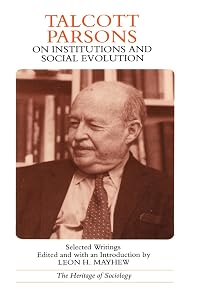
Talcott Parsons on Institutions and Social Evolution: Selected Writings (Heritage of Sociology Series)
by Talcott Parsons
20 Members (5.00)
On This Page
Description
Talcott Parsons is regarded, by admirers and critics alike, as a major creator of the sociological thought of our time. Despite the universal recognition of his influence, however, Parsons's thought is not well understood, in part because his work presents the reader with almost legendary difficulties. Most of his important essays and books presume that the reader is familiar with his rather specialized vocabulary, and even when Parsons begins by defining basic terms, his special uses for show more words and his style of exposition strike many readers as forbidding. In his extensive introduction to this volume, Leon H. Mayhew brings a new focus and clarity to Talcott Parsons's work. Explicating Parsons on his own terms, Mayhew discusses the basic tools of Parsonian analysis and interprets the larger themes of his work. He provides a chronological account of the development of Parsons's thought, his presuppositions, and his position on the ideological spectrum of social thought. Mayhew then presents twenty of Parsons's essays, touching on each of the major aspects of his work, including "action" theory and the celebrated four-function scheme. Other topics covered include the role of theory in social research, evolutionary universals in society, influence, control, and the mass media. "Talcott Parsons on Institutions and Social Evolution will become a standard reference for those studying that development of his sociological ideas."—Martin Bulmer, The Times Higher Education Supplement show lessTags
Recommendations






















Member Reviews
Members
- Recently Added By
Author Information

71+ Works 995 Members
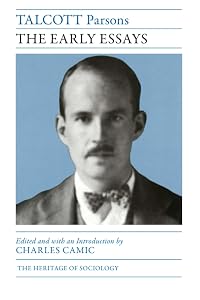
Talcott Parsons, an American sociologist, introduced Max Weber to American sociology and became himself the leading theorist of American sociology after World War II. His Structure of Social Action (1937) is a detailed comparison of Alfred Marshall, Emile Durkheim, Max Weber, and Vilfredo Pareto. Parsons concluded that these four scholars, coming show more from contrasting backgrounds and from four different countries, converged, without their knowing of the others, on a common theoretical and methodological position that he called "the voluntaristic theory of action." Subsequently, Parsons worked closely with the anthropologists Clyde Kluckhohn, Elton Mayo, and W. Lloyd Warner, and the psychologists Gordon W. Allport and Henry A. Murray, to define social, cultural, and personality systems as the three main interpenetrative types of action organization. He is widely known for his use of four pattern variables for characterizing social relationships:affectivity versus neutrality, diffuseness versus specificity, particularism versus universalism, and ascription versus achievement. (Bowker Author Biography) show less
Series
Belongs to Publisher Series
Classifications
Statistics
- Members
- 20
- Popularity
- 1,285,015
- Rating
- (5.00)
- Languages
- English
- Media
- Paper
- ISBNs
- 2