
David Riesman (1) (1909–2002)
Author of The Lonely Crowd: A Study of the Changing American Character
For other authors named David Riesman, see the disambiguation page.
About the Author
Image credit: Criminologia
Works by David Riesman
Associated Works
Tagged
Common Knowledge
- Birthdate
- 1909-09-22
- Date of death
- 2002-05-10
- Gender
- male
- Education
- Harvard Law School
- Occupations
- attorney
sociologist - Organizations
- Harvard University
- Awards and honors
- American Academy of Arts and Letters Academy Award (Literature, 1954)
- Nationality
- USA
- Birthplace
- Philadelphia, Pennsylvania, USA
- Place of death
- Binghamton, New York, USA
- Associated Place (for map)
- USA
Members
Reviews

Originally published in 1950, this fascinating sociological analysis was one of the assigned readings for a college course I once took on the intellectual history of twentieth-century America, and has - despite its flaws - been very influential in shaping my own ideas about conformity and independent thinking. An examination of the various "character types" to be found in the American middle class, Riesman, Glazer and Denney's magnum opus tackles the difficult topic of conformity, seeking to show more determine what type of person is most dominant in society, and the implications this has for autonomous thought and action.
The authors lay out three basic character types, comprising: the "tradition-directed" person, who takes his or her behavioral cues from long-established social patterns; the "inner-directed" one, who is motivated largely by internal moral/ethical concerns and standards; and the up-and-coming "other-directed" type, who is zealously tuned in to the behavior of their group (whatever that might be). While all of these "types" represent ways of being in the world that allow the individual to integrate into society, and are thus all, to one extent or another, encouraging of conformity (there being, thankfully, no cartoon-like Ayn Rand characters in The Lonely Crowd), Riesman et. al. note that it is the third and final character type alone - the "other-directed" - that emphasizes behavioral conformity for its own sake.
Paradoxically, it is this same type - the one the authors believed was rapidly coming to dominance in the American culture at the time they were writing - that also seemed to offer, through its emphasis on self-analysis, the possibility of a shift toward a more autonomous "inner-directed" type. That shift toward greater autonomy, and the seeking after it, was something the authors envisioned as occurring in a number of counter-cultural arenas (notably: "Bohemia," "sex," and "tolerance"), although it is instructive to note that they also observed that supposedly rebellious enclaves could be as rigidly conformist, internally, as anything they opposed externally.
Although it has been some years since I last picked it up, I can still call to mind the mixture of admiration and frustration I experienced, when first reading The Lonely Crowd (a memorable title, if ever there was one). On the one hand, I found the authors' character-type analysis very persuasive, particularly as I think that the "other-directed" type has continued to dominate the American scene. On a personal level, as someone raised in a progressive home - someone who had always been willing to champion unpopular causes - I found the discussion of conformity within counter-cultural groups very enlightening. It seems self evident to me now, but the idea that rebellion might go hand in hand with obedient conformity, that the mores of the dominant society might simply have been replaced by those of a smaller group, was revelatory.
But although there is no denying the importance of this book, as a means of understanding 20th-century American culture, it is not without significant flaws. The limitations inherent in an analysis that focuses exclusively on the middle class, however dominant that class might be, leap immediately to mind, all the more so given the racial divisions that run alongside class ones, in the American model. Prescient in some ways, and oblivious in others, The Lonely Crowd is still a book that I would recommend to all readers with an interest in group and identity formation, and issues of independence and conformity. show less
The authors lay out three basic character types, comprising: the "tradition-directed" person, who takes his or her behavioral cues from long-established social patterns; the "inner-directed" one, who is motivated largely by internal moral/ethical concerns and standards; and the up-and-coming "other-directed" type, who is zealously tuned in to the behavior of their group (whatever that might be). While all of these "types" represent ways of being in the world that allow the individual to integrate into society, and are thus all, to one extent or another, encouraging of conformity (there being, thankfully, no cartoon-like Ayn Rand characters in The Lonely Crowd), Riesman et. al. note that it is the third and final character type alone - the "other-directed" - that emphasizes behavioral conformity for its own sake.
Paradoxically, it is this same type - the one the authors believed was rapidly coming to dominance in the American culture at the time they were writing - that also seemed to offer, through its emphasis on self-analysis, the possibility of a shift toward a more autonomous "inner-directed" type. That shift toward greater autonomy, and the seeking after it, was something the authors envisioned as occurring in a number of counter-cultural arenas (notably: "Bohemia," "sex," and "tolerance"), although it is instructive to note that they also observed that supposedly rebellious enclaves could be as rigidly conformist, internally, as anything they opposed externally.
Although it has been some years since I last picked it up, I can still call to mind the mixture of admiration and frustration I experienced, when first reading The Lonely Crowd (a memorable title, if ever there was one). On the one hand, I found the authors' character-type analysis very persuasive, particularly as I think that the "other-directed" type has continued to dominate the American scene. On a personal level, as someone raised in a progressive home - someone who had always been willing to champion unpopular causes - I found the discussion of conformity within counter-cultural groups very enlightening. It seems self evident to me now, but the idea that rebellion might go hand in hand with obedient conformity, that the mores of the dominant society might simply have been replaced by those of a smaller group, was revelatory.
But although there is no denying the importance of this book, as a means of understanding 20th-century American culture, it is not without significant flaws. The limitations inherent in an analysis that focuses exclusively on the middle class, however dominant that class might be, leap immediately to mind, all the more so given the racial divisions that run alongside class ones, in the American model. Prescient in some ways, and oblivious in others, The Lonely Crowd is still a book that I would recommend to all readers with an interest in group and identity formation, and issues of independence and conformity. show less
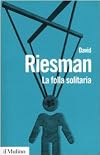
Monumentale e indispensabile, la principale sensazione dopo la lettura è: come ho fatto a non conoscerlo finora? Non soltanto è un classico del pensiero sociologico moderno (1950), ma resta un riferimento attualissimo che chiarisce cose che già sappiamo (o pensiamo di sapere) fornendo categorie interpretative precise e ricche di esempi “pop” tratti da letteratura e cinema (uno dei tratti più godibili del libro). Soprattutto, il libro evoca ulteriori riflessioni sulla compresenza e show more sulla distribuzione sociale dei tre “tipi” descritti dal libro (diretto dalla tradizione, auto-diretto, etero-diretto) che portano a rileggere criticamente lo sviluppo storico/geografico di specifiche macro o micro-comunità (fino alla famiglia). Imprescindibile poi l’approfondimento dedicato al mondo del lavoro, che affianca questo libro ad altri classici come “L’uomo dell’organizzazione” di Whyte (1956). Infine, il libro fa ben notare, indirettamente, quanto eravamo già americani forse senza saperlo. show less

I admire Riesman trying to assay the "American Character" with three pigeonholes of inner-, outer- and tradition-directed. I find the meat here beyond the triptych taxonomy of character to the plumbing of the post-Puritan American soul:
Riesman sees the distractible even gullible other-directed ... basically I feel Riesman has identified the born-consume-spawn-die American:
As I review in my mind this book, I can't be appreciate the author's review here of The Fountainhead:
There are here keen observations, including the malleability of the American mind to what it reads:
I have been beginning to feel that Gutenberg led to the bloody Reformation wars, Marconi's radio gave us Hitler and have we seen the worst social media will deliver? Even back during this writing, a 'dullification' of American life was observed:
All of this leading to the stultifying conformity:
This strikes me as an insightful even incisive observation that is even more true now in the social media age:
And, with all this decades even centuries of productivity increases, why are we not living in a Utopian state of increasing leisure when we work and strive as hard as our great-grandparents did? Reisman asks the same and believe such Arcadian visions may yet be realized:
Like Debord's spectacle, Riesman decades ago seemed to predict the modern realities of social media and streaming services:
Much of that media is about superhero movies today and I wish Riesman was around commenting on their CGI-drenched visions:
...we have also inherited obstacles to leisure from the puritan wing of inner-direction, which succeeded in destroying or subverting a whole historic spectrum of gregarious fun-making: sport, drama, feast days, and other ceremonial escapes. Even thoseshow more
ceremonies that survive, or have been newly invented, such as the Fourth of July or Halloween, have had to meet, if not the critique of puritan asceticism, then the critique of puritan rationalism, from which young children have been precariously exempted. For many adults our holidays make work out of fun-making or gift-giving which we have neither the wit to welcome nor the courage to refuse; we know holidays are calculated steps in the distributive economy and that new holidays, e.g., Mother's Day, are foisted on us-there are more commercially sponsored "Weeks" than there are weeks in the year. Here puritanism has proved an Indian giver: it not only gives priority to work and distribution but, what is more, takes back the niggardly holidays it gives us. The scars that puritanism has left on the American, and not only on the Philadelphian, Sunday are well known.
It may take a long time before the damage done to play during the era depending on inner-direction can be re paired. In the meantime other-direction has added new hazards. The other-directed man approaches play, as he approaches so many other areas of life, without the inhibitions but also without the protections of his inner-directed predecessor. Beset as he is with the responsibility for the mood of the play-group, he might like to fall back on fixed and objective play ceremonials, and to some extent he does so it is a common mistake to assume that American city dwellers are wholly without rituals. Our various drinks, our various card and parlor games, our various sports, and our public entertainments-all can be arranged in a series from the less to the more intimate, the less to the more fluctuating, innovational, and subjective. Even so, the responsibility of all to all, that each join in the fun and involve himself at a similar level of subjectivity, interferes with spontaneous sociability in the very effort to invoke it.
Riesman sees the distractible even gullible other-directed ... basically I feel Riesman has identified the born-consume-spawn-die American:
In my scheme of values, persuasion, even manipulative persuasion, is to be preferred to force. There is the danger, in fact, when one speaks of the "softness of the personnel," that one will be understood to prefer hardness. On the contrary, one of the main contentions of this book is that the other-directed person, as things are, is already too hard on himself in certain ways and that his anxieties, as child consumer-trainee, as parent, as worker and player, are very great.
As I review in my mind this book, I can't be appreciate the author's review here of The Fountainhead:
A movie or book occasionally comes along that departs from this formula. The Fountainhead, by Ayn Rand, a popular book and movie, pictures its architect hero as standing out, in violent integrity, against the pressure for group adjustment and, in the end, successfully bringing the jury of his peers along with him. He does take all: the heights of fame, his rival's wife, the death of his rival. What is most striking in all this, however, is the unintended caricature, both of group adjustment and of group resistance. The group is made out not tolerant but mean, inartistic, and corrupt. And group resistance is seen in terms of nobility on the part of the sadistic hero, who wants to deny any ties to humanity, any dependency. This superman for adults is the very apotheosis of the lonely success, to be ad mired perhaps by the reader but too stagey to be imitated.
In all likelihood, moreover, the Ayn Rand audience that applauds fiery denunciations of group-mindedness and sub mission to others is quite unaware of its own tendencies to submission in the small, undramatic situations of daily life. In that sense The Fountainhead is escapist.
There are here keen observations, including the malleability of the American mind to what it reads:
Words not only affect us temporarily; they change us of leisure they socialize or unsocialize us. Doubtless the printing press alone cannot completely assure any particular form of social coercion-and of course not all children, even in the inner directed middle class, were readers. But print can power fully rationalize the models which tell people what they ought to be like. Reaching children directly as well as through their parents and teachers, it can take the process of socialization out of the communal chimney corner of the era depending on tradition-direction and penetrate into the private bedrooms and libraries of the rising middle class: the child is allowed to gird himself for the battle of life in the small circle of light cast by his reading lamp or candle. To understand this more fully we must realize that the rise of literacy affects not only the content and style of the literary and journalistic genres but also their audience reception. The increased quantitative flow of content brings about an enormous increase in each child's power to select, as compared with the era of tradition-direction. As a result, more and more of the readers begin to see messages not meant for them. And they read them in situations no longer controlled and structured by the teller-or by their own participation. This increase in the number, variety, and "scatter" of the messages, along with the general impersonalization in print which induces these specific effects, becomes one of the powerful factors in social change. The classic instance in Western history, of course, is the translation of the Vulgate into the spoken languages, a translation which allowed the people to read a book which only the priests could read before. Some of the difficulties of discussing the shift from the era depending on tradition-direction to that of inner-direction arise from the teleological drift of the language we are likely to use. For example, we are prone to overlook the unintended audience...
I have been beginning to feel that Gutenberg led to the bloody Reformation wars, Marconi's radio gave us Hitler and have we seen the worst social media will deliver? Even back during this writing, a 'dullification' of American life was observed:
'Howard C. Becker ("Role and Career Problems of the Chicago Public School Teacher," unpublished Ph.D. dissertation, University of Chicago, 1951) has been observing the classroom consequences of the decline of the practice both of skipping grades and of holding children back who must repeat the grade. The teachers, faced with a group of identical age but vastly different capacities and willing nesses, meet the situation by dividing the class into two or three like-minded groups. Mobility between groups is discouraged, and children are encouraged to imitate their groupmates. The teacher herself, in the public schools, is probably inner-directed, but she is forced by her situation to promote other-direction among her charges. The following quotation from Mr. Becker's interviews is a poignant example of how a teacher will promote other direction in her efforts to get the children to have more interesting weekends: "Every class I have I start out the year by making a survey. I have each child get up and tell what he did over the weekend. These last few years I've noticed that more and more children get up and say, 'Saturday I went to the show, Sunday I went to the show' I've been teaching twenty-five years, and it never used to be like that. Children used to do more interesting things, they would go places instead of 'Saturday I went to the show, Sunday I went to the show'... What I do is to give a talk on all the interesting things that could be done-like going to museums and things like that. And also things like playing baseball and going on bike rides. By the end of the term a child is ashamed if he has to get up and say, "Satur day I went to the show, Sunday I went to the show. All the rest of the children laugh at him. So they really try to do some interesting things."
All of this leading to the stultifying conformity:
...other-direction is the dominant mode of insuring conformity. It would be premature, however, to say that it is already the dominant mode in America as a whole. But since the other-directed types are to be found among the young, in the larger cities, and among the upper income groups, we may assume that, unless present trends are re versed, the hegemony of other direction lies not far off. If we wanted to cast our social character types into social
class molds, we could say that inner-direction is the typical character of the "old" middle class-the banker, the trades man, the small entrepreneur, the technically oriented engineer, etc.-while other-direction is becoming the typical character of the "new" middle class-the bureaucrat, the salaried employee in business, etc. Many of the economic factors associated with the recent growth of the "new" middle class are well known. They have been discussed by James Burnham, Colin Clark, Peter Drucker, and others. There is a decline in the numbers and in the proportion of the working population engaged in production and extraction-agriculture, heavy industry, heavy transport-and an increase in the numbers and the proportion engaged in white-collar work and the service trades. People who are literate, educated, and provided with the necessities of life by an ever more efficient machine industry and agriculture turn increasingly to the "tertiary" economic realm. The service industries prosper among the people as a whole and no longer only in court circles. Education, leisure, services, these go together...
This strikes me as an insightful even incisive observation that is even more true now in the social media age:
The more advanced the technology, on the whole, the more possible it is for a considerable number of human beings to imagine being somebody else. In the first place, the technology spurs the division of labor, which, in turn, creates the possibility for a greater variety of experience and of social character. In the second place, the improvement in technology permits sufficient leisure to contemplate change—a kind of capital reserve in men’s self-adaptation to nature—not on the part of a ruling few but on the part of many. In the third place, the combination of technology and leisure helps to acquaint people with other historical solutions—to provide them, that is, not only with more goods and more experiences but also with an increased variety of personal and social models.
And, with all this decades even centuries of productivity increases, why are we not living in a Utopian state of increasing leisure when we work and strive as hard as our great-grandparents did? Reisman asks the same and believe such Arcadian visions may yet be realized:
Is it conceivable that these economically privileged Americans will some day wake up to the fact that they overconform? Wake up to the discovery that a host of behavioral rituals are the result, not of an inescapable social imperative but of an image of society that, though false, provides certain secondary gains for the people who believe in it? Since character structure is, if anything, even more tenacious than social structure, such an awakening is exceedingly unlikely—and we know that many thinkers before us have seen the false dawns of freedom while their compatriots stubbornly continued to close their eyes to the alternatives that were, in principle, available. But to put the question may at least raise doubts in the minds of some.
Occasionally city planners put such questions. They comprise perhaps the most important professional group to become reasonably weary of the cultural definitions that are systematically trotted out to rationalize the inadequacies of city life today, for the well-to-do as well as for the poor. With their imagination and bounteous approach they have become, to some extent, the guardians of our liberal and progressive political tradition, as this is increasingly displaced from state and national politics. In their best work, we see expressed in physical form a view of life which is not narrowly job-minded. It is a view of the city as a setting for leisure and amenity as well as for work. But at present the power of the local veto groups puts even the most imaginative of city planners under great pressure to show that they are practical, hardheaded fellows, barely to be distinguished from traffic engineers.
However, just as there is in my opinion a greater variety of attitudes toward leisure in contemporary America than appears on the surface, so also the sources of utopian political thinking may be hidden and constantly changing, constantly disguising themselves. While political curiosity and interest have been largely driven out of the accepted sphere of the political in recent years by the focus of the press and of the more responsible sectors of public life on crisis, people may, in what is left of their private lives, be nurturing newly critical and creative standards. If these people are not strait-jacketed before they get started—by the elaboration and forced feeding of a set of official doctrines—people may some day learn to buy not only packages of groceries or books but the larger package of a neighborhood, a society, and a way of life.
If the other-directed people should discover how much needless work they do, discover that their own thoughts and their own lives are quite as interesting as other people’s, that, indeed, they no more assuage their loneliness in a crowd of peers than one can assuage one’s thirst by drinking sea water, then we might expect them to become more attentive to their own feelings and aspirations.
This possibility may sound remote, and perhaps it is. But undeniably many currents of change in America escape the notice of the reporters of this best-reported nation on earth. We have inadequate indexes for the things we would like to find out, especially about such intangibles as character, political styles, and the uses of leisure. America is not only big and rich, it is mysterious; and its capacity for the humorous or ironical concealment of its interests matches that of the legendary inscrutable Chinese. By the same token, what my collaborators and I have to say may be very wide of the mark. Inevitably, our own character, our own geography, our own illusions, limit our view.
But while I have said many things in this book of which I am unsure, of one thing I am sure: the enormous potentialities for diversity in nature’s bounty and men’s capacity to differentiate their experience can become valued by the individual himself, so that he will not be tempted and coerced into adjustment or, failing adjustment, into anomie. The idea that men are created free and equal is both true and misleading: men are created different; they lose their social freedom and their individual autonomy in seeking to become like each other.
Like Debord's spectacle, Riesman decades ago seemed to predict the modern realities of social media and streaming services:
Education, leisure, services, these go together with increased consumption of words and images from the new mass media of communications.
Much of that media is about superhero movies today and I wish Riesman was around commenting on their CGI-drenched visions:
...if other-directed child comic fans read or hear stories that are not comics they will read them as if they were comics. They will tend to focus on who won and to miss the internal complexities of the tale, of a moral sort or otherwise. If one asks them, then, how they distinguish the "good guys" from the "bad guys" in the mass media, it usually boils down to the fact that the former always win; they are good guys by definition.show less
But of course the child wants to anticipate the result and so looks for external clues which will help him pick the winner. In the comics this is seldom a problem: the good guys look it, being square-jawed, clear-eyed, tall men; the bad guys also look it, being, for reasons of piety, of no recognizable ethnic group but rather of a generally messy south European frame oafish and unshaven or cadaverous...
One correlate is that the comic book differs from the fairy tale in several important respects. In the fairy tale the protagonist is frequently an underdog figure, a younger child, an ugly duckling, a commoner, while the villain is frequently an authority figure, a king, a giant, a stepmother. In the comics the protagonist is apt to be an invulnerable or near-invulnerable adult who is equipped, if not with supernatural powers, at least with two guns and a tall, terrific physique. Magical aid comes to the underdog—who remains a peripheral character—only through the mediation of this figure. Thus, whereas Jack of Jack and the Beanstalk gains magical assistance chiefly through his own daring, curiosity, and luck, a comic-book Jack would gain magical assistance chiefly through an all-powerful helper. While vaguely similar themes may be found in the stories of Robin Hood and Sir Galahad, the comics show a quantitative increase in the role of the more or less invulnerable authority-hero.

Amazing how much was said about modern society fifty years ago, that still is relevant and insightful, and still is chewed upon or simply stated as new ideas.
The sociological explanation being that in the fifties of the last century society was on a fast track to the consumer society with its mass media. In the mean time creating people that 'know what they like, but don't know what they want'. And all of that was quite new at that time
The sociological explanation being that in the fifties of the last century society was on a fast track to the consumer society with its mass media. In the mean time creating people that 'know what they like, but don't know what they want'. And all of that was quite new at that time
Lists
Awards


You May Also Like


Associated Authors
Statistics
- Works
- 15
- Also by
- 1
- Members
- 1,258
- Popularity
- #20,396
- Rating
- 3.6
- Reviews
- 13
- ISBNs
- 52
- Languages
- 10
- Favorited
- 3