
Erving Goffman (1922–1982)
Author of The Presentation of Self in Everyday Life
About the Author
Erving Goffman, an American sociologist, received his Ph.D. from the University of Chicago. He is known for his distinctive method of research and writing. He was concerned with defining and uncovering the rules that govern social behavior down to the minutest details. He contributed to show more interactionist theory by developing what he called the "dramaturgical approach," according to which behavior is seen as a series of mini-dramas. Goffman studied social interaction by observing it himself---no questionnaires, no research assistants, no experiments. The title of his first book, The Presentation of Self in Everyday Life (1959), became one of the themes of all of his subsequent research. He also observed and wrote about the social environment in which people live, as in his Total Institutions. He taught his version of sociology at the University of Pennsylvania; he died in 1983, the year in which he served as president of the American Sociological Association. (Bowker Author Biography) show less
Image credit: American Sociological Association
Works by Erving Goffman
Asylums: Essays on the Social Situation of Mental Patients and Other Inmates (1961) 918 copies, 6 reviews
Modelli di interazione 5 copies
Verhalten in sozialen Situationen Strukturen und Regeln der Interaktion im öffentlichen Raum (1971) 2 copies
Le Parler frais d'Erving Goffman 2 copies
Η παραφροσύνη κατ΄οίκον 1 copy
Studies in the Anthropology of Visual Communication -- Gender Advertisements (Volume 3, Number 2) (1976) 1 copy
הצגת האני בחיי היומיום 1 copy
Associated Works
Tagged
Common Knowledge
- Birthdate
- 1922-06-11
- Date of death
- 1982-11-19
- Gender
- male
- Education
- University of Manitoba, Winnipeg, Canada
University of Toronto (BA)
University of Chicago (PhD) - Occupations
- professor
- Organizations
- National Film Board of Canada
University of California, Berkeley
University of Pennsylvania
American Academy of Arts and Letters
American Sociological Association (President) - Awards and honors
- Mead Award, Society for the Study of Symbolic Interaction
- Nationality
- Canada
- Birthplace
- Mannville, Alberta, Canada
- Place of death
- Philadelphia, Pennsylvania, USA
- Associated Place (for map)
- Canada
Members
Reviews
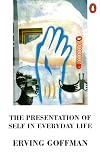
Although now seventy years old, Goffman's classic text in social psychology is still useful once you accept that its verities have to be filtered through an understanding of Anglo-American culture as it stood in the 1950s, a limitation that the author acknowledged at the time.
The clue to its context lies in the three references to Sartre and the four references to De Beauvoir. Their near-contemporary 'existentialist' insights regarding social role-playing and the formation of identity sit in show more parallel with Goffman's own field work.
The bottom line here is that (while being aware that it is just a metaphor) human social interactions are a set of performances between individuals operating in teams who cannot know other's minds. In other words deception and role-playing are built into the human condition.
Although written in a rather dogged and dull (enlivened by very many short but enlightening observational case studies) report style careful to cover every angle in the construction of his thesis, the whole remains very persuasive. All the world is a complex of stages and performances.
You could say that inauthenticity is baked in to the human condition. The dogged report style should nevertheless lead any intelligent reader to consider the degree to which they are trapped in their roles by social requirements and what is actually authentic about themselves.
The book could lead to cynicism. It could even lead to a Ligoti-esque extreme conclusion that we are all social puppets with his cosmic evil replaced by a more insidious deterministic vision of social structures creating our selves as cogs and wheels in its cohesion and 'progress'.
Perhaps Goffman (because of his own 'awakening' mission which is implicit rather than explicit) underplays the possibility of modes of resistance once one is aware of the 'dramaturgical' (as he puts it) aspects of our social existence. Yet a great deal of apparent resistance may also be performative.
The key question raised is the one explicit in the title - is what is presented in everyday life all that there is to the self? And there is no firm philosophical answer in what is a book on social psychology that simply exposes how we behave and the social limits on personal authenticity.
Indeed, a careful reading of the book gives us, in effect, not only a description of the world but something like an introductory manual for our own performance and manipulations in the world, both in identifying the tricks of others and which tricks to deploy ourselves in relation to others.
And exactly how much freeedom from our partial puppet status (since it is also true that there are multiple socially constructed selves according to the audience and 'theatre' in which we perform) do we have? Do multiple selves imply more freedom that being stuck with just one role?
Decades on, social changes in Anglo-American society collapsed much of the rigidity reported here although these rigidities still exist in transmuted form in any commercial or institutional setting but we may not have done more than multiplied our roles to create a greater illusion of 'authentic' self.
To be clear, I happen to believe (unlike many fashionable theorists) that there is a firm self that is possible. Such a self is quite capable of being sufficiently aware to 'mask' and create a social self whose only purpose is, consciously, to protect and defend that self in a society of wolf packs.
The social problem is that those who have selves constructed with awareness of social performativism can be saints or demons, kind or con men. Our inability to know other minds (which 'society' may seek to change through technology) has meant the necessary evolution of inauthentic forms.
Which leads to another countervailing thought that the relative collapse of the more rigid conformities of the Anglo-American past has led to the paradoxical result that levels of formal trust have also collapsed leading to an increase in the opportunities for human wolf packs to prey on sheep.
Socially generated and highly evolved cultural controls which were clearly insufficient to stop predation (as evidenced in many examples in the book) have now required complex regulatory structures to deal with predators which predators simply work around.
The conundrum here lies in the fact that every strategy for dealing with the human condition - a hive-like status of potentially free animals - whether it be a claim to authenticity, social cohesion through conformity or implicit authoritarian control, breaks down on that condition's reality.
Goffman's service lies not in providing a solution (he does not and cannot and the book is admirably academic and non-judgmental) but in pointing out with clarity a problem that has not been resolved probably because it cannot be resolved under conditions of resource scarcity.
Resource scarcity may always be with us because human beings will always want something other human beings have or do not have such as status, power or the 'unique' so performative manipulation is almost certainly never going to go away while we present as human.
What we are definitely seeing now, unfolding over all those decades since the book, is a general collapse in performative institutional trust. 'Authentic selves' without the intellectual capacity to be authentic have been unravelling things (of which the BBC is the current most obvious victim).
There is no going back despite the atavism of 'conservatives' because social trust once lost is gone for ever. Audiences for social performances have become justifiably cynical as the back stages have been opened up to view and the shoddy aspects of the performers and their incapacities revealed.
Trying to impose order through liberal authoritarian means is failing. We seem to be in a transitional phase where we are waiting on either mind control technologies to accentuate that 'liberal' strategy or resource limitations to be lifted sufficiently to weaken incentives for the worst of the wolves.
In the meantime the liberatory position of Sartre and De Beauvoir (and implicitly of Goffman) now looks naive. Given the increased opportunity to be 'authentic', very few humans seem to have been aware of the possibility, let alone had the capacity to attain the status even if allowed by society.
Far from adopting the techniques of 'know thyself' and sufficient performative skills to survive (rather than believing in them as truths), the collapse of social formalities seems to have simply led to more creative invention of new social roles that cut across and degrade institutional efficiencies.
The obvious example is the person who becomes an attribute instead of a person in the case of 'identity politics' and then insists on introducing that politics into the functioning of the State, the hospital, the military or the business but there are many others.
The book, therefore, presents a base line of understanding of the human condition to be read critically and to be used not as a description of our world but as a description of human behaviours that are culturally variable but which share certain similarities in the way social selves are constructed.
So which self are we to be? One we construct over and against society? One dictated to us wholly by our social condition? One that we accept is a puppet because that is all we can be - puppets of our history and of others' expectations? One of resistance that may be always only be partial and flawed? show less
The clue to its context lies in the three references to Sartre and the four references to De Beauvoir. Their near-contemporary 'existentialist' insights regarding social role-playing and the formation of identity sit in show more parallel with Goffman's own field work.
The bottom line here is that (while being aware that it is just a metaphor) human social interactions are a set of performances between individuals operating in teams who cannot know other's minds. In other words deception and role-playing are built into the human condition.
Although written in a rather dogged and dull (enlivened by very many short but enlightening observational case studies) report style careful to cover every angle in the construction of his thesis, the whole remains very persuasive. All the world is a complex of stages and performances.
You could say that inauthenticity is baked in to the human condition. The dogged report style should nevertheless lead any intelligent reader to consider the degree to which they are trapped in their roles by social requirements and what is actually authentic about themselves.
The book could lead to cynicism. It could even lead to a Ligoti-esque extreme conclusion that we are all social puppets with his cosmic evil replaced by a more insidious deterministic vision of social structures creating our selves as cogs and wheels in its cohesion and 'progress'.
Perhaps Goffman (because of his own 'awakening' mission which is implicit rather than explicit) underplays the possibility of modes of resistance once one is aware of the 'dramaturgical' (as he puts it) aspects of our social existence. Yet a great deal of apparent resistance may also be performative.
The key question raised is the one explicit in the title - is what is presented in everyday life all that there is to the self? And there is no firm philosophical answer in what is a book on social psychology that simply exposes how we behave and the social limits on personal authenticity.
Indeed, a careful reading of the book gives us, in effect, not only a description of the world but something like an introductory manual for our own performance and manipulations in the world, both in identifying the tricks of others and which tricks to deploy ourselves in relation to others.
And exactly how much freeedom from our partial puppet status (since it is also true that there are multiple socially constructed selves according to the audience and 'theatre' in which we perform) do we have? Do multiple selves imply more freedom that being stuck with just one role?
Decades on, social changes in Anglo-American society collapsed much of the rigidity reported here although these rigidities still exist in transmuted form in any commercial or institutional setting but we may not have done more than multiplied our roles to create a greater illusion of 'authentic' self.
To be clear, I happen to believe (unlike many fashionable theorists) that there is a firm self that is possible. Such a self is quite capable of being sufficiently aware to 'mask' and create a social self whose only purpose is, consciously, to protect and defend that self in a society of wolf packs.
The social problem is that those who have selves constructed with awareness of social performativism can be saints or demons, kind or con men. Our inability to know other minds (which 'society' may seek to change through technology) has meant the necessary evolution of inauthentic forms.
Which leads to another countervailing thought that the relative collapse of the more rigid conformities of the Anglo-American past has led to the paradoxical result that levels of formal trust have also collapsed leading to an increase in the opportunities for human wolf packs to prey on sheep.
Socially generated and highly evolved cultural controls which were clearly insufficient to stop predation (as evidenced in many examples in the book) have now required complex regulatory structures to deal with predators which predators simply work around.
The conundrum here lies in the fact that every strategy for dealing with the human condition - a hive-like status of potentially free animals - whether it be a claim to authenticity, social cohesion through conformity or implicit authoritarian control, breaks down on that condition's reality.
Goffman's service lies not in providing a solution (he does not and cannot and the book is admirably academic and non-judgmental) but in pointing out with clarity a problem that has not been resolved probably because it cannot be resolved under conditions of resource scarcity.
Resource scarcity may always be with us because human beings will always want something other human beings have or do not have such as status, power or the 'unique' so performative manipulation is almost certainly never going to go away while we present as human.
What we are definitely seeing now, unfolding over all those decades since the book, is a general collapse in performative institutional trust. 'Authentic selves' without the intellectual capacity to be authentic have been unravelling things (of which the BBC is the current most obvious victim).
There is no going back despite the atavism of 'conservatives' because social trust once lost is gone for ever. Audiences for social performances have become justifiably cynical as the back stages have been opened up to view and the shoddy aspects of the performers and their incapacities revealed.
Trying to impose order through liberal authoritarian means is failing. We seem to be in a transitional phase where we are waiting on either mind control technologies to accentuate that 'liberal' strategy or resource limitations to be lifted sufficiently to weaken incentives for the worst of the wolves.
In the meantime the liberatory position of Sartre and De Beauvoir (and implicitly of Goffman) now looks naive. Given the increased opportunity to be 'authentic', very few humans seem to have been aware of the possibility, let alone had the capacity to attain the status even if allowed by society.
Far from adopting the techniques of 'know thyself' and sufficient performative skills to survive (rather than believing in them as truths), the collapse of social formalities seems to have simply led to more creative invention of new social roles that cut across and degrade institutional efficiencies.
The obvious example is the person who becomes an attribute instead of a person in the case of 'identity politics' and then insists on introducing that politics into the functioning of the State, the hospital, the military or the business but there are many others.
The book, therefore, presents a base line of understanding of the human condition to be read critically and to be used not as a description of our world but as a description of human behaviours that are culturally variable but which share certain similarities in the way social selves are constructed.
So which self are we to be? One we construct over and against society? One dictated to us wholly by our social condition? One that we accept is a puppet because that is all we can be - puppets of our history and of others' expectations? One of resistance that may be always only be partial and flawed? show less
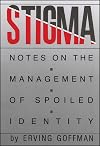
Finished this while locked out of GR due to some no doubt well-intentioned addition of captcha software to the login process, so initial impressions were not captured.
This is not a scientific book, nor is it an analysis. As the title and introduction both indicate, these essays are notes or thoughts in response to Goffman's various readings on stigmatized individuals. These would be referred to as "marginalized" now, and 21st-century readers may take issue with some of the groups identified show more as such. That would miss the point, though: what Goffman has noticed is that the strategies for dealing with a stigma are similar across different communities or stigmas or what have you, and it is these strategies that interest him. What also intrigues him is the gradient nature of stigma, or as someone who spends too much time online might say, how stigma is a spectrum: the criteria that define the "normal" are very, very narrow, and every person is guaranteed to pass out of it at some point in their life (too young, too old, unemployed, etc). So in a very real sense, everybody is stigmatized at some point in their lives, and the stategies they have adopted for coping with this are similar to, or even learned from, those who are stimagtized for their entire lives.
It's a good book, worth reading. Other GR reviewers seem hung up on the fact that it's not written like a self-help book. Let's be honest: if you find this book to be dry or difficult reading , you're not going to make it very far past the sort of thing offered in airport newsstands. Goffman is readable, he makes a few amusing points some of which might be generously construed as "jokes", and he neatly summarizes information or episodes from multiple sources (synthesizes, as a friend used to describe it, and really that is what social scientists do). What Goffman does *not* do is start from a premise and work towards a definite conclusion, and this can make the book feel pointless or meandering: but as the title says, these are notes, not a Theory. show less
This is not a scientific book, nor is it an analysis. As the title and introduction both indicate, these essays are notes or thoughts in response to Goffman's various readings on stigmatized individuals. These would be referred to as "marginalized" now, and 21st-century readers may take issue with some of the groups identified show more as such. That would miss the point, though: what Goffman has noticed is that the strategies for dealing with a stigma are similar across different communities or stigmas or what have you, and it is these strategies that interest him. What also intrigues him is the gradient nature of stigma, or as someone who spends too much time online might say, how stigma is a spectrum: the criteria that define the "normal" are very, very narrow, and every person is guaranteed to pass out of it at some point in their life (too young, too old, unemployed, etc). So in a very real sense, everybody is stigmatized at some point in their lives, and the stategies they have adopted for coping with this are similar to, or even learned from, those who are stimagtized for their entire lives.
It's a good book, worth reading. Other GR reviewers seem hung up on the fact that it's not written like a self-help book. Let's be honest: if you find this book to be dry or difficult reading , you're not going to make it very far past the sort of thing offered in airport newsstands. Goffman is readable, he makes a few amusing points some of which might be generously construed as "jokes", and he neatly summarizes information or episodes from multiple sources (synthesizes, as a friend used to describe it, and really that is what social scientists do). What Goffman does *not* do is start from a premise and work towards a definite conclusion, and this can make the book feel pointless or meandering: but as the title says, these are notes, not a Theory. show less
In many ways the book shows its age. Some of the language--for instance, using the word "normal" to describe non-stigmatized people (implying others are "not normal") sounds odd and--to use a word that wasn't available to Goffman when he wrote--"ableist" today. As is often the case for me when reading sociology books, I was frequently irritated or critical of the way this author, like others in this field, makes sweeping generalizations about how people behave. The beauty and complexity of show more individual experience is smoothed over; the only way sociologists seem to write about "society" is by lumping everyone together into a bland wad of humanity and then write about how alike we all are. What I'm writing here all sounds highly critical of the book, and I have to say I spent much of my time as I read in a state of actively disliking what I was reading on the page. And yet it challenged my thinking and made me re-examine my notions about stigma and identity and even challenged how I thought such things should be written about, which are all great things.
This book makes an interesting contrast with Andrew Solomon's "Far From the Tree," which deals with the same topic--how society treats people who belong to marginalized and stigmatized groups--but Solomon builds his arguments by piling on one unique anecdote after another in a beautiful mosaic, a book that celebrates individuality rather than erasing it. show less
This book makes an interesting contrast with Andrew Solomon's "Far From the Tree," which deals with the same topic--how society treats people who belong to marginalized and stigmatized groups--but Solomon builds his arguments by piling on one unique anecdote after another in a beautiful mosaic, a book that celebrates individuality rather than erasing it. show less
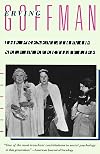
If you’re a Martian, or in the far end of the autism spectrum, or a cockroach archeologist from the future, you need to read this book. It's the best description I’ve ever seen of human beings—how they go about living, and why. Ever had the inkling that everyone is faking it all the time—at such a fundamental level that the moral charge of “faking” stops making sense? Then read this book. It’s one of those Weltanschauung-changing treatises that manage to single out and name, show more with seemingly magical explanatory powers, dozens of important phenomena that you always knew were there, but couldn’t think about clearly because they had no names. By the end of the book you’ll have neck pain, because you’ll be nodding the entire time. A path to knowledge this clear and enlightening could only be created by the author’s commendable commitment to honesty: he isn’t here to judge, recommend, or lecture; his one unwavering desire is to find out what _is_.
Goffman’s prose is not obscure as some have claimed, but it’s dense—often enough, a single paragraph or sentence is heavy with meaning, and you’ll find yourself coming back to ruminate. It’s the kind of book that requires one to climb the walls of words with icepicks—but every meter climbed opens new, fascinating vistas. Totally worth it. show less
Goffman’s prose is not obscure as some have claimed, but it’s dense—often enough, a single paragraph or sentence is heavy with meaning, and you’ll find yourself coming back to ruminate. It’s the kind of book that requires one to climb the walls of words with icepicks—but every meter climbed opens new, fascinating vistas. Totally worth it. show less
Lists
Awards


You May Also Like


Associated Authors
Statistics
- Works
- 35
- Also by
- 3
- Members
- 6,056
- Popularity
- #4,062
- Rating
- 4.0
- Reviews
- 39
- ISBNs
- 226
- Languages
- 20
- Favorited
- 9